Feeds:
Posts
Comments

Posts Tagged ‘vaccine’

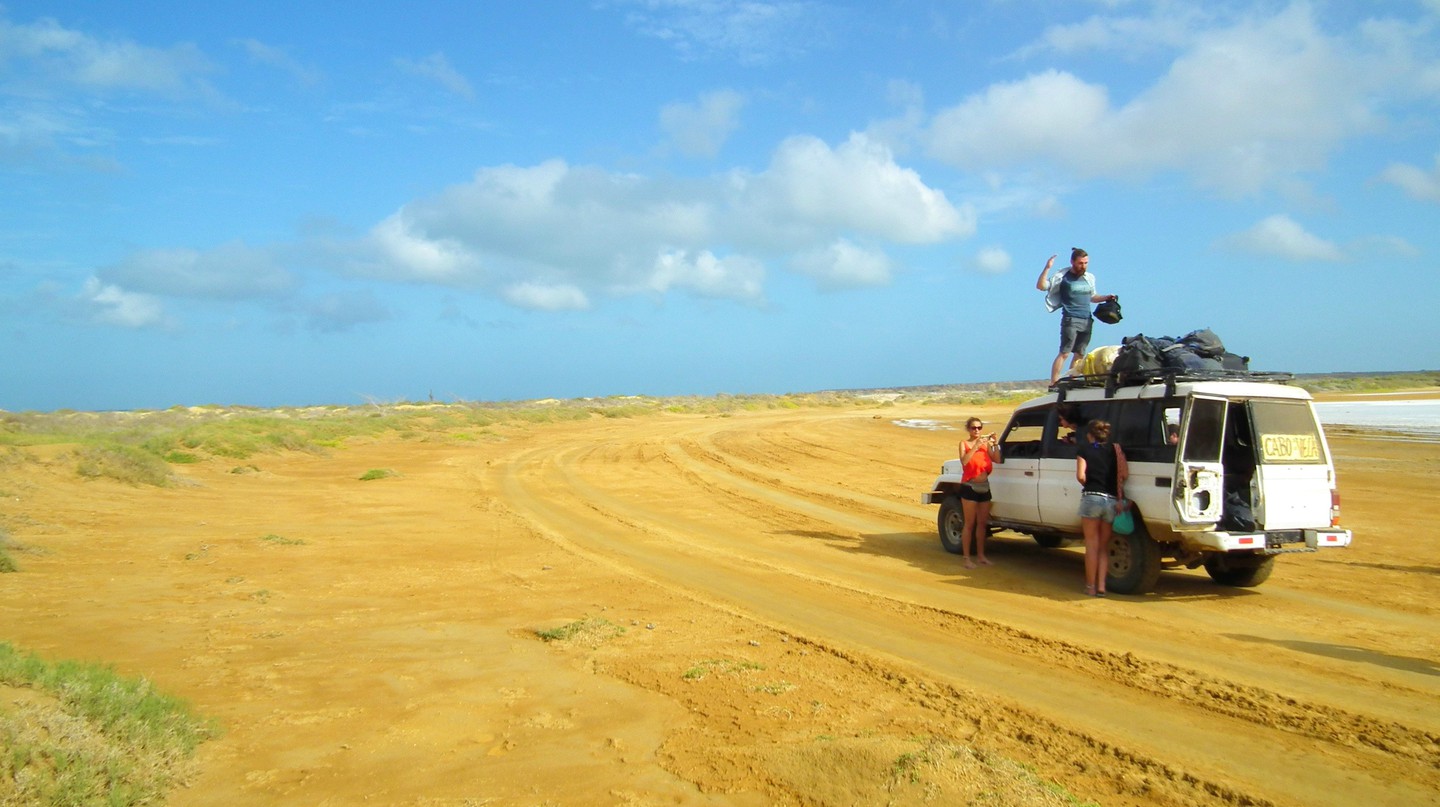
Photo: Chris Bell/The Culture Trip.
Tourists in La Guajira, a remote part of Colombia. Nowadays the focus is on a vaccine outreach to wary indigenous residents.

John assures me that pandemics always peter out as variants emerge weaker and weaker. I hope he’s right. Meanwhile, some experts are saying we won’t be done with Covid until we vaccinate the whole world.

Samantha Schmidt at the Washington Post wrote recently about an effort to reach a remote corner of Colombia — one step in vaccinating the whole world.

“The vaccination team had spent an hour bouncing and bucking down a dirt road and over train tracks when the van driver issued a warning. The toughest part of the drive was still to come. The two women gripped their seat cushions as the van jolted, climbed a mound of dirt and fishtailed in the slick mud. Driver Toto Girnu honked at passing goats as he followed a path blazed only by tire tracks. In the distance, he spotted dark, menacing clouds.

“If the group was lucky, the drive through this remote desert would take four or five hours. If it rained, as it did when Girnu made this trip a few days earlier, it could take more than 10.

“But this was the only way to reach the Indigenous families who live in this arid swath of land in the northern department of La Guajira, where there are no paved roads, no electricity, no running water and no other access to the vaccines that would protect their communities.

“Travel is only part of the challenge confronting the team, one of many contracted by the Colombian government to deliver vaccines to some of the country’s remotest peoples. There is also a lack of information about the coronavirus, hesitation around vaccines and a general mistrust of authorities.

“The van, ‘Route of Hope’ written across the windshield, came upon a roadblock. Adults and children here string ropes across the road, to be lifted only in exchange for water, food or cash.

“ ‘Are you vaccinated?’ vaccine team coordinator Katherin Gamez shouted to a young man. Girnu gave the man a fist bump, tossed him a small bag of water and translated the question into Wayuunaiki, the language of the local Wayuu Indigenous people.

“ ‘For what?’ he asked.

“Across the Andes, a region that has reported some of the world’s highest covid-19 death rates, teams are traversing deserts, mountains, rainforests and rivers to vaccinate isolated communities.

“Such teams are particularly active in Colombia, a country of more than 48 million people, where about 16 percent of the population lives in rural areas that were often neglected by the government during more than five decades of armed conflict. …

“About 35 percent of Colombia’s population has been fully vaccinated, according to the Health Ministry. More than half of residents in major cities — 62 percent in the capital of Bogotá — have received at least one dose.

“But in La Guajira, home to the country’s largest Indigenous population, only 38 percent have received at least one dose. … Years of government abandonment and mismanagement have caused many Wayuu residents to mistrust the health system. Only 4 percent of Wayuu people here have access to clean water, Human Rights Watch reported last year; 77 percent of Indigenous households are food insecure. In Alta Guajira, where the largest number of Wayuu people live, there is only one hospital, and it offers only basic care. …

“ ‘By the time a lot of them get to care, they’re so near death … there’s this perception that maybe the care didn’t help,’ said Shannon Doocy, an associate professor of international health at Johns Hopkins who co-wrote the Human Rights Watch report. …

“ ‘We’re getting close,’ Girnu told Gamez and Eliana Andrioly, the team’s Indigenous leader. They sped down a salt flat, their view miles of sand and the distant bay. …

“A team of nursing assistants and a doctor were waiting. The providers spend 15 days at a time living in a dormitory next door, sleeping in hammocks and showering with buckets of water, to stage daily medical missions to the surrounding communities.

“The organization, IPSI Palaima — ‘land of the sea’ in Wayuunaiki — was founded in 2007 by an Indigenous woman who grew up in the area. It is one of the only providers in Alta Guajira with a permanent vaccine refrigerator, in a medical center powered by solar panels.

“The team member in charge of shots this week was Daniela Vergara, a 21-year-old nursing assistant who had never been to AltaGuajira before she applied for the job. Each day, Vergara aims to vaccinate at least 10 people — a modest goal that often requires a massive effort.

“On this Monday, she had not yet reached her target. She packed her cooler — a blue backpack filled with vials of the single-dose Johnson & Johnson shot that has been a godsend to rural vaccine teams — and set out for a community across the bay. [Then] they drove to a gathering place where they hoped to meet people interested in the vaccine.

“ ‘There’s no one here,’ Vergara said. ‘We got here too late.’

“A local leader suggested they go house to house. As darkness fell, the team members asked anyone who looked 18 or older if they wanted the vaccine. Soon a woman recounted a rumor they had heard many times: Outsiders were pushing a vaccine that was sickening members of the Wayuu community.

“The woman, a teacher who spoke some Spanish, knew what was at stake. She had contracted the virus a few months earlier, after a trip to the town of Uribia. For a month, she suffered chest pains, headaches, an intense cough and the loss of taste and smell. … She worried about a 66-year-old neighbor who had no interest in getting a shot.

“ ‘Many people are dying from this disease,’ Juan Larrada, a Wayuu doctor in the group, said in Wayuunaiki. He said the vaccine could have side effects, but it would protect them from serious illness. He asked Amaita Uriana why she did not want it.

“ ‘Because I was afraid of getting sicker,’ she said. ‘I really feel very sick. I carry pains in my body. That’s why I refused when a girl came here for the same reason. Besides, she was very pretentious. And we had already heard about the experiences of other Wayuu who had been vaccinated and become ill.’

“ ‘The vaccine can have those effects,’ Larrada agreed. ‘Fever, muscular pains, that’s normal.’

“Understanding the doctor as he spoke to her in her own language, Uriana assented. She closed her eyes; Vergara emptied the syringe into her arm.”

Read about the many Wayuu who cannot be persuaded and why that is, here. The photos in the article are terrific, but I can’t share them because they’re blocked. If you have a subscription, you are in luck.
Read Full Post »

Photos: James Austin V.
Alaska is delivering vaccines by sled, boat, plane, and snowmobile. Flashback to the Iditarod origins — when diphtheria antitoxin was rushed to Nome by dog sled.

It’s so interesting to me which states are doing well with vaccine distribution and why! West Virginia was ahead of the pack because it used local pharmacies but also had a central sign-up site. Now Alaska seems to have taken the lead, and its techniques are completely different.

Cathy Free writes at the Washington Post, “Alaska, the state with the largest land mass in the nation, is leading the country in a critical coronavirus measure: per capita vaccinations.

“About 13 percent of the people who live in Alaska have already gotten a shot. … But the challenge for Alaska has been how to get vaccines to people across difficult, frigid terrain — often in remote slivers of the state.

“ ‘Boats, ferries, planes, snowmobiles — Alaskans will find a way to get it there,’ said the state’s chief medical officer, Anne Zink, 43.

“Alaskans are being vaccinated on fishing boats, inside 10-seater planes and on frozen landing strips. Doctors and nurses are taking white-knuckle trips to towns and villages across the state to ensure residents are protected from the coronavirus.

“Contributing to Alaska’s quick speed in getting the vaccine to its residents is a federal partnership that allows the state, which has more than 200 indigenous tribes, to receive additional vaccines to distribute through the Indian Health Service.

“Other reasons include the state’s small population of 732,000, as well as a high number of veterans, Zink said. The U.S. Department of Veterans Affairs is working with the Centers for Disease Control and Prevention to ensure that high-risk veterans receive priority for the vaccine.

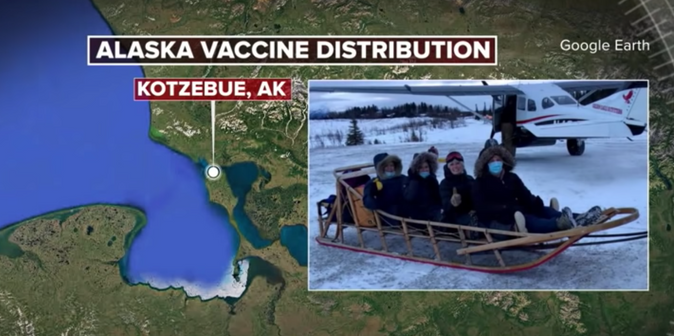
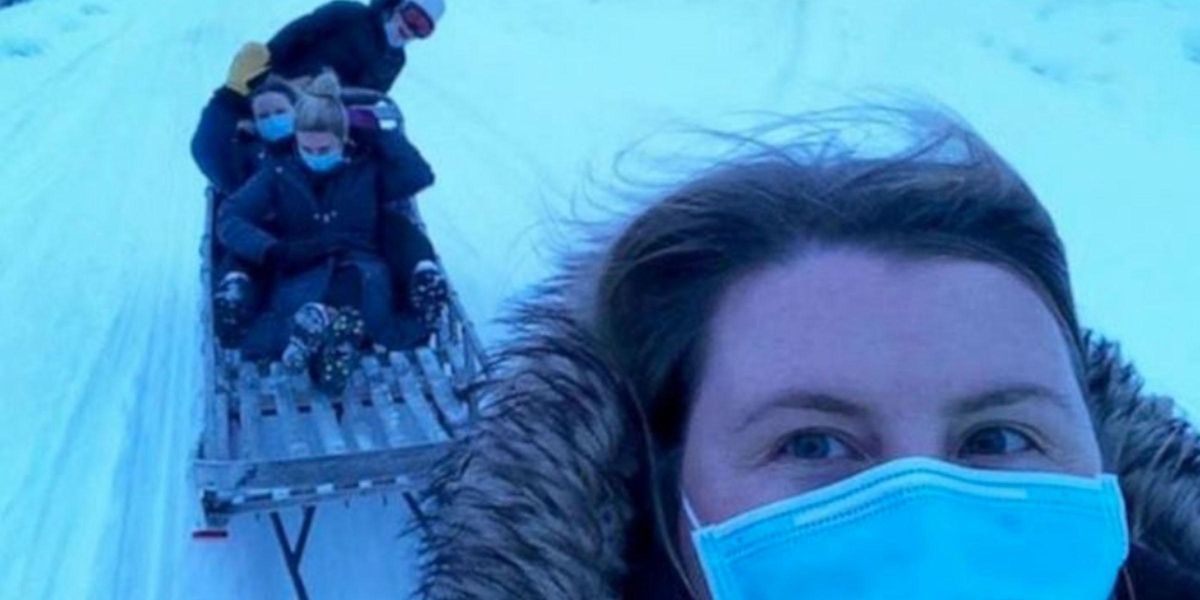
“But one big reason is the state is practiced in delivering precious cargo by transport not often used in the Lower 48. Sometimes that even means adventures by sled. One all-female medical crew of four in December used a sled pulled by a snowmobile to deliver vaccine to the village of Shungnak in the state’s remote Northwest Arctic Borough.

‘It’s just an easier way to get around when you don’t have a lot of roads,’ said Kelli Shroyer, public communications director for the Maniilaq Health Center in Kotzebue, Alaska, where the crew started their journey. …

“Zink was so impressed by the sled crew’s delivery in December that she posted about it on her Facebook page. ‘I love the pictures of vaccination distribution in Alaska,’ she wrote. ‘Recipients expressed how grateful they were that even though they are so remote, they are getting this vaccine. They are not forgotten. …

‘One chief told me how his grandmother took his mother out to the wilderness for a year so that she would be safe. When they returned, they learned that most of their village had died.’ …

“Thousands of Alaskans are playing a role in getting people vaccinated, Zink said.

“Curt Jackson used to employ his water taxi, the Orca, to shuttle tourists from the small city of Homer to villages across Kachemak Bay that aren’t accessible by roads. In late December, Jackson received a request to take three nurses across the bay to Seldovia, a town with about 450 residents, including members of the Seldovia Village Tribe. Planes couldn’t fly that morning because of weather, and the water was rough.

“When the women climbed aboard his 32-foot aluminum landing craft and took seats in the windy darkness, Jackson said, he noticed that the woman in the middle, Candace Kreger, was clutching a bright blue cooler. That was when he realized that the women were traveling with the precious doses. …

“For Ellen Hodges, a doctor from Bethel, Alaska, the coronavirus vaccination effort is the most rewarding project in which she has been involved, she said. Hodges, 46, has flown to several villages in a six-seater plane to vaccinate medical workers and elders, who meet her on the runway.

“ ‘We land in the isolated tundra, and they’ll be lined up waiting,’ she said. ‘Some places have up to 30 people, and some have only one.’ “

More at the Washington Post, here.

An all-female medical crew from Alaska’s Maniilaq Health Center took a sled to deliver vaccine to the isolated village of Shungnak in December.

Read Full Post »

img_8986_custom-0cb667b47e7c6a098a31a26f45b4f79e29ddd580-s600-c85

Photo: Peter Yeung
One African country has made impressive strides in reducing the child mortality rate.

Sometimes it’s the poorest countries in the world that lead the way in solving a problem. Recently I learned that Rwanda, for example, is on track to be the first country to wipe out cervical cancer, thanks to its massive roll-out of HPV vaccine.

And as Peter Yeung reports at National Public Radio (NPR), Mali has drastically cut child mortality rates.

“Imagine a world in which pregnant women and little kids get regular home visits from a health worker — and free health care,” Yeung writes. “That’s the ground-breaking approach that’s being adopted in one of the world’s poorest countries: the West African nation of Mali.

“And it’s already underway in a pilot program. Nana Kadidia Diawara is one of many community health workers who do daily rounds through the sprawling, dusty streets of Yirimadio, a neighborhood on the outskirts of the capital city of Bamako. …

” ‘I know everyone in my area, and it’s a system that works very well,’ she says, while measuring the skinny arm of a child to check for signs of malnutrition. The child lives in a one-story concrete compound that is home to ten families.

“A nurse who’s joined the country’s cadre of community health workers, Diawara visits each of the homes in her designated area, which contains roughly 1,000 people, at least twice a month. She diagnoses, treats and refers patients. It’s part of a free door-to-door health-care plan that began in Yirimadio in 2008 as a trial by the government.

“When data from a seven-year trial was compiled by a team including researchers from the University of California, they found that child mortality for kids under age 5 in Yirimadio dropped by an astounding 95%, according to findings published last year in BMJ Global Health. …

“Now the program will be extended to the entire country. This spring, President Ibrahim Boubacar Keïta announced a target date of 2022 for nationwide coverage — at a cost of $120 million. This localized, free health care for pregnant women and children under age 5 could help the West African nation meet the U.N. Millennium Development Goals. A key factor will be the provision of community health care workers who’ll be trained to do the door-to-door work. …

“Astan Koné, a 28-year-old mother of two in Yirimadio, [offers praise]. During Mali’s hot season last year – which regularly exceeds 100 degrees Fahrenheit – one pregnant relative was diagnosed with stomach ulcers.

” ‘It makes me very happy that the government will do that for the rest of the country,’ says Koné. ..

“[Currently] Mali’s planned reforms rely on external funding, secured with help from the Clinton Health Access Initiative, to supplement government spending. But there is no guarantee this supplemental funding will last in future decades, and Mali will need to find a long-term solution that may involve restructuring its budget. …

“The key to long-term success, according to [Robert Yates, an advocate for universal health care coverage at the U.K.-based think tank Chatham House,] will be political support – which Mali already has – and a long-term funding plan. ‘Clearly countries need more public finances to do it,’ he says. ‘But it’s perfectly feasible – by allocating a greater proportion of the budget to the health sector.’

“The cost of the Mali’s reforms, averaging $8 per person a year, could reasonably be covered by what the region’s governments are already spending on healthcare, Yates believes. …

“Community health workers — who in Mali are trained for at least a year and are able to carry out basic medical procedures — are so important.

” ‘The leading causes of maternal, newborn and child death are curable,’ says Dr. Ari Johnson, a medical doctor and co-founder of Muso. The nongovernmental organization, which aims to end preventable deaths, has supported the trials in Yirimadio with staffing and training. ‘Diseases like malaria and newborn sepsis can kill within hours. … But in status quo health-care systems, poor patients face many barriers that delay their access to care: fees they can’t afford to pay, distance they cannot travel to the nearest provider.’

“Back in Yirimadio, one 6-month-old girl in a white dress calmly awaits treatment on her father’s lap under the shade of a mango tree. ‘She is suffering,’ says Naba Fané of his daughter, who has pain when urinating. Community health worker Diawara writes the family a referral to the local health clinic in a matter of minutes.”

More at NPR, here.

Read Full Post »