Feeds:
Posts
Comments

Posts Tagged ‘venice’

Photo: Charlie Rubin/Kasmin, New York.
An example of sculpture by Alma Allen, ‘Not Yet Titled‘ (2024). He is the artist chosen by a conservative art group to represent the US in the 61st Venice Biennale.

With all the sinister goings-on in the world, you might think that something strange in the art world would be the least of our worries. But this creepy story really got under my skin, and I’m wondering what the artists among you have to say about it.

Ben Davis reports at Artnet that the administration “has picked its artist for the 61st Venice Biennale. After months of speculation and much confusion, the artist to represent the U.S. will be Mexico-based sculptor Alma Allen, in a pavilion organized by curator Jeffrey Uslip. The sponsor is the American Arts Conservancy (AAC).

“But what is this organization, now vaulted front and center of the international art conversation, which no one I know has ever heard of? I was perplexed. So I took a spin around the internet to get a sense of what its chops were. Here are some observations.

“If no one has heard of the Tampa-based AAC, this is because it was founded only in July of this year. The press release is so poorly edited that it repeats the same quote by executive director Jenni Parido twice.

“The fact that this gaffe stands, four months later, as AAC takes on the most high-profile job in the arts, might put into question their professionalism in organizing a major international art exhibition. …

“Parido is an enigma on the art scene. According to her LinkedIn, her primary work experience is as the founder of Feed Pet Purveyor, a Tampa vendor specializing in natural foods for pets, which she ran from 2014 to 2023. …

“Frank Bardonaro was named president of the AAC board of directors in late August; he’s the CEO of the Houston-based Brock Group, a conglomerate that provides scaffolding, insulation, and the like for industrial and commercial customers. John Mocker, who serves as board secretary, is head of a pipe distributor, LB Industries.

“Mocker distinguishes himself as arty in this company because his biography identifies him as a collector of ‘American and international art.’ I’m interested! All I was able to find out, though, was that he also had a bit part in the unknown 2024 Abigail Breslin feature Chapter 51 directed by photographer Tyler Shields. …

“Ryan Coyne joined the AAC board as treasurer in September. He is best-known for running Starboard, a digital marketing, media, and government relations business. Among other things, it owns BizPac Review, which promises ‘breaking news and analysis unfiltered by the liberal bias that has eroded the media’s credibility.’ Starboard is probably best known for purchasing Parler, the right-wing Twitter clone, in 2023. Coyne also runs We the People Wine, ‘America’s Favorite Patriotic Wine.’

“Finally, AAC vice president Janet Steinger is a socialite married to superstar Palm Beach personal-injury lawyer Michael Steinger. …

“ ‘The Conservancy brings together a national network of curators, scholars, educators, artists, and patrons who believe in the transformative power of the arts,’ AAC boasted when it launched. Let’s take a look at what that means. The advisory board includes: curator Jeffrey Uslip, who is helming the Alma Allen pavilion in Venice, socialite Mackenzie Brumberg, socialite Nicola Verses … Nicole McGraw, a Palm Beach art dealer and former CEO of Jupiter NFT Group [now] ambassador to Croatia … artist Brendan Murphy, who made a diamond-encrusted spaceman sculpture for a Four Seasons in Riyadh … photographer, artist, and Web3 entrepreneur Brandon Ralph. …

“One name on the advisory board list, Madison Wright, remains an unknown, as the AAC site does not identify or provide links for its advisory board, just names. ‘Mathew Taylor’ and ‘Michelle Taylor’ are also listed. ‘Mathew’ seems to be a misspelling of ‘Matthew.’ It probably refers to a filmmaker who goes by both M.A. Taylor and Matthew Taylor, depending on whether he is directing films about conservative politics or art. He has directed both Marcel Duchamp: The Art of the Possible (2019), about the famed father of conceptual art, and Government Gangsters (2024) [about] Kash Patel‘s book about a deep state conspiracy. …

“The other big initiative AAC is pushing is the ‘Passport to Patriotism: America 250’ exhibition, which it says will happen next year. ‘Children ages 5–15 are invited to submit original works that express what patriotism means to them,’ for possible inclusion. …

“The ‘children’s art’ used to illustrate the contest has the hallmarks of very bland A.I., including [one] where Lady Liberty has six fingers, and the stripes on the flag inexplicably flip colors. …

“A bare-bones official website for the U.S. pavilion now exists. On Instagram and Facebook, AAC posted a short statement about the vision of the show.”

Maybe I read too many murder mysteries, but the thin online presence of these entities sure do suggest the shell companies I’m currently reading about in a novel by Richard Osman.

More at Artnet, here.

Read Full Post »

Photo: Wave Murano Glass.
Roberto Beltrami, pictured, is one of the youngest Murano glass masters, founding his workshop when he was just 25 years old. 

I had a memorable trip to Europe when I was 16, and one of the highlights was Venice and the glassmaking island of Murano. Have you been there?

Rebecca Cairns reports at CNN that the ancient craft of Murano glassmaking has benefited from new and younger talent.

“Born in the Italian town of Brescia, Roberto Beltrami grew up just a few hours’ drive from Venice and the island of Murano, world-famous for producing beautiful glassware. But it was nearly 4,000 miles away in Boston, Massachusetts, that he first came across the art of glassblowing. …

“It was 2011, and Beltrami, then a sophomore physics student at Boston University, was captivated by an exhibition of the work of American artist Dale Chihuly. Known for pushing the boundaries of contemporary glassblowing, Chihuly’s pursuit of his craft has taken him around the globe, including a stint in Murano in the 1960s.

“Beltrami visited the island on his summer break, taking up a class in glassblowing. That class turned into an apprenticeship, and the summer turned into a year. Beltrami quit university, trading lecture halls for roaring furnaces, sweating it out in centuries-old workshops, and studying under some of the world’s most renowned glassblowing masters.

“At one time, Murano was the global leader in glassmaking, renowned for unparalleled quality, style, and innovation, including the invention of ‘cristallo,‘ clear glass. …

“With a long legacy of closely guarding their trade secrets, workshops in Murano are reluctant to welcome newcomers, said Beltrami, 34. ‘Everybody was afraid you were going to steal their job, and nobody wanted to teach you anything.’ …

“Frustrated by the lack of opportunities, Beltrami decided to strike out on his own. In 2017, the then-25-year-old started his own workshop, Wave Murano Glass.

“Now with a team of 20, many of them in their twenties and thirties, Beltrami — believed to be the youngest glass master in Murano — is ushering in a new generation of artisans. …

“In Venice, glass has been manufactured for over 1,000 years. To prevent fires from the hot furnaces and keep trade secrets from escaping the city, all the glass factories were moved to Murano in 1291, where they’ve remained since.

“In addition to the invention of cristallo, Murano became well-known for its ability to add vibrant color to clear glass.

“ ‘It’s not so easy to have different colors of glass together and have them match chemically,’ said Beltrami, explaining that each shade uses a unique element — such as cobalt for purple-blue, lead for pale yellow, or tellurium for a pink tint — which expand and contract at different rates when they heat and cool. …

“The size and weight of many of the glass objects require at least one person to hold the pipe and turn the molten glass, while another shapes it, and another person may be required to torch the glass to keep it pliable, or add embellishments. ‘It’s like a choreography,’ Beltrami added. …

“The small factories struggle to compete on large-scale industrial orders, said Beltrami. Murano instead focuses on luxury and artistic glassware, although that too has been threatened by an influx of counterfeit goods. … The industry has been further impacted by a series of crises, including the financial crash of 2008, the Covid-19 pandemic, and rising gas prices. But despite the challenges, Beltrami is optimistic about the future of the craft.

“A major problem he saw across the factories he worked in previously was antiquated equipment and inefficient processes. So, at Wave Murano Glass, he introduced a variety of modern technologies, including streamlining administrative workflows with AI-enabled software and introducing more energy-efficient furnaces.

“Designed in the US, these furnaces capture heat that is typically lost via exhaust fumes and reuse it to preheat the air going into the burner, reducing gas usage by 80% compared to furnaces of a similar size, said Beltrami.

“According to Beltrami, Murano’s factories have historically worked on small-scale industrial orders, with many rejecting commissions of less than a few hundred but unable to cater for those of a few thousand. Seeing a missed opportunity, he set up his furnaces to be flexible, allowing Wave to cover anything from one-off pieces, to a few dozen, up to 1,200 pieces.

“While the bulk of Wave’s output is white label products for brands, designers, and artists, up to 10% of the company’s turnover comes from classes and tours, which Beltrami hopes can share the art of glass blowing with a wider audience.

“His efforts have already paid off. Beltrami has made a point of offering internships to young, enthusiastic talent from around the globe, many of whom are now employed at Wave, including several women, who are underrepresented in the industry.

“For Beltrami, finding new talent is an essential step in preserving the craft he’s come to love — and continuing its legacy of artistry and innovation.”

More at CNN, here. No paywall. Great videos of glassmaking.

Read Full Post »

Photo: Marica S. Tacconi, CC BY-SA.
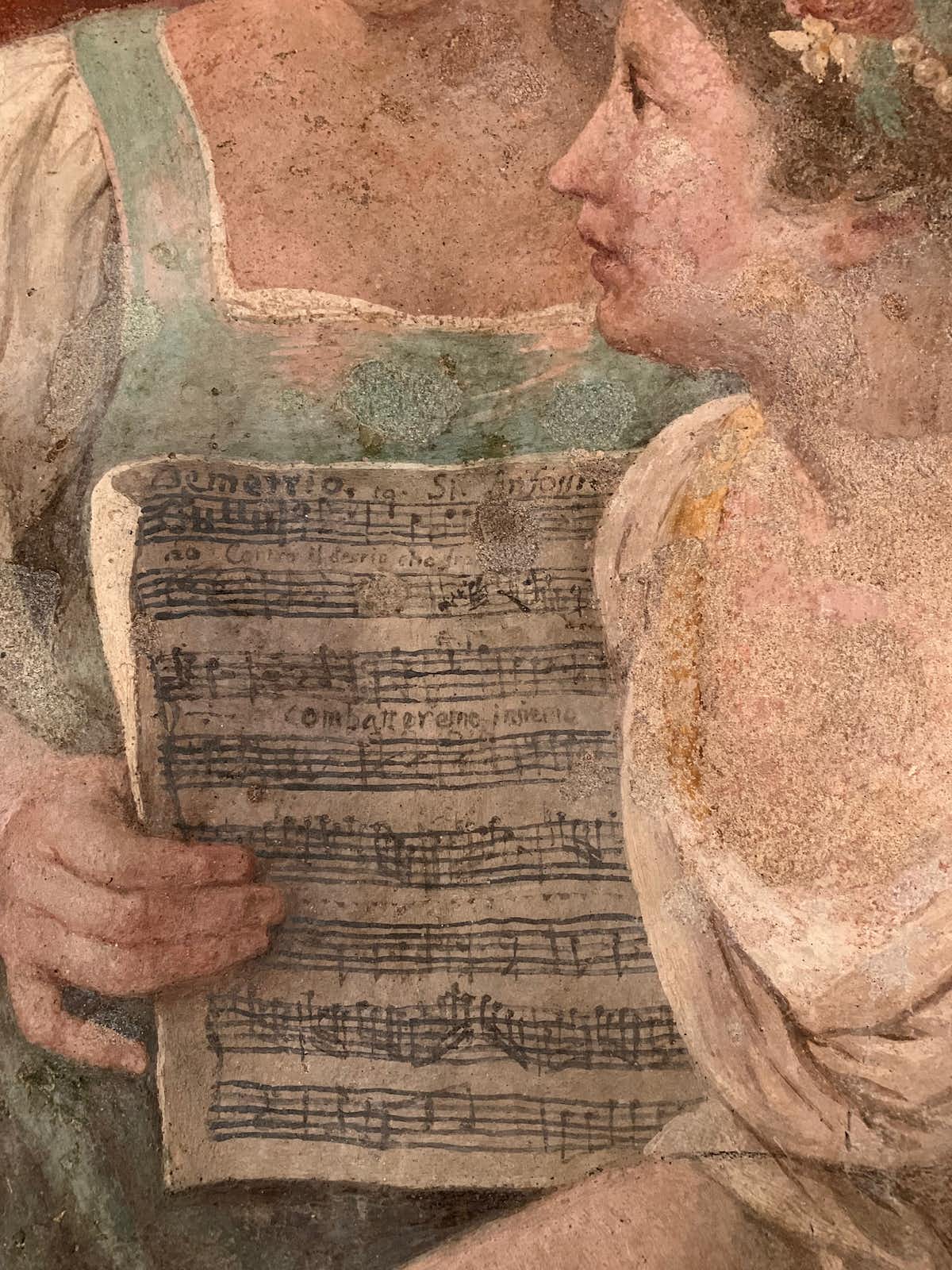
The musical score depicted in Jacopo Guarana’s fresco in a Venetian orphanage. 

I know there is a lot of drudgery in historical research and archaeology, but what fun to discover clues about the past that can be brought to life in the present!

That’s what Marica S. Tacconi, professor of musicology and art history at Penn State, does. At the Conversation, she writes about her determination to bring back music painted on the walls of a Venetian orphanage centuries ago.

She begins by asking the reader to imagine today’s rock stars “teaching at an orphanage or homeless shelter, offering daily music lessons” and says “that’s what took place at Venice’s four Ospedali Grandi, which were charitable institutions that took in the needy – including orphaned and foundling girls – from the 16th century to the turn of the 19th century.

“Remarkably, all four Ospedali hired some of the greatest musicians and composers of the time, such as Antonio Vivaldi and Nicola Porpora, to provide the young women – known as the ‘putte’ – with a superb music education.

“In the summer of 2019, while in Venice on a research trip, I had the opportunity to visit the Ospedale di Santa Maria dei Derelitti, more commonly known as the Ospedaletto, or ‘Little Hospital, because it was the smallest of the four Ospedali Grandi.

“As a musicologist specializing in the music of early modern Venice, I was especially excited to visit one of the hidden gems of the city: the Ospedaletto’s music room, which was built in the mid-1770s. …. Little did I know that I would encounter music that hasn’t been performed in nearly 250 years.

“As we entered the stunning music room, I was immediately struck by its elegance and relatively small size. In my mind, I had envisioned a large concert hall; instead, the space is intimate, ellipse-shaped and richly decorated.

“Overshadowed by the more prominent Ospedale della Pietà, not much is known about the music-making that took place for centuries behind the walls of the Ospedaletto. But one of the greatest clues to its venerable history as a music school is literally on one of its walls.

“A fresco on the far wall of the room, painted in 1776-77 by Jacopo Guarana, depicts a group of female musicians – likely portraits of some of the putte – at the feet of Apollo, the Greek god of music. Some of them play string instruments; one, gazing toward the viewer, holds a page of sheet music. …

“The music notation was quite legible, and the composer’s name was inscribed in the upper-right corner: ‘Sig. Anfossi.’

“I took several photos of the fresco. I wanted to learn as much as I could about that piece of music painted on the wall. …

“Armed with those clues on the wall, I continued my research in the days following the visit to the Ospedaletto. I learned that the music by ‘Signor Anfossi’ shown in the fresco was drawn from the opera Antigono, composed by Pasquale Anfossi (1727-97) on a libretto by Pietro Metastasio. The work premiered in Venice at the Teatro San Benedetto in 1773.

“The text of the [aria] is legible in the excerpt on the wall. It reads, ‘Contro il destin che freme, combatteremo insieme’ – ‘Against quivering destiny, we shall battle together.’

“Like many works from the 17th and 18th centuries, the entire opera is lost. I was determined to find out, however, if that particular aria had survived. … Luck was on my side: To my delight, I found a copy of the aria in a library in Montecassino, a small town southeast of Rome. Why was that particular excerpt chosen to be displayed so prominently on the wall?

“Like other institutions in Venice, the Ospedaletto faced financial hardship in the 1770s. Evidence suggests that the putte of the Ospedaletto were likely involved in raising the funds for the decoration of the music room. The new hall enabled them to give performances for special guests and benefactors, which brought in substantial donations. Together with Pasquale Anfossi, who was their music teacher from 1773 to 1777, they rallied behind their beloved institution, saving it – at least temporarily – from financial destitution. …

“Incidentally, the putte may also have wanted to honor their teacher, as Pasquale Anfossi, too, is portrayed in Guarana’s fresco, directly behind the young woman holding up his music.

“One of the aspects I find most rewarding about the study of older music is the process of discovering a work that has been neglected and unheard for hundreds of years and bringing it back to modern audiences.

“Inspired by the Ospedaletto’s music room, [my colleague] Liesl Odenweller and I have embarked on a collaborative project that brings back not only the aria on the wall but also other music from the institution that has gone unheard for centuries … thanks to a generous grant from the Gladys Krieble Delmas Foundation, the Venice Music Project. …

“Because the music of the past was written in a notation that’s different from that used today, it’s necessary to translate and input every mark of the original score – notes, dynamics and other expressive marks – into a music notation software to produce a modern score that can be easily read by today’s musicians.

“By performing on period instruments and using a historically informed approach, the musicians of the Venice Music Project and I are excited to revive this remarkably beautiful and meaningful music. Its neglect is certainly not a reflection of its artistic quality but rather likely the result of other composers, such as Vivaldi and Mozart, taking over the spotlight and overshadowing the works of other masters.”

More at the Conversation, here. The author has a nice description of her colleague testing the room’s exceptional acoustics.

Read Full Post »


Photo: Michael Miller / OCA.
Venice Biennale Sámi Pavilion artist Máret Ánne Sara and her brother, Jovsset Ante Sara.

The Sámi are indigenous people of Finland, Norway, and Sweden. Today’s post is about the art some of them have chosen to present to the world at the Venice Biennale this year.

Anna Souter reports at Hyperallergic, “Sámi artist Pauliina Feodoroff says that ‘to be Indigenous is to be site-specific.’ For centuries, colonial governments have deliberately represented the site-specific Indigenous landscapes of the European Arctic as empty wildernesses. In reality, these are the ancestral lands of the Sámi people. Far from empty, they are ecologically diverse sites of culture, care, and collective endeavor. 

“At this year’s Venice Biennale, the Nordic Pavilion will be transformed for the first time into the Sámi Pavilion. The project undermines the nationalistic structure behind the Biennale, instead recognizing the sovereignty and cultural cohesion of Sápmi, the Sámi cultural region, which covers much of the northernmost areas of Norway, Sweden, and Finland, as well as part of Russia. The three contributing artists — Pauliina Feodoroff, Máret Ánne Sara, and Anders Sunna — draw attention to the ongoing colonial oppression and discrimination experienced by Indigenous Sámi under local and national governments across the Nordic region. 

“Feodoroff’s family members are Skolt Sámi reindeer herders, originally from the part of Sápmi within the Russian border. They were pushed into Finland after World War II, into a reputedly toxic area ravaged by mining and fallout from Chernobyl. Feodoroff’s work for the Sámi Pavilion will combine performance and video installations to explore non-colonial modes of physical expression, emphasizing the close relationship between the body and landscape in Sámi culture.

“Feodoroff has no artist studio; instead she sees the landscapes with which she works as her expanded studio. Her creative practice is inseparable from her work as a land defender. … She laments and resists the logging of old, slow-growth forests for one of Finland’s key exports: toilet paper. The bathos is not lost on Feodoroff and local Sámi reindeer herders, who are bypassed by the transaction, gaining nothing but a degraded landscape and poorer survival rates for their reindeer. 

“To protect and restore remaining old-growth forests, Feodoroff is attempting to use the art market to buy back land to be owned and managed collectively by Sámi people. Purchasing one of her works is framed as a contract through which the collector buys the right to visit an area of land in Sápmi; in return, the artist pledges to protect that land. …

“In 2015, the Norwegian government introduced mass reindeer culling quotas for Sámi herders, hitting younger herders such as artist Máret Ánne Sara’s brother particularly hard. Throughout a lengthy and expensive legal process, Sara has supported her brother’s appeal against the ruling, showing solidarity and resistance through her artistic project ‘Pile o’Sápmi’ (2016-ongoing).

“In 2016, Sara piled 200 reindeer heads outside the Inner Finnmark District Court and topped the pile with a Norwegian flag. The work refers to the 19th-century white settler policy of controlling the Indigenous population of Canada by slaughtering millions of buffalo and piling their bones in enormous heaps. …

“Sara’s work emphasizes that reindeer herding is at the heart of both Sámi culture and the complex ecologies of Sápmi. Her installation for the Sámi Pavilion incorporates preserved dead reindeer calves as bittersweet symbols of both loss and hope. …

“Anders Sunna’s painting and sound installations speak directly to his own history. ‘My paintings tell stories of what happened to my family,’ he says. ‘Today our family has no rights at all, we have lost everything.’ Located on the Swedish side of Sápmi, Sunna’s family has been refused its ancestral right to herd reindeer because of the competing interests of local Swedish landowners. … Sunna’s family has been practicing what he describes as ‘guerrilla reindeer herding’ for 50 years.

“Sunna’s paintings borrow motifs from international protest movements, news footage of riots, and his artistic origins as a graffitist. His move into the fine art world is helping to bring his family’s story to an international audience. For the 2022 Venice Biennale, he has created five paintings depicting episodes from the last five decades of the Sunna family’s struggles. … Sunna tells stories of oppression and even despair in the face of relentless attacks on his family’s rights, but he also hopes for a better future for the next generation.

“Before I visited Sápmi to meet the Sámi Pavilion artists in February 2022, I felt disillusioned with the power of the art world to enact change; despite countless artworks raising awareness of climate breakdown, for example, society has failed to make meaningful changes. But across Sápmi, I met individuals who believed in the capacity for art — and for the Venice Biennale — to make a difference. …

“The stories told in the Sámi Pavilion have rarely been presented on an international stage; and though often deeply personal, they speak to issues that affect us all. The Arctic is warming four times faster than the rest of the world; it is a litmus test for our environmental future. Indigenous knowledge and Indigenous land management could lead us toward a safer ecological future.”

More at Hyperallergic, here. For related posts, search on “Sámi” at this blog.

Read Full Post »

Photo: Federico Vespignani/Bloomberg.
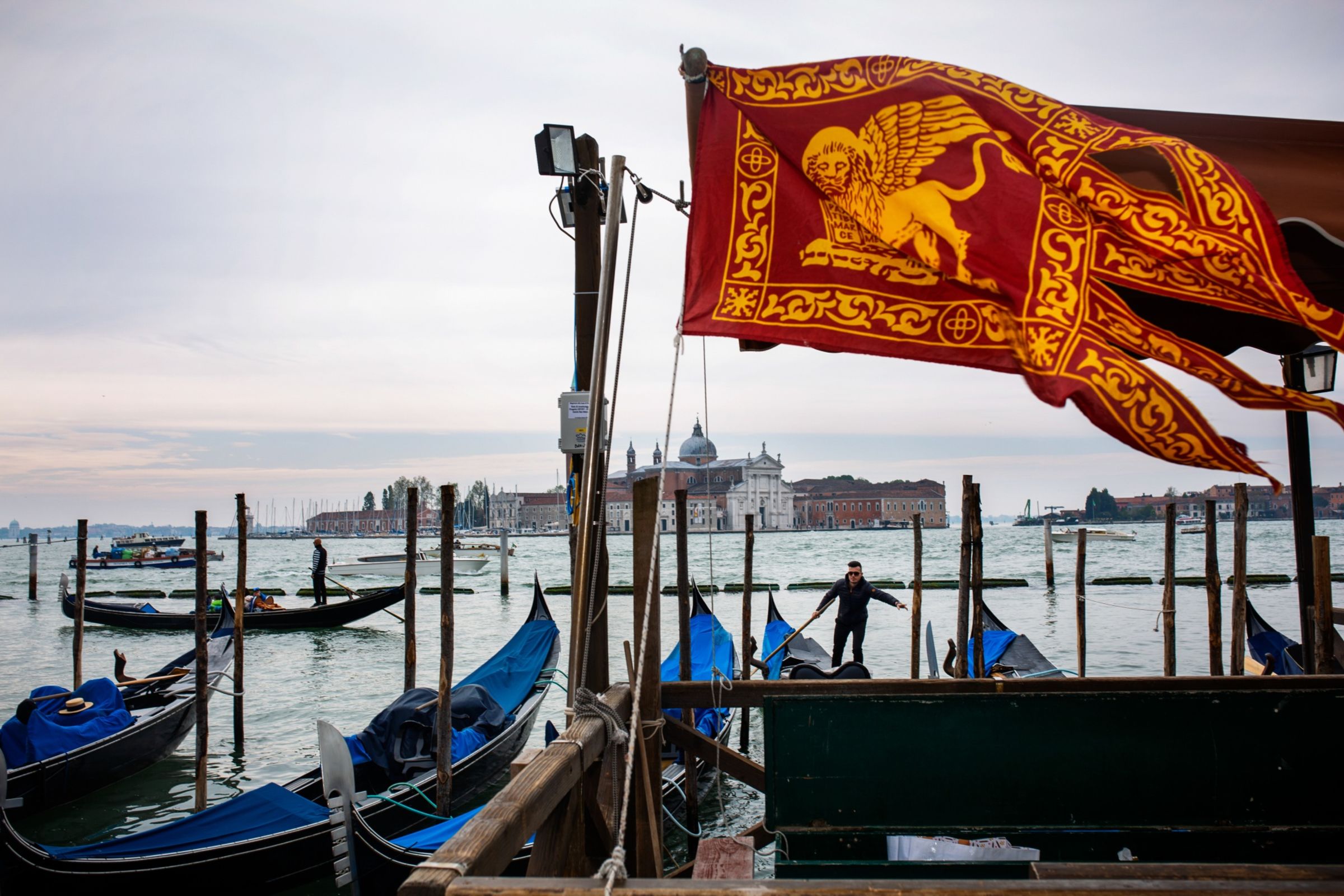
The Standard of Saint Mark, the flag of the Venetian region, flies above gondolas. Venice is eager to attract young professionals who want to live in, not just visit, the city. 

I’m not sure how a floating city puts out the welcome mat, but this one is inviting young professionals to come and be part of its daily life. Just don’t try to recreate the culture of any other city there. As one resident says, “You do have to live by Venice’s rules.”

Catherine Bennett writes at Bloomberg’s City Lab, “From Karuna Clayton’s window, she can see a gondola bobbing in a Venetian canal and a simple white stone church on one side of a small campo, or city square. Normally there would also be a steady trickle of tourists walking below, but on a January afternoon amid the pandemic’s omicron wave, the square’s empty. 

“For the last nine months, this has been Clayton’s home and workspace. Formerly a commercial food photographer based in London, she now shares an apartment in Venice with her partner and two-year-old daughter, running a coaching business and teaching yoga alongside her photography.

“ ‘I’ve always called myself location-independent,’ she says. … Young, skilled and nomadic, the 35-year-old Clayton represents exactly the demographic that the new Venice-based project Venywhere is trying to attract.

“Launched in December 2021 by the Università Ca’ Foscari and the Fondazione di Venezia, a nonprofit group that protects Venice’s cultural heritage, Venywhere aim is to convince people who can do their jobs from anywhere to do so in Venice. …

“Inspired by the Tulsa Remote work program in the U.S. and a slew of similar efforts from around the world, leaders in the Italian city are eager to bring in young professionals who want to live and work there, not just vacation. …

“ ‘The pandemic has created a large population of highly skilled people who want to move,’ says Venywhere founder Massimo Warglien, a professor of management at the Università Ca’ Foscari. He believes that the pandemic’s disruptive impact on the world of work, from the ‘Great Resignation’ to a new breed of flexible and remote workers, could present a solution to Venice’s chronic brain drain. ‘This is a way of repopulating Venice,’ he says. …

“Unlike remote-worker programs in less-charismatic sites, Venywhere isn’t offering cash incentives to prospective residents. Instead, digital nomads who want to move to Venice will pay a one-time fee to get access to a concierge service that eases them into Venetian life: viewing apartments on their behalf, advising them on how to get a SIM card or access the health system, and even showing them where to shop. The platform promises to help newcomers navigate the city’s many eccentricities, connecting them with workspaces, language lessons and recreational amenities off the beaten tourist paths. …

“The latest population data shows that there are twice as many people in their 50s living in the historical center as there are people in their 20s. Sara Ajazi, a 26-year-old project manager at Venywhere, says that she was the only one of 300 students in her management class to stay and work in the city after graduating from the Università Ca’ Foscari.

For freshly minted graduates who don’t want to be gondoliers, tourist guides or waiters, building careers in Venice can be a challenge. …

“Could an injection of remote workers reverse this demographic trend? The Venywhere project is banking on a domino effect: If large firms send remote teams to the city, that will attract investment and, eventually, more startups who would hire the city’s graduates.

“But some people say it’s hard to see Venice transforming into an entrepreneurial hub or hot destination for remote workers anytime soon. ‘It’s not the easiest city to live in,’ says Riccardo Longobardi, a former Venice resident and the founder of the Digital Nomads in Italy Facebook group. ‘It’s very beautiful, but it’s a bit isolated. Digital nomads tend to look for places with a big nomad community.’

“Clayton agrees. ‘Venice isn’t set up for remote workers, unless you have a nice space to work in. There are almost no coworking spaces and it’s not a thing here to sit at a café for a few hours, getting coffee or lunch and working on your laptop. Lots of places don’t even have Wi-Fi.’

“Solving connectivity problems is one of the first things Venywhere plans to address, in part by creating a network of open-air Wi-Fi hotspots around the city. …

“To accommodate new workers, Venywhere proposes repurposing historic buildings, scattering workers across several sites. The economics campus of the Università Ca’ Foscari, where the team behind Venywhere works, is a perfect example of this: Sleek, white-painted coworking stations, student cafeterias and tutor rooms occupy mid-19th century brick buildings that used to be the municipal San Giobbe slaughterhouse.

“Alternatively, remote workers could hop on a vaporetto and head to Giudecca island, where the bare stone galleries and vaulted ceilings of former tanneries, mills and shipyard buildings in the Giudecca Art District are more often used to host art exhibitions during the Venice Biennale. Venywhere plans to use spaces like these, along with unused rooms in museums, artists’ studios that lie empty without an artist-in-residence, vacant hotel rooms and even restaurant tables between mealtimes as alternatives to the traditional rent-a-desk coworking set-up.

“ ‘This isn’t an expensive project because we are using what is already there. So many structures in the city are only half-used,’ says Warglien.

“The same can be said for the city’s rental housing during the pandemic. Living in Venice can be expensive: In the last few decades, efforts to build social housing have stalled as the region’s conservative politicians have chosen instead to turn residential lots over to the more lucrative tourist market, driving up prices in the city center. Venice has become increasingly unaffordable for Venetians, many of whom have migrated to terraferma, the mainland. The apartments that they left behind have been bought up by private companies for rent to tourists through platforms like Airbnb and Booking.com. Ocio, a local organization that investigates the city’s housing issues, has found that there are now as many beds for tourists in the city as there are for residents.” More at CityLab, here.

Read Full Post »

Photo: Reuters via the Christian Science Monitor.
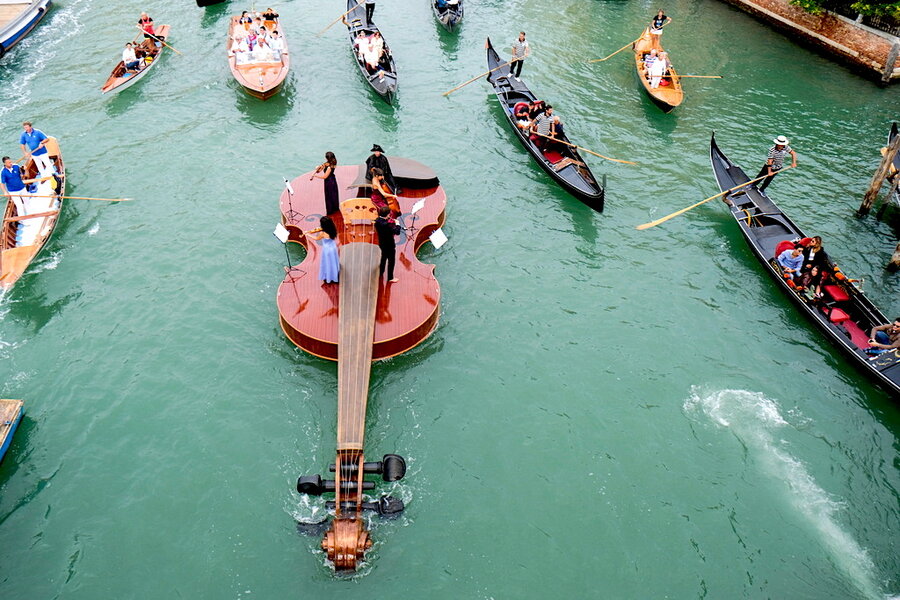
The giant violin above was built by Venetian artisans and carries musicians performing a live concert.

How have people around the world found a path to joy and laughter during the pandemic? In Venice, a giant, floating violin is providing fun on the Grand Canal.

As Elisabetta Povoledo reported this month at the New York Times, “In its 1,600-odd years, any number of phantasmagorical vessels have floated down Venice’s Grand Canal, often during regattas or elaborate ceremonies dedicated to the sea. On Saturday morning, a decidedly unusual head-turner took a spin: a gigantic violin, carrying a string quartet playing Vivaldi’s ‘Four Seasons.’

“The craft, called ‘Noah’s Violin,’ set sail accompanied by an escort of gondolas, and in no time a small flotilla of motorboats, water taxis and traditional flat-bottomed Venetian sandoli joined the violin as it glided from city hall, near the Rialto Bridge, to the ancient Customs House across from Piazza San Marco, about an hour’s ride.

“The vessel is a faithful, large-scale replica of a real violin, made from about a dozen different kinds of wood, with nuts and bolts inside, as well as space for a motor. In addition to the artistry involved, it took a lot of tinkering and nautical expertise to make it seaworthy, its makers say.

‘It was a novelty for us, too,’ said Michele Pitteri, a member of the Consorzio Venezia Sviluppo, which financed the boat and built it along with Livio De Marchi, a Venetian artist, who conceived the idea during last year’s lockdown.

“De Marchi named the work ‘Noah’s Violin,’ because like the ark, it was meant to bring a message of hope after a storm, in this case a message that promoted ‘art, culture and music,’ he said.

“It’s no coincidence that the journey down the Grand Canal was plotted to end beside the church of La Salute, Italian for health, in the Dorsoduro district, which was built as a votive offering to the Virgin Mary for deliverance from a plague that decimated the city in 1630. …

“The boat was steered by a helmsman dressed in a black cape and wearing a black tricorn hat like those popular in the 18th century. ‘I wanted him to channel the spirit of Vivaldi,’ De Marchi said.

“Leone Zannovello, the president of the consortium, said that the project had revived enthusiasm at the shipyard on the island of Giudecca, where it was made, after the darkest days of the coronavirus pandemic. Companies and individuals who weren’t part of the group even offered to help out, he said. ‘It was something that united us even more,’ he said. ‘We worked with our hearts.’

“On Saturday, Zannovello and others followed the violin down the Grand Canal on sundry boats, palpably proud.

“ ‘Bravo Livio!’ a voice cried out in praise of De Marchi.

“ ‘Bravi tutti!’ (‘Well done, everyone!’), De Marchi responded.

“It was mostly smooth sailing, though De Marchi mumbled anxiously whenever the prow (the neck of the violin) veered too sharply to one side or other. But even though the musicians played standing up (barefoot for a better grip), they scarcely missed a note. At one point the score for the viola flew off the music stand and into the water, but it was quickly recovered.

“ ‘Let’s just say that between the wind and the waves, it was challenging,’ said Caterina Camozzi, the viola player, after she was back on dry ground. Tiziana Gasparoni, the cellist, chimed in to say, ‘as a Venetian and a musician, it was the most moving experience of my life.’

“As is often the case in Italy, the real hitches along with way were bureaucratic.

“ ‘We were told we needed a vehicle registration plate, but officials didn’t know how to classify it,’ said Mario Bullo, a carpenter in the consortium. At first, they were issued the same plates given to rafts. ‘But the traffic police objected, saying that’s not a raft, it’s a violin,’ he said with a shrug. In the end, city officials worked it out. …

“ ‘The artisans in the city never stopped during the lockdown. Even if they couldn’t work with their hands, they still used their brains,’ said Aldo Reato, a local lawmaker who arranged for the half-dozen gondolas to accompany the violin. ‘There is no one better than a gondolier to represent the city’s traditions,’ he said.

“It’s not the first time that De Marchi, an artist known for sculpting household objects or clothing in wood, has created large-scale floating works. He began with an origami-style paper hat made of wood, in 1985, and since then he’s put several large-scale wooden objects out to sea, including a woman’s shoe, a pumpkin coach with horses, and a variety of cars, including a 1937 Jaguar, a Volkswagen Beetle and a Ferrari convertible.

“People gathered over the Ponte dell’Accademia and along the paved banks of the Grand Canal to watch the floating concert that included works by Bach and Schubert. …

“A brief ceremony attended by members of the consortium and their families and friends, followed. De Marchi made a speech, and commemorated the relatives of people who had worked on the violin who had died before seeing it finished. The Rev. Florio Tessari blessed the violin and said he hoped it would ‘travel the world as a message of hope.’ There has been interest in the violin from businesses in Italy and a museum in China, De Marchi said.

“The musical entertainment continued there along with toasts and a singalong of sorts.

“Zannovello, the consortium president, said he hoped the violin would serve to showcase Venetian crafts after a slow and difficult period. ‘I am convinced there will be a return,’ he said.”

Do check out the photos at the Times, here, and enjoy the grins of people just having fun.

Read Full Post »

A friend from my childhood called Caroline has been following this blog, sometimes making comments related to her field, which is architecture.

Today Caroline sent me a link that she knew would be a perfect fit here. The story is about a design competition to address New York City’s rising seawater.

Kayla Devon wrote about it at Builder Online, “In the next 30 years, roughly 30% of Manhattan is expected to sink below sea level, according to a climate study by the NASA Goddard Institute for Space Studies. Instead of trying to stop the inevitable, Brazilian architect Walmir Luz focused on embracing it.

“After studying climate predictions from the United States Landfalling Hurricane Probability Project and the history of Manhattan’s edge, Luz designed a utopian/dystopian future for New York (depending if you’re a glass half-full or half-empty kind of person).

“Luz’s NYC 2050 concept makes flooding a part of city life by taking inspiration from Venice. Luz designed structures as levels that could allow water to move through lower levels as the sea rises. Streets would become permeable so water can wash over the roads instead of flooding them, and more barriers would surround the city’s edges.

“Luz completed the concept as his thesis for his Bachelor of Architecture degree from Cornell University, and won a Silver award in the urban planning and urban design category at the A’Design Award & Competition. He now works as an architect for Gensler.” More at Builder Online.

I love it when people who read the blog come upon topics that they know will fit and then send them along. I like being able to share the cool stuff with a wider audience. Thank you, Caroline.

Design: Walmir Luz
Luz won a design award for a concept making the best of rising sea levels in New York City.

Read Full Post »