Feeds:
Posts
Comments

Posts Tagged ‘Biennale’

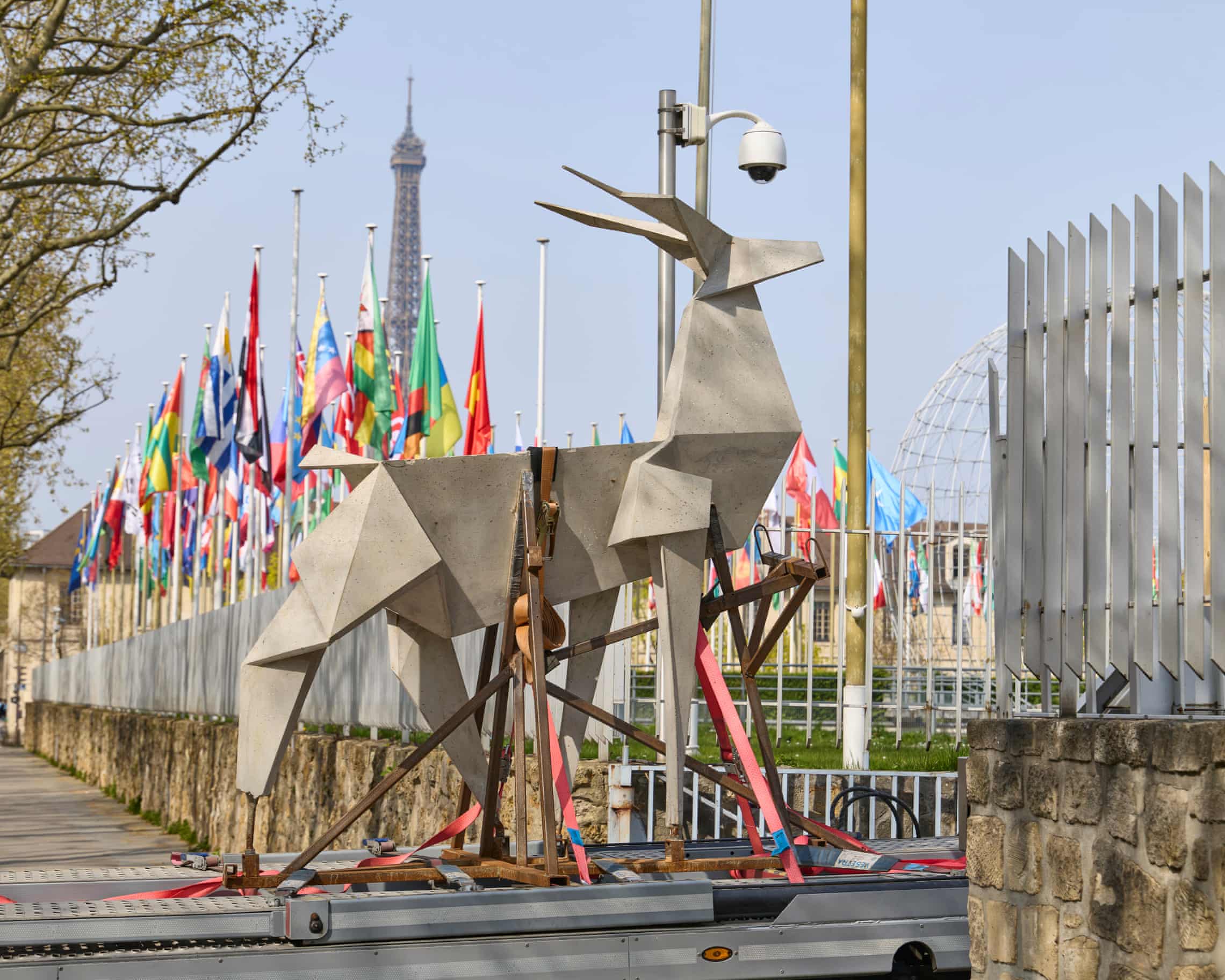
Photo: David Levene/Guardian.
Zhanna Kadyrova’s sculpture arrives at the headquarters of Unesco in Paris, on its way to the Venice biennale. “It has become a symbol of hope” in Ukraine.

The Venice Biennale is a celebration of art and culture from countries around the world. What different nations send to the event shows what they think they stand for and what they want others to know. This year, war-torn Ukraine didn’t try to send high art but a sculpture that has become a symbol of hope.

Charlotte Higgins reported at the Guardian in May, “On a perfect spring day in Paris, the deer is first visible in the distance, poised between an avenue of just-budding plane trees in the 7th arrondissement. Its head is raised, its body poised. Seen there among the trees, it really could be a wild animal. In reality, it is a concrete deer, and not even a particularly naturalistic one, since it has the distinct look of origami about it. The sculpture is a play of scale and weight, as if feather-light folded paper has been enlarged and transformed into heavy concrete.

“The deer is strapped to a flat-bed truck, and it is being driven into the grand modernist headquarters of Unesco, the UN agency that looks after heritage, culture and education. It will stand there for a day in its gardens, with Alexander Calder’s Spirale for company and the Eiffel Tower as a backdrop. It is the last stop on a long overland journey across eastern, central and western Europe before it crosses the Venetian lagoon and docks in Venice for the 2026 art biennale, where, from this month, it will be the most prominent component of Ukraine’s national pavilion.

“The deer sculpture is by Kyiv-based artist Zhanna Kadyrova, who has been making resonant work reflecting the violence of the Russian attack of Ukraine since 2022. The work, however, predates Russia’s full-scale invasion. In 2018, she was commissioned by the city of Pokrovsk, in the Donetsk region, to help regenerate a large park. It was one of a number of efforts to invest in the cities of Ukraine’s east after Russian-backed separatists took over chunks of territory in the Donetsk and Luhansk regions. She and her partner, Denys Ruban, worked in the city for several months. …

“Fast forward to the summer of 2024. More than two years into Russia’s invasion of Ukraine, Pokrovsk was on the frontline. Kadyrova’s friend Leonid Marushchak – an educator, historian and now co-curator of Ukraine’s Venice pavilion – was at that time organizing perilous evacuations of museum collections from frontline towns. … Marushchak said: ‘I saw the deer was still standing there. I called Zhanna to find out if she was not against the evacuation of the sculpture. We went to the local museum – some of the staff were still working. They said they understand that they have to evacuate it, but they had no idea how to do it.’

“Marushchak began negotiating with the city authorities – whose first priority, as drone and artillery attacks heightened in their intensity, was not a slightly odd contemporary concrete sculpture in the park. His ‘trick,’ as he called it, was to undertake to evacuate a statue of Mykola Leontovych, too – a beloved Ukrainian composer who wrote the renowned, evocative Carol of the Bells. …

“A moving film, which will also be shown in Venice, documents the process. While the men are at work, Kadyrova asks locals – some about to leave for ever, some determined to tough it out come what may – what they think of the sculpture. Some are nonplussed, but others clearly love it, and the conversation is bound up with the ache of leaving a place, maybe for good. …

“It was last year that Kadyrova and Marushchak, with fellow curator Ksenia Malykh, proposed a project centering on the sculpture for Ukraine’s Venice Biennale pavilion. … And so, early this spring, the sculpture set out on its journey to Venice – a slow and circuitous one through Warsaw, Prague, Vienna, Brussels and finally Paris.

“Along the way, it has paused in each city, often in grand imperial architectural settings in which it was never intended to be seen, designed as it was for a park in a small, industrial city. And over the course of its journey, it has accrued more and more meaning and significance. Refugees from Pokrovsk, Kadyrova tells me, regularly come to see the deer, and a new tradition has arisen, of touching it and making a wish.”

More at the Guardian, here.

Read Full Post »

Photo: Charlie Rubin/Kasmin, New York.
An example of sculpture by Alma Allen, ‘Not Yet Titled‘ (2024). He is the artist chosen by a conservative art group to represent the US in the 61st Venice Biennale.

With all the sinister goings-on in the world, you might think that something strange in the art world would be the least of our worries. But this creepy story really got under my skin, and I’m wondering what the artists among you have to say about it.

Ben Davis reports at Artnet that the administration “has picked its artist for the 61st Venice Biennale. After months of speculation and much confusion, the artist to represent the U.S. will be Mexico-based sculptor Alma Allen, in a pavilion organized by curator Jeffrey Uslip. The sponsor is the American Arts Conservancy (AAC).

“But what is this organization, now vaulted front and center of the international art conversation, which no one I know has ever heard of? I was perplexed. So I took a spin around the internet to get a sense of what its chops were. Here are some observations.

“If no one has heard of the Tampa-based AAC, this is because it was founded only in July of this year. The press release is so poorly edited that it repeats the same quote by executive director Jenni Parido twice.

“The fact that this gaffe stands, four months later, as AAC takes on the most high-profile job in the arts, might put into question their professionalism in organizing a major international art exhibition. …

“Parido is an enigma on the art scene. According to her LinkedIn, her primary work experience is as the founder of Feed Pet Purveyor, a Tampa vendor specializing in natural foods for pets, which she ran from 2014 to 2023. …

“Frank Bardonaro was named president of the AAC board of directors in late August; he’s the CEO of the Houston-based Brock Group, a conglomerate that provides scaffolding, insulation, and the like for industrial and commercial customers. John Mocker, who serves as board secretary, is head of a pipe distributor, LB Industries.

“Mocker distinguishes himself as arty in this company because his biography identifies him as a collector of ‘American and international art.’ I’m interested! All I was able to find out, though, was that he also had a bit part in the unknown 2024 Abigail Breslin feature Chapter 51 directed by photographer Tyler Shields. …

“Ryan Coyne joined the AAC board as treasurer in September. He is best-known for running Starboard, a digital marketing, media, and government relations business. Among other things, it owns BizPac Review, which promises ‘breaking news and analysis unfiltered by the liberal bias that has eroded the media’s credibility.’ Starboard is probably best known for purchasing Parler, the right-wing Twitter clone, in 2023. Coyne also runs We the People Wine, ‘America’s Favorite Patriotic Wine.’

“Finally, AAC vice president Janet Steinger is a socialite married to superstar Palm Beach personal-injury lawyer Michael Steinger. …

“ ‘The Conservancy brings together a national network of curators, scholars, educators, artists, and patrons who believe in the transformative power of the arts,’ AAC boasted when it launched. Let’s take a look at what that means. The advisory board includes: curator Jeffrey Uslip, who is helming the Alma Allen pavilion in Venice, socialite Mackenzie Brumberg, socialite Nicola Verses … Nicole McGraw, a Palm Beach art dealer and former CEO of Jupiter NFT Group [now] ambassador to Croatia … artist Brendan Murphy, who made a diamond-encrusted spaceman sculpture for a Four Seasons in Riyadh … photographer, artist, and Web3 entrepreneur Brandon Ralph. …

“One name on the advisory board list, Madison Wright, remains an unknown, as the AAC site does not identify or provide links for its advisory board, just names. ‘Mathew Taylor’ and ‘Michelle Taylor’ are also listed. ‘Mathew’ seems to be a misspelling of ‘Matthew.’ It probably refers to a filmmaker who goes by both M.A. Taylor and Matthew Taylor, depending on whether he is directing films about conservative politics or art. He has directed both Marcel Duchamp: The Art of the Possible (2019), about the famed father of conceptual art, and Government Gangsters (2024) [about] Kash Patel‘s book about a deep state conspiracy. …

“The other big initiative AAC is pushing is the ‘Passport to Patriotism: America 250’ exhibition, which it says will happen next year. ‘Children ages 5–15 are invited to submit original works that express what patriotism means to them,’ for possible inclusion. …

“The ‘children’s art’ used to illustrate the contest has the hallmarks of very bland A.I., including [one] where Lady Liberty has six fingers, and the stripes on the flag inexplicably flip colors. …

“A bare-bones official website for the U.S. pavilion now exists. On Instagram and Facebook, AAC posted a short statement about the vision of the show.”

Maybe I read too many murder mysteries, but the thin online presence of these entities sure do suggest the shell companies I’m currently reading about in a novel by Richard Osman.

More at Artnet, here.

Read Full Post »