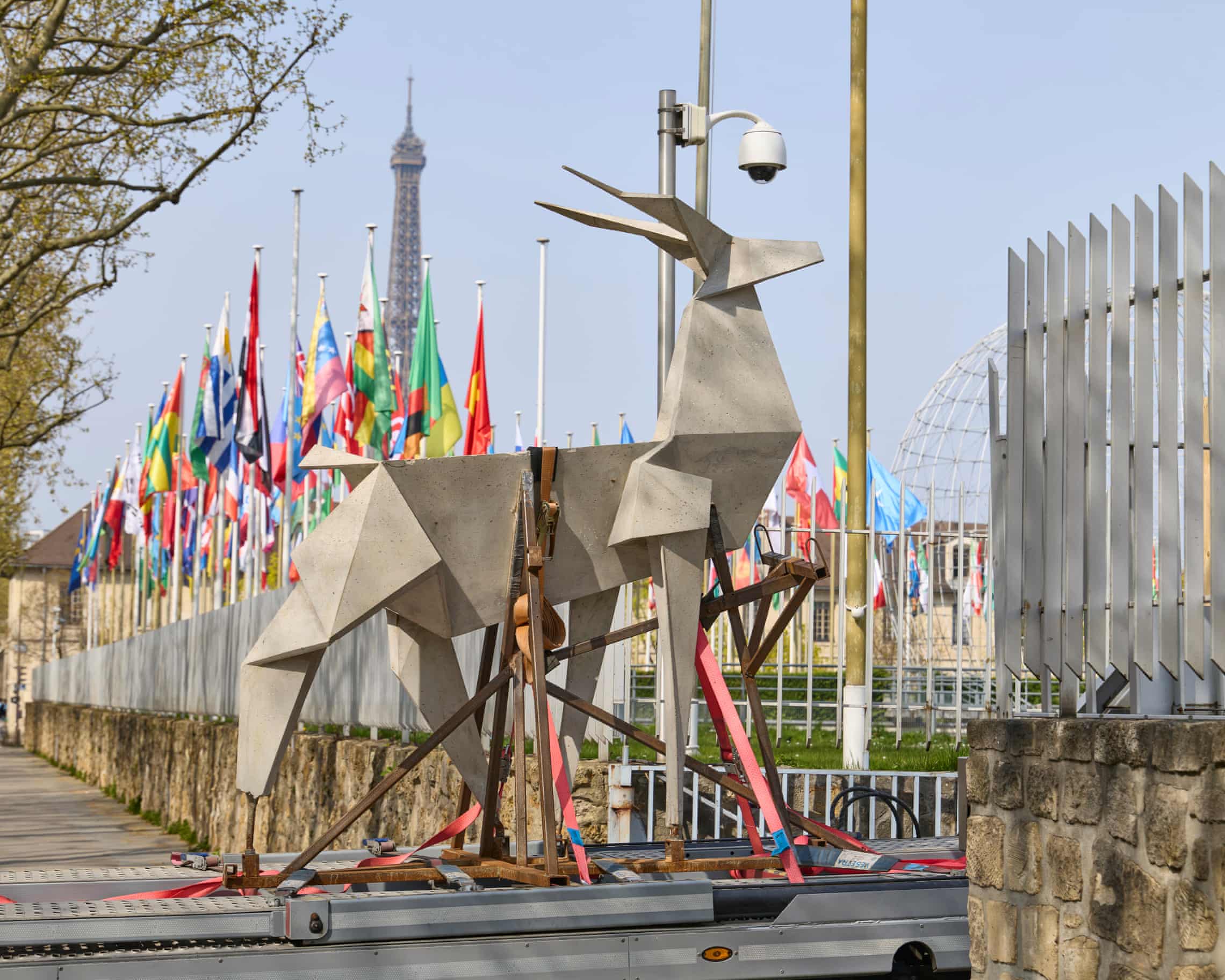
Photo: David Levene/Guardian.
Zhanna Kadyrova’s sculpture arrives at the headquarters of Unesco in Paris, on its way to the Venice biennale. “It has become a symbol of hope” in Ukraine.
The Venice Biennale is a celebration of art and culture from countries around the world. What different nations send to the event shows what they think they stand for and what they want others to know. This year, war-torn Ukraine didn’t try to send high art but a sculpture that has become a symbol of hope.
Charlotte Higgins reported at the Guardian in May, “On a perfect spring day in Paris, the deer is first visible in the distance, poised between an avenue of just-budding plane trees in the 7th arrondissement. Its head is raised, its body poised. Seen there among the trees, it really could be a wild animal. In reality, it is a concrete deer, and not even a particularly naturalistic one, since it has the distinct look of origami about it. The sculpture is a play of scale and weight, as if feather-light folded paper has been enlarged and transformed into heavy concrete.
“The deer is strapped to a flat-bed truck, and it is being driven into the grand modernist headquarters of Unesco, the UN agency that looks after heritage, culture and education. It will stand there for a day in its gardens, with Alexander Calder’s Spirale for company and the Eiffel Tower as a backdrop. It is the last stop on a long overland journey across eastern, central and western Europe before it crosses the Venetian lagoon and docks in Venice for the 2026 art biennale, where, from this month, it will be the most prominent component of Ukraine’s national pavilion.
“The deer sculpture is by Kyiv-based artist Zhanna Kadyrova, who has been making resonant work reflecting the violence of the Russian attack of Ukraine since 2022. The work, however, predates Russia’s full-scale invasion. In 2018, she was commissioned by the city of Pokrovsk, in the Donetsk region, to help regenerate a large park. It was one of a number of efforts to invest in the cities of Ukraine’s east after Russian-backed separatists took over chunks of territory in the Donetsk and Luhansk regions. She and her partner, Denys Ruban, worked in the city for several months. …
“Fast forward to the summer of 2024. More than two years into Russia’s invasion of Ukraine, Pokrovsk was on the frontline. Kadyrova’s friend Leonid Marushchak – an educator, historian and now co-curator of Ukraine’s Venice pavilion – was at that time organizing perilous evacuations of museum collections from frontline towns. … Marushchak said: ‘I saw the deer was still standing there. I called Zhanna to find out if she was not against the evacuation of the sculpture. We went to the local museum – some of the staff were still working. They said they understand that they have to evacuate it, but they had no idea how to do it.’
“Marushchak began negotiating with the city authorities – whose first priority, as drone and artillery attacks heightened in their intensity, was not a slightly odd contemporary concrete sculpture in the park. His ‘trick,’ as he called it, was to undertake to evacuate a statue of Mykola Leontovych, too – a beloved Ukrainian composer who wrote the renowned, evocative Carol of the Bells. …
“A moving film, which will also be shown in Venice, documents the process. While the men are at work, Kadyrova asks locals – some about to leave for ever, some determined to tough it out come what may – what they think of the sculpture. Some are nonplussed, but others clearly love it, and the conversation is bound up with the ache of leaving a place, maybe for good. …
“It was last year that Kadyrova and Marushchak, with fellow curator Ksenia Malykh, proposed a project centering on the sculpture for Ukraine’s Venice Biennale pavilion. … And so, early this spring, the sculpture set out on its journey to Venice – a slow and circuitous one through Warsaw, Prague, Vienna, Brussels and finally Paris.
“Along the way, it has paused in each city, often in grand imperial architectural settings in which it was never intended to be seen, designed as it was for a park in a small, industrial city. And over the course of its journey, it has accrued more and more meaning and significance. Refugees from Pokrovsk, Kadyrova tells me, regularly come to see the deer, and a new tradition has arisen, of touching it and making a wish.”
More at the Guardian, here.


What a wonderful sculpture, made poignant by its country of origin!
LikeLiked by 1 person
I can’t believe this war is still going on and that the Russian people haven’t finally dumped Putin.
LikeLiked by 1 person
Right? Very hard to dislodge a tyrant and a dictator. I feel for the Russian people. I expect many of them do not support Putin or the war.
LikeLiked by 1 person
Wow. I love this story. May the concrete/origami deer inspire hundreds, thousands and millions of human hearts/minds!
LikeLike
I love that it’s concrete “paper.” Something to think about.
LikeLiked by 1 person
Impressive!
LikeLiked by 1 person