Feeds:
Posts
Comments

Posts Tagged ‘voting’

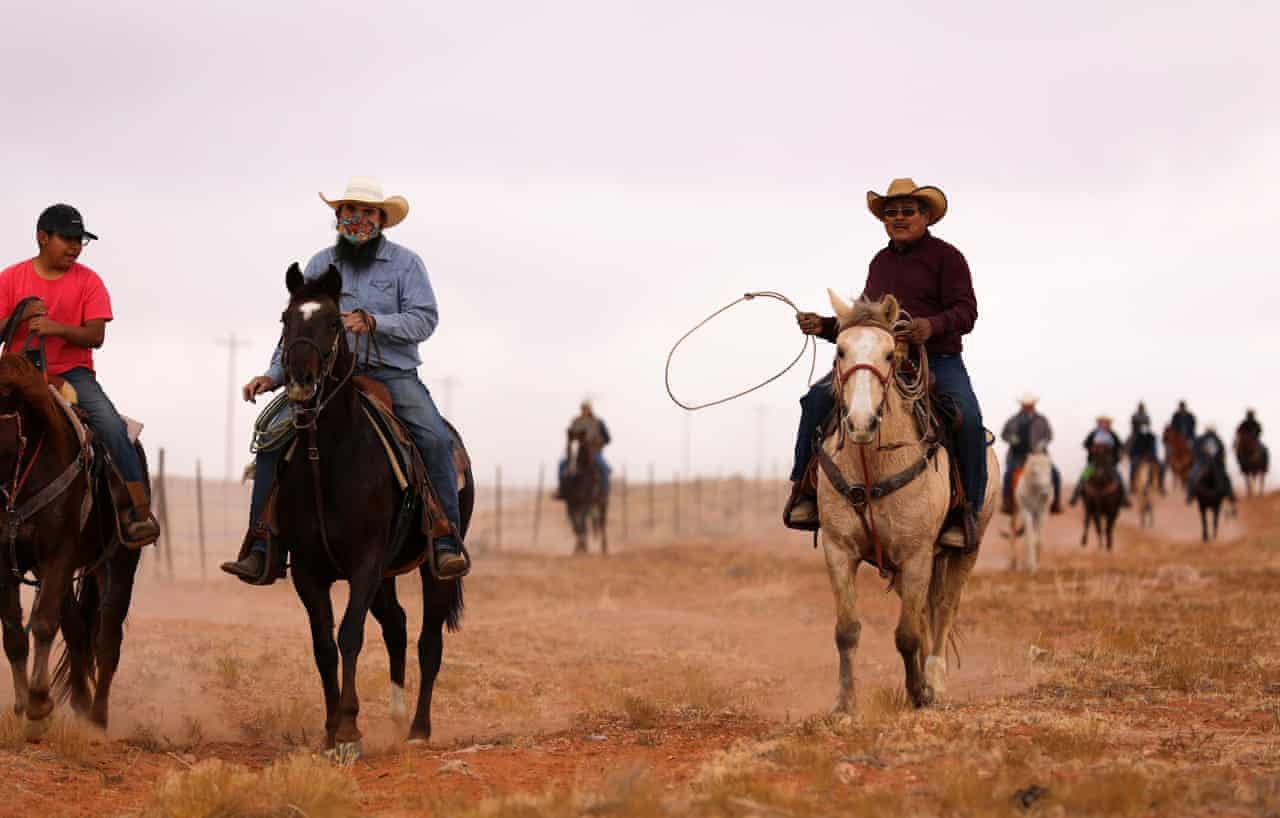
Photo: Larry Price/The Guardian.
Diné voters ride on horseback through the Navajo Nation to the polls in 2020. Allie Young, a Diné grassroots organizer, started the Ride to the Polls campaign.

Elections never stop being important, and next Tuesday, Nov. 4, will be a critical one in many parts of the country as we struggle to shore up democracy. Today we learn about how hard indigenous people sometimes work to get to the polls.

Melissa Hellmann wrote at the Guardian last year about Navajo people’s understanding of voting as an important way to protect the environment.

“In Diné, or Navajo, culture, the horse symbolizes strength and resilience, as well as a connection to the earth. Cowboy culture is so relevant to Native communities, that horseback trail rides are used to draw awareness to issues within the community including suicide prevention, and alcohol and drug use, said Allie Young, a 34-year-old Diné grassroots organizer. This fall, Young has harnessed the trail ride to engage Diné voters for the presidential election: her group’s voter-registration events will culminate with 100 Indigenous voters riding on horseback to a polling station in Arizona on election day. …

“Young, founder of the Indigenous-led civic engagement program Protect the Sacred, told the Guardian. ‘[When] we’re connected with the horse, we’re then reconnected to Mother Earth and reminded of our cultural values and what we’re fighting for, what we’re protecting.’ …

“Political representation that brings needed resources into Native communities is particularly important on tribal lands, where 75% of roads remain unpaved. …

“Young said she hopes that the success of the Ride to the Polls campaign in 2020 and 2022 will encourage ‘the greatest Native turnout ever’ in the upcoming election. This year, the campaign has extended its reach with events such as skateboarding and bull-riding competitions, heavy metal and country music concerts.

“ ‘We’re trying to communicate to our community that we need to protect our tribal sovereignty,’ said Young, ‘and with that, protect our sacred sites, protect our lands, our cultures, our languages, our traditions.’

“Young launched the Ride to the Polls campaign in 2020 in response to the rapid spread of Covid-19 infections in the Navajo Nation, where some counties saw the highest death rates per capita in the nation. She wanted to ensure that her community filled out the US census to receive the funding they deserved and to elect politicians who prioritize the concerns of Native communities.

“ ‘Our nation and many tribal nations across the country were devastated by the onset of Covid-19 because our system is being chronically underfunded,’ said Young, ‘which revealed to the rest of the world what we already know: that the government is not honoring our treaty, which says that we are to receive good healthcare and education.’ She began creating culturally relevant initiatives so that young Diné citizens who felt disenfranchised would see voting as a tool to ‘rebuild our power as a community.’ …

“So far, they have registered 200 new voters and checked or updated the registrations of about 400 people.

“On 12 October, the actor Mark Ruffalo will join Ride to the Polls to help mobilize Native voters and to mark the 100th anniversary of Native Americans being granted the right to vote. …

“ ‘Indigenous people have only been able to fight for their future at the ballot box for 76 years,’ Ruffalo said in a statement. ‘Now we’re seeing a massive movement of young Indigenous folk exercise their power at the polls.’ …

“All Native Americans were finally granted the right to vote under the federal voting rights act of 1965. Still, barriers have remained that make it difficult for Diné to register to vote and cast ballots, including a lack of residential addresses since many people on the Navajo Nation use post office boxes. It also can take up to an hour to drive to a polling location, said Young. And this summer, the US Supreme Court ruled that Arizona can enforce a state law requiring prospective voters to include proof of US citizenship in registration forms, which Young said was a ‘slap in the face to Native Americans, who are the first peoples of this land, to be asked to prove their citizenship.’

“To help address some of those hurdles, Protect the Sacred is partnering with the Indigenous-led voter-engagement non-profit Arizona Native Vote. Indigenous organizers register voters and help residents find their addresses by locating their houses on Google Maps. ‘A key talking point when we talk to voters is letting them know that voting and registering to vote should not be this hard,’ Jaynie Parrish, executive director of Arizona Native Vote, said. …

“During a six-stop trail ride to register Diné citizens throughout the Navajo Nation in mid-September [2024] indigenous organizers discussed with voters the importance of casting ballots in every election. They served citizens stew and frybread while explaining to them that county elections can determine how local government operations are funded. Young said: ‘I believe that we started a movement around the power of the Native vote.’ ”

And so, they voted. We know what happened in 2024, and we know what has been happening to environmental protection since then. But every election counts in moving the needle back toward the people. So, please vote on Tuesday and at every election in the future.

More at the Guardian, here.
Read Full Post »

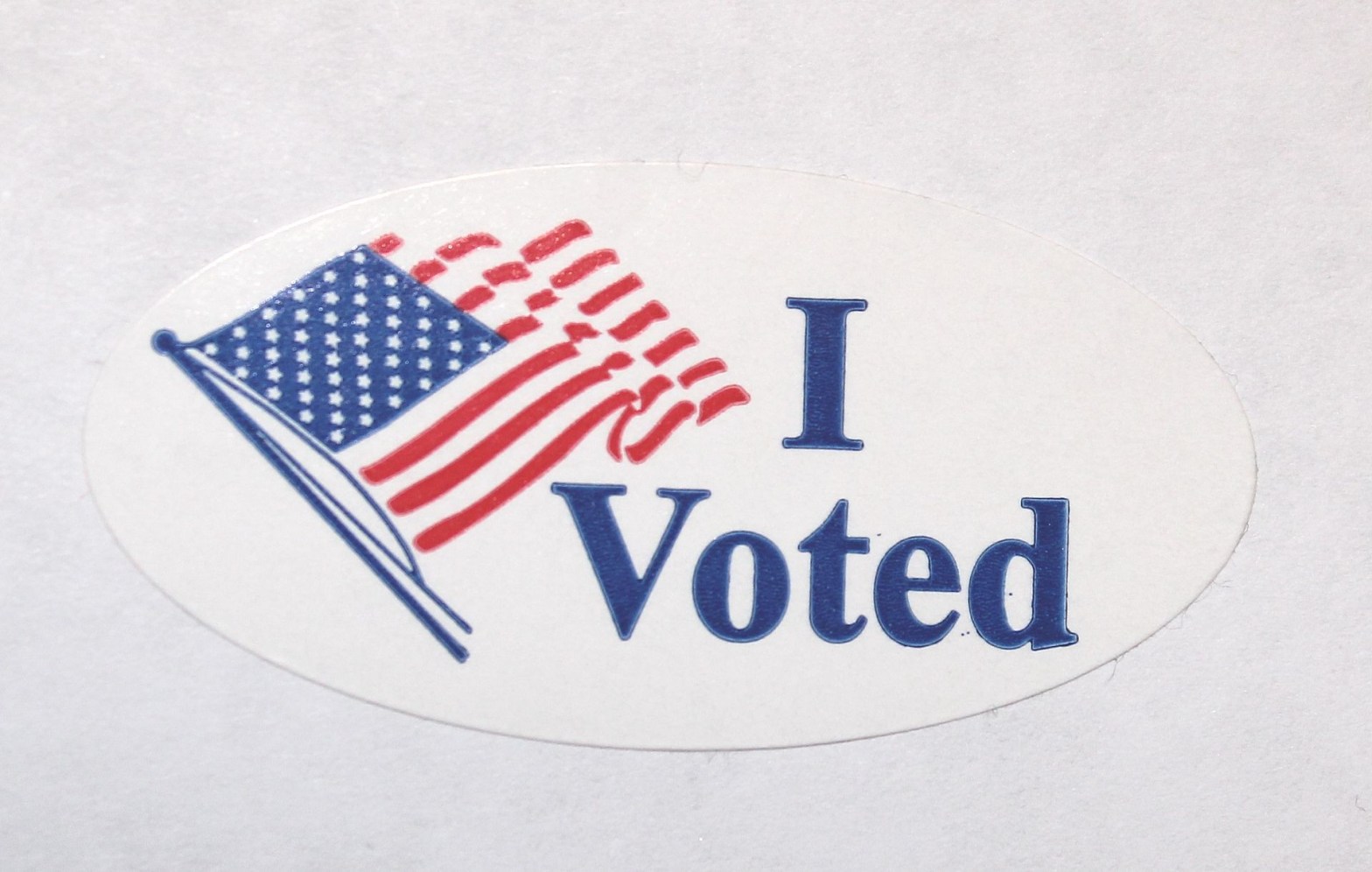
Art: Janet Boudreau/GPA Photo Archive via Flickr.
Boudreau’s 1987 sticker is the most familiar “I Voted” design.

Have you noticed that whenever you take a break from being involved in the maintenance of democracy, bad things happen? I think I’ve learned never to look away, never to leave democracy to others. Democracy is not so strong that it can take care of itself.

Because voting is the cornerstone of democracy, citizens often display the “I Voted” after going to the polls. Today’s story is about the sticker.

Rhea Nayyar writes at Hyperallergic, “The oval-shaped  ‘I Voted’ sticker with the billowing flag has been a staple within American voting culture for decades — so much so that even some absentee ballots include it in the envelope. While the sticker remains ubiquitous as the country’s most beloved participation trophy, many are unaware of its origins.

“States and counties across the nation have strayed from the historic sticker, holding contests for original designs that better reflect their local elections. While some areas of the country are phasing out the sticker reward in an effort to save money, 14-year-old Hudson Rowan swept the Ulster County, NY, ‘I Voted’”’ sticker contest with his viral spider-demon design entry, sparking a renewed interest in voter participation and voting paraphernalia all together.

“ ‘We’ve had a lot of fun this year with the sticker contest and are so proud of the positive attention it has brought to the voting process, specifically when it comes to engaging with younger voters,’ Commissioner Ashley Dittus of the Ulster County Board of Elections in New York said to Hyperallergic.

“It’s unclear where the first voting sticker debuted as they’ve been regionally available through local businesses and organizations post-World War II. The Miami Herald mentions the distribution of an ‘I Have Voted’ sticker at Miami polls as early as 1950 to remind others of their civic duty, and another article from 1982 notes small businesses offering Election Day discounts and freebies for those donning the sticker in Fort Lauderdale. On the other side of the country, the Phoenix Board of Realtors claimed that they designed and distributed the first ‘I Voted Today’ sticker for poll visitors in 1985 in an effort to get better acquainted with the community and promote voter turnout in favor of a freeway expansion query that was on the ballot that year.

“The rippling flag sticker design was developed in 1987 by Janet Boudreau, election supply vendor Independent Tabulation’s (InTab) former president, in acknowledgment of the lack of public awareness of Election Day. Boudreau had the design copyrighted, and by late 1988, the stickers were available in all 50 states.

‘I wanted them to see people with an “I Voted” sticker and think, “Oh, I should do that,” ‘ Boudreau told Time Magazine in 2016. ..

“I consulted with Claire Jerry, a political history curator at the Smithsonian Institution’s National Museum of American History (NMAH) in Washington, DC, home to a collection of voting paraphernalia from the 20th century.

“ ‘The oldest Election day paraphernalia we have is from 1920, during the women’s suffrage movement,’ Jerry told Hyperallergic. ‘We have a button with a ribbon extending down that says “I cast my first vote on November 2nd, 1920.” It’s the first time women would’ve been voting nationally in the presidential election, but it mentions specifically the Republican party for which they voted because that was the party that supported suffrage.’ …

“Jerry also pointed out a voting mobilization effort from 1972, when the 26th amendment granted 18-year-old American citizens the right to vote, appeasing the demands of activists who criticized the government for lowering the military draft age from 21 to 18 without lowering the voting age accordingly. …

“Jerry also provided an array of both humorous and serious voting bumper stickers that were circulating between the 1960s to the 1990s. … Certain states, counties, and cities have customized their ‘I Voted’ sticker designs to better reflect their voting populations. During the 2016 presidential election, Chicago administered tri-lingual ‘I Voted’ wristbands instead of stickers as if casting one’s ballot granted admission to a mosh pit. To be fair, many people were punched in the face during the 2016 election season so it’s not totally outrageous to make that comparison.

“When asked about the efficacy of ‘I Voted’ stickers, Jerry wasn’t so sure about their impact on today’s voters. ‘I don’t think it mobilizes people to go vote anymore. … I do hear parents talking about taking their children with them to vote and then sharing their sticker with their child, so I wonder if it’s a way of saying “let’s get future generations thinking about voting” with something that appeals to them.’ “

See a super collection of stickers at Hyperallergic, here. No firewall, but subscriptions are encouraged.

Read Full Post »

Vote

I went to vote before work. I’d heard on the radio it would be a low turnout because it was a primary and on a Thursday, which is unusual. But one hotly contested election brought out the troops.

As I left the polls, I was thinking how some folks complain their vote won’t matter or nothing will change. But I think voting is important even if it isn’t perfect.

At this very moment, people around the world are literally dying for the right to vote. And if they do get the franchise, they line up for hours time and time again even if they know it’s not perfect — too many candidates, fraud attempts, threats of violence, the wrong person winning.

A few years ago I was reading stats about Dubai, just a list of facts like population, natural resources, weather, religion. I came to the column “franchise,” and it said “none.”

None? I never really thought about it although I knew the country was a monarchy.

Franchise: none. Wow.

Read Full Post »