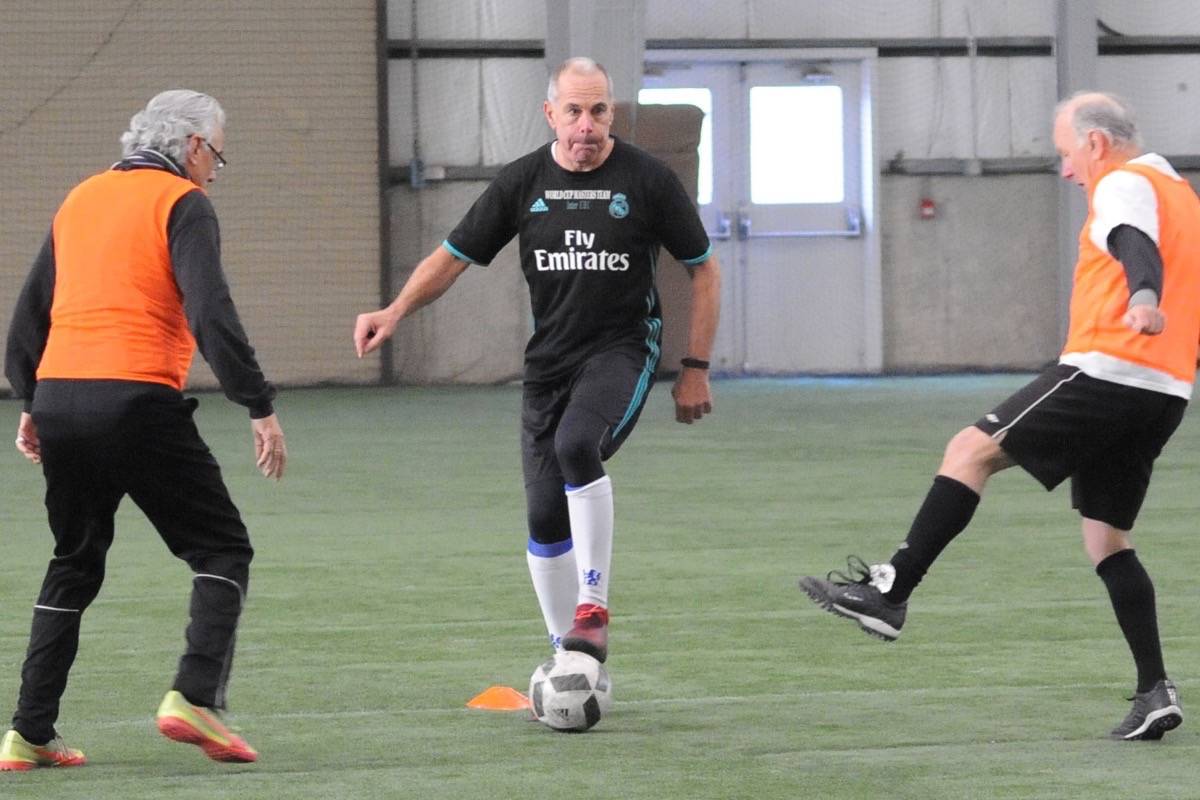
Photo: Michael Briones via Vancouver Island Free Daily.
Vancouver Island Walking Soccer Alternate’s Rob Jonas (left) and Bob Unwin try to stop Harry Hubbal of UBC Masters.
The second time my neighbor Ralph broke his leg playing pick-up soccer with other old folks, he decided maybe it was time to give it up. But he loved playing the game. Giving it up was going to be hard.
Wait! There’s hope for people like Ralph! Meeri Kim describes the interesting alternative at the Washington Post.
“Aside from his wife, soccer is the love of Gary Clark’s life. He started playing at age 7 and kept it up for more than four decades, even representing his home country Canada at the international level.
“His involvement in the sport, though, was cut short at age 48, following a knee replacement surgery. When Clark asked about getting back on the field, his doctor told him to go ahead — but only if he wanted another knee replaced.
“He dipped his toe in the water by joining a pickup game and tore the cartilage in his other knee.
“ ‘There was a sense of loss at not being able to go out and partake in my passion,’ said Clark, now 68, of Coquitlam, B.C. ‘And I knew that if I tried, I would injure myself again.’ …
“The game requires rapid accelerations, decelerations, turns and stops, which take a toll on players’ knees and ankles. A standard soccer pitch, at 115 yards long and 74 yards wide, is larger than an American football field. Players cover, on average, nearly seven miles, in a single match.
“So when a variant of the sport with no running allowed emerged in 2011, some laughed it off as a joke. Walking soccer, however, has become a global phenomenon.
“In 2011, Chesterfield FC Community Trust launched its walking football program in Derbyshire, England, as part of an initiative for older adults.
“Players can’t run or jog, with or without the ball, and one foot must be in contact with the ground at all times. Other rules also differ from regular soccer, to prioritize players’ health and safety. For example, tackling is only allowed with no contact; all free kicks are indirect; and the ball must never go over head height.
“Walking soccer is played on a smaller field (55 to 65 yards long, and 35 to 45 yards wide) and with six people on each team instead of 11.
“There are about 600 walking football clubs in England alone, for men and women.
“The country is also home to the international governing body for walking football, the Federation of International Walking Football Associations (FIWFA), which includes member organizations from countries such as Italy, Nigeria, Australia, South Korea and India. And the inaugural World Nations Cup — the equivalent of the World Cup for walking soccer — will take place in August in the United Kingdom.
“Clubs have cropped up in Seattle, Chicago, Southern California, Vancouver and a few other cities and regions in the United States and Canada. …
“ ‘I have lost weight playing, so I think that’s a good sign,’ said Clark, who has played with the Tri-City Walking Soccer Club for about a year. He logs up to 13,000 to 18,000 steps in a single game, but notes that most players average around 3,500 to 7,000 steps.
“George Gorecki, 62, started Walking Soccer Chicago in early 2019, after hearing about the sport from a U.K.-based friend. The Chicago resident used to play competitive amateur soccer with a club before arthritis in his left knee and right hip slowed him down. Many older members of Walking Soccer Chicago found themselves in the same boat — unable to play because of medical conditions. …
“ ‘The guys really took to it because they were able to reconnect with their teammates, both on the field and in a social setting after the game,’ Gorecki said. …
“Most studies on walking soccer have small sample sizes, but a 2020 review of research on the sport determined that it may have health benefits and help build social connections. A 2015 study found that 12 weeks of walking soccer, in the form of a two-hour training session per week, significantly reduced body mass and percentage body fat in 10 older men. Participants, with an average age of 66, had various comorbidities, including hypertension, knee osteoarthritis and Type 2 diabetes.
“The researchers concluded that walking football is safe and effective as a public health intervention — for not only healthy individuals but also those with various exercise-limiting medical conditions.
“Other research has focused on the mental and social aspects of the sport. In a 2022 study, seven men with mental health conditions such as depression or anxiety underwent a walking football intervention. It involved up to an hour playing a game, followed by an opportunity to meet and socialize. The men reported several positive effects on their well-being. They enjoyed socializing, developed new friendships and felt a renewed sense of purpose.” More at the Post, here.
I don’t know why I am chuckling my way through this story. I do think it’s a great idea for soccer lovers — maybe even less dangerous than pickleball.

 Suzanne's Mom's Blog