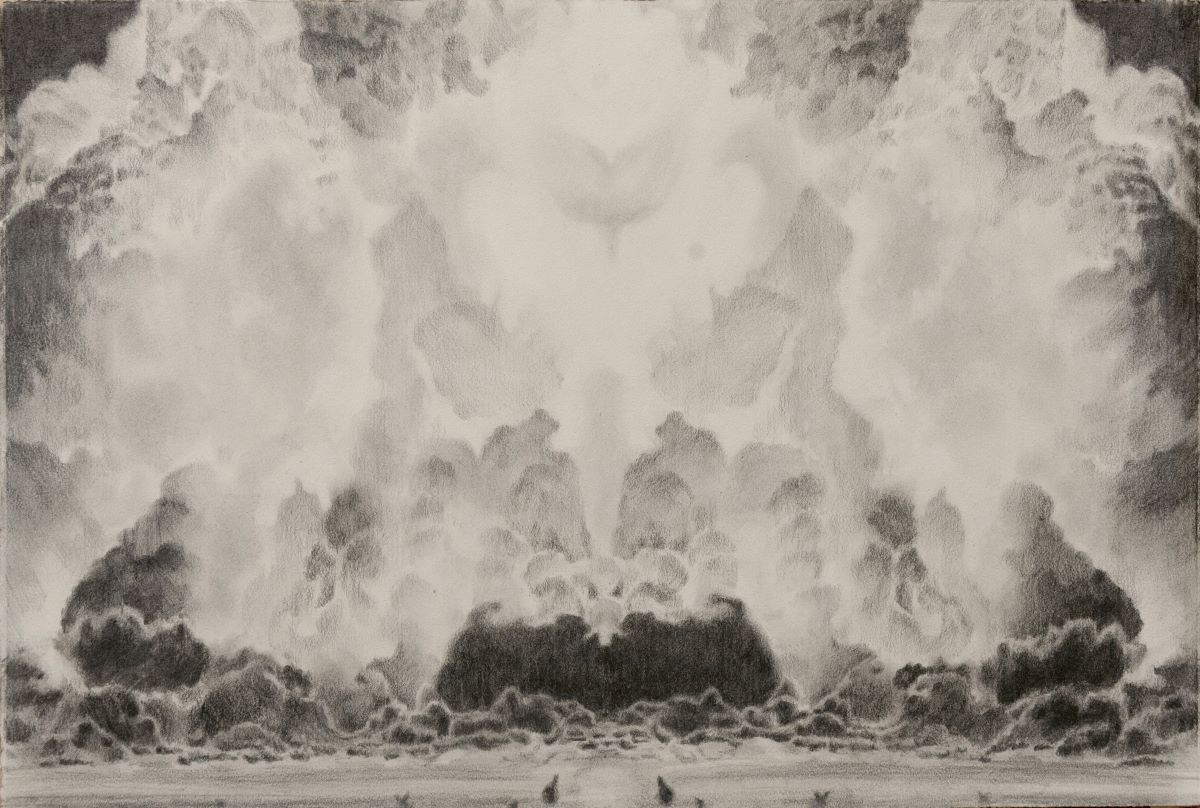
Art: Cara Despain via the gallery Current Work.
Increasing numbers of artists are addressing climate disasters, as in “test still no. 1 (Upshot-Knothole — Simon)” (2022), graphite on paper, above.
I always feel grateful to artists for the way they make the invisible visible to those of us who lack a second sight.
Hyperallergic recently posted an article about artists using ash and residue from natural disasters to convey their messages about the environmental calamity they perceive.
Reporter Scotti Hill gets a bit sidetracked by other environmental disasters in the Hyperallergic article, but I thought her words on the art itself were worth sharing.
“Many of us recall the haunting early pandemic-era imagery of individuals wandering amid orange, smoke-filled backdrops that synthesized the reoccurring horror of wildfires on the West Coast and beyond. Such images accompanied headlines of widespread home evacuations, wildlife loss, and blankets of smoke covering entire states.
“Now artists on a local and international scale are using their craft to bring attention to this issue, using a novel formal process — cultivating ash and residue from natural disasters, namely fires, as an actual medium of expression.
“Cara Despain’s work, which ranges from public installation to video and painting, confronts complex issues of wildfires, nuclear testing, and land use in her native Utah and beyond. Her latest exhibition, Ashes of Her Enemy, [has been] on view at new Salt Lake City gallery Current Work. …
“Upon encountering Despain’s photographs of beautiful landscapes, chosen by the artist for their similarity to famously iconic Western views like Monument Valley, one detects a scarring on the face of each image. Here, Despain devised a frame with a fuse inside that, when lit on one side, ripples across the image, burning the pristine image in its wake. She ignited each of the images at the exhibition opening for an active audience. To Despain, this process is a metaphor for the West’s changing landscape and the fallacy of pristine nature untouched by human intervention. …
“Despain’s wildfire paintings … are made from the soot of the wildfires that share their name. She crafted the works’ scale and composition to work in dialogue with large-scale Thomas Moran-style landscape paintings. …
“Despain is not the first artist to incorporate ash into her creative process. Artist Zhang Huan crafts large-scale paintings made from the ash residue of burned incense used in Buddhist temple ceremonies. By foraging ash from various temples around Shanghai, Huan sees the ash as symbolic of ‘the fulfillment of millions of hopes, dreams, and blessings,’ according to his website.
“In the months preceding the pandemic, Filipino artist Janina Sanico used ash from the active Taal Volcano in her watercolors, while German artist Heide Hatry incorporated cremated remains into darkly meditative portraits. …
“This fall, the Palo Alto Art Center debuted Fire Transforms, an exhibition featuring several Bay Area artists whose work considers the impact of fire in the area of the country most fraught by wildfire devastation. …
“Artist Andrea Dale forages the burnt remnants of plants and human-made structures left in the aftermath of California wildfires. Her application of ash draws inspiration from East Asian ink wash painting with an application that is at once loose and also sequestered to the bottom quarter of pristine resin-covered panels. New Mexico-based Nina Elder crafts intricately detailed drawings of decimated forests from the incinerated debris of pulp mills to ‘focus the viewer on the textures and scale of deforestation,’ according to her site.
” ‘We often look at big catastrophes, but it’s the small stuff that’s going to get us,’ [Despain] explained in an interview at Current Work of the particulate matter left behind after fires, often invisible yet enormously destructive. Despain emphasizes that fire is a natural part of environmental ecology, yet the increased prevalence and scale of wildfires is unprecedented and follows a decades-long history of nuclear testing. …
“For Despain, the story of the West’s atomic testing is personal — her mother grew up in Southern Utah’s Cedar City. Due to atomic testing, half of her high school class died early of various radiation-related ailments. … After the war, expansive areas of government-owned land north of Las Vegas were designated as optimal sites for domestic nuclear testing. [Residents] of Southern Utah’s Iron County received assurances that atomic testing was being carried out with utmost safety. Yet, in the years to come, those same residents would suffer startlingly high rates of cancer, birth defects, and adverse health issues. …
“Such histories often recede into the realm of whispers, relegated to the annals of history and individual familial tragedy. Yet, they are part of the indelible fabric of the West both past and present that are connected to the environmental calamity unfolding before us. Formally, artistic processes which imbue ash and residue visualize the otherwise infinitesimal markers of this legacy.”
More at Hyperallergic, here. No firewall. Contributions welcome.

 Suzanne's Mom's Blog