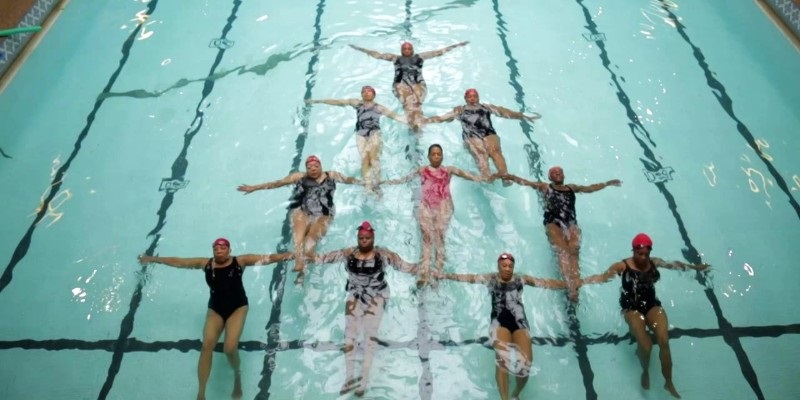
Photo: Harlem Honeys and Bears.
Formed in 1979, the Harlem Honeys and Bears Swim team teaches seniors ages 64 and over, how to survive in the water, as a therapy for chronic illness, and to promote health and wellness in general.
Reading today’s story about water ballet in Harlem, I am remembering how much I enjoyed the synchronized swimming class I took a long time ago. I still find the move called skulling useful in the water.
Laure Andrillon reports at the Washington Post about a senior group in Harlem that uses the practice for both socialization and health.
“Monica Hale recently turned 69,” writes Andrillon, “but she says she still feels like a youngster every time she dives, swims upside-down or practices the ‘barrel,’ a sophisticated move she usually attempts with a trusted synchronized swimming partner.
“Hale, who is Black, became fascinated with synchronized swimming as a child while watching the champion swimmer and movie star Esther Williams, a White woman, perform in water musicals on television. ‘She would do these fabulous turns and come up at the surface like a flower,’ Hale recalls. ‘I remember thinking, I want to do this one day. But you never saw Black people doing this. You never saw Black people very much in the water at all.’
Today, Hale is the proud captain of the Harlem Honeys and Bears, a synchronized swimming team for seniors 55 and older, whose current members are between 62 and 101 and almost exclusively Black.
“Like Williams, the Honeys and Bears create and perform what used to be called ‘water ballet’ — synchronized choreographed routines accompanied by music — in addition to competing in traditional swim races. But instead of Hollywood, Harlem is their home, and part of their mission is teaching younger Black swimmers. …
“It is a survival skill still deeply lacking in the African American community. … At their biweekly practices, Hale spends most of her time in the shallow end of the pool, teaching basic skills to recruits, some of whom don’t know how to swim when they join the team. She holds their hands while they submerge their faces in the water and cradles them while they learn to float on their backs. …
“The Honeys and Bears also hold monthly meetings to share ideas about how to spread the message that swimming can be learned by anyone, at any age. They find purpose in trying to bridge the racial gap that makes Black people of their generation less likely to swim than White seniors.
“Team members say synchronized swimming takes care of the body and the mind, and being part of a close-knit team is a way to work out and socialize at the same time. Their impressions are borne out by research, which finds that swimming offers a full-body workout that’s easy on injured or arthritic joints — a common problem for older people. It also de-stresses and burns calories, and it’s good for the heart.
“The Honeys and Bears perform at local pools, in other boroughs of New York and even out of state. Since the early 2000s, they have also traveled as a team to race individually during the state and national Senior Games, always sporting matching red sweatsuits. Some use a cane or a walker to access the pool deck, and sometimes employ a lift to slip into the water. But once they float in what they nickname their ‘fountain of youth,’ they feel more capable than when on land.
“The Honeys and Bears started gathering at the ‘bathhouse,’ an old name for what is now called the Hansborough Recreation Center, in 1979. … It was their way, they say, of reclaiming the swimming pool, a place where many team members did not feel welcome or comfortable for most of their lives.
“Some migrated to Harlem from states where interracial swimming was not allowed until the Civil Rights Act outlawed segregation in public spaces in 1964. Others grew up in New York, where pools were not officially segregated, but ‘a de facto racially segregated use was in place,’ historian Jeff Wiltse writes in Contested Waters: A Social History of Swimming Pools in America.
“ ‘When I was a little girl, my brother and I would go to the pool on colored days,’ explains Rasheedah Ali, 87, a member of the team who lived in Cincinnati before moving to Harlem in 1967. …
” ‘Of course, we need to remember our past,’ she says. ‘But we should also tell the story of whom we became — a bunch of joyful Black elders who thrive in the water.’
“Born and raised in Harlem, Gerterlyn Dozier, 89, remembers swimming in the late 1930s at what was then called Colonial Park on 146th Street, instead of the Thomas Jefferson pool on 111th Street, just a few blocks from her building. ‘If you had dark skin, it was too dangerous for you to wander’ near the closer pool, she says, because of hostile White neighbors. …
” ‘[Today] we make it a party,’ says Dozier with a burst of youthful laughter. ‘Hopefully, our kids will feel like they belong in this space and this sport. And by the time the next generation comes, the statistics will have changed.’ ”
More at the Post, here, and at Columbia Community Service, here.

 Suzanne's Mom's Blog