Feeds:
Posts
Comments

Posts Tagged ‘water conservation’

Photo: Roberto Nutlouis.
Danielle Kaye builds a berm spillway on the farm of Roberto Nutlouis. The berm holds back water, flooding the cornfield behind it. Navajos are using ancient ways to restore parched earth.

In their eagerness to invent, humans seem to be programmed to forget why ancient ways worked. Then they have to reinvent the wheel. Fortunately, indigenous people often are repositories of that wisdom and can produce it as needed.

Lela Nari writes at YaleEnvironment360, “Here in Burnt Corn Valley, smack in the middle of the Navajo reservation’s vast Black Mesa region, the hilly land both craves water and is brutalized by it. The sandy Arizona soil cracks under a punishing August sun as red-striped blister beetles search for moisture across its baked surface. Cottonwood trees and sagebrush rise from deep gullies carved by floodwaters that, during the intensifying summer monsoon, sluice off surrounding mesas and wash away fragile topsoil — reminders that with climate change, even quenching rains harbor powers of destruction.

“This portrait of climatic havoc belies a softer reality, though. Farming once thrived in this parched region and could once again — if the right practices are adopted. Exhibit A: The crops on Roberto Nutlouis’s 12-acre Sliding Rock Farm, in his reservation hometown of Piñon, a five-hour drive north of Phoenix.

“ ‘The corn is actually pretty big and thriving,’ Nutlouis says. He believes — and both Western science and the lived experience of his Native elders affirm — that the traditional rock and stick structures he’s built on his property, which help store water and prevent erosion, have a lot to do with it.

“These structures, similar to those used by Native peoples long before Europeans arrived on the continent, are not only delivering water to crops. … They are also restoring Nutlouis’s watershed and those of his neighbors, helping to sequester carbon, and reviving this high-desert ecosystem. It’s all part of a bigger effort among a range of local and regional grassroots organizations to build back the reservation’s fragile, depleted ecosystems and bring greater sovereignty over food, water, and health to its communities.

“Diné (the Navajo name for themselves) are well aware that climate change is making the weather on their semi-arid plateau weirder, wilder, and more destructive. … The ecological health of the reservation has also been weakened by deforestation from timbering operations and from overgrazing over the years.

“Still, this season, Nutlouis, 44, has been able to skip his usual two-hour roundtrip drive to a reliable well to haul water home for his corn. His crop is healthy and hydrated because his land still holds last winter’s snowmelt. Clearly, his heavy labor over the past 20 years — during which he has built woven brush dams, gabions (wirework cages filled with rocks), earthen berms, concrete spillways and trenches, limestone aprons and walls, and stone-lined ‘Zuni bowls,’ which stabilize eroding streambeds — is paying off.

“Diné and others living in arid zones around the world have long used structures made of naturally occurring materials to capture and control water to grow crops and to mitigate the devastation of floods in ephemeral stream systems. …

“Time and again over the last 15 years, Laura Norman, a research scientist with the U.S. Geological Survey, has seen evidence that when these structures — which Norman calls Natural Infrastructure in Dryland Streams, or NIDS — are placed in gullies, they slow water to mitigate erosion, collect nutrient-rich sediment and plant debris that nourish both crops and wild plants, help store carbon, improve groundwater recharge, and increase downstream water availability by as much as 28 percent. ‘It’s a snowball effect that counters degradation, and you get all of these ecosystem services,’ she says.

“The structures on Nutlouis’s farm are integral cogs in a larger system. … Nutlouis’s property lies in an alluvial fan, where mineral-rich sediments and plant waste atop mesas and other uplands wash down onto flatter ground with rainwater, snowmelt, and spring water. Across the valley, similar farms rely on this kind of system, many of which feature stone and stick constructions that Nutlouis helped build. The organic materials trapped behind the structures, says Jonathan Sandor, an emeritus agronomy professor at Iowa State University, ‘are a major input into keeping the fertility of the soils up.’ …

“Whether rock walls or ramps, hand-dug depressions in the soil, earthen walls, or branches plaited into dams, NIDS splash water over a wider area and slow its flow so it can better soak into the soil. Many trap sediments behind them, fertilizing whatever grows nearby. The stone structures create a hyperlocal cooling effect, especially when they’re combined with shade-making vegetation.

“Here, too, smallness is a boon. ‘Even tiny little one-rock dams can make big changes on the landscape,’ Norman says. …

“Lately, climate change has thrown extra challenges at the reservation. … But the ecosystem services provided by Nutlouis’s structures on his farm and elsewhere do seem to be meeting those climatic challenges. He’s noticed small juniper trees popping up on hillsides around his property despite the dryness; A cottonwood tree towering over one cornfield is also lush and full. ‘The idea that Earth will restore itself with natural seed dispersal’ after NIDS begin to do their job ‘has been my observation,’ says Norman.

“Or as Nutlouis puts it, ‘We’re allowing nature to do its own thing and restore itself.’ ”

More at Yale e360, here. Fascinating pictures. No firewall.
Read Full Post »

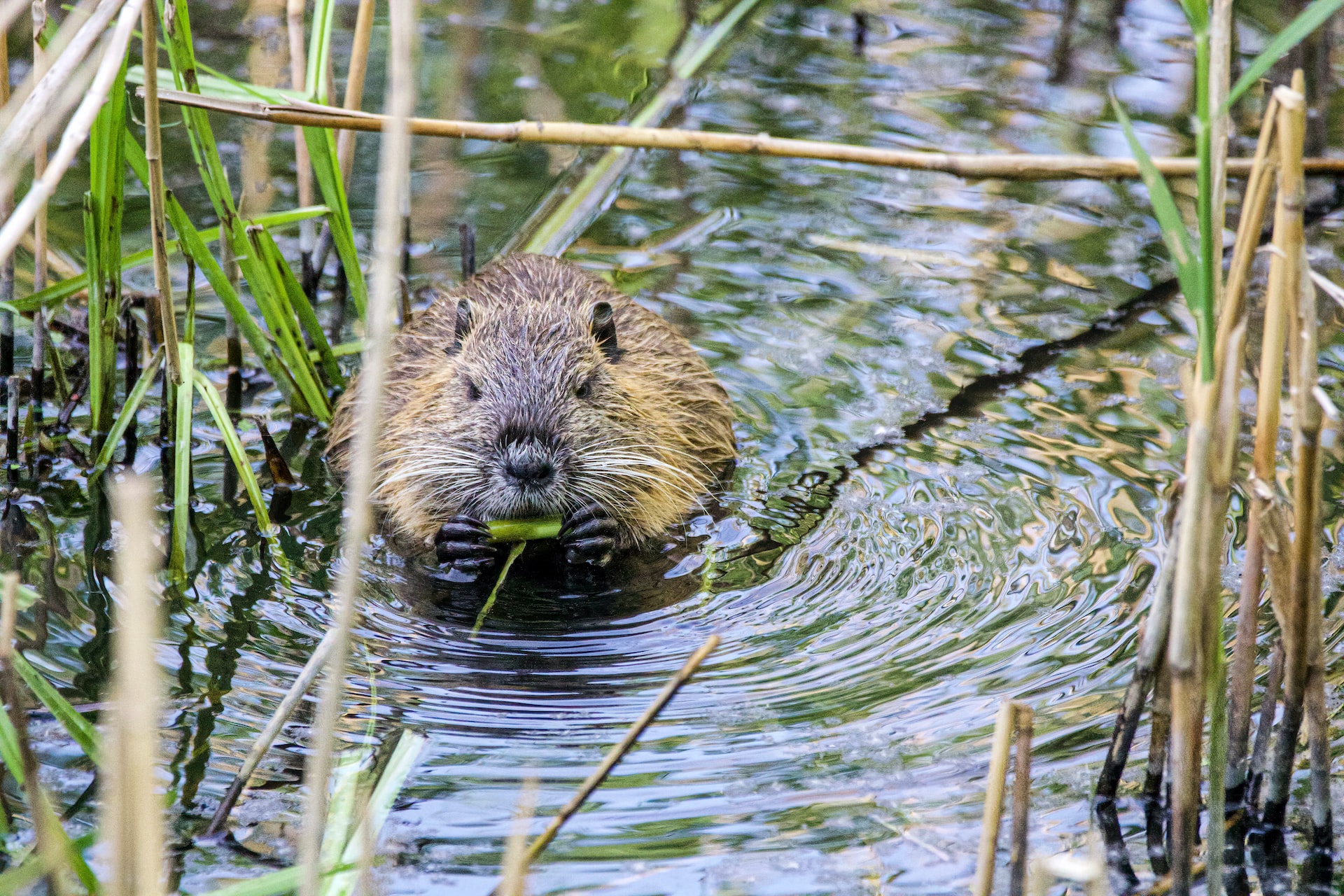
Photo: Svetozar Cenisev/ Unsplash.
When vegetation that beavers flood is dying, neighbors object to the smell. But often they like the lake that comes later.

There was a woman in my town who was up in arms about beavers flooding part of her property to build a dam. That is, she was angry until the odor of dying grasses dissipated and a beautiful lake appeared.

According to Catrin Einhorn at the New York Times, farmers out West are finding other reasons to appreciate the work of beavers.

She reports, “Horace Smith blew up a lot of beaver dams in his life. A rancher here in northeastern Nevada, he waged war against the animals, frequently with dynamite. Not from meanness or cruelty; it was a struggle over water. Mr. Smith blamed beavers for flooding some parts of his property, Cottonwood Ranch, and drying out others.

“But his son Agee, who eventually took over the ranch, is making peace. And he says welcoming beavers to work on the land is one of the best things he’s done.

“ ‘They’re very controversial still,’ said Mr. Smith, whose father died in 2014. ‘But it’s getting better. People are starting to wake up.’

“As global warming intensifies droughts, floods and wildfires, Mr. Smith has become one of a growing number of ranchers, scientists and other ‘beaver believers’ who see the creatures not only as helpers, but as furry weapons of climate resilience.

Last year, when Nevada suffered one of the worst droughts on record, beaver pools kept his cattle with enough water.

“When rains came strangely hard and fast, the vast network of dams slowed a torrent of water raging down the mountain, protecting his hay crop. And with the beavers’ help, creeks have widened into wetlands that run through the sagebrush desert, cleaning water, birthing new meadows and creating a buffer against wildfires.

“True, beavers can be complicated partners. They’re wild, swimming rodents the size of basset hounds with an obsession for building dams. When conflicts arise, and they probably will, you can’t talk it out.

“Beavers flood roads, fields, timber forests and other areas that people want dry. They fell trees without a thought as to whether humans would prefer them standing. In response to complaints, the federal government killed almost 25,000 beavers last year.

“But beavers also store lots of water for free, which is increasingly crucial in the parched West. And they don’t just help with drought. Their engineering subdues torrential floods from heavy rains or snowmelt by slowing water. It reduces erosion and recharges groundwater. And the wetlands beavers create may have the extra benefit of stashing carbon out of the atmosphere.

“In addition to all that, the rodents do environmental double duty, because they also tackle another crisis unleashed by humans: rampant biodiversity loss. Their wetlands are increasingly recognized for creating habitat for myriad species, from salmon to sage grouse.

“Beavers, you might say, are having a moment. In Colorado, Idaho, Montana, Nevada, Oregon, Utah and Wyoming, the Bureau of Land Management is working with partners to build beaver-like dams that they hope real beavers will claim and expand. In California, the new state budget designates about $1.5 million a year to restoring the animals for climate resiliency and biodiversity benefits.

“ ‘We need to get beavers back to work,’ Wade Crowfoot, California’s secretary of natural resources, said in a webinar this year. ‘Full employment for beavers.’ (Beaver believers like to note that the animals work for free.) …

“Instead of killing beavers, the federal government should be embracing them as an important component of federal climate adaptation, according to two scientists who study beavers and hydrology, Chris Jordan of National Oceanic and Atmospheric Administration Fisheries, and Emily Fairfax of California State University Channel Islands.

“ ‘It may seem trite to say that beavers are a key part of a national climate action plan, but the reality is that they are a force of 15-40 million highly skilled environmental engineers,’ Dr. Jordan and Dr. Fairfax wrote this year in a perspective article in the research journal WIREs Water. …

“When human-beaver conflicts arise, they can be addressed without killing the animals, experts say. Paint and fencing can protect trees from gnawing. Systems like the Beaver Deceiver secretly undo their handiwork with pipes that drain water from beaver settlements even when the animals keep building. Such measures are actually a more effective solution than removing the animals, according to advocates, because new beavers tend to move into empty habitat.

“If coexistence is impossible, a growing number of groups and private businesses are seeking to relocate, rather than kill, nuisance beavers.

“ ‘We put the nuisance in air quotes,’ said Molly Alves, a wildlife biologist with the Tulalip Tribes, a federally recognized tribal organization just north of Seattle that moves unwanted beavers to land managed by the United States Forest Service.

“The group’s impetus was a desire to expand the extraordinary habitat that beavers offer salmon, a culturally and economically important species. When they started in 2014, the Tulalip Tribes had to invoke their sovereign treaty rights to relocate beavers because doing so was illegal in their area under Washington State law. After a lobbying push, beaver relocation is now legal statewide and the tribes are advising state officials on a program to train others in best practices.”

More at the Times, here. Hat tip: John.

Read Full Post »

Following up on my 2012 post about fairy circles.

Rachel Nuwer writes at the NY Times, “When Stephan Getzin, an ecologist at the Helmholtz Center for Environmental Research in Leipzig, Germany, opened the email, his heart began to flutter. Attached was an aerial image of fairy circles, just as he had seen in countless photos before. But those images were always taken along long strips of arid grassland stretching from southern Angola to northern South Africa. These fairy circles — which looked nearly identical — came from Australia, not Africa. …

“The emailed photo came from Bronwyn Bell, who does environmental restoration work in Perth. She had read about Dr. Getzin’s research in Namibia and made a connection to the odd formations in her home state, Western Australia. …

“Scientists have been interested in fairy circles since the 1970s, but have not been able to agree on what causes the patterns to form. Researchers generally fall into two groups — team termite and team water competition — but there are other hypotheses as well, including one involving noxious gases.

“Dr. Getzin, like others on team water competition, explains the circles through pattern-formation theory, a model for understanding the way nature organizes itself. The theory was first developed not by biologists, but by the mathematician Alan Turing. In the 1990s, ecologists and physicists realized it could be tweaked to explain some vegetation patterns as well. In harsh habitats where plants compete for nutrients and water, the new theory predicts that, as weaker plants die and stronger ones grow larger, vegetation will self-organize into patterns …

“In the case of African fairy circles, the bare patches act as troughs, storing moisture from rare rainfalls for several months, lasting into the dry season. Tall grasses on the edge of the circles tap into the water with their roots and also suck it up with the help of water diffusion through the sandy soil.

“Although similar in appearance, Australian fairy circles turn out to behave differently, Dr. Getzin and his colleagues have found. … Aussie circles feature a very hard surface of dry, nearly impenetrable clay, which can reach up to a scalding 167 degrees during the day. Despite the differences, though, they believe the fairy circles’ function remains the same. When the researchers poured water into the circles in a simple irrigation experiment, it flowed to the edges, reaching the bushy grass …

“The new research ‘moves us closer toward a unifying theory of fairy circle formation,’ said Nichole Barger, an ecosystem ecologist at the University of Colorado, Boulder.

“It could be that more fairy circles are yet to be discovered in arid environments around the world, she said.

“According to Walter Tschinkel, an entomologist at Florida State University, the findings strengthen the claim that the circles are a result of self-organization by plants. He cautioned, though, that to be more certain, scientists would need to control environmental factors — water and termites, for example — to see which produce the predicted outcome.”

More here.

Photo: Norbert Jürgens
Tracks of Oryx antelopes crossing fairy circles in Namibia.

Read Full Post »