Feeds:
Posts
Comments

Posts Tagged ‘welsh’

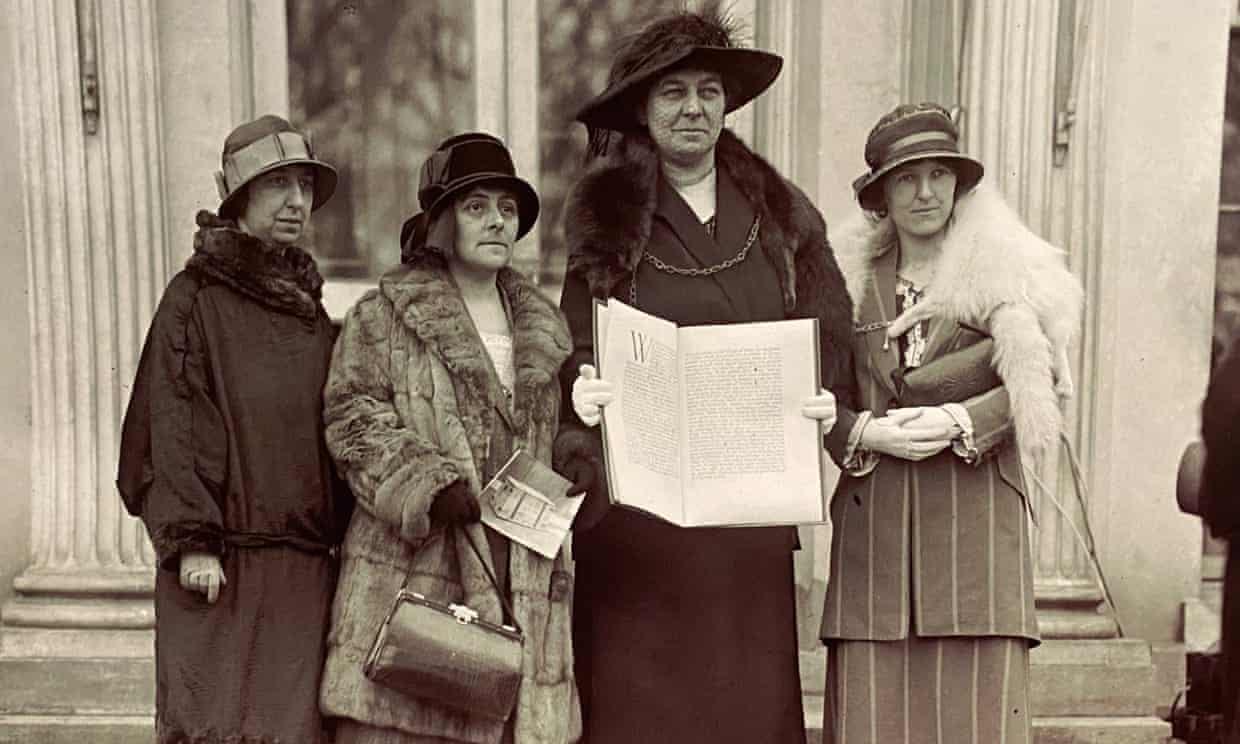
Photo: WCIA [Welsh Centre for International Affairs].
Annie Hughes-Griffiths holds the women’s peace appeal outside the White House in 1924 after a meeting with President Coolidge, with (from left) Gladys Thomas, Mary Ellis and Elined Prys. 

There are so many great initiatives by women that take years to get broad recognition because, at the time, they weren’t highly valued. That’s why I love sharing them now.

Steven Morris covered today’s example for the Guardian.

“There were tears of joy, speeches of hope and sighs of relief that all had gone smoothly after an extraordinary century-old document – reputedly seven miles long – completed its transatlantic trip back to Wales.

“The peace petition, signed by almost three-quarters of all Welsh women in the 1920s but forgotten until the last few years, arrived at the National Library of Wales [in April] after being gifted to the country by the National Museum of American History in Washington.

“Over the coming weeks and months, the reams of sheets will be taken carefully out of the hefty oak chest where they are stored, then digitized at the library in Aberystwyth, before a crowd-sourcing exercise takes place to transcribe all 390,296 signatures and addresses.

Prof Mererid Hopwood, the chair of the Peace Petition Partnership, said she was so excited she could hardly breathe and, though it was an overcast day in Wales, quoted the Welsh phrase mae’r haul yn gwenu – the sun smiles.

” ‘Actually, I think the sun’s practically chuckling with joy in Aberystwyth today. We are so very delighted,’ she said.

“In 1923, galvanized by the horrors of the first world war, a group of Welsh women decided to organize a campaign for world peace.

“During a Welsh League of Nations Union (WLNU) conference at Aberystwyth University, they agreed that the best way would be to appeal to the women of the US to work with them for a world without war. Two paid officers and 400 local organizers set about collecting names from every community in Wales.

“In 1924 the Welsh delegation, led by Annie Hughes-Griffiths, the chair of the WLNU, crossed the Atlantic with the petition and worked with American women such as the women’s rights campaigner Carrie Chapman Catt to disseminate their message.

“They received an enthusiastic welcome and travelled through the US addressing audiences. The US press claimed that if the signature sheets were laid end to end they would go on for 7 miles.

“However, over the years the petition was forgotten, until a mysterious plaque mentioning it was uncovered at the time of the centenary of the first world war in Cardiff’s Temple of Peace.

“ ‘It was a lost story, a hidden story,’ said Hopwood, a poet and the chair of Welsh and Celtic studies at Aberystwyth University. She said the idea of returning the petition to Wales was both to remind people of its amazing story and to inspire people today to campaign for peace.

“Hopwood pointed out that Wales has a history of its citizens working for peace, including … the women who marched from Wales to Greenham Common in Berkshire in 1981 to protest against nuclear weapons. …

“The Welsh deputy minister for arts and sport, Dawn Bowden, said it was an inspiring document: ‘I hope that the return of the petition to Wales will inspire and motivate a new generation of advocates for peace.’

“Dafydd Tudur, the head of digital services at the National Library of Wales, called it an ‘historic’ day.

“He said he hoped a pilot of the crowd-sourcing exercise would take place in the autumn, before fully beginning next year. An exhibition will be organized to present the chest and petition at three locations – Aberystwyth, St Fagans in south Wales, and Wrexham in the north.

“Tudur studied modern Welsh history but had not heard of the petition until the plaque was found. ‘It was forgotten. People are amazed when they hear about it,’ he said.” More at the Guardian, here. No firewall.

For more on the peace agenda, click here on an article co-authored by my friend Ann Tickner. The article examines “feminism in international relations from the emergence of women’s peace pragmatism during WW I to the development of the United Nations (UN) Women, Peace, and Security (WPS) agenda a century later. … We show how the principles articulated by women peace activists at the 1915 Hague Conference represent distinct contributions to the discipline.”
Read Full Post »

200331092911-02-wild-goats-wales-coronavirus-exlarge-169

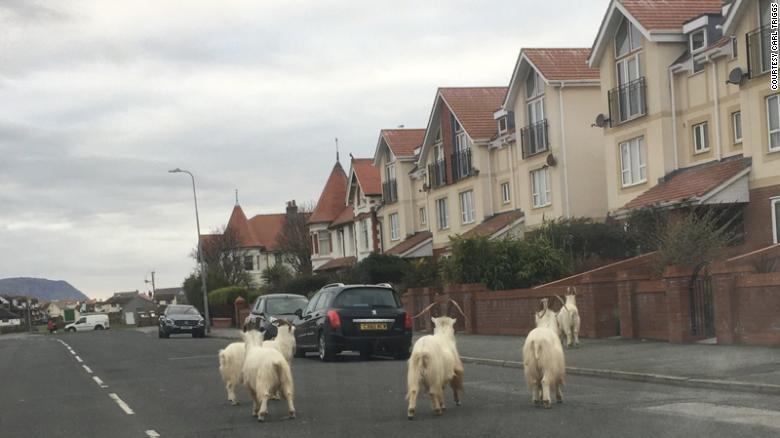
Photo: Carl Triggs
Wild Kashmiri goats pay a visit to a newly empty Welsh town. “The goats live on the hill overlooking the town. They stay up there, very rarely venturing into the street,” a resident told CNN.

They say that Nature abhors a vacuum, but I doubt anyone was thinking of this. In a Welsh town under quarantine, wild Kashmiri goats decided it was safe to check things out.

Aleesha Khaliq writes at CNN, “A coastal town in north Wales has found a whole new meaning to the phrase herd immunity, after goats were spotted roaming its quiet streets.

“It comes just days after British Prime Minister Boris Johnson introduced tighter restrictions around social movement last week in a bid to limit the spread of coronavirus.

“Residents spotted herds of goats strolling around Llandudno on Friday and over [last] weekend, after more than a dozen of the animals ventured down from the Great Orme headland and roamed the streets of the coastal town. …

“They are referred to as Great Orme Kashmiri goats, whose ancestors originated from northern India, according to the town’s official website.

“Town resident, Carl Triggs, was returning home after delivering personal protective equipment masks when he saw the goats. ‘The goats live on the hill overlooking the town. They stay up there, very rarely venturing into the street,’ he told CNN. …

“Mark Richards, from hotel Lansdowne House, told CNN: ‘They sometimes come to the foot of the Great Orme in March but this year they are all wandering the streets in town as there are no cars or people.’ …

“Local councilor Penny Andow told CNN she has lived in the area for 33 years and has never seen the goats venture from the Great Orme down into the town. …

“However, the [police] force said it was ‘not that unusual in Llandudno. … They usually make their own way back.’ ” More here.

The town’s website has lots more: “The first intimation of Llandudno Goat – Latin name, Capra Markhor, is the rank odour. It is strong, musty and compelling (a bit stinky). … The creatures eat with discrimination. Delicately nibbling the juiciest berries, whilst carefully avoiding the thorns. …

“All goats have their own peculiarities, and it is possible to identify individuals. One billy, in particular, is easily recognisable. He is smaller than the others, and has a longer, shaggier coat. This goat is an outsider. He is one of three goats introduced into the herd from Whipsnade Zoo.

“It was not a very successful experiment. The first goat died within weeks of arrival. The second decided that he was probably not a goat, but a sheep. He mixed quite happily with the flock, until, unfortunately, he fell off a cliff and was killed. This is very unusual, as goats are extremely sure footed. The third goat survived, and eventually became accepted by the herd.”

You know what I would like to see walking through town: a moose. I have always wanted to see a moose that wasn’t just in a zoo. What would you like to see? Mythological beasts permissible.

Read Full Post »

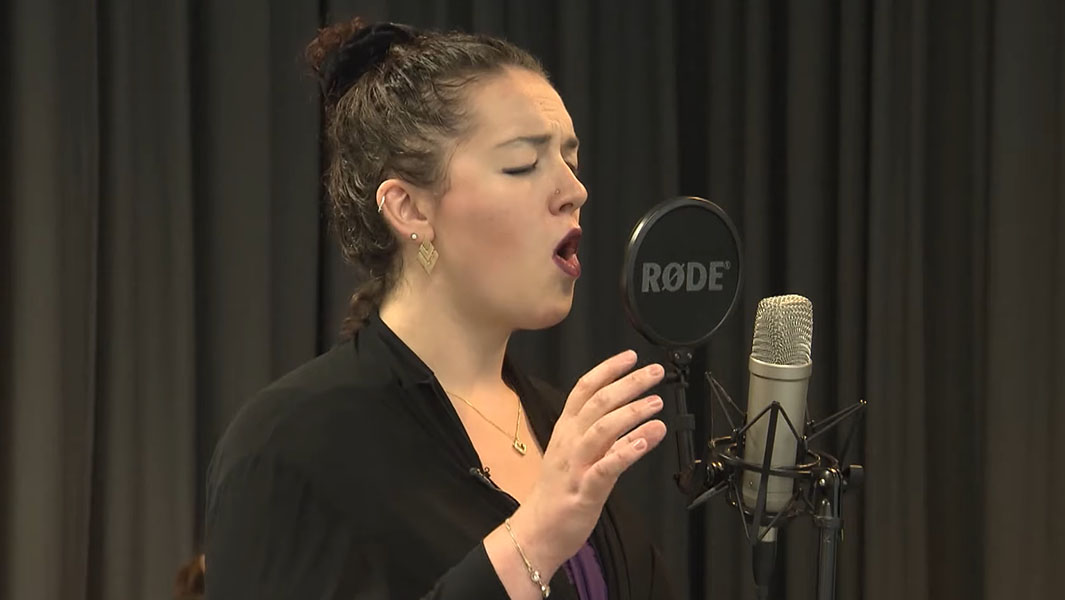
lowest-vocal-note-header_tcm25-584243Photo: Guinness World Records
Helen Leahey, a Welsh musician living in Germany, recently broke the record for the lowest vocal note (female).

Hello, friends, are you ready for another story on the unusual world records that adventurous humans can’t wait to break? (Remember this one on a poetry recitation in 111 languages and this one on running backwards?)

Well, let me introduce you to Helen Leahey, the “Bass Queen.”

Connie Suggitt writes at the Guinness World Records website that Leahey “sang from a D5 to a D2 note at an incredibly deep 72.5 hertz(es) in her attempt at the Music School Wagner in Koblenz, Germany.

“Helen, originally from St Asaph in Wales but now living in Germany, has recently returned to singing after the birth of her first child. …

” ‘I have been encouraged for some years to pursue a musical career professionally, in part because of my unique voice,’ Helen explained. ‘Everywhere I sing, I hear that nobody has heard a woman who can hit the low notes like me. I guess I wanted to see how unique my voice truly is.’ …

“During her attempt, Helen had eight industry professionals present, including qualified music teachers and sound engineers. Her witnesses were Tatjana Botow, a singing teacher, and Elmar Wald, a sound engineer. …

“After a couple of attempts, sound engineer Tobias Jacobs confirmed Helen had achieved the record-breaking low note. …

“Helen’s naturally deep voice has helped define and shape her music career, as has Celtic roots. In her songs, many instruments can be heard, including the guitar, Irish bouzouki, harmonica and the Irish drum (Bodhrán). …

” ‘When I play music, there is no filter, nothing, nowhere, where I can hide. Singing my own songs in front of an audience is incredibly humbling and intimate,’ Helen says on her website.” More at Guinness, here.

I have known women in a cappella groups who have deep enough voices to sing the bass line, but this takes the cake.

Read Full Post »

The last time I checked into the always intriguing website This Is Colossal, I followed a link to My Modern Met, where Katie Hosmer writes about a trampoline that people are bouncing on in the Llechwedd slate caverns of Wales.

“This underground labyrinth of netting is a giant trampoline playground set inside a slate quarry cavern in the Welsh mining town of Blaenau Ffestiniog. Developed by Zip World, Bounce Below [offers] visitors a playful experience deep beneath the surface of the earth.

“The tourist attraction features three giant trampolines suspended across the cave, ranging from 20 feet to 180 feet high. Ten foot net walls prevent people from climbing out, while walkways connect the trampolines, and slides offer an easy way to exit. As visitors jump around, the walls of the surrounding cavern are illuminated with glowing blue, green, pink, and purple lights.

” ‘We got the idea when my business partner saw this done in woods in France but this has never been done in a cavern, this really is a world first in Wales,’ says Sean Taylor, owner of Zip World. ‘It’s a one hour activity where customers get dressed up in a cotton overall and given a helmet; they then jump on a train and travel inside the mountain.’ ”  More crazy pictures at My Modern Met, here.

How do you keep ’em down in the bouncy house after they’ve seen cave trampolining?

Photo: My Modern Met

Read Full Post »