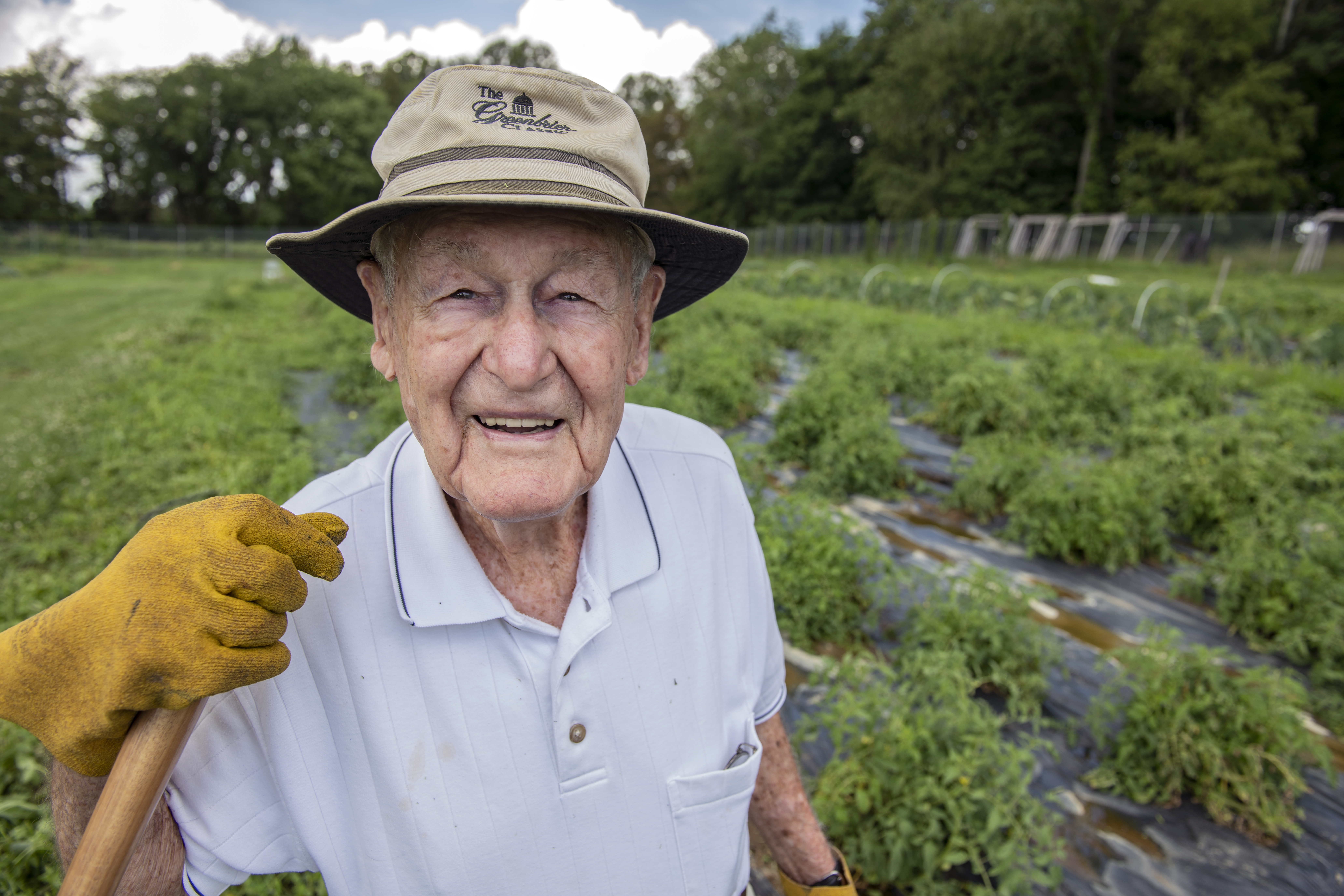
Photo: West Virginia University.
Mannon Gallegly, WVU plant pathology professor emeritus, has created four tomato varieties, including his last, “Mannon’s Majesty,” free to West Virginians.
For a short time in my childhood, I was a member of a 4-H club and won a $0.75 check for a tomato that my father really grew — a check I failed to cash before it expired!
I still love tomatoes. This is the time of year for gorgeous tomatoes. Ashley Stimpson writes at the Washington Post about the 101-year-old West Virginia professor who brought four special varieties into the world, including one he made free to West Virginians.
“You may not have heard of Mannon Gallegly, but chances are you’ve eaten one of his tomatoes, and perhaps even grown one in your garden. More than 60 years ago, Gallegly bred the first tomato that could stand up to Phytophthora infestans, otherwise known as tomato blight. The West Virginia ’63, sometimes called ‘the people’s tomato,’ is still a seed-catalogue superstar and beloved around the world, gracing gardens from Alabama to Africa.
“This year marks the first time since 1949 that Gallegly, who moved into a nursing home after falling ill in the spring, has missed the annual planting. … This morning’s planters are a mix of graduate students from WVU’s Davis College of Agriculture — where Gallegly worked for 38 years — and volunteers who have known the plant pathologist for decades. Gallegly developed three more hardy tomato varieties since 1963, each of which has claimed a spot in this year’s field, including his latest and likely his last.
“After the college publicized the release of the tomato, called Mannon’s Majesty, earlier this year — noting that it was free for any West Virginian who wanted seeds, per Gallegly’s insistence — WVU’s greenhouse manager Whitney Dudding came to work the next Monday morning to find 2,000 email orders waiting in her inbox, a number that far outstripped availability. …
“Until very recently, Dudding held out hope Gallegly might make it to the organic farm for the occasion. … ‘Every year, even last year, he’s been out there on the soft soil, out there in the heat, walking around, right there with us,’ she says. ‘I really don’t know how he does it.’
“The son of a carpenter and a school dietitian, Gallegly grew up in the rural southwest corner of Arkansas. ‘We were pretty poor people,’ he says. During the Great Depression, his parents grew cotton on rented land, where Gallegly logged the first of many hours spent walking between crop rows.
“A teacher from Future Farmers of America inspired Gallegly to attend college, and a Sears Roebuck scholarship made it financially feasible. After graduating from the University of Arkansas with a degree in agriculture, Gallegly went to the University of Wisconsin to get his master’s in plant pathology, working on a rice disease called white tip.
“In June 1949, Gallegly arrived in Morgantown. … ‘That was my favorite month,’ he recalls. ‘I had a new job, I had a new wife, I had a new baby.’ He also had a new three-acre research farm on the grounds of the nearby medium-security prison, where he could conduct trials on plant diseases, including tomato blight.
“By the following summer, Gallegly’s fields swayed with potato and tomato plants of all different varieties. Then disaster struck. ‘The disease farmers and gardeners feared most’ arrived, he says: late blight. The pathogen leaves ugly brown bruises stretching across the leaves, stem and fruit until the plant looks like it’s been blasted with a blow torch.
“That year, Gallegly lost nearly his entire crop of tomatoes to late blight — except for a few wild varieties with tiny fruit that showed a curious resistance to the disease.
“In the 1950s, late blight was more than just an annoyance for the home gardener. In the right conditions, Phytophthora infestans, which is Greek for ‘plant destroyer,’ can wipe out entire food supplies, as it did during the 1840s, when about 1 million people starved during the Irish Potato Famine. …
“For 13 years, Gallegly worked on developing an indestructible tomato, crossing those initial wild varieties that showed genetic resistance to blight with popular commercial tomatoes. …
“Finally, he stumbled upon a variety that was both blight-resistant and delicious. ‘Good things happen sometimes,’ he says.
“Gallegly, who primarily views himself as a public servant, called his creation ‘the people’s tomato.’ When it was released to the public in 1963 as part of the state’s centennial celebration it was given a new name: the West Virginia ’63. …
“Gallegly retired in 1986, but that didn’t stop him from coming into work every day. …
“In addition to writing books and breeding tomatoes, Gallegly has mentored countless plant pathologists getting their start in Morgantown. Dudding, who has helped Gallegly with cultivating diseases (to test for resistance in plants) and crossbreeding, ‘because my hands were smaller and steadier than his,’ says the scientist ‘is never in a hurry. He has always had time to talk to me and teach me.’
“WVU graduate student Inty Hernández, who’s been working with Gallegly on breeding new tomatoes, agrees, saying: ‘He’s very supportive all the time. It has been very inspiring to work with him. Sometimes you feel tired, you know, and then you arrive to the greenhouse and there’s a 100-year-old man hard at work.’ ”
More at the Post, here. Is your garden producing tomatoes right now?


 Photo: Jason Margolis

 Suzanne's Mom's Blog