Feeds:
Posts
Comments

Posts Tagged ‘whale’

Photo: Nick Ut / AP.
A blue whale, the largest mammal on Earth, surfaces in the Pacific Ocean near Long Beach, California.

Whether we’re talking about Jonah and the whale or Pinocchio or the lobster fisherman’s uncomfortably close encounter in 2021, we humans have always been fascinated by the largest mammals on Earth. And the blue whale is the most massive of them all. But what is going on with Leviathan of late?

Shola Lawal writes at Al Jazeera that it is not singing as much as it used to.

“Unlike our musical sounds, those produced by whales are a complex range of vocalizations that include groans, clicks and whistles and that can sound like anything from the mooing of a cow to the twitter of a bird. These vocalisations can be so powerful that they can be heard as far as 10km (6 miles) away, and can last for half an hour at a time. …

“For researchers, these complex sounds are a window into whale behavior, even if humans don’t yet know exactly how to decode them.

“The frequency of songs and their intensity can signal various things: an abundance of food, for example. In recent studies, however, researchers have been alarmed to find that blue whales, the largest whales and, indeed, the largest mammals on Earth, have stopped singing at specific times.

“Their eerie quietness, scientists say, is a signal that ocean life is changing fundamentally. The most recent study, conducted by scientists from the Monterey Bay Aquarium Research Institute in California in the US and published in February, examined three types of whales. Researchers found that blue whales, in particular, have become more vulnerable to this change.

“Whale songs are critical for communication between males and females when mating and among schools of whales migrating. …

“The first study, conducted in the sea waters between the islands of New Zealand between 2016 and 2018, was led by scientists from the Marine Mammal Institute at Oregon State University in the US. Over that period of time, researchers tracked specific blue whale vocalizations linked to feeding (called D-calls) and mating (called patterned songs).

“Researchers used continuous recordings from underwater devices called hydrophones, which can log sounds over thousands of kilometers, and which were placed in the South Taranaki Bight – a known foraging spot for blue whales off the west coast of New Zealand.

“They discovered that during some periods, particularly in the warmer months of spring and summer when whales usually fatten up, the frequency and intensity of sounds related to feeding activity dropped – suggesting a reduction in food sources. That decline was followed by reduced occurrences of patterned songs, signaling a dip in reproductive activity.

” ‘When there are fewer feeding opportunities, they put less effort into reproduction,’ lead researcher Dawn Barlow told reporters. The results of that study were published in the journal Ecology and Evolution in 2023.

“Then, in a study published in the scientific journal PLOS One in February [2025] researchers tracked baleen whale sounds in the California Current Ecosystem, the area in the North Pacific Ocean stretching from British Columbia to Baja California. Blue whales are a type of baleen whale, and the study focused on them, alongside their cousins, humpback whales and fin whales.

“Over six years starting in 2015, the scientists found distinct patterns. Over the first two years, ‘times were tough for whales,’ lead researcher John Ryan, of the Monterey Bay Aquarium Research Institute in California, noted in a press statement, as the whales, particularly blue whales, were found to be singing less. Over the next three years, however, all three whale species were back to singing more frequently, the study noted.

“Both studies found one main reason for the reduction of whale song: food or, in this case, the lack of it. It turns out that the research, conducted between 2015 and 2020, captured periods of extreme marine heatwave events that killed off krill, the small shrimp-like animals that blue whales feed on.

“Those heatwaves are part of a looming environmental catastrophe … caused by high-emission human activities, chief among them being the burning of fossil fuels. …

“Krill, which blue whales primarily feed on, are highly sensitive to heat and can all but vanish during heatwaves, the studies found. Their movement patterns also change drastically: instead of staying together, as they usually do, krill disperse when it is hot, making them harder for predators like blue whales to find.

“Typically, when foraging, blue whales sing to others to signal that they have found swarms of krill. … Heatwaves can also trigger harmful chemical changes in the oceans that encourage the growth of toxic algae, which causes poisoning and death to mammals in the oceans and sea birds, researchers have previously found, suggesting that blue whales are also at risk of being poisoned.

“In the more recent study in California, researchers found that in the first two years when whales were singing less frequently, there was also a reduction in other fish populations. …

“ ‘Compared to humpback whales, blue whales in the eastern North Pacific may be more vulnerable due to not only a smaller population size but also a less flexible foraging strategy,’ Ryan, the lead author of the California study said in a statement. …

“It is likely, both studies say, that blue whales need to spend more time and energy finding food when it is scarce, instead of singing.”

At Al Jazeera, here, you read about climate change effects on other species, too.

Read Full Post »

Photo: Alex Hecht for the New York Times.
A team helps Hunter Noack and his piano travel to scenic locations to give his concerts an outdoor vibe.

What I’m wondering as I read today’s story about classical piano in the great outdoors is whether the project is more about bringing nature into the concert experience or about attracting new audiences. Doesn’t it draw traditional concertgoers? Besides the whale, that is.

Sopan Deb reports at the New York Times that “for the last decade, the classical pianist Hunter Noack has been embarking on an unusual journey: He hauls a thousand-pound 1912 Steinway concert grand piano to places in the outdoors not known for hosting concerts. …

“This summer, Noack, 36, is in the midst of a 10th-anniversary tour of his ‘In A Landscape’ project, which has taken him to Jack London State Historic Park in Glen Ellen, Calif.; Black Butte Ranch in Sisters, Ore.; and Warm Springs Preserve in Ketchum, Idaho. …

“Inspired by the preservationist John Muir, Noack started the project as a way of getting closer to nature, and bringing classical music to rural areas where it is not typically accessible. The idea, Noack said, is to remove the barriers that typically limit classical music to concert venues like Carnegie Hall.

“ ‘What John Muir was trying to articulate is that we don’t just need the wild to recreate in,’ Noack said in an interview. ‘We need the wild to be human, and to be more compassionate, and to be more empathetic. And that’s the medicine that I needed. To be outside.’

“The roots of the project can be traced back to 2015. Noack, a native of Sunriver, Ore., had just moved to Portland, a couple of years after graduating from the Guildhall School of Music in London. He was working odd jobs and struggling with student debt. He considered joining the National Guard, but instead applied for a small grant from a regional arts and culture council in Portland to try an experiment. …

“After graduating from college, Noack, along with a friend from boarding school, created an immersive play in San Francisco. In London, Noack eagerly took in shows by the experimental theater company Punchdrunk.

“ ‘These theater and opera companies were really pushing the boundaries, and that’s what I wanted to do with my art: classical piano,’ Noack said.

“A traveling group of six helps Noack bring his piano to the various remote locations. The team has developed a system for moving the nine-foot instrument. The piano sits on a custom-designed 16-foot flatbed trailer, and can go anywhere that a four-wheel-drive vehicle can. Once they have arrived at a destination, the trailer turns into the stage.

“The first year, Noack rented a piano from a local dealer. But when he said he wanted to bring the rented piano to Mount Bachelor, in Bend, Ore., and the Alvord Desert, in the southeastern part of the state, the dealer did not want to take on the insurance liability. Afterward, in 2017, a philanthropist purchased and donated the piano that Noack uses today.

“Noack didn’t intend for ‘In A Landscape’ to be a full-time job, but the initial audience response was so large that he kept going. … The concerts are held rain or shine, hot or cold. (The temperature during concerts has ranged from subfreezing to above 100 degrees.)

“Among the notable locales where Noack has played are the entrance to Yellowstone (via the Roosevelt Arch in Montana), Joshua Tree National Park in California, Crater Lake in southern Oregon and Banff National Park in Canada. …

“Noack’s shows have even appeared to attract wildlife. He recalled that at a two-night run near the Oregon coast, the piano was located near a cliff. A whale swam up to shore for both performances and lingered for their entirety.

“ ‘I like to think that the whale was enjoying this show,’ Noack said.

“Among other wildlife that made appearances were free-range horses, birds and deer.

“Noack’s ambition to bring a piano to unfamiliar territory is expansive. He said he wants to perform at, among other striking sites, remote villages in Canada; at the Preikestolen, a steep cliff in Norway; during a safari in Africa; atop Vinicunca, the rainbow mountain in the Andes of Peru; and by the salt flats of Bolivia.

“ ‘My hope is that I can use this project, my love of the music and my curiosity about how public lands and natural resources are managed, to explore the world and learn,’ Noack said.”

More at the Times, here.

Read Full Post »

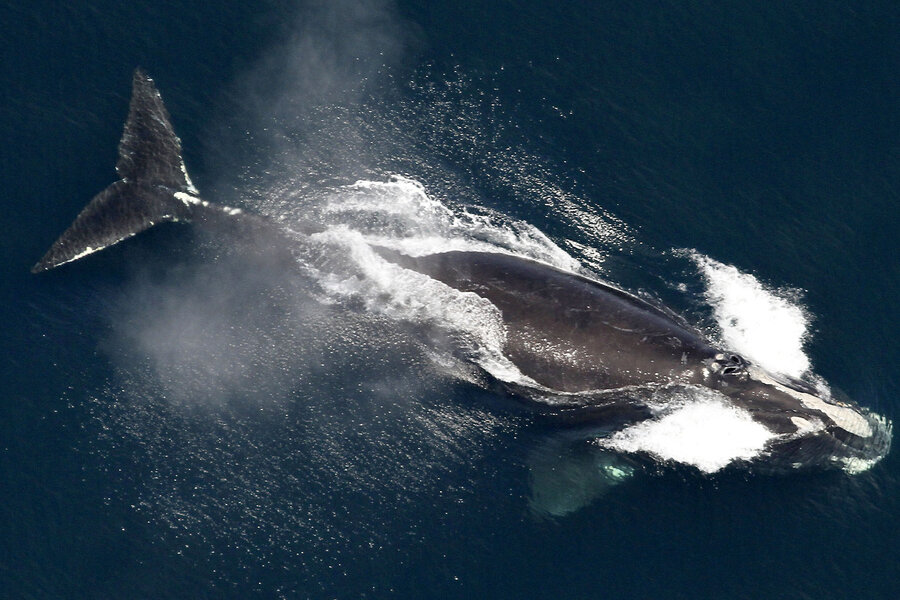
Photo: NOAA/AP file.
A North Atlantic right whale swims in New England waters.

Can we save treasured wildlife if we try? I can’t help thinking that before we pushed dodos and passenger pigeons to extinction, humans were not as aware. Now that we understand the dangers of losing species, can we put in the extra effort to preserve them?

Some humans are all in on protecting one particular species — the North Atlantic right whale.

Nate Iglehart reports at the Christian Science Monitor, “By the time Herman Melville wrote Moby Dick in 1851, New England was already famous for its whaling industry – hunting the North Atlantic right whale to near extinction. …

“Today, the once-targeted whales are prized conservation targets as New England leads efforts to bring them back from the brink. An emerging linchpin to their survival is taking form in a small but mighty network of coastal signaling devices.

“North Atlantic right whales are one of the most endangered large whale species in the world, with only about 370 left. Although whaling was almost entirely banned worldwide in 1986, the whales’ numbers have not recovered. Eleven new right whales were born this year, far below the 50 per year needed to create a stable population. Some models predict their extinction by 2035. …

“Now, everyone from fishers and marine ecologists to maritime corporations and coastal residents [is] leaning into technology to help stem the decline. …

“Mariners already try to avoid whales to protect the animals and their ships. But they don’t always know when one is around. When a whale is spotted, the National Oceanic and Atmospheric Administration (NOAA) sets up a slow zone, in which mariners are asked to slow their speed to 10 knots (11.5 mph) or less to reduce the likelihood of hitting a whale and the risk of fatally injuring it. The zones are separate from seasonal management areas, which have mandatory speed rules.

“Boaters are mainly alerted through email and text updates, and an app called WhaleAlert, which acts as a database for whale sightings and slow zones, says Greg Reilly, the International Fund for Animal Welfare’s marine campaigner. However, both need an internet connection, which is not required for boaters and is often spotty at sea.

“That’s where Moses Calouro, CEO of Maritime Information Systems, comes in. Over the last two years, Mr. Calouro has partnered with businesses, nonprofits, and coastal towns to install devices called StationKeepers along the entire Atlantic coast. These small 20-pound boxes sit high on coastal buildings and lighthouses. Using an Automated Identification System (AIS), they transmit locations of whales and speed zones directly to the navigation screens of ships. …

“Mr. Calouro’s 2024 pilot program focused on the Stellwagen Bank National Marine Sanctuary, an underwater plateau and feeding ground for right whales off the coast of Cape Cod. Upon entering, over 85% of ships slowed down, with an additional 10% doing so after receiving an automatic message warning.

Pete DeCola, the sanctuary’s superintendent, says the StationKeepers, combined with other efforts already under way to protect right whales, have reduced the risk of ships encountering whales by over 80%. …

“In 2010, NOAA researchers at the sanctuary created a program with the Massachusetts Port Authority and the International Fund for Animal Welfare that grades boaters and companies on their compliance. Last year, 91% of the 104 companies … that passed through slowed their boats appropriately. …

“Vessels that didn’t slow down were mainly new to the area. … That lack of knowledge is another challenge Mr. Calouro’s system aims to address. Mariners are skilled at avoiding hazards; it’s what they do for a living, says Mr. Reilly. But ‘they have to know where the hazard is.’ …

“But perhaps the biggest threat to North Atlantic right whales is entanglements, often in fishing gear. Even if the whale survives the tangle, the damage and stress of thrashing in the lines hurt their ability to give birth, says Courtney Reich, coastal director of the Georgia Conservancy.

“Technological advancements can reduce the need for buoy lines. Mike Lane, a lobsterman based out of Cohasset, Massachusetts, has worked with the underwater technology company EdgeTech to create prototypes of ropeless fishing gear. Typically, rope connects traps with buoys at the surface. But with ropeless gear, the traps use pop-up buoys, lift bags, or buoyant spools that, when remotely triggered, inflate or detach and bring the trap to the surface for collection.

“The gear is not perfect, Mr. Lane says, but it allows lobster fishers to keep working during the months that fisheries close due to the whales’ migration paths. He says that extra work can help lobster fishers financially, and it helps to know their gear is not snagging whales.

“But this gear, compared with a buoy and rope, is costly and can stress the fishers’ thin profit margins. There’s also a learning curve. … One of the biggest issues, he says, is keeping track of the traps so they don’t interfere with other fishers. If you tried to plot hundreds of ropeless traps in the water, the mapping data would be too cluttered to use effectively. Losing the expensive gear would be devastating. …

” ‘I’m not a huge fan of it,’ he says. ‘It’s not the way I prefer it. … The [mapping] technology is there; someone’s just got to package it properly.’ “

More at the Monitor, here. No paywall, but supporting this great news source is reasonable.

Read Full Post »

Photo: Jules Struck.
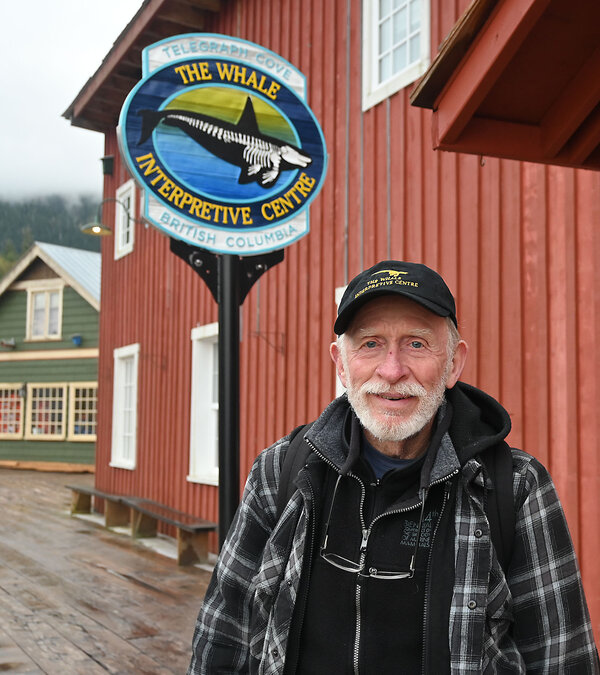
Jim Borrowman was part of a successful lobby to create an ecological reserve in western Canada’s Johnstone Strait in the 1980s.

Today’s story is about a few people whose determination helped to reverse the decline of a group of Orca whales — people who just don’t give up.

At the Christian Science Monitor, Jules Struck wrote recently about their work.

“Jim Borrowman cut the engine of the Nisku in the gray water of the Johnstone Strait, relinquishing his boat to an eastbound tide. He unraveled the line of a hydrophone – a cylindrical, underwater microphone – and dropped it portside.

“On the other end of the cord a pint-size Honeytone speaker in the cabin broadcast a conversation from the deep: the ethereal, two-toned call of an orca whale to her clan.

“ ‘I think they’re what we call “A1s,” ‘ said Mr. Borrowman, browsing a database of local orcas on his phone.

“Mr. Borrowman has been watching, and watching over, these whales for decades. He was one in a band of Vancouver Islanders who successfully lobbied in the early 1980s to set aside a protected area for Northern resident orcas, which lost a third of their population to hunting and capture in the 1950s and ’60s.

“This early act of ocean preservation laid a foundation from which decades of important research – and a deep local allegiance to the whales – have flourished. Galvanized by this data, environmentalists and First Nations just won a battle to evict commercial open-net fish farms from the area, which compete with the orcas’ food supply.

“With early signs of abundant salmon, and a small but decades-long uptick in Northern resident population numbers, it feels to some like nature rallying.

“ ‘You can see the whales coming back,’ says Alexandra Morton, an author and marine biologist who has studied salmon in the Johnstone Strait since the 1980s. She was part of a group that occupied a Vancouver Island fish farm in 2017 in protest of the industry.

“The A1s spotted by Mr. Borrowman from the bow of the Nisku are one pod of one type of orca, called Northern resident killer whales, which number some 400 and live along the coast of British Columbia.

“They’re doing particularly well, and have been growing by a handful of members each year since the ’70s. Northern residents are the most reliable visitors to the Robson Bight (Michael Bigg) Ecological Reserve, where Mr. Borrowman has served as a warden and run a whale-watching tour business with his wife, Mary, for decades until recently retiring.

“ ‘This is a beautiful, sensitive estuary at the terminus of a 100,000-acre watershed, the last untouched one on the east coast of Vancouver Island at the time,’ he says.

“It’s unique for another reason. At two known beaches at the mouth of the Tsitika River, Northern resident orcas rub gracefully along the seafloor pebbles in what scientists have dubbed a unique ‘cultural behavior.’

“It was this behavior, first captured in underwater footage by Robin Morton, Alexandra Morton’s late husband, that convinced the public, the press, and finally the federal government to set aside about 3,000 acres of water plus shore buffer as a protected area closed to boat traffic.

“Today, volunteer wardens with the Cetus Research & Conservation Society Straitwatch program monitor the reserve and gather population data on the whales and their pods. …

“Today, the whales’ major issues are food scarcity, noise, and chemicals in the water. But if the threats to orcas have become more complex, the responses have grown increasingly well-informed by a bedrock of research, much of which has come out of the ecological reserve and its orbit. …

“Decades of research have since shown that major pathogens and lice leak from [salmon] farms’ huge, suspended net pens straight into the paths of migrating salmon, ravaging their thin-skinned young and immobilizing the adults.

“Pacific salmon are also an important food source and cultural pillar for First Nations. They are intricately linked to the ecosystem, and scientists have even tracked nutrients from decomposed salmon high into the mountains.

“Ms. Morton campaigned for decades to close the fish farms. Nothing changed until she and Hereditary Chief Ernest Alexander Alfred, with a group of other First Nations people, peacefully occupied a Vancouver Island salmon farm owned by Marine Harvest.

“That protest led to a 2018 agreement with the British Columbia government requiring the consent of three First Nations – ‘Namgis, Kwikwasut’inuxw Haxwa’mis, and Mamalilikulla – for fish farms to operate around Vancouver Island.

“First Nations closed more than a dozen salmon farms in and near the strait. Then, the federal government announced it would ban all open-net farms in British Columbia by 2029.

“The decision is not universally supported by First Nations along the coast: 17 have agreements with salmon farming companies, which collectively employ around 270 Indigenous people, according to the Coalition of First Nations for Finfish Stewardship. Overall, open-net salmon farming accounts for 4,690 jobs and $447 million in gross domestic product across Canada, according to the BC Salmon Farmers Association.

“But for many, it was a turning point. Coho and especially Chinook salmon stocks spiked this year in Vancouver Island and its inlets, according to the Pacific Salmon Foundation, after years of downturn.”

Read more at the Monitor, here.

Read Full Post »

Photo: Associated Press.
This image from the National Oceanic and Atmospheric Administration [NOAA], shows a North Atlantic right whale in the waters off New England, May 25, 2024.

Recently a long Inside Climate News essay about NOAA’s efforts to get lobster fishermen to switch to ropeless gear — and save a few whales — appeared in the Boston Globe. The approach is sound but costly for lobster fishermen struggling to make a living.

Kiley Price wrote, “It was a blessedly calm day as Scott Landry’s team set out in their inflatable boat to scan the glistening waters of Great South Channel between Rhode Island and Massachusetts for an endangered whale affectionately known as Wart. They were on a mission to save her life.

“The group, from the nonprofit Center for Coastal Studies located in nearby Provincetown, had spent the better part of three years monitoring Wart after an aerial team spotted the North Atlantic right whale with a large piece of rope lodged in her mouth.

“Instead of coming loose on its own, the fishing rope slowly tangled itself deeper into Wart’s baleens, hindering her ability to eat and reproduce. Finally, Landry’s team decided to take a more hands-on approach — a dangerous but necessary last resort. …

“His team had to rig up a tool that could slice the rope at a distance — essentially a crossbow with an arrow like a throwing star. Eventually, Wart came up for air close enough to Landry’s dinghy for him to get a single clean shot. He took a breath and fired. The whale immediately dove underwater again, leaving the team in suspense. A few minutes later, she popped back up, revealing the knife had cut right through the chunky rope. …

“Wart’s case is a rare bright spot in the pervasive problem of rope entanglements, one of the leading causes of death for whales. …

“The situation is particularly dire for North Atlantic right whales like Wart, with only around 350 left in the wild. Found along the East Coast of North America, the whales’ migratory paths overlap with highly productive lobster fishing areas in Maine and Massachusetts, where scientists say the whales struggle to dodge copious amounts of gear and traps. …

“Scientists and conservationists are scrambling to find a strategy to reduce entanglement risk without threatening the lobster industry, which is facing its own struggles with climate change. In recent years, a seemingly simple approach has taken center stage: getting rid of the rope.

“The traditional lobster traps that sit on the seafloor are connected to the surface by a line of rope attached to a floating buoy. But the National Oceanic and Atmospheric Administration (NOAA) is working with manufacturers and partners to help develop different high-tech traps that they can sink to the seafloor without the rope tethered to the surface — in hopes of giving whales an unobstructed path through fishery waters. Then lobstermen can use a device to call these wireless traps back up to the surface with their catch.

“Officials say this ‘ropeless’ on-demand gear could help people continue to work during seasonal fishing closures. Enacted by the federal government in New England over the past decade, these restrictions limit lobster harvesting at different times of the year during the whales’ migration season. As whale populations struggle to bounce back, more potential closures loom. …

“The problem? Many lobstermen don’t want it.

“Rob Martin’s lobster boat carved through the gray waters off Cape Cod’s Sandwich Marina this May, temporarily transformed into a gear testing laboratory. NOAA scientists and tech experts had squeezed in alongside Martin, a Massachusetts lobsterman, and his crewmate, former lobsterman Marc Palombo.

“Martin brought the boat to a halt once they were far enough out in the bay, and the team dropped on-demand traps into the water, which quickly sank to the seafloor. Several minutes later, Martin activated the gear using a device onboard. … A few yards away, a bright yellow buoy that had been underwater a moment before now bobbed in the water. Martin and Palombo fished the float out of the water, revealing a cage with a string of lobster traps attached to it. …

“This year, fishers from 19 vessels participated in restricted area trials using on-demand equipment borrowed from a NOAA-run ‘gear library’ located in Woods Hole, Massachusetts. Under a special permit, the participants are allowed to keep and sell their catches throughout the winter and spring months. …

“The end goal for these ropeless gear efforts is to give lobstermen an option to get back out on the water during seasonal fishing closures or restrictions. That includes one in place since 2015 across a stretch of Cape Cod Bay every February to April. The federal government is likely to establish new large closures in just a few years to prevent right whales from going extinct. …

“In 2022, the Massachusetts Division of Marine Fisheries published a report to assess the feasibility of ropeless gear throughout the state, produced by the ocean policy consulting company Homarus Strategies. To assess potential economic impacts, Homarus combined the estimated costs of switching to ropeless gear with the potential loss of revenue from the additional time it takes to operate the gear compared to traditional traps — and the findings were stark. If the government mandates a fisheries-wide shift to ropeless gear, the state could lose around $24 million in revenue per year, according to the report.

“There’s a big caveat to that conclusion: The government has no plans to require this type of shift, said Colleen Coogan, branch chief for the Marine Mammal and Sea Turtle Team at NOAA Fisheries Greater Atlantic Region’s Protected Resources Division.

“ ‘We’ll never require fishermen to use ropeless gear, but that means that if they don’t use it, there will be areas that will be closed for fishing,’ she told Inside Climate News. ‘It’s more that the closure is what helps the whales; the ropeless [gear] is what helps the fishermen.’ …

“ ‘Personally, I don’t think there’s anything that they’re going to be able to do to make it viable … to deal with the financial burden,’ said Cape Cod lobsterman Jeff Souza, whose house is the collateral for a loan he took out a few years ago to build a new boat. … ‘I just want to keep being able to fish and not go broke.’ …

“In the fight to pull right whales back from the brink of extinction, there is a bright spot. Last year, NOAA released the annual population estimate for the species using the most up-to-date data, and found that the rate of their decline is slowing down, likely due to the regulations protecting them. Research suggests that ropeless gear could further help. …

“Landry thinks whales can deal with ‘some level of challenge that we throw at them, but, you know, it’s pile upon pile. There’s the changing of the prey, there’s the rope, there’s the boats. You’re asking a lot of a population of 350 animals.’ ”

More at Inside Climate News via the Globe, here.

Read Full Post »

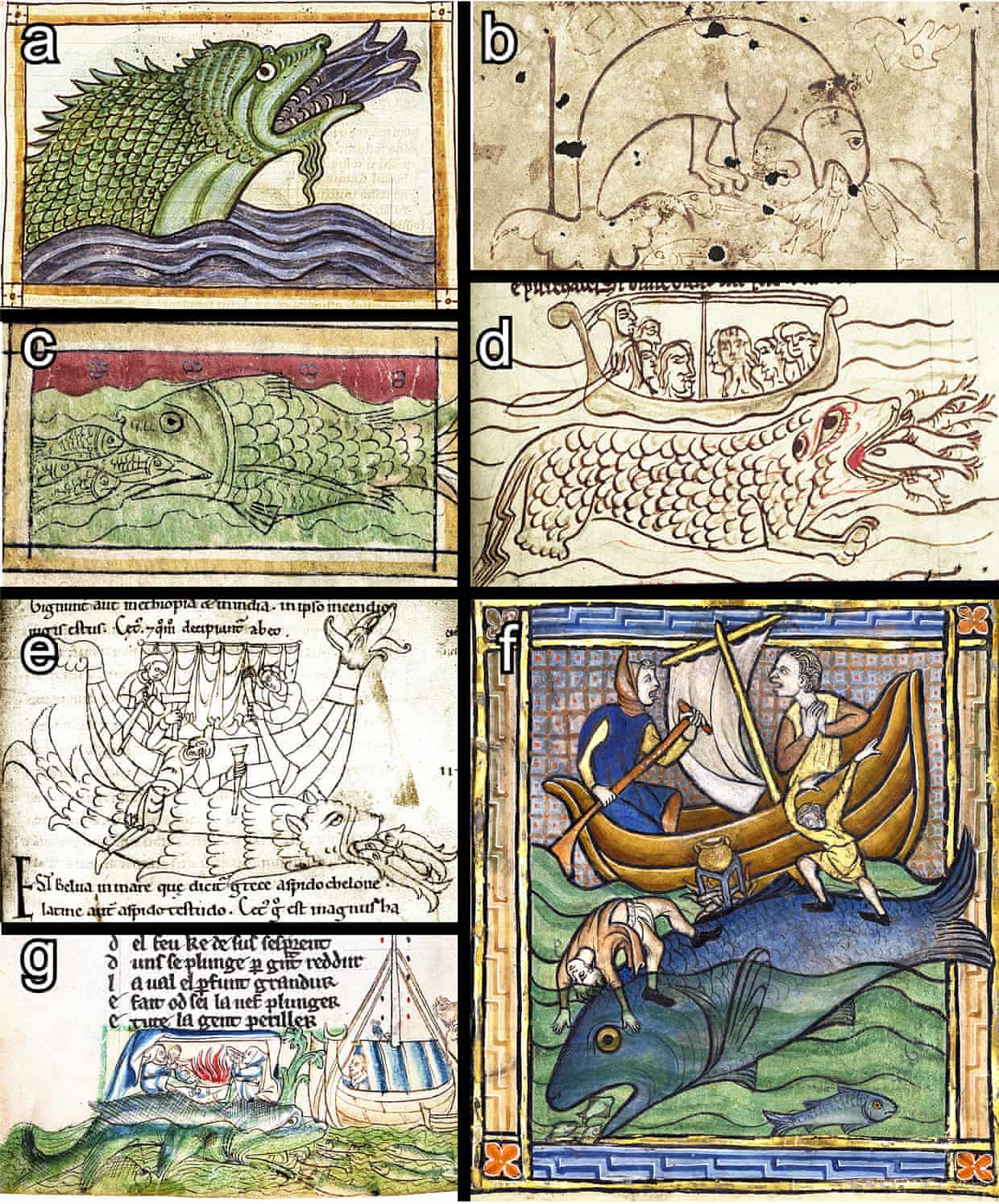
Images: Public domain.
Depictions of sea creatures in 13th C manuscripts
. How marvelous these illustrations are!

The maritime archaeologist in today’s article says it was just a coincidence that he was reading ancient Norse texts and connected the description of a sea creature to recent observations of whales. But I believe it’s not a coincidence. Everything connects to everything, and the more widely you read, the more likely you are to find the connections.

The researchers noted: ‘Definitive proof for the origins of myths is exceedingly rare and often impossible, but the parallels here are far more striking and persistent than any previous suggestions.’

Donna Lu writes at the Guardian, “Mysterious whale feeding behavior only documented by scientists in the 2010s has been described in ancient texts about sea creatures as early as two millennia ago, new research suggests.

“In 2011, Bryde’s whales in the Gulf of Thailand were first observed at the surface of the water with their jaws open at right angles, waiting for fish to swim into their mouths. Scientists termed the unusual technique, then unknown to modern science, as ‘tread-water feeding.’ Around the same time, similar behavior was spotted in humpback whales off Canada’s Vancouver Island, which researchers called ‘trap-feeding.’

“In both behaviors the whale positions itself vertically in the water, with only the tip of its snout and jaw protruding from the surface. Key to the technique’s success, scientists believe, is that fish instinctively shoal toward the apparent shelter of the whale’s mouths.

“Flinders University scholars now believe they have identified multiple descriptions of the behavior in ancient texts, the earliest appearing in the Physiologus – the Naturalist – a Greek manuscript compiled in Alexandria around 150-200CE.

“Dr John McCarthy, a maritime archaeologist at Flinders University in Adelaide, South Australia, and the study’s lead author, made the discovery while reading Norse mythology, about a year after he had seen a video of a whale tread-water feeding.

“He noted that accounts of a sea creature known as hafgufa seemed to describe the feeding behavior. ‘It really was a coincidence,’ McCarthy said.

“The most detailed description appeared in a mid-13th-century Old Norse text known as Konungs skuggsjá – the King’s Mirror. It reads: ‘When it goes to feed … the big fish keeps its mouth open for a time, no more or less wide than a large sound or fjord, and unknowing and unheeding, the fish rush in in their numbers. And when its belly and mouth are full, [the hafgufa] closes its mouth, thus catching and hiding inside it all the prey that had come seeking food.’

“The King’s Mirror was an educational text used for explaining the world to young people, McCarthy said. ‘They exaggerate the size … [but] it’s not a fantastical description with any kind of supernatural elements.’ …

” 1986 analysis of the King’s Mirror had found correlations between 26 Old Norse descriptions and scientifically recognized marine animals, but had concluded that the hafgufa ‘must be relegated to the world of the miraculous.’

“ ‘The hafgufa was frustrating for these scholars because they couldn’t quite figure out any animal that this matched to,’ McCarthy said. …

“In the Naturalist – a 2,000-year-old text that ‘preserves zoological information brought to Egypt from India and the Middle East by early natural historians like Herodotus, Ctesias, Aristotle and Plutarch’ – the ancient Greeks referred to the creature as aspidochelone.

“A surviving version of the text reads: ‘When it is hungry it opens its mouth and exhales a certain kind of good-smelling odor from its mouth, the smell of which, once the smaller fish have perceived it, they gather themselves in its mouth. But when his mouth is filled with diverse little fish, he suddenly closes his mouth and swallows them.’ …

“Bryde’s whales and humpbacks are both rorquals, a type of baleen whale. The study was published in the journal Marine Mammal Science.”

More at the Guardian, here. No firewall. Donations encouraged.

Read Full Post »

Photo: Minette Layne/Wikimedia Creative Commons.
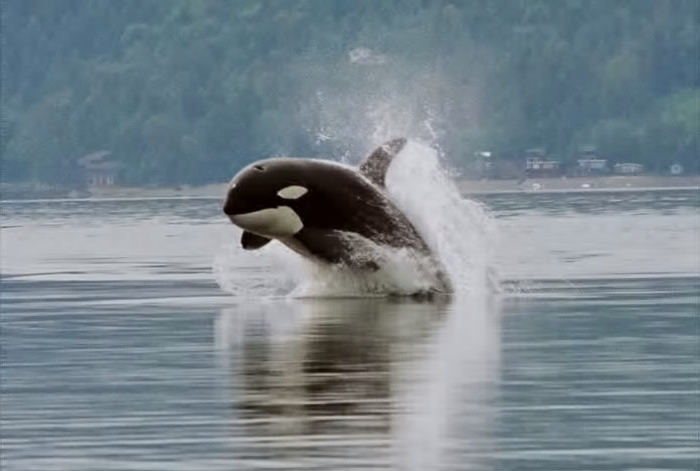
Toothed whales like orcas can make astonishingly loud sounds in three vocal registers. How do they do it despite the tremendous pressure underwater?

Do you remember Rudyard Kipling’s Just So Stories? Our favorite growing up was “How the Elephant Got Its Trunk.” I still have a wonderful recording on cassette of my father reading it aloud in his stentorian voice. We loved Kipling’s robust language and used his expressions in daily life. For example, we always said that our Uncle Jim spoke just like the tale’s python rock snake, who lived “on the banks of the great grey-green, greasy Limpopo River, all set about with fever-trees.”

(Is Kipling PC these days? I hope we can take him with a grain of salt. I would hate to lose these stories.)

Hannah Devlin at the Guardian harks back to Kipling in her report on whales with voices.

“The question of how the whale got its voice has been solved by scientists, who have discovered how the creatures use ‘phonic lips’ in their nose to produce the loudest sounds in the animal kingdom.

“The research also reveals that toothed whales, a group that includes killer whales, sperm whales, dolphins and porpoises, use three vocal registers equivalent to vocal fry (a low creaky voice), a normal speaking voice and falsetto.

“The research [was presented] at the annual meeting of the American Association for the Advancement of Science (AAAS) in Washington DC. …

“Prof Peter Madsen, a whale biologist at Aarhus University in Denmark and lead author, said: ‘These animals are producing the loudest sounds of any animal on the planet while being at a depth of 1,000 metres [3,280 feet]. It just seems such a paradox.’

“A central puzzle was how whales manage to generate sufficient flow of air, given that at 1,000 metres below the surface the pressure is so great that the air in the whale’s lungs is crushed to 1% of the volume it would occupy at the surface.

“The latest work shows that as whales dive deep below the surface, their lungs collapse and air is compressed into a small muscular pouch inside the mouth. To make a click, the whale opens a valve on the pouch for about a millisecond causing a high pressure blast of air to pass through a vibrating structure in the nose, called the phonic lips.

“ ‘When the lips slap back together, that’s what makes the click,’ said Madsen. The clicks, used to navigate and hunt prey, can reach volumes equivalent to a very powerful rifle being fired.

“The study, carried out over a decade, used high-speed video recorded through endoscopes, and collected audio recordings, using electronic tags, from trained dolphins and porpoises, and sperm whales and false killer whales in the wild. The researchers approached the huge marine mammals at sea in small boats and waited for them to come close in order to attach lightweight recording devices.

“ ‘Many whales will come up to us and have a look and echo-locate on the boat,’ said Madsen. ‘I sometimes wonder who is studying who – except they don’t put a tag on us.’ The recordings revealed three distinct registers. …

“The analysis, published in the journal Science, showed the whales use two additional registers for social communication. Scientists know that toothed whales have sophisticated social communication abilities, ranging from cooperation during hunting to the signature whistle that dolphins use to identify themselves. Other species, such as killer and pilot whales, make very complex calls that are learned and passed on culturally like human dialects.”

More at the Guardian, here. No firewall. Donations solicited.

Read Full Post »

Photo: Todd Cravens via Unsplash.
Some whales “pass their songs across oceans,” says the New York Times. Humpback whales have been studied the most extensively, but other species of whales also sing complex songs.

Although we are surrounded by ocean, I fear that we rarely give much thought to how really extraordinary the ocean is and how many wonders dwell there. Today’s story is about whales that share their song lists around the world.

Carl Zimmer writes at the New York Times, “In a study published [in August], scientists found that humpback songs easily spread from one population to another across the Pacific Ocean. It can take just a couple of years for a song to move several thousand miles.

“Ellen Garland, a marine biologist at the University of St. Andrews in Scotland and an author of the study, said she was shocked to find whales in Australia passing their songs to others in French Polynesia, which in turn gave songs to whales in Ecuador.

“ ‘Half the globe is now vocally connected for whales,’ she said. ‘And that’s insane.’

“It’s even possible that the songs travel around the entire Southern Hemisphere. Preliminary studies by other scientists are revealing whales in the Atlantic Ocean picking up songs from whales in the eastern Pacific.

“Each population of humpback whales spends the winter in the same breeding grounds. The males there sing loud underwater songs that can last up to half an hour. Males in the same breeding ground sing a nearly identical tune. And from one year to the next, the population’s song gradually evolves into a new melody.

“Dr. Garland and other researchers have uncovered a complex, language-like structure in these songs.

The whales combine short sounds, which scientists call units, into phrases. They then combine the phrases into themes. And each song is made of several themes.

“Male humpbacks sometimes change a unit in their song. Sometimes they add a new phrase or chop out a theme. The other males may then copy it. These embellishments cause the population’s song to gradually evolve, resulting in drastically different melodies from one population to the next.

“Michael Noad, a marine biologist at the University of Queensland, discovered that a population’s song can sometimes make a sudden, dramatic change. In 1996, he and his colleagues noticed that a male on the east coast of Australia had given up the local song and was now singing a tune that matched one previously sung on the west coast of the country.

“Within two years, all of the males on the east coast were singing that song. Dr. Noad’s landmark study was the first to discover this kind of cultural revolution in any animal species.

“Dr. Garland … wondered if their songs were spreading farther east across the Pacific. An opportunity to find out arrived when Judith Denkinger and Javier Oña, marine biologists at the University of San Francisco de Quito in Ecuador, offered to collaborate. They study humpback whales that breed on the coast of Ecuador.

“For their new study, Ms. Denkinger and Mr. Oña recorded humpback whales from 2016 to 2018. Over the same period, Michael Poole, a marine biologist at the Marine Mammal Research Program on the French Polynesian island of Moorea, recorded whales there. …

“In 2016 and 2017, the two populations of whales had clearly distinct songs. But in 2018, a revolution happened: The whales in Ecuador were putting French Polynesian themes in their songs. The scientists reported their findings [in] the journal Royal Society Open Science.

“Elena Schall, a postdoctoral researcher at the Alfred Wegener Institute in Bremerhaven, Germany, who was not involved in the study, said that she is seeing some similar patterns in the Atlantic Ocean. Humpback whales off the coast of Brazil and South Africa are picking up themes previously recorded off the coast of Ecuador.

“It is conceivable, Dr. Schall said, that songs flow all the way around the Southern Hemisphere. ‘It’s possible, but there’s a data gap in the Indian Ocean,’ she said. ‘I think that will definitely be the next step, if we can find enough data.’ “

More at the Times, here. Amazing to think that whales in one part of the world can “cover” the songs of whales thousands of miles away.

Read Full Post »

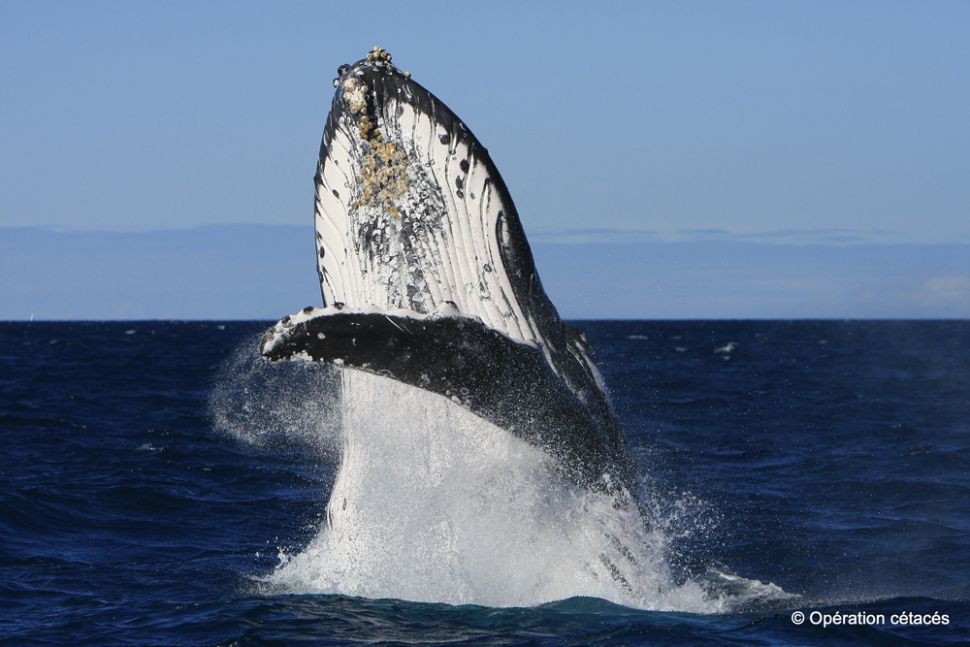
Photo: Opération cétacés.
Humpback whale breaching.

In case you couldn’t get behind the New York Times firewall to read about the whale that tried to swallow a lobster fisherman, here’s the gist of it. It’s a great reminder that all our ancient, impossible-seeming stories, from the Bible’s Jonah to Pinocchio and Geppetto, generally have a basis in fact.

Maria Cramer reported, “It was sunny and clear on Friday morning and the water was calm off the coast of Provincetown, Mass., where Michael Packard was diving for lobsters. His longtime fishing partner, Josiah Mayo, was following him in their fishing vessel, the J&J, tracking him through the bubbles that rose from Mr. Packard’s breathing gear to the surface of the water. The men had already caught 100 pounds of lobster, and Mr. Packard was about 40 feet underwater, looking for more.

“Suddenly, the bubbles stopped, Mr. Mayo said. Then, the water began to churn violently. A creature breached the surface and for an agonizing split second, Mr. Mayo thought it was a white shark.

‘I immediately thought it was the shark encounter that we’d unfortunately been preparing for for years,’ he said in an interview on Saturday.

“Then, he saw the fluke and the head of a whale. Moments later, he saw Mr. Packard fly out of the water.

“ ‘ “It tried to eat me,” ’ Mr. Packard sputtered, according to Mr. Mayo. The whale, a humpback, swam away as Mr. Mayo and another fisherman helped Mr. Packard back into the boat.

“Such terrifying encounters are virtually unheard-of, according to Charles Mayo, Josiah Mayo’s father and a senior scientist at the Center for Coastal Studies in Provincetown, a town of about 3,000 people on the tip of Cape Cod. …

“ ‘I’ve never heard of that ever happening,’ Dr. Mayo said of Mr. Packard’s ordeal. Still, the encounter is explainable, he said.

“The whale, possibly a 32- to 35-foot juvenile that had previously been seen swimming in the area, was most likely diving for food when it inadvertently caught Mr. Packard in its enormous mouth.

“Humpback whales spend much of their time in that part of New England, searching for and engulfing small schooling fish, said Jooke Robbins, director of the humpback whale studies program at the Center for Coastal Studies. They lunge fast, open their mouths and use baleen plates to ‘filter’ the water out before swallowing the fish, Dr. Robbins said in a statement.

“When the whale realized it had caught something that was not its typical prey — in this case, an unsuspecting lobsterman — it responded the way a human who accidentally ingested a fly would, Dr. Mayo said. …

“Mr. Packard told reporters that he was on his second dive, going toward the bottom of sea when he felt ‘this truck hit me.’ His first thought was that a white shark had attacked him, but when he did not feel teeth piercing into him, he realized he was inside a whale.

“ ‘I was completely inside; it was completely black,’ Mr. Packard told The Cape Cod Times. ‘I thought to myself: There’s no way I’m getting out of here — I’m done, I’m dead. All I could think of was my boys — they’re 12 and 15 years old.’ …

“He said he struggled against the mouth of the whale and could feel its powerful muscles squeezing against him. Then, he saw light and felt the whale’s head shaking and his body being thrown into the water. …

“Mr. Packard, who was released from the hospital on Friday, had extensive bruises, but no broken bones.”

More at the Times, here.

Read Full Post »

Photo: Reuters

Did someone read you Rudyard Kipling’s Just So Stories when you were a child? My father read them to me. My favorite was “The Elephant’s Child.”

“In the High and Far-Off Times the Elephant, O Best Beloved, had no trunk.” I loved hearing about the elephant’s child’s “satiable curiosity.” I loved the way the characters talked. The bi-colored python rock snake on the banks of the grey-green, greasy Limpopo River all set about with fever trees spoke just like my Uncle Jim.

Recently, an article in the Guardian reminded me of Kipling’s fanciful stories about how animals looked before they acquired their characteristic traits. It was an article about the whale.

Riley Black wrote, “Whales used to live on land. This fact never ceases to amaze me. Even though every living species of cetacean – from the immense blue whale to the river dolphins of the Amazon basin – is entirely aquatic, there were times when the word ‘whale’ applied entirely to amphibious, crocodile-like beasts that splashed around at the water’s edge. This week, paleontologists named another.

Peregocetus pacificus – as named by a seven-strong paleontologist team led by Olivier Lambert – is [a mammal] that was excavated from the bed of an ancient ocean now preserved in Peru. … This was a whale that still had arms and legs, the firm attachment of the hips to the spine and flattened toe-tips indicating that Peregocetus was an amphibious creature capable of strutting along the beach. Yet conspicuous expansions to the tailbones of Peregocetus are reminiscent of living mammals, such as otters, that swim with an up-and-down, undulating motion … different from the side-to-side swish of most fish. …

“There are two points that make Peregocetus stand out. The first, Lambert and colleagues point out, is where Peregocetus was found. This early whale wasn’t discovered in ancient Asia, like many others, but in South America. It’s the first of its kind to be found on the continent, and from the Pacific side, at that. This is something of a surprise. Clearly whales were eminently seaworthy long before they became more streamlined and lost their hindlimbs. Finds such as Peregocetus, as well as the related Georgiacetus from North America, indicate that walking whales were capable of crossing entire oceans.

“But, more importantly, Peregocetus is a reminder of what wonders still await us in the fossil record. … Peregocetus [stands] in our fossiliferous imagination with its hind feet on the land and front paws in the water. The whale certainly adds to our understanding of how and when cetaceans took to the seas, but the most powerful fact of all is simply that such an unusual and unexpected creature existed.” More here.

Read Full Post »

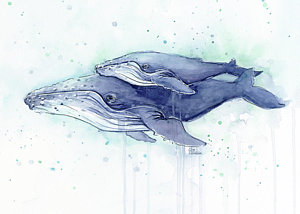
whales-humpback-watercolor-mom-and-baby-olga-shvartsur

Art: Olga Shvartsur/Fine Art America
Humpback whale and baby. Recently, a humpback whale appeared to intentionally protect a researcher from a tiger shark.

A scientist who studies whales underwater was astonished and more than a little frightened in September 2017 when a whale kept pushing her toward her boat. After her colleagues pulled her to safety, she saw that in the other direction a dangerous tiger shark was lurking. The researcher believes that the whale was intentionally trying to protect her. Other scientists argue that whales aren’t altruistic.

I say, Who cares? The point is the whale’s action moved the diver away from danger, and she is grateful.

Sarah Gibbens writes at the National Geographic, “For 28 years, Nan Hauser has been researching and diving with whales. The biologist is the president and director of the Center for Cetacean Research and Conservation. … During a trip to look at whales in the Cook Islands in the South Pacific last September, Hauser says she had an encounter unlike any she had experienced before.

“A humpback whale, a marine mammal capable of weighing 40 tons and growing 60 feet long, swam toward Hauser. For ten minutes, it nudged her forward with its closed mouth, tucked her under its pectoral fin, and even maneuvered her out of the water with its back. …

” ‘I was prepared to lose my life,’ she says. ‘I thought he was going to hit me and break my bones.’

“In addition to conducting research, Hauser says she was also in the Cook Islands to work on a nature film, so at the time the whale approached, both she and a fellow diver were armed with cameras. Hauser’s point-of-view footage shows just how persistently the whale nudged her. A second whale can also be seen lurking just behind the first.

“When she finally made it out of the water and up onto her boat — bruised and scratched from the barnacles on the whale — Hauser saw a third tail moving from side-to-side.

” ‘I knew that was a tiger shark,’ she says.

“Now, after viewing the footage and reflecting on the whole harrowing experience, Hauser concludes that the whale who nudged her likely exhibited an extraordinary example of altruism. …

“Hauser’s retelling isn’t the first time scientists have questioned whether humpback whales can show signs of altruism. A 2016 study in the journal Marine Mammal Science looked at 115 instances from the past 62 years in which humpbacks interfered with a pod of hunting orcas.

“Banding together, humpbacks were seen effectively protecting their calves. But there were also examples of humpbacks showing the same behavior to protect other species of whales, seals, and sea lions. …

“Martin Biuw from the Institute of Marine Research in Nowary is skeptical of Hauser’s claim that altruism is at play in the video. Hauser had speculated the whale was male, but Biuw believes it appears to be a female.

” ‘If that is the case, it is possible that she may show protective behavior towards a human (or other animal for that matter) if she has for instance recently lost her calf,’ he says.

“Biuw explained that hormonal changes could have spurred the whale to show protective behavior.” Oh, ha, ha, hormonal changes? Good grief, give me a break.

More at the National Geographic, here.

Read Full Post »

I wish Pete Seeger were around for this story. The folksinger spent many years sailing his sloop the “Clearwater” up and down the Hudson River to draw attention to pollution. Today the river is in good enough shape to attract a whale chasing its dinner.

Recently, New York Times reporter Katie Rogers interviewed Dr. Rachel Dubroff, whose apartment overlooks the Hudson. She writes that the first time Dubroff spotted a whale swimming outside her living room window, “she didn’t quite believe the sighting was real,” but news reports in November confirmed that “the Hudson River has a resident humpback.”

Continues Rogers, “The Hudson, as scenic as it is, does not scream ‘whale habitat.’ But experts say cleanup and conservation efforts have led to cleaner waters and an abundance of fish. …

“A whale appearing in the Hudson is very rare, [Paul Sieswerda, the president of Gotham Whale, an organization that tracks marine life around the city] said, which is why he thinks this one is a solo traveler. But the whale still faces significant danger because it is swimming in traffic-laden waters. …

“ ‘When you have whales chasing the bunker [menhaden], and fishermen chasing the stripers that chase the bunker, accidental interactions between whales and vessels can occur,’ Jeff Ray, a deputy special agent with NOAA’s law enforcement division,” added.

I hope everyone using the river will watch out for whales and try to coexist. It would be great if the whale came back after the usual typical retreat to warmer breeding grounds in winter.

More at the New York Times, here.

Art: Amy Hamilton
A humpback whale like the one spotted in New York’s Hudson River in November 2016.

Read Full Post »

I spent four months reading MobyDick in 2010, and I must say that for me there was way too much information about different kinds of ropes, how to cut up a whale, and the categories of seagoing creatures. I could not figure out why people I admire read MobyDick over and over.

So, avast! There is now a way for people like me to grasp the essence of Herman Melville’s classic. It’s a one-man show performed by the Irish actor Conor Lovett, who — along with his wife and director, Judy Hegarty Lovett — adapted the book’s highlights.

ArtsEmerson presented this wonder in Boston recently, and I’m in awe.

Despite (or perhaps because of) the fact that the actor in his Ishmael role has the stunned, wounded look of Tommy Smothers (remember the insecure brother in the 1970s comedy duo?), Conor is heartbreaking. His facial expressions and body language before he speaks Melville’s famous opening, “Call me Ishmael,” convey a haunted man, one who, like Coleridge’s ancient mariner, has witnessed mysteries beyond human understanding and feels condemned to tell the story to anyone who will listen. His look says, Why was I spared? Why did I choose this voyage? Why did I listen to the prophetic mad sailor Elijah on a wintry Nantucket dock and still choose to sail on the cursed Pequod?

The production is full of dark musings, the roars of a crazed Captain Ahab, and the savagely raging elements of air, water, and fire. But at the outset, stage time is lovingly devoted to the humorous side of Ishmael searching for New Bedford lodgings, having to bunk with the “harponeer” Queeqeg, and learning to recognize the interior decency behind the mask of the “cannibal.”

That the novel is deep is clearer to me now. I’m still pondering Ahab’s speech about whaleness being merely the “mask” that MobyDick wears. When the devout first mate Starbuck says it’s wrong to seek revenge against a whale that is merely a dumb beast — a creature of God — Ahab counters that beneath the mask is an infinitely malevolent force that must be conquered at all costs. We never feel sure what this force is supposed to be. Satan? Then why do the natural elements seem to take the side of the whale? I’m still wondering why we never learn if the whale dies or lives to wreak havoc another day.

But at last I see why people admire this book. Read more here.

P.S. The play is part of Imagine Ireland, “a year of Irish arts in America.” Check it out.

Read Full Post »