Feeds:
Posts
Comments

Posts Tagged ‘wife’

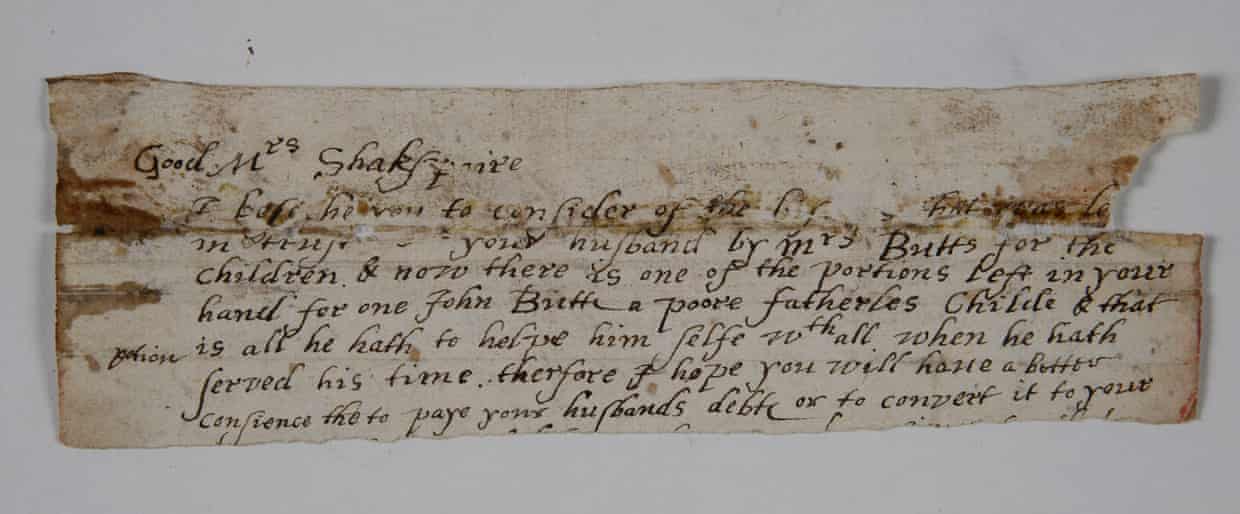
Photo: Hereford Cathedral and the Hereford Mappa Mundi Trust.
The letter fragment seems to place Anne Hathaway in London with William Shakespeare. 

Where do our firm convictions about history come from? Sometimes the accepted wisdom is based on facts, sometimes on what the influencers of the time thought, sometimes on mistakes. If for example, we have always thought Shakespeare had a bad marriage because his wife never came to London with him, what does new information contradicting that do to the accepted wisdom?

And there’s always new information.

Dalya Alberge writes at the Guardian, “It has long been assumed that William Shakespeare’s marriage to Anne Hathaway was less than happy. He moved to London to pursue his theatrical career, leaving her in Stratford-upon-Avon and stipulating in his will that she would receive his ‘second best bed,’ although still a valued item.

“Now a leading Shakespeare expert has analyzed a fragment of a 17th-century letter that appears to cast dramatic new light on their relationship, overturning the idea that the couple never lived together in London.

“Matthew Steggle, a professor of early modern English literature at the University of Bristol, said the text seemed to put the Shakespeares at a previously unknown address in Trinity Lane – now Little Trinity Lane in the City. It also has them jointly involved with money that Shakespeare was holding in trust for an orphan named John Butts.

“Addressed to ‘Good Mrs Shakspaire,’ the letter mentions the death of a Mr Butts and a son, John, who is left ‘fatherles,’ as well as a Mrs Butts, who had asked ‘Mr Shakspaire’ to look after money for his children until they came of age. It suggests the playwright had resisted attempts to pay money that the young Butts was owed.

“Steggle said: ‘The letter writer thinks that “Mrs Shakspaire” has independent access to money. They hope that Mrs Shakspaire might “paye your husbands debte.” ‘

“They do not ask Mrs Shakspaire to intercede with her husband, but actually to do the paying herself, like Adriana in The Comedy of Errors, who undertakes to pay a debt on her husband’s behalf, even though she was previously unaware of it: “Knowing how the debt grows, I will pay it.” ‘ …

“The fragment was preserved by accident in the binding of a book in Hereford Cathedral’s library. Although it was discovered in 1978, it has remained largely unknown because ‘no one could identify the names or places involved,’ Steggle said.

“Crucial evidence includes the 1608 book in which the fragment was preserved, Johannes Piscator’s analyses of biblical texts. It was published by Richard Field, a native of Stratford, who was Shakespeare’s neighbor and his first printer.

“Steggle said that it would be a ‘strange coincidence’ for a piece of paper naming a Shakspaire to be bound, early in its history, next to 400 leaves of paper printed by Field, ‘given Field’s extensive known links to the Shakespeares.’

“John Butts seems to have been serving an apprenticeship because the letter mentions ‘when he hath served his time.’ Scouring records from the period 1580 to 1650, Steggle found a John Butts, who was an apprentice, fatherless and in the care of his mother. …

“Steggle found John Butts in later records, placing him in Norton Folgate, outside the city walls, and living on Holywell Street (Shoreditch High Street today), home to several of Shakespeare’s fellow actors and associates.

“It was an area in which Shakespeare worked in the 1590s, first at the Theatre in Shoreditch, the principal base for the Lord Chamberlain’s Men throughout those years, and then at its near neighbor, the Curtain theatre. Shakespeare’s lifelong business partners, the Burbages, were involved in innkeeping and victualing nearby.

“Steggle said: ‘The adult John Butts, living on the same street as them, working in the hospitality industry in which they were invested … would very much be on the Burbages’ radar. So Shakespeare can be linked to Butts through various Norton Folgate contacts.’

“If the writing on the back of the letter – in another hand – was written by Anne, the words would be ‘the nearest thing to her voice ever known,’ he noted.

“The research is being published in Shakespeare, the journal of the British Shakespeare Association.”

What accepted wisdom will future historians overthrow by their scouring of our — probably digital — records? And will they draw such broad conclusions about what they find? I myself don’t see how you claim that Shakespeare had a good or bad marriage on the basis of his wife’s residence in London. But it’s fun to see how long new ideas can keep turning up.

More at the Guardian, here.
Read Full Post »

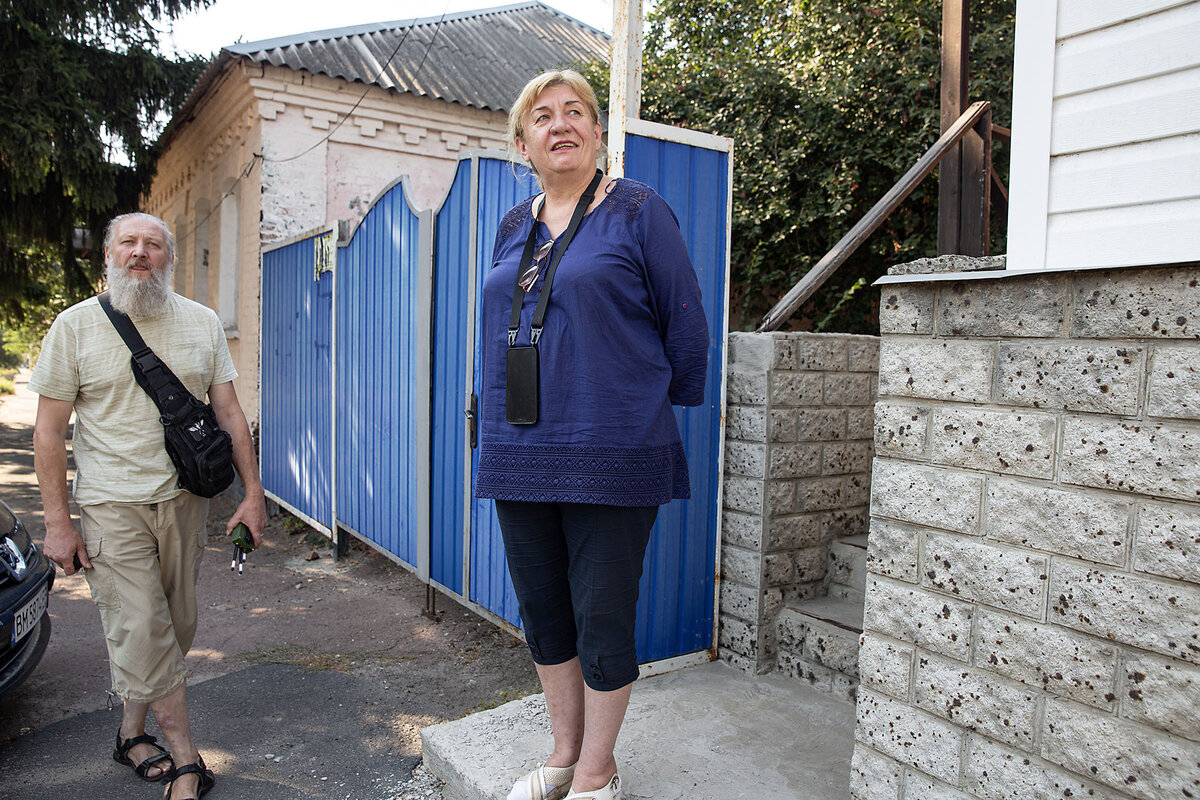
Photo: Dominique Soguel.
Nataliia Kalinichenko and her husband, Yurii, outside the office of the print weekly Bilopilshchyna, which they have continued to publish despite the war.

And while we’re on the subject of Ukraine, I want to share a story while it’s fresh, because in a war zone, you never know how long a piece of good news will last.

Dominique Soguel (with support from Oleksandr Naselenko) reports at the Christian Science Monitor, “The streets of [Bilopillia, Ukraine], just seven miles from the Russian border, are nearly deserted. Air-raid sirens have been a round-the-clock reality for weeks, and people take them seriously: When the warnings blare, everyone lies flat to take cover or scrambles to underground shelters.

“But for Nataliia Kalinichenko and her husband, Yurii, there’s no break from getting the news out to the community. They have safety routines; Ms. Kalinichenko asks friends or relatives to monitor social media platform Telegram for news of incoming Russian attacks, while Mr. Kalinichenko uses a drone detector while driving. But their mission is to keep locals informed through publication of their print weekly, Bilopilshchyna.

“Before the war, the newspaper featured 12 to 16 colorful spreads with articles on local entertainment, politics, and practical information like bus schedules. Now, it is a stark black-and-white publication filled with military and civilian obituaries and snapshots of local buildings destroyed by Russian attacks.

“ ‘With the onset of Russia’s invasion, our community’s information needs changed dramatically, as did our ability to meet them,’ says Ms. Kalinichenko, who joined the newspaper in 1996 and became its editor-in-chief a decade later. ‘Safety became the primary concern.’ …

“The information landscape has transformed over the past 2 1/2 years. Televisions, once tuned to Russian and Ukrainian channels, lost their appeal. The first Russian strike on the town’s television tower in March 2022 marked the beginning of a series of barrages. Telegram, which now tracks incoming missiles, has become a lifeline – though it requires electricity and an internet connection. Both have been hard to reliably access amid Russia’s offensive. …

“Inevitably, the community has shrunk. The agricultural district of Bilopillia was once home to about 16,000 residents. Now the figure is between 3,000 and 8,000, according to Ms. Kalinichenko. Residents come and go depending on attacks and electricity supplies. New arrivals from other regions temporarily swell the numbers.

“The Kalinichenkos are determined to stay put and keep the paper running as a team. On the walls of their office hang photographs documenting the paper’s history, including a period when it was known as the Flag of Stalin. Piles of newspapers are testament to disruptions in postal delivery services, and a collapsed ceiling from a recent blast prevents Ms. Kalinichenko from sitting at her usual desk.

“At a nearby shop, salesperson Nina Davydova and her teenage daughter, Victoria, discuss the toll of constant strikes. Though Victoria gets her news only through Telegram, Nina says Bilopilshchyna is still popular.

“ ‘People really like to buy the newspaper,’ she says, pointing out that she has already sold six copies this morning, even though Russian attacks were particularly intense. ‘Grandmothers will buy five to six copies so that they can bring it to their neighbors who cannot walk.’

“The newspaper sells at 20 locations in the Sumy region, which shares a 28-mile border with Russia. While many readers have fled, they continue to pay for a subscription in order to remain connected to their homeland, says Ms. Kalinichenko. Even in its reduced format, it serves as a vital source of information for local agricultural communities.

“Serhii, a sardonic shopkeeper, displays the latest copies alongside shrapnel that damaged his shop, which sits a few blocks from Nina’s. ‘If people would not buy it, I would not sell it,’ he says. ‘About five people buy it every day. But people also come from surrounding villages on market days to buy 10 copies at a time.’

“Articles pay tribute to slain soldiers and quote analysts to dispel rumors and dismantle Russian disinformation. One recent instance involved pollution of the river Seim – caused by industrial activities upstream in Russia. Russian trolls on Telegram spread the notion that drinking water had also been compromised, but that was not actually the case. Experts quoted in the paper helped debunk that notion.

“ ‘For villagers with no internet, it is an important source of information and local news,’ says Serhii.

“That assessment is echoed by customer Dymtro Potiomkyn, who grew up with the paper on the family table. He recalls it being a way for people to buy and sell goods locally. Today, it publishes information about what kind of social help is available locally. He buys the paper in person, while his mother gets it delivered by mail.

“ ‘This newspaper is crucial for villages that are right on the border with Russia,’ says Mr. Potiomkyn, who runs a funeral business in the region. ‘Some have been without electricity or internet for years. It’s literally their only source of Ukrainian news.’ “

I know from my own four-month remote gig with a Ukrainian news outlet that Telegram is important to the information landscape there. I also know about Ukrainians’ concern that the outside world gets false information from social media posted by Russians. That’s why Americans like me were helping Ukrainian journalists put their own Twitter and Facebook updates in colloquial English. My experience here.

More at the Monitor, here. No paywall. Subscriptions are reasonable.

Read Full Post »