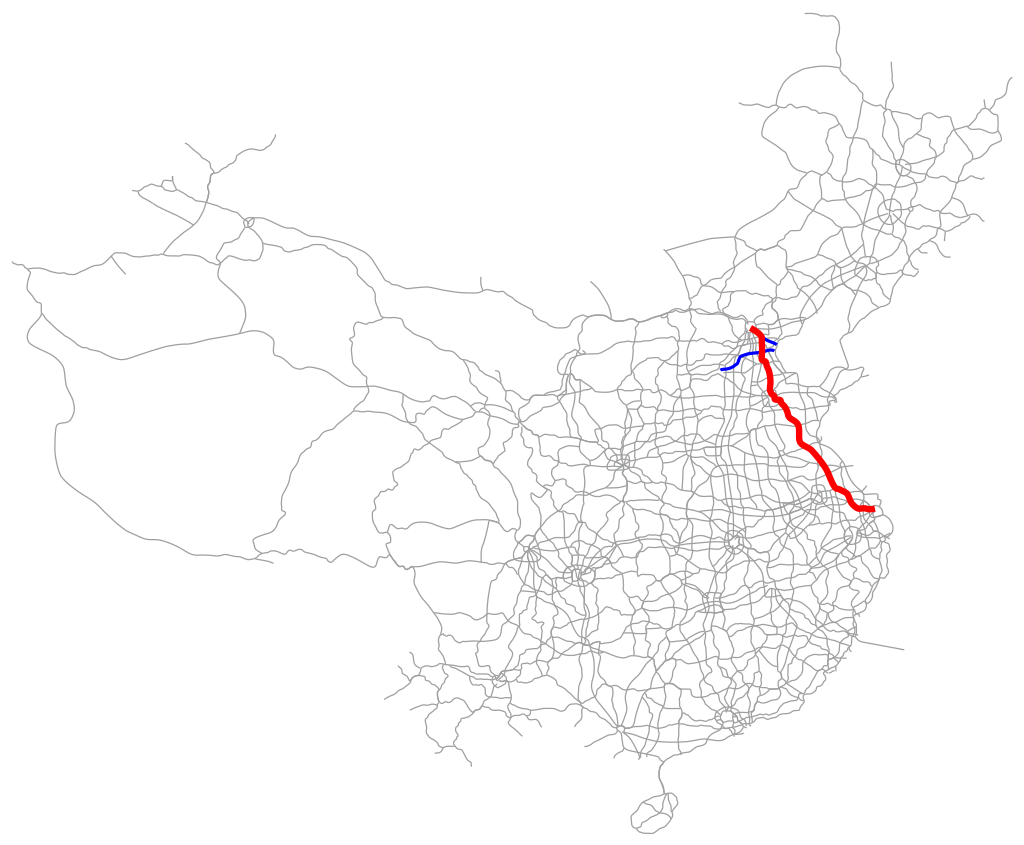
Image: Alan Fan Pei via Wikimedia Commons.
China National Expressway G2, Beijing to Shanghai. Who can you trust?
Back when I got my first full-time copyediting job, Wikipedia was new. We were not allowed to reference it for a citation. At the same time, Wikipedia required its own references to be to books and other long-accepted documents — nothing online.
Those days are gone, but the encyclopedia we can’t live without is still evolving, and differing constituencies struggle behind the scenes.
Consider the passionate world of roadmaps.
Stephen Harrison reports at Slate, “When Ben, also known as bmacs001, posted a TikTok video promising to ‘spill the tea’ on how the site treats road and highway articles, the Wikipedia contributor suspected that people would find the topic intriguing: ‘Forty of Wikipedia’s most prolific editors have seceded and made their own wiki, and I’m among them.’
“Ben was part of the contingent of Wikipedia editors who contributed to the site’s pages covering road and highway infrastructure — everything from Interstate 80 and Route 66 to tinier highways on the side of the Jersey Shore. ‘We’ve been chugging along doing our own thing on the ’pedia for the past two decades now, [but] our little corner of the site has come under attack,’ Ben said. … Wikipedia’s highway enthusiasts felt they had no choice but to break away and form a separate project: AARoads Wiki.
“With over 800,000 views and counting, the nearly four-minute TikTok video is a testament to how even extremely niche topics gain visibility on the platform. As the post’s top comment put it, ‘I’m so here for interstate Wikipedia drama.’ But behind this seemingly amusing clash of nerds is a far more pressing issue: how to reconcile 20 years of Wikipedia’s core principles and values with the practical demands of present circumstances. …
“Roadgeeks are drawn toward the immediacy of the subject matter — since many users drive on roads every day — while railfans gravitate toward the historical aspect, since locomotives aren’t nearly as common as they once were. …
One flashpoint that inspired the recent revolt was a strict interpretation of the site’s reliable sourcing policy. …
“Take the example of an article about West Virginia Route 891, a short east–west highway that ends on the Pennsylvania state line. A volunteer editor seeking to contribute content to the page might use information found on the West Virginia Department of Transportation’s website as a reference source. However, policy sticklers are likely to deny this usage because DOT is a primary source for highways (directly involved in the subject matter). According to the site’s policies, Wikipedia should be based mainly on reliable secondary sources, such as newspapers.
“Angry road editors like Ben are up in arms, claiming that this hard-line interpretation of the guideline does not reflect the realities of the situation. With local newspapers going out of business left and right, there are rarely any other sources to draw from for these kinds of articles. Why not allow Wikipedians to cite from DOT, which is responsible for publishing highway routes?
“Then again, it’s worth remembering that most of the time Wikipedia has good reasons for the prohibition against primary sources, especially with government entities. A state’s DOT content might generally be reliable — but allowing Wikipedians to cite from other primary sources, such as China’s Central Propaganda Department, is not a risk worth taking. The question is whether there is some way to recognize an exemption, granting that some types of primary sources may be reliable while still protecting the integrity of the rule.
“Wikipedia’s road editors have also struggled with the site’s prohibition against original research. … The policy has helped stop users from adding pseudoscience about Bigfoot excursions to the site, for example. But road editors are understandably frustrated when ‘no original research’ is applied to exclude maps. Why should someone have to search out a second source to confirm in words what the map communicates in visual form? …
“Finally, there’s the issue of Wikipedia’s notability guideline — the principle that only topics that are truly ‘worthy of notice’ should be included on the encyclopedia. Lack of notability is the reason why the proposed articles about many aspiring influencers get deleted every day. Roadgeeks tend to argue that highways are generally notable. …
“ ‘The people who want to destroy, the only work that they need to do is destroy. Creating involves a lot more work, so we’re trying to fight back against people who have more time for deleting stuff,’ Ben told me.”
More at Slate, here. You’re allowed a few articles for free there.

 Suzanne's Mom's Blog
