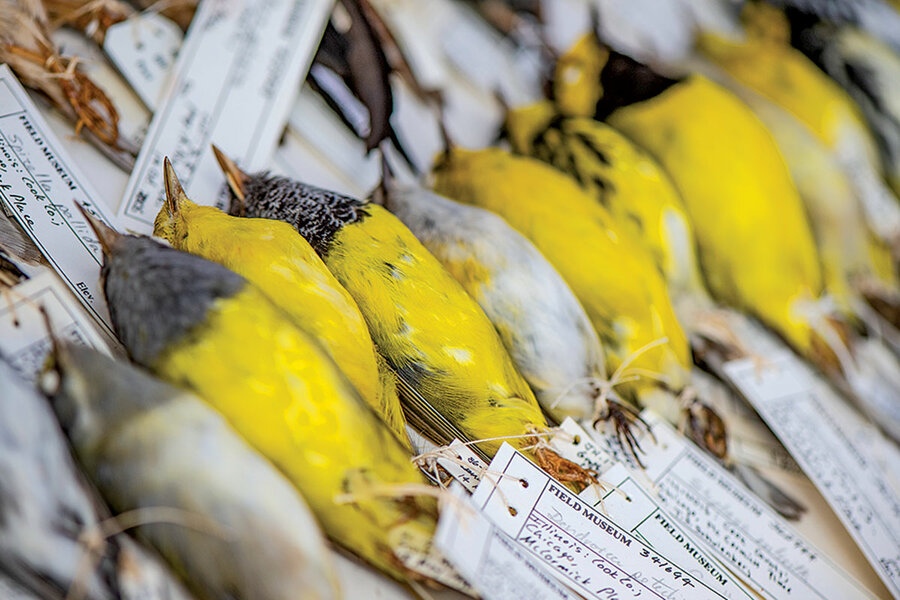
Photo: Ann Hermes/CSM Staff
Collections at the Field Museum include more than 100,000 birds killed in collisions with buildings in Chicago,” the Christian Science Monitor reports. “Each bird is stuffed and tagged.”
I learned decades ago that if small birds start flying into my windows, I need to hang up images of hawks or cats to warn them away. Sometimes I bought images of predators from Audubon or Duncraft. Other times I cut shapes out of black cardboard.
For skyscrapers, it’s not so easy, even though suburban homes kill more birds. At the Christian Science Monitor, Richard Mertens writes about the skyscraper challenge.
“The bird lies on its side, a clump of feathers no bigger than a crumpled leaf. It’s just a dark speck on the concrete, with massive glass and steel skyscrapers rising above it in the pre-dawn light.
“Annette Prince sees it at once. She hurries over and lifts it gently in her right hand. It has a slender bill, a tuft of yellow on its rump, and dark eyes that show no glimmer of life. A yellow-rumped warbler, bound for the warmth of the Caribbean or the American South, has met its end in Chicago’s Loop. …
“In the contest between birds and cities, the cities are winning. Scientists estimate that, on average, at least a million birds die in collisions with buildings each day in the United States – and as many as a billion a year. Most perish during the spring and fall migrations in which vast numbers journey up and down the continent, flying mainly at night. City lights attract and disorient them, and many end up crashing into windows, not just the sides of gleaming office towers but suburban patio doors as well. The problem, then, is twofold: lights and glass.
The light from ever-expanding cities is disrupting the movement of creatures that evolved to migrate in the dark, using the stars and the Earth’s magnetism as their guides.
“And the modern architectural penchant for glass has proved deadly for them. Most glass is invisible to birds, appearing either as clear air to fly through or as a reflection of the trees and sky behind them.
“There are growing efforts to make cities safer for birds. The National Audubon Society’s Lights Out programs, in which owners and managers agree to switch off exterior lights during migration, have spread to 45 U.S. cities. Architects and developers are learning how to make buildings bird-friendly by using specially treated glass that birds can see. Grassroots activists like Ms. Prince are monitoring collisions, pressuring businesses and local officials to take bird safety seriously, and in some places asking homeowners to consider their own windows. Scientists say more birds die by hitting houses – urban and rural – than by striking downtown skyscrapers.
“For many conservationists, the issue is far more than birds. … ‘It’s a proxy for a much bigger problem of our stewardship of the planet,’ says Andrew Farnsworth, an ornithologist with the Cornell Lab of Ornithology and an expert on bird collisions. …
“A 2019 study by the Cornell Lab concluded that the North American bird population had declined by 29%, more than 3 billion birds, over the previous half-century. The biggest reason, scientists say, is probably habitat loss. Feral cats also kill birds – by some estimates more than windows – as do collisions with vehicles and power lines. But the combination of buildings and city lights is deadly.
“By this measure, Chicago may be the deadliest city of all. According to a 2019 study, Chicago endangers more migrating birds than any American city, followed by Dallas and Houston. It’s a matter of lighting, but also geography. Chicago sits on the Lake Michigan shore and within the Mississippi Flyway, a broad path that funnels migrating birds from as far as the Arctic to the Gulf of Mexico, Central America, and beyond.
“Yet if Chicago is one of the worst cities for birds, it’s also one of the best. It has produced a strong response in defense of avian migrants, including a well-established Lights Out program and architects who use bird-friendly designs. It also has some of the most determined advocates for bird safety in the country. Ms. Prince’s group started with just a handful of volunteers two decades ago and has grown to more than 150. These monitors take turns patrolling a square mile or more of downtown Chicago, searching at daybreak for dead or wounded birds. It’s difficult, labor-intensive work, and few cities can match the scale of the effort.
“If a bird is alive, monitors take it to a rehabilitation center in the suburbs. They take the dead ones to Chicago’s Field Museum, where volunteers prepare them for storage in the museum’s collections. Over the years, the museum has acquired more than 100,000 birds this way. Songbirds, especially warblers and sparrows, are the most common, but bird kills encompass as many as 170 species.
“The monitors also work with building managers to reduce collisions. Turning off exterior lighting is a start. The lights of entryways, lobbies, and glassed-in atria also attract birds. Moreover, birds drawn to a city typically spend a day or two there, pausing to rest and feed before continuing their journey. Most collisions happen on the lower floors, during the day. Monitors encourage building managers to dim interior lights, move plants away from windows, and apply speckled film to clear glass so birds can see it.
“Geoffrey Credi was one of the first to embrace this effort. Two decades ago, Mr. Credi, director of operations at Blue Cross Blue Shield Tower in downtown Chicago, attended a symposium about birds and buildings. He was surprised to discover that his building, which overlooks Grant Park, was considered one of the worst in town. He already knew there was a problem. Collision monitors and custodial staff had found birds outside. Mr. Credi threw himself into efforts to make the building safer. He and his staff began to track where birds were hitting. They had speckled film applied to clear-glass entryways. An olive tree in an atrium attracted birds, so Mr. Credi had it moved. …
“The effect of city lights on birds is well established. One of the most dramatic examples involves the 9/11 memorial in New York. The National 9/11 Memorial & Museum’s ‘Tribute in Light’ consists of two columns of light shining into the night, a symbol of the fallen towers. It’s switched on once a year to mark the anniversary.
“Members of NYC Audubon and others were alarmed when it was first turned on in 2002. Videos show hundreds of birds circling and crossing through the light, like insects in a car beam. Radar and ground observation revealed that the number of birds in lower Manhattan increased from around 500 to as many as 15,700. Conservationists reached a compromise with the museum. Monitors would consult radar and watch the sky. When the number of birds in the beams exceeds 1,000 in 20 minutes, the organizers would turn off the lights for 20 minutes.
“ ‘There was an immediate reduction,’ says Dr. Farnsworth. Some years, he says, the lights go off eight times on the tribute night. Other years, when migration is low, they stay on all night.
“Meanwhile, architects are beginning to design buildings that reduce bird collisions. Jeanne Gang, a prominent Chicago architect, is well known for her efforts. Her designs do not eschew glass, but modify it in critical places to discourage collisions. On lower floors, the glass is fritted – printed in the factory with a ceramic pattern that is both durable and visible to birds.
“A simple pattern consists of lots of small dots. But other patterns work, too. Glass on a dormitory complex that Ms. Gang designed for the University of Chicago is imprinted with pale white chevrons, making an aesthetic element out of a safety feature. Elsewhere in the building, decorative steel panels screen the glass. Retractable shades reduce transparency. At glass corners, vertical shields eliminate the see-through effect that is perilous for birds. …
“The world of bird-friendly architecture is evolving rapidly. Glass companies are coming out with more products, including glass imprinted with patterns only visible to humans under ultraviolet light. Birds can see the patterns; people can’t. Architects also are finding new ways to reconcile the competing demands of function, aesthetics, and economics. At the Jacob K. Javits Convention Center in New York, architects used fritted glass to reduce sunlight into the building and save on energy bills. The pattern also reduces bird collisions.”
Lots more at the Monitor, here. No firewall, but subscriptions are solicited.








 Suzanne's Mom's Blog