Feeds:
Posts
Comments

Posts Tagged ‘WWII’

Photo: Lisa Guerriero.
A restored 1946 Wurlitzer jukebox model 1015, known as “the Bubbler” for the bubble tubes on its front.

In the 1950s, when the jukebox was at the height of its popularity, one of my brothers received for Christmas a magnificent toy version. I remember it lighting up in bright colors when you turned it on. It could not exchange records like tan authentic jukebox, but it was real enough to become the wonder of the neighborhood, at least for a while.

At the Smithsonian, Steven Melendez reminds us that the basic concept was launched long before the 1950s.

“In 1889, a San Francisco tavern called the Palais Royale debuted a hot new attraction: a modified Edison phonograph that, when a customer inserted a nickel, played music from a single wax cylinder. Electrical sound amplification was still years away, so customers had to insert stethoscope-like tubes into their ears to hear anything. …

“Despite this unwieldy setup, the machine reportedly brought in more than $1,000 (some $34,000 today) in less than six months, and coin-operated music machines soon proliferated in bars, at drugstores and even in new listening parlors across the country. Alas, poor sound quality meant selections couldn’t be soft or subtle, so popular offerings included such earsplitting numbers as John Philip Sousa marches and the novelty whistler John Yorke AtLee performing popular ditties of the day. By the early 1900s, the machines struggled to compete against player pianos and other automated instruments that could entertain whole venues with higher-quality audio. …

“Record players continued to improve in quality and volume, and pay-to-play phonographs made a huge comeback in the 1920s, paving the way for the jukebox era. In 1927, the Automatic
Musical Instrument Company unveiled the first amplified, multi-record coin phonograph.

“Jukeboxes — they took on this nickname in the 1930s in reference to African American ‘juke joints’ of the South — introduced the world to music on demand, for far less than buying a record (and on better equipment than people had at home). … Danceable big-band numbers and tunes like the ‘Beer Barrel Polka’ were early hits, and the irrepressible popularity of jukeboxes soon rocketed artists like swing impresario Glenn Miller to national fame, creating an audience for loud, catchy, rollicking tunes. …

“Jukebox operators came to account for a majority of record sales, as they frequently changed out selections to keep customers dropping nickels. Using meters within the machines, operators could track which tunes were most popular at which locations, and they programmed boxes accordingly, offering a mix of national hits and more regionally specific selections. The latter included many tunes by Black and working-class musicians, in folk genres such as country and blues that tended to get scant airplay on the radio of the day but soon found appreciative listeners on jukeboxes. 

“By the early 1940s, about 500,000 jukeboxes dotted the country, sometimes inspiring too much of a ruckus: Newspapers frequently reported on bar fights over music selections. …

“Jukeboxes had a chance to prove their patriotic bona fides during World War II, when they provided vital entertainment on military bases and at troops’ canteens, sometimes on machines donated by public-spirited American operators — not a single nickel required. …

“After the war, stylish and streamlined jukebox cabinets in diners let teenagers listen to rock ’n’ roll at volumes generally impossible (or at least inadvisable) to achieve at home. Jukeboxes became indelibly associated with 1950s youth culture. … The format of hit-after-hit music queues also helped inspire teen-friendly Top 40 radio, replacing older formats that defaulted to playing several songs in a row by a single artist.

“Over the next couple of decades, jukeboxes would see their numbers dwindle as fans turned to other sources of entertainment, including increasingly high-fidelity home stereos, television and the transistor radio.”

Teddy Brokaw continues the jukebox story at Smithsonian with a description of how mobsters saw easy money in the phenomenon.

“The jukebox,” Brokaw reports, “with its all-cash business model and fungible record-keeping, showed clear potential for tax evasion and money-​laundering operations and quickly caught the attention of organized crime.

“By the 1940s, Mafiosi, foremost among them Meyer Lansky, had pioneered the typical racket: Buy up all the jukeboxes in an area and lease them to businesses in exchange for 50 percent or more of the take. But the scheme’s true brilliance was its scope: The mob owned not only the jukeboxes, but also, often, the record companies supplying the discs and the contracts of the artists cutting the records. It was a masterpiece of vertical integration, and it worked gangbusters.

“By the mid-1950s, one enterprising gangster — Chicago Outfit member Jake ‘Greasy Thumb’ Guzik … controlled 100,000 of America’s half-million jukeboxes and was raking in several million dollars a year. 

“With made men at the helm, the jukebox industry relied on hits — of both kinds. Mobsters could make or break an artist’s career through their control over what made it into the machines and thus climbed the charts. And beatings, bombings and even murders were just ‘one of the liabilities of the business,’ as a Wurlitzer sales executive testified to a Senate investigative committee in 1959. Jukebox owners who didn’t play nice risked seeing their machines destroyed, while rival jukebox distributors who refused to cut the mob in on their operations were whacked on more than one occasion.

“The jukebox may be a relic of a bygone era, but the mob’s influence in jukeboxes remains. As recently as 2018, a reputed mobster was gunned down. … The victim’s funeral procession was led by a car carrying — what else? — a jukebox made of flowers.”

More at Smithsonian, here.
Read Full Post »

Photo: Stiftung Jüdisches Museum Berlin/Jewish Museum Berlin/ Convolute 816/Curt Bloch collection
Het Onderwater Cabaret, 1943. The satirical magazine, now on exhibit in Berlin, was produced by a German Jew hiding in a Dutch attic during the war.

Both the New York Times and the Guardian reported recently that a German Jew, hiding like Anne Frank in a Dutch attic during WWII, produced an angry, humorous magazine because he could. His magazine was in the news thanks to an exhibit in Berlin.

Nina Siegal writes at the Times that many people hid in attics during the war but that Curt “Bloch’s experience was different because, in addition to sustenance and care, his helpers brought him pens, glue, newspapers and other printed materials that he used to produce a startling publication: his own weekly, satirical poetry magazine.

“From August 1943 until he was liberated in April 1945, Bloch produced 95 issues of Het Onderwater Cabaret, or the Underwater Cabaret. … Writing in both German and Dutch, [he] mocked Nazi propaganda, responded to war news and offered personal perspectives on wartime deprivations.”

Charlie English at the Guardian has more from the perspective of Bloch’s daughter, Simone, now 64.

“As the daughter of antiques dealers, Simone Bloch grew up in a New York house filled with rare and mysterious materials. The dining room was packed with precious volumes, including a collection of small, hand-written magazines, illustrated with collages in a dadaist or surrealist style.

“ ‘All of my parents’ books were kind of intimidating,’ Simone, now 64, says. ‘But this was weirder. It wasn’t something I would ever want to pick up.’

“She found them a little creepy, with their frequent images of Adolf Hitler and other wartime leaders. It was only many years later that Simone came to understand that these magazines represented her father’s resistance to the Holocaust.

“Born in Dortmund in 1908, Curt Bloch was the first in his family to go to university, studying law in the German capital, which at that time was the centre of the buzzing avant-garde cabaret scene. Curt was Jewish and objected to Hitler from the first. In 1933, when Hitler introduced a law banning Jews from civil service positions unless they had fought in the first world war, Bloch wrote a biting response to the authorities, declaring that, no, he hadn’t served in the war since he was only five when it had broken out. When the Gestapo came knocking, Curt was ready. He slipped out of a top floor window with some cash he’d hidden, and fled across the rooftops, eventually reaching Holland.

“But he wasn’t safe for long. The Germans invaded the Netherlands in 1940, and … Bloch took refuge in the crawlspace above the attic of a small suburban house in Enschede, on the German border. It was here that he began to produce the first issue of his magazine. He wrote in fountain pen, made collages from cuttings and stitched the pages together by hand. He called his volume the Underwater Cabaret in reference to the Dutch term for people in hiding, ‘divers,’ and to the favored form of political theatre in Weimar Berlin. Friends in the Dutch resistance helped circulate the Underwater Cabaret to 30 or so other ‘divers.’ They would bring the issue back a week later, by which time Bloch had prepared a new one.

“Alongside political commentaries, Bloch published highly personal writing. His mother Paula and little sister Hélène had followed him to the Netherlands, and had also gone into hiding. In May 1943 they were detained. … He devoted several poems to Hélène, one of which contained the lines: ‘Stay strong against the hatred, betrayal, and scorn / And when the war someday comes to an end / I will go looking for you.’

“Writing this kind of material was extremely dangerous. … Why take the risk? Simone believes it was a way for her father ‘to fight his own despair.’ It was a demonstration that, even in such circumstances, resistance was possible. ‘It’s getting away with something when you can’t get away with anything,’ Simone suggests. …

“In all, Bloch produced 95 magazines. The last issue is dated 3 April 1945. By that day Enschede had just been liberated, and Bloch could leave his hiding place. He travelled back to Amsterdam, where he met and married an Auschwitz survivor, Ruth Kan. In 1948 they emigrated to the US. …

“It was only recently, after years of research conducted in part by her daughter, Lucy, that Simone came to understand the full significance of the zine as a rare literary monument capturing a terrible period in history.”

More at the Times, here. And at the Guardian, here. Is it any wonder that today’s Germany is a loyal supporter of Israel? Unlike America, I suggest, Germany has reckoned with the weight of history.

All 95 copies of the Underwater Cabaret are on loan to the Jewish Museum Berlin, where an exhibition will run to 26 May.

Read Full Post »

Photo: JSTOR.
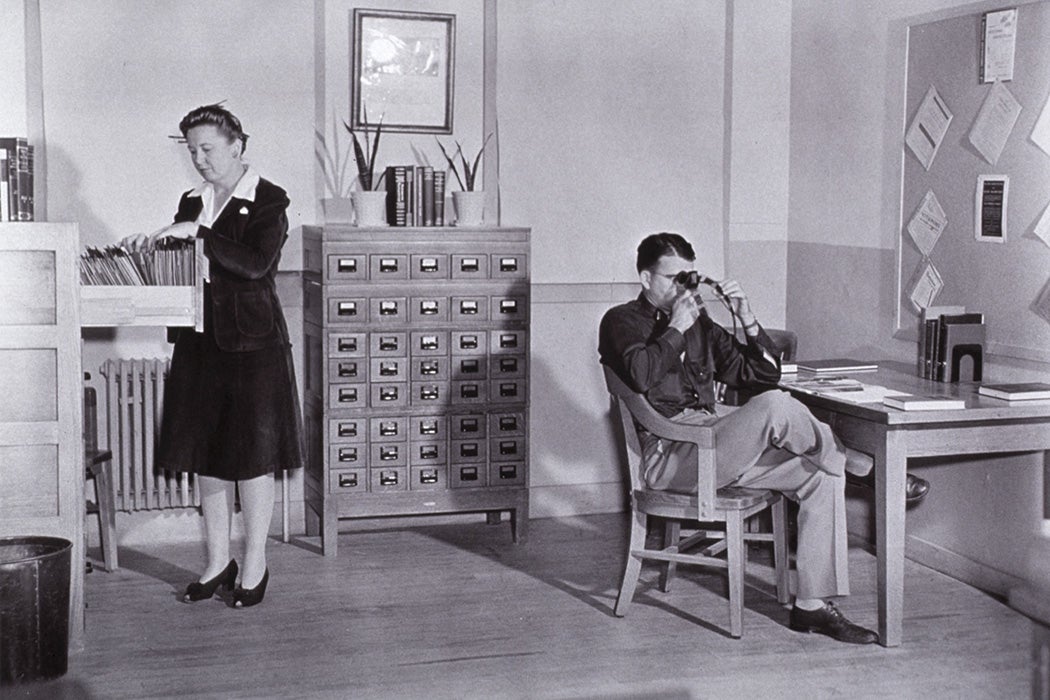
A librarian at the San Antonio Aviation Cadet Center and a patron examining microfilm. US librarians and the invention of microfilm were important to the war effort in the 1940s.

The enduring appeal of fictional detectives like Miss Marple has something to do with the idea that they are very unlikely sleuths. The “mild-mannered” (like Superman’s alter ego Clark Kent) are always undercover, and criminals never notice they are being casually but carefully observed.

Librarians, too, often described as “unassuming,” are not exactly James Bond material. But as we learn in today’s true story, they may provide vital intelligence in wartime.

Katie McBride Moench at JSTOR Daily writes, “In war, as in everything, information is power. And for the United States and its allies in World War II, an epic battle from an analog age, that meant obtaining and transmitting by hand useful intel. ….

“Enter the librarians, tapped by US government officials to help in this effort. These librarians adopted technology from other fields to photograph an array of documents, including those that were rare and/or archival, and found means of sending them across continents. They used both microfilm and microphotography — technologies that came to play a key role in the wars of the twentieth century.

“To the librarians of the World War II-era, microforms were a revelation; microfilm, for instance, was revolutionizing universities. Before its adoption, scholars generally traveled to sites housing materials they wanted or hired locals to do research on their behalf. Microfilm, the product of scaling text or graphics down into miniature forms, made it possible to streamline this process and ship scans anywhere. All that was needed was a microfilm reader on the receiving end to enlarge a scan to the point of readability. This innovation vastly broadened the scope of information researchers around the world could now access.

“It became clear to President Franklin Roosevelt in the months before the US entered the war in 1941 that there was a lag in intelligence gathering. To rectify this, Roosevelt tapped William ‘Wild Bill’ Donovan, a veteran and lawyer, to develop the Office of Strategic Services (OSS) — the precursor to the Central Intelligence Agency. Donovan worked with Archibald MacLeish, a Librarian of Congress who saw the potential for librarians to serve as valuable assets. …

“Under the auspice of the Interdepartmental Committee for the Acquisition of Foreign Publications (IDC), co-created by Donovan and Roosevelt, he enlisted the help of librarians and researchers from across the US.

Adele Kibre, the daughter of a connected Hollywood family, was one such recruit, working out of the IDC’s Stockholm office. Kibre attended the University of California, Berkeley; thereafter she went to the University of Chicago for graduate school, getting a PhD in medieval linguistics in 1930. Like many women of her day, she was denied a career in academia and instead conducted research for other scholars. On one such assignment, she visited the heavily restricted Vatican archives to photograph rare manuscripts; there she saw fellow researchers using microphotography.

“ ‘I acquired the habit of visiting the photographic studio in order to observe philologists, paleographers, and art historians rapidly filming their research materials with miniature cameras,’ Kibre is reported to have said, according to Kathy Peiss’s Information Hunters. Kibre followed suit with a microfilm-producing micro-camera and sent the films back to her employers. …

“Of course, microfilm was only part of the puzzle of increasing the information the US government gathered. … Kibre and IDC staff cultivated relationships with members of resistance movements and Allied sympathizers, creating a pipeline of scientific information leading to the US. Kibre was celebrated for the volume of sources she assembled. She relied on her experience talking her way into archives, museums, and rare books storerooms and on her knack for building relationships with the guardians of these institutions. She cultivated ties with government agencies, librarians, and booksellers sympathetic, or at least agnostic, to the Allied cause. …

“In total, the Stockholm station delivered more than 3,000 books and documents to the US during the war. … The IDC likewise established a station in Lisbon, where its work represented a collaboration between Ralph Carruthers and Reuben Peiss [uncle of author Kathy Peiss] of the OSS and Manuel Sanchez of the Library of Congress. 

“Arriving in Portugal in early 1943, Sanchez spent his first few days shaking the undercover agents trailing him. Once he evaded them, he began buying printed matter he believed would be of value to the Library of Congress. He also cultivated a partnership with the Andrade brothers; they owned a bookstore and were Allied sympathizers.

“The three men habitually crossed into Franco-controlled Spain to elude suspicion during book-buying expeditions. Meanwhile, Carruthers, an expert on microfilm, photographed thousands of pages of text, and Peiss, a librarian, developed systems of information classification and retrieval for the mass of intel collected. So extensive was their work that staff members worked ’round-the-clock shifts to photograph obtained documents, using micro-cameras to create microfilms that would be shipped on a Pan Am Clipper.”

More at JSTOR Daily, here. No firewall.

Read Full Post »