Feeds:
Posts
Comments

Posts Tagged ‘Yo-Yo Ma’

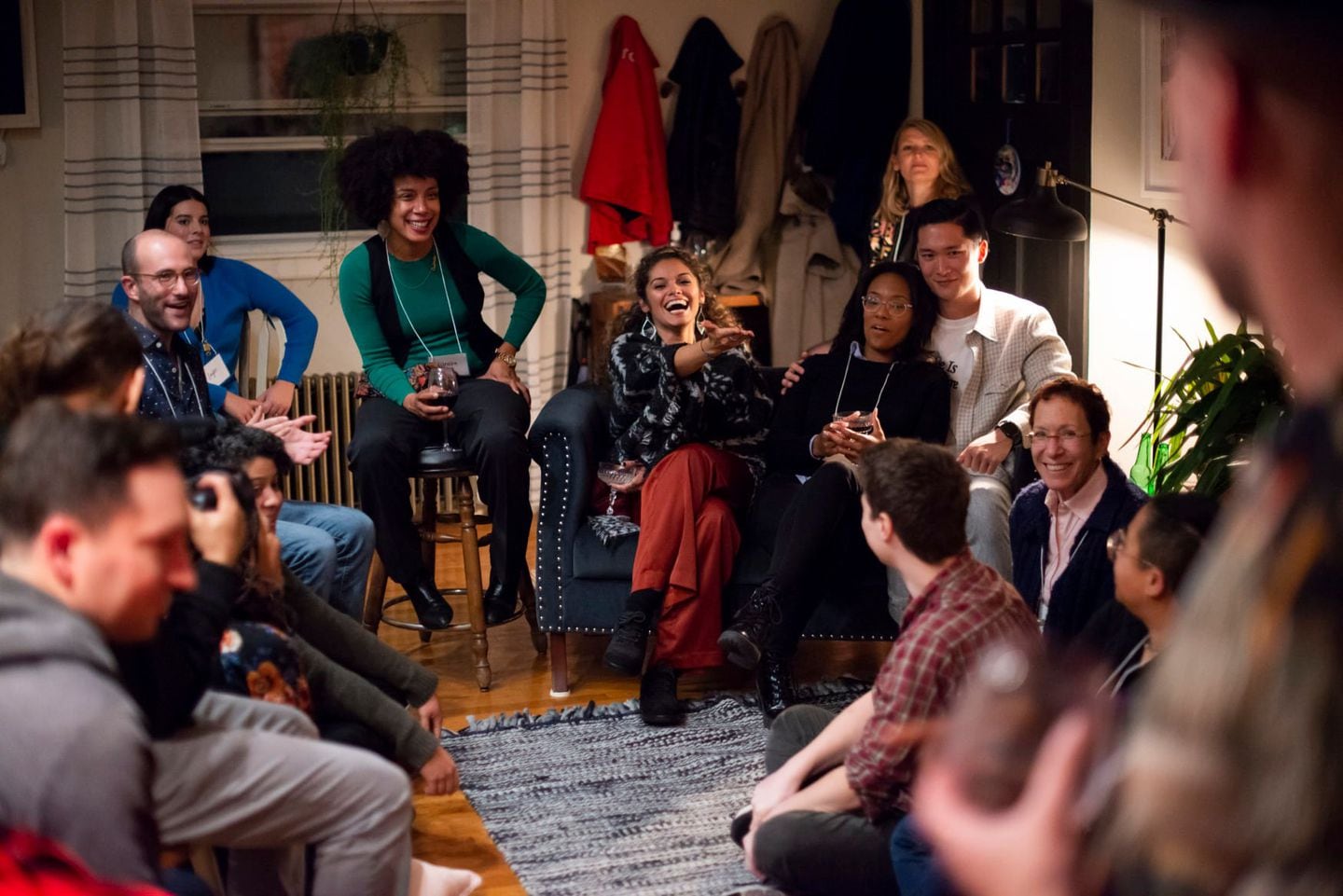
Photo: Anna Olivella/The Jar via the Boston Globe.
A dinner party “salon” hosted by The Jar, a Boston-based organization that uses works of art to create shared cultural experiences.

Many people who would like to reach across to people who are different from them just don’t know how to get started. It’s a challenge. Today’s story is about a group of artists who decided to tackle the challenge. And to have some fun along the way.

Peter Marks writes at the Washington Post, “On a chilly night in the Roxbury neighborhood, dozens of people — White, Black, Asian American, straight, gay, nonbinary, you name it — gathered for an invitation-only event that was equal parts about making art and making friends. Seated on the stage were Yo-Yo Ma, the celebrated cellist, and Liza Donnelly, the New Yorker cartoonist, who had been paired for the evening by the moderator, Guy Ben-Aharon, to explore how their creative lives might converge.

“As Ma played and Donnelly sketched him on a tablet projected onto a large screen, the audience was treated to a rare intersection — and another installment of The Jar, a pioneering nonprofit that aspires to knit a disparate citizenry together. Founded four years ago by Ben-Aharon, a 33-year-old stage director who previously ran his own Boston-based theater company, Israeli Stage, The Jar has developed a gentler model of social engineering. Its goal is forging comradeship via conversations about artistic experiences among groups that otherwise find few opportunities to commingle.

“ ‘There’s something so invigorating about making friends as an adult,’ said Rokeya Chowdhury, a Boston restaurateur and Jar proponent. …

“Bolstered by a $750,000, three-year grant from the Andrew W. Mellon Foundation, The Jar is in the vanguard of a movement seeking to capitalize on the communal powers of the visual and performing arts. … In a society that feels ever more tribal — even in cities that may have progressive cultures but checkered racial histories — inviting someone demographically unlike you to share a drink and an opinion is sometimes akin to a radical act.

“ ‘If you want to see a diverse and vibrant cultural community come to fruition, you have to build it,’ Ben-Aharon said over breakfast. ‘With The Jar, you’re actively invited to build the world you want to live in.’

“Invitation is the password unlocking the group’s mission. Here’s how The Jar works: Several people of divergent backgrounds agree to be ‘conveners’ for a Jar program or ‘happening,’ centered on a preselected reading, poem, playlet, painting or other work. Each convener agrees to bring five others to the event, at $10 a head, with the goal of an audience capped at 96. 

“One invitee in each ‘jar’ of six people is an intimate of the convener; two are ‘usuals’ — friends or colleagues. But two others must be ‘unusuals,’ people the convener barely or only incidentally knows. Or as Ben-Aharon put it, ‘people who you wouldn’t normally experience culture with.’ …

“ ‘The profoundness of it is that it invites people to do it themselves,’ he added about the process. … ‘They don’t really know what effect it will have on them,’ Ben-Aharon said. ‘Let’s say you go to church, and you’re a White gay man, and you go to this church with your husband, and your normal circle is White gay men. …

“ ‘But suddenly you’re invited to The Jar and you have to think of who are the two “unusuals,” and you invite a Black lesbian couple from that church. And suddenly you create a friendship with them. Suddenly you create a bond — and this actually happened, by the way.’ …

“Unlike, say, a religious community, where faith provides the link, Ben-Aharon and The Jar count on the creative soul as its spiritual source. …

“Ben-Aharon and his handful of staffers have had no trouble finding like-minded Bostonians; the catch is that the gatherings are small by design, and cracking the next challenge — how to grow the project, expand it perhaps to other cities — remains elusive. So does attracting additional capital.

“ ‘What we’re trying to do is scale intimacy,’ said Jeff Kubiatowicz, The Jar’s chief of staff. ‘On one hand, we need to use technology in order to make that happen. On the other hand, we have to keep it really, really personal. And we’re trying to balance those two things as we grow it.’

“The Jar’s participants seem to share a passionate belief in the outstretched hand. ‘The Jar’s model is very radical, very subversive,’ said Samantha Tan, an executive leadership consultant who chairs the board. ‘First of all is joy, right? Come here and enjoy yourself — enjoy meeting people who are not like you.’ …

“A few months ago in Roxbury, long a Black neighborhood that has, like so many enclaves in gentrifying cities, undergone changes in its class and ethnic makeup [a] renovated brick-walled space was donated for the happening by Chowdhury. …

“You could sense the audience’s pleasure, not only in meeting these artists up close, but also in having been asked, individually, to be there. ‘I like the people that I meet; it’s good to have places like this,’ said Cornell Coley, who came to the happening from Mattapan, another Boston neighborhood. ‘They created something that brings you out.’

“For artists, too, the invitation to be part of The Jar can elicit joy. Donnelly, who draws for the New Yorker and has also worked for CBS and had cartoons in publications such as Vanity Fair, said in an interview that she hadn’t been sure what to expect. What struck her was that she was able to make a connection herself. ‘Cartooning is communication, dialogue with other people. … I felt the warmth.’ ”

More at the Post, here. See also an earlier article in the Boston Globe, here.
Read Full Post »

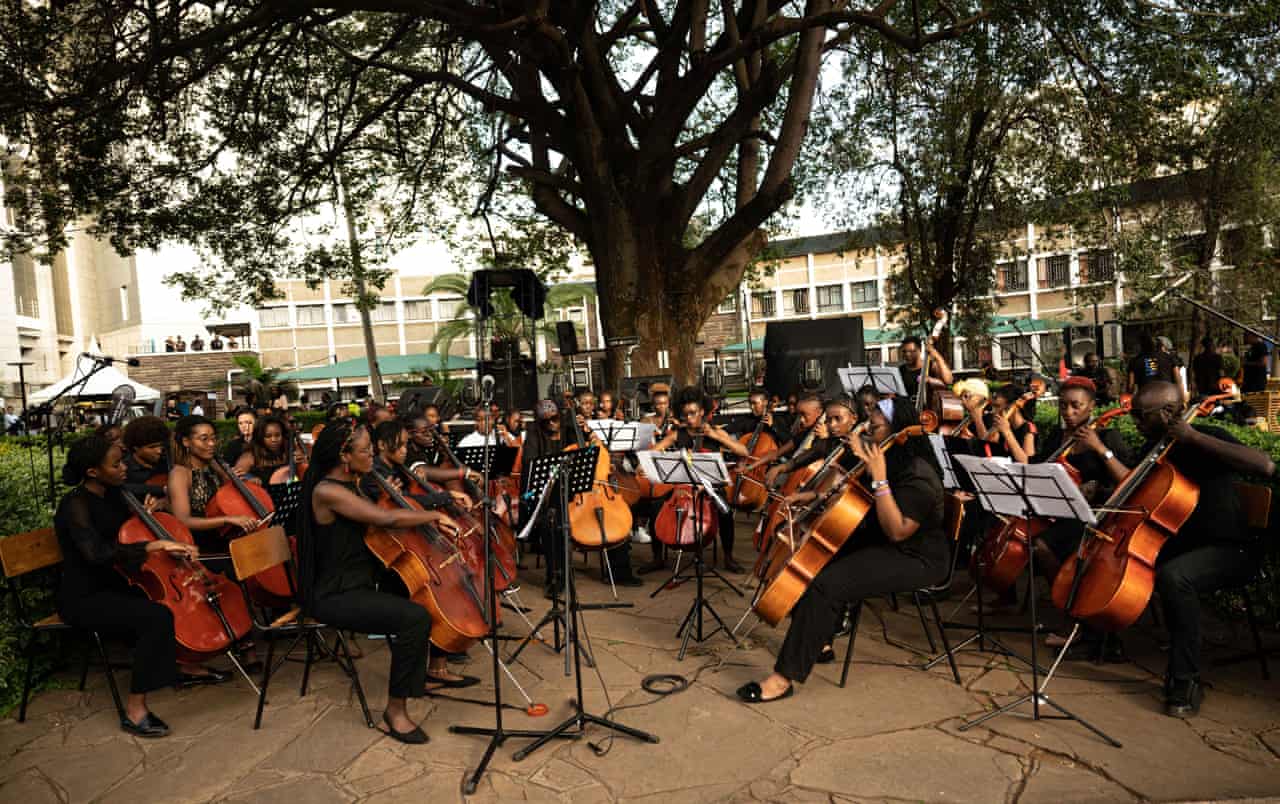
Photo: Edwin Ndeke/The Guardian.
Kenyan classical musicians gave an outdoor performance in Nairobi recently. Cellist Yo-Yo Ma also performed that day. 

Do you know the cellist Yo-Yo Ma? He seems to be performing in a different country every day, and often he’s performing for charity. I follow him on Instagram, and I’m always amazed.

Caroline Kimeu wrote at the Guardian in June about Yo-Yo Ma’s recent visit to Kenya.

“Nairobi’s bustling Kenyatta market is an unlikely place to hear classical music. Yet playing today in front of stalls where butchers roast meat and hairdressers compete over heads to braid is a very surprising busker: the distinguished cellist Yo-Yo Ma. Playing ‘Over the Rainbow’ alongside Kenyan percussionist Kasiva Mutua, he matches his cello to her beats in a truly eclectic mix.

“Ma’s broad artistic sensibilities make weaving together the diverse musical traditions of drum and cello seem like a natural fit. ‘It was symbolic to introduce [classical] music to the crowd through something they know and understand,’ says Mutua. ‘Africans understand rhythm to their core.’ …

“Nairobi is Ma’s last stop of his Bach Project – a five-year, six-continent global tour. With its rising cultural and artistic scene, organizers say the city was near the top of the cellist’s list.

“The project marked Ma’s ambition to connect cultures and people across the world, performing Johann Sebastian Bach’s cello suites in 36 countries. …

“Bach’s cello suites were not well known by the time of the composer’s death in 1750. They began to resurface nearly a century later, and were brought to prominence in the 1930s when Pablo Casals, one of the world’s most highly regarded cellists, performed and recorded the neglected suites.

“Ma has recorded interpretations of the suites three times, with more than a decade between each.

“They are wrapped up with his life’s memories, he has said, citing his first encounter with Bach’s music when he was four: his father, Dr Hiao-Tsiun Ma, taught him the first suite in small, incremental steps. …

“ ‘For almost six decades, they have given me sustenance, comfort and joy during times of stress, celebration and loss,’ Ma wrote at the start of the Bach Project in 2018. ‘What power does this music possess that even today, after 300 years, it continues to help us navigate through troubled times?’

“Beyond busking, Ma takes to a more conventional stage with a concert at the Kenya national theatre. His audience now is a classical crowd – the [$145] auditorium tickets sold out in 24 hours – with prominent members including the arts minister, Ababu Namwamba, and the US ambassador, Meg Whitman. …

“Ma plays as though he is the only person in the room. Only the loud applause breaks through to him, earning his bow and embrace of the audience, arms flung wide. The solemn, lonely fifth cello suite – his penultimate performance – makes the auditorium fall silent.

“From a viewing room on the upper balcony, Brian Kivuti, a 34-year-old Kenyan jeweler, listens with closed eyes. ‘For me, it was a practice in presence,’ says Kivuti. ‘There are no lyrics telling you how to feel. It’s just the music and you, feeling your way through, so you pay more attention to how the notes make you feel. …

“ ‘When I started to listen with my body, I could feel notes of hope, the quiet of a Sunday morning, the dizziness of preparing for a party. The rise and fall of the notes allow you to tap into more than just everyday feelings.’

“At the theatre’s Wasanii restaurant, workers perched on rooftop balcony seats to watch a screening of the performance. For Margaret Wanjiru, a 22-year-old waitress, Ma’s music is a far cry from what she knows, such as her tribe’s Mugiithi. ‘It may not be the music I grew up with, but it slows you down, however much you’re busy, and allows you to get lost in your thoughts.’

“The Nairobi Orchestra, one of the oldest in Africa, performs ahead of Ma’s set, and its musicians are thrilled to have him in the auditorium. Violinist Bernadette Muthoni says: ‘For me, it was very huge to think that Ma was going to play just a few metres from where we were. He’s what a lot of us aspire to.’ …

“Ma is increasingly interested in using his work for social impact. He played outside the Russian Embassy in Washington DC last year to protest against its war in Ukraine, and dedicated his Songs of Comfort to providing solace for people during the difficult days of the pandemic.”

More at the Guardian, here.

Read Full Post »

ma-bb21-2018-beat-billboard-1548

Photo: Judith Jockel/laif/Redux
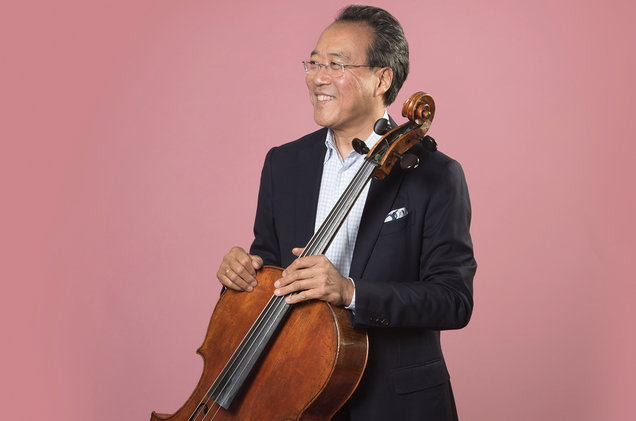
Cellist Yo-Yo Ma is a musician who knows the power of music to be a force for good. Concerned about our fractured society, he asked himself, “What can I do?”

Recently, my husband and I watched the lovely documentary Won’t You Be My Neighbor? — about children’s television visionary Fred Rogers.

Mister Rogers had a gift for speaking directly to the individual child through a mass medium, unlikely as that sounds, looking into the child’s eyes and letting the child know that she was seen.

Cellist Yo-Yo Ma, who ultimately became a friend of Mister Rogers, is seen in the documentary making his first appearance on the show. He tells the documentarian, who happens to be his son Nicholas, that he was scared to death when Mister Rogers put his face very close and looked into his eyes, until he realized that’s what children do.

It made me a bit sad and more conscious of the lack of eye contact today’s children get as we imagine we’re interacting if we talk to them while looking at our phones. No wonder they get stressed. Generally speaking, it’s through the eyes that children learn they are really seen. Mister Rogers understood their needs. He was a great healer.

Yo-Yo Ma is also a healer, but although he has appeared often on television like Mister Rogers, it is music that is his medium. Rebecca Milzof reports at Billboard about Ma’s current project to use his musical gift to help heal the fractured world.

“On Sept. 2, cellist Yo-Yo Ma played all six of Bach’s cello suites at the Nikolaikirche in Leipzig, Germany. It wasn’t out of the ordinary for the world’s most famous classical musician, who was playing at the church where the composer premiered many of his works. But the setting had a deeper meaning: In 1989, it’s where peaceful rebellions against communist rule — which led to the fall of the Berlin Wall — began.

“ ‘This is the very [place] where these [political] changes happen,’ says Ma, 62, over the phone from Leipzig. Today, he notes, Syrian refugees are coming to the city and facing demonstrations of a different sort — from right-wing nationalists. ‘It’s the right moment to explore the idea of home. What is home? It’s where you go to be sustained in difficult times. For me, Bach is home.’

“Over the next two years, Ma will visit 36 sites worldwide as part of his Bach Project, playing the cello suites in places like the Nikolaikirche — settings with sociopolitical meaning. It coincides with the recent release of his third and final recording of the suites, Six Evolutions.

“ ‘We live in more and more of a fractured society,’ the 18-time Grammy winner says. ‘As a cellist, I was thinking, “What can I do to help?” I’ve been toying with the idea of “citizen musicians” for a while.’ …

“So far, that has meant engaging with the Mexican-American community around Denver after playing Red Rocks in August and meeting community organizers spurring industrial revitalization outside Cleveland.

“ ‘One of the things culture does best is to make the “other” into “us,” ‘ he says. He’ll test that idea on six continents.” More at Billboard, here.

By the way, Nell Minnow has a really nice interview with the younger Ma about Won’t You Be My Neighbor? on Medium, here. He talks about performing with his dad as a child on Mister Rogers’ Neighborhood, and he still sounds amazed that Fred Rogers could get him to do that.

Read Full Post »