
Feeds:
Posts
Comments

Posts Tagged ‘young people’

Photo: Trilogy Captain’s Log.
“Lahaina Strong Paddle Out” expresses the determination of young Hawaiian climate activists after the fires in Maui.

I am so relieved to see young people taking charge of some of the issues that have messed up our planet. They focus on goals and don’t get distracted by the usual specious arguments for not upsetting the apple cart or for taking more time. Good things do happen when you don’t realize your goal is “impossible.”

Consider these young people in Hawaii.

Dharna Noor and Lois Beckett write at the Guardian, “Hawaii officials have announced a ‘groundbreaking’ legal settlement with a group of young climate activists, which they said will force the state’s department of transportation to move more aggressively towards a zero-emission transportation system.

“ ‘You have a constitutional right to fight for life-sustaining climate policy and you have mobilized our people in this case,’ Josh Green, the Hawaii governor, told the 13 young plaintiffs in the case, saying he hoped the settlement would inspire similar action across the country.

“Under what legal experts called a ‘historic’ settlement, announced [in June], Hawaii officials will release a roadmap ‘to fully decarbonize the state’s transportation systems, taking all actions necessary to achieve zero emissions no later than 2045 for ground transportation, sea and inter-island air transportation,’ Andrea Rodgers, one of the attorneys representing the plaintiffs in the case, said at a press conference with the governor.

“ ‘This is an extraordinary, unprecedented victory for the youth plaintiffs,’ Michael Gerrard, the faculty director of the Sabin Center for Climate Change Law at Columbia University, told the Guardian.

“While Hawaii has long embraced a progressive climate change agenda, with 2045 as a target year for decarbonization, the new settlement is ‘as big a deal as everyone said it is,’ said Denise Antolini, an emeritus professor of law at the University of Hawaii Law School, who has followed climate change litigation for decades. …

“The June 2022 lawsuit, Navahine F v Hawaii Department of Transportation, was filed by 13 young people who claimed the state’s pro-fossil fuel transportation policies violate their state constitutional rights. By prioritizing projects like highway expansion instead of efforts to electrify transit and promote walking and biking, the complaint says, the state created ‘untenable levels of greenhouse gas emissions.’ As a result, state officials harmed the plaintiffs’ ability to ‘live healthful lives in Hawaii.’ …

“It named the Hawaii Department of Transportation and its director, as well as the state of Hawaii and its former governor David Ige, as defendants.

“The plaintiffs, most of whom are Indigenous, alleged that by contributing to the climate crisis, the state hastened the ‘decline and disappearance of Hawaii’s natural and cultural heritage.’ When the case was filed, the plaintiffs were between the ages of nine and 18. …

“Navahine, whose name is on the lawsuit, is a 16-year-old Native Hawaiian whose family has been farming the land ‘for 10 generations.’ Drought, flooding and sea level rise were all having immediate effects on her family’s crops, she said. ‘Seeing the effects, how we were struggling to make any money for our farm, kind of pushed me to this case,’ she said.

“Officials said the legal settlement brings together activists with all three branches of the state’s government to focus on meeting climate change goals, including mobilizing the judicial branch. The court will oversee the settlement agreement through 2045 or until the state reaches its zero emission goals, Rodgers said.”

More at the Guardian, here. No paywall. Donations sought.
Read Full Post »

Photo: The Guardian.
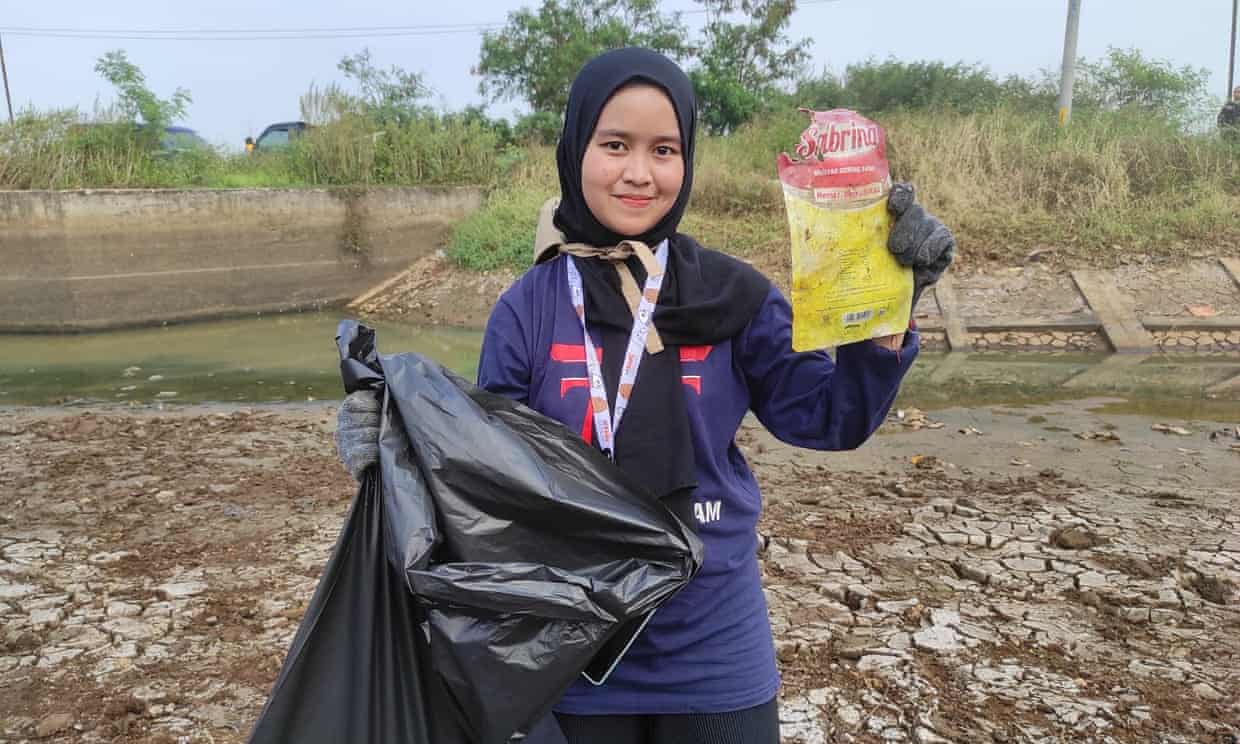
Resti Khairunnisa, 22, is a follower of Pandawara on TikTok. She joins other followers in collecting plastic waste from the Bandung dam in Indonesia. 

The young people will save us all. They certainly shouldn’t have to, but it restores our faith in humanity when we see them taking “arms against a sea of troubles” and not wasting time blaming those of us who deserve blame.

What is the secret of their strength? Perhaps not knowing what’s “impossible” enables people to do it anyway.

Guardian reporter Ardila Syakriah has this story from Indonesia.

“They started as flood victims, now they are touted as local heroes for cleaning up the rivers and beaches of Indonesia’s third largest city, Bandung in West Java, amassing over 9 million followers on TikTok and Instagram in the process and influencing others across the country to join the fight against pollution.

“The Pandawara group is five men in their early twenties and was formed in 2022 after flooding caused by rivers clogged with rubbish damaged their homes. … On TikTok, their profile – @pandawaragroup – contains over 100 short videos of their river and beach clean ups, earning them millions of views and totalling over 100 million likes.

“ ‘We have a team of river hunters who identifies rivers with urgent trash issues, where flooding can happen after rainfall,’ Pandawara member Gilang Rahma told the Guardian.

“The Greater Bandung area where they live produces 2,000 tons of waste each day, 10 to 20% of which doesn’t make it to landfill and often ends up in rivers. The vast mountain of waste produced in the region has exceeded landfill capacity by 800%, according to West Java official Prima Mayaningtyas. …

“Pandawara began modestly in 2022, cleaning up rivers around their neighborhood, protected by rubber hand gloves and boots. As they became full-time online celebrities-slash-activists, they were invited to meet government officials and receive partnership deals. As their popularity grew, so did their cleanups, which spread to other islands in Indonesia. 

TikTok went as far as to deem some videos as sensitive content because the sight of decaying rubbish might be considered disturbing by some viewers. …

“ ‘Sometimes when we call for volunteers, thousands would sign up but we could only select dozens due to limited space. At other times we don’t limit the number. These are for when we can’t clean up by ourselves,’ Gilang said, adding that the group hoped to use the social media platform to raise gen Z’s awareness of pollution.

“Pandawara’s latest call saw 600 people, including local government staff and officials, join the clean up of 17 tons of waste from the Bugel dam in Bandung regency, which is connected to West Java’s longest river, on 27 July.

“One of them was 22-year-old Resti Khairunnisa, who went straight to volunteering after finishing a night shift. Resti, who lives nearby the dam, said she had been inspired by Pandawara’s videos and would not hesitate to jump in even with limited protective gear.

“ ‘I haven’t slept at all. I’ve been concerned about waste pollution, but this is my first time taking action,’ she said after three hours of cleaning up, her sandals fully covered by mud.

“Another volunteer, 21-year-old university student Imam Ahmad Fadhil, himself a victim of floods, said he had been following Pandawara since before they became famous and lauded the group’s consistency. But he maintained that community-based initiatives were not enough.

“ ‘Some people know littering is wrong, but there is no waste facility in their village, nor do they have the tools to transport the waste, so they are left with no other options,’ he said.

“West Java official Prima Mayaningtyas acknowledged the need to improve waste management and people’s behaviors amid growing waste volumes, as the government looks to complete the construction of its estimated [$265 million] waste to energy plants by 2030.”

More at the Guardian, here.

Read Full Post »

As I often say to my grandchildren when they come up with creative ideas, “I love people with ideas!” And nowadays I find young leaders with ideas especially inspiring. I think if teens and 20-somethings working to end gun violence and reduce global warming are successful, they will have earned the mantle of the Great Generation.

Today’s story is about a couple of teens who wanted to use music to help children smile.

Kyle Melnick writes at the Washington Post, “After asking nine children on her computer screen to retrieve a piece of paper and something to draw with, Charu Balamurugan explains the class’s next lesson.

“ ‘We’re going to listen to parts from each of these three different songs,’ Balamurugan says, ‘and you’re going to use … different types of lines [or drawings] to show how it makes you feel; the emotions you feel.’

“A few moments later, when Balamurugan plays the first song, Peter Schmalfuss’s version of ‘Clair De Lune,’ the children put their heads down and draw images that pop into their minds.

“By the time Balamurugan has streamed three classical songs during this Zoom class on a Friday evening in late August, the kids’ papers feature drawings of watermelon, roller coasters, chocolate bars, sunsets, cupcakes, pumpkin patches and Snoopy.

“Los Angeles high school students Balamurugan and Katheryn Williams created this class, Music for Milestones, to provide local children a creative outlet through music. The free Zoom classes give children a chance to socialize and clear their minds at a time when they’re usually stuck in their homes during the coronavirus pandemic.

‘The most meaningful part about all of this is getting to see the kids smile every single class and the joy on their faces,’ Williams said. …

“Balamurugan began playing the piano at age 6. She went through hour-long practices almost every day and partook in local competitions. Balamurugan enjoyed playing waltz, but she also liked performing pop songs to energize family and friends. Playing the piano would boost her family members’ spirits after they returned from work.

“In high school, the piano became more of a creative outlet for Balamurugan as she realized how composers deliver a story or message through their performances. She taught piano to family friends who had money for lessons, but she wanted to reach those who didn’t.

“Meanwhile, music was a driver in Williams, improving her state of mind. When she was 9, she lost motivation to pursue goals in and outside of school. She felt angry at the world.

“Around that time, Williams’s grandmother, Delmy Lopez, played her ‘Esta Vida’ by Jorge Celedón — a song that preaches appreciating the small pleasures in life. That song changed her perspective, and the next day she signed up for her school’s band, learning the bass, guitar and drums. She later gained the confidence to try out for the school’s basketball team.

“In December, Balamurugan and Williams attended a meeting at their school about the Dragon Kim Foundation, which offers a fellowship program that provides $5,000 to a handful of California teenagers, helping jump-start programs they aim to form in their communities. … They wanted to team up to create a music program.

“They decided they would teach music to children around the Los Angeles area. They would create a free workbook for the class and use the grant they’d receive to purchase keyboards for the children participating. …

“Balamurugan said, ‘Katheryn is an amazing public speaker and has such an affable personality, and with me taking the reins on the organizational aspects, we played on each other’s strengths.’ …

“The original plan was for the hour-long classes to occur in-person, but they shifted to Zoom when the pandemic arrived. Online classes have allowed Balamurugan and Williams to expand their reach, as families have inquired about joining from multiple states. … Balamurugan and Williams go over the basics of music notes and tempos, give instructions on how to play the piano and suggest how to use music to improve one’s mind-set. …

“Balamurugan and Williams are proud to inspire children by showing them women of color can create and teach music, too.

“ ‘We want kids to know that through all your struggles, through anything that you’re facing,’ Williams said. More here.

Read Full Post »