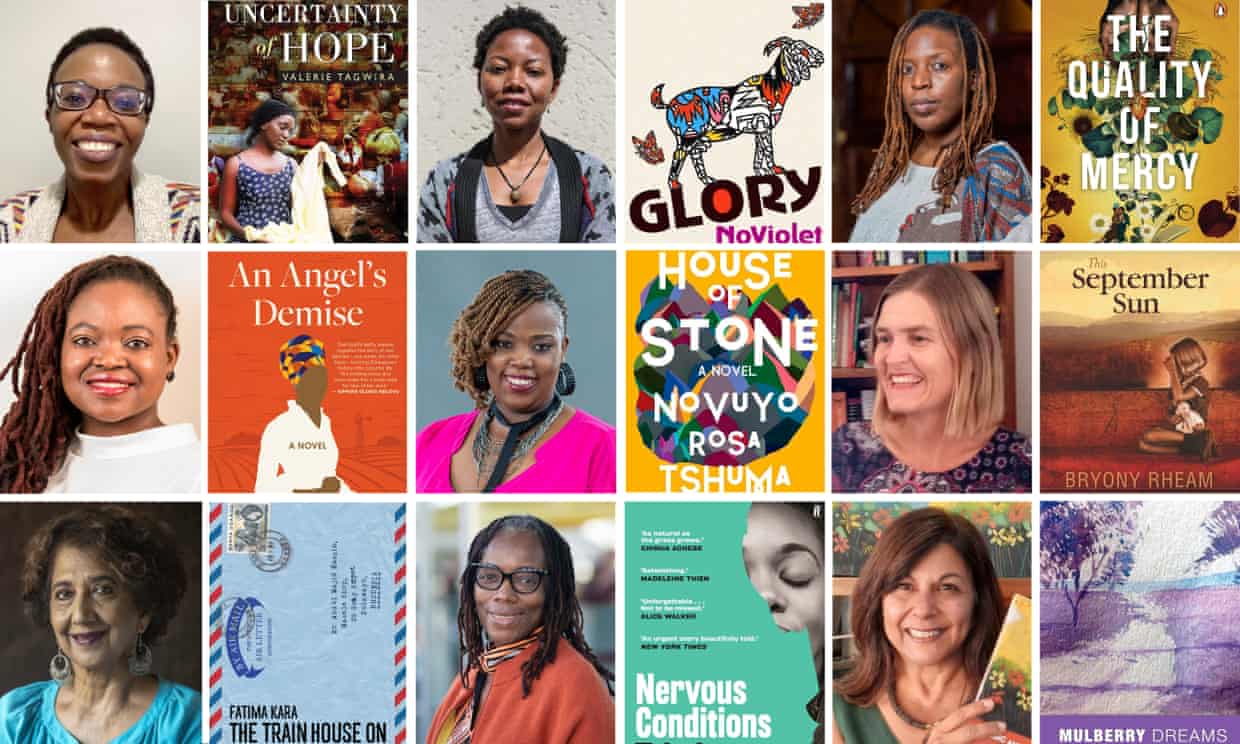
Photo: The Guardian notes that women are at the forefront of a seminal moment in Zimbabwe literature.
The African nation Zimbabwe, formerly a British colony called Rhodesia, has suffered years of trauma perpetrated by every side in the conflicts. But when women start publishing books in record numbers, you can bet the country is moving into a new and better phase.
Tawanda Mudzonga reports at the Guardian, “A handful of events, says author Siphiwe Gloria Ndlovu, define her generation. ‘The war, the HIV crisis, migration and the brain drain, and the creation of the Zimbabwean diaspora.’
“They have not been topics that the country’s rulers want spoken of and many who have spoken frankly about Zimbabwe have been imprisoned or persecuted. But a new generation of female novelists is exploring the people, the political problems and the history of this complicated and still fledgling nation.
“ ‘I wanted to talk about what had happened. What does 40 years of a postcolonial country look like, and what does 40 years of a postcolonial country look like for us,’ says Ndlovu, author of the award-winning The Theory of Flight. …
“Ndlovu and her contemporaries, who include Novuyo Rosa Tshuma, Sue Nyathi and Valerie Tagwira, follow in the footsteps of celebrated author Tsitsi Dangarembga, whose 1988 book, Nervous Conditions, was the first published novel that had been written in English by a black Zimbabwean woman.
“Ndlovu’s lyrical writing has reimagined how stories about post-independence Zimbabwe are told, and reflected some of the country’s darker moments. …
“Ndlovu comes from Bulawayo, in the Matabeleland region. In The Theory of Flight, she writes about the Gukurahundi massacres, committed in the 1980s under the direction of Robert Mugabe, which killed an estimated 20,000 people, predominantly ethnic Ndebele from Matabeleland and Midland regions.
“Postcolonial Zimbabwe has been defined by a narrative in which the ruling Zanu-PF party explains its valiant efforts and sacrifice to liberate Zimbabwe, but the events of Gukurahundi do not feature in the country’s history books.
“ ‘What happened in the 80s, in this part of the country – it left something unresolved that needed to be resolved. A lot of writers decided the best way to do that is to write about it.’
“Novuyo Rosa Tshuma explores the same period in her debut book, House of Stone. ‘I didn’t know much about Gukurahundi, and it was the act of writing House of Stone that helped me sit with it and unpeel those layers,’ says Tshuma, who is also from Bulawayo. ‘We didn’t speak about it in my family. We knew it happened, but we were always encouraged not to talk about it. …
“ ‘If you notice the forms of violence that have come after that, experienced in the 2000s, what we are experiencing stemmed from that period, and also from the liberation period. That’s why I think it’s important to look at that time – it helps us to frame and think about and understand why we are where we are.’ …
“The novel is not available inside Zimbabwe. [Says] Tshuma, ‘That made me sad because I had envisioned this as a book that speaks to Zimbabweans directly. I’m talking to my people.’
“Dr Tinashe Mushakavanhu, a research fellow in African and comparative literature at the University of Oxford, says this is a seminal moment in Zimbabwean literature. ‘It’s exciting. … At the turn of the millennium, it is the women writers who have been carrying the burden of Zimbabwean literature.’ …
“The excitement comes at a price. ‘It is a burden to carry because Zimbabwe is not a forgiving country, especially if you choose to use your voice, if you are opinionated,’ Mushakavanhu says. … ‘In terms of the abuse one gets, the name-calling, you do not find that when male writers are writing Zimbabwe.’
“Sue Nyathi, whose novel, An Angel’s Demise, was published in 2022, says there is risk associated with writing. ‘The politics is such that there’s a lot of censorship. You can’t just write what you like without fear.
“ ‘That’s why people write books like Animal Farm. They use satire. There’s a fear of persecution when writers express themselves in their stories, and self-censorship.’ …
“Valerie Tagwira was afraid of the repercussions from her novel The Uncertainty of Hope, published just after the government’s Operation Murambatsvina (Clear Out the Trash), a slum clearance operation which displaced thousands of people in 2005. … ‘[My cousin] said: “Why are you being so reckless? Writing about this, we could end up being targeted.” ‘ …
“Tagwira asked her publisher if she thought it would be seen as a political book. ‘I was a bit scared because of what my cousin said.’ Her publisher assured her it wouldn’t be, and cautioned her against self-censorship. …
“Other success stories are white Zimbabwean Bryony Rheam with her award-winning debut novel, This September Sun, and Violette Kee-Tui and Fatima Kara who have written about Zimbabwe’s mixed-race and Indian communities respectively, in Mulberry Dreams and The Train House on Lobengula Street.“
More at the Guardian, here. No firewall.


 Suzanne's Mom's Blog