Photo: The Guardian.
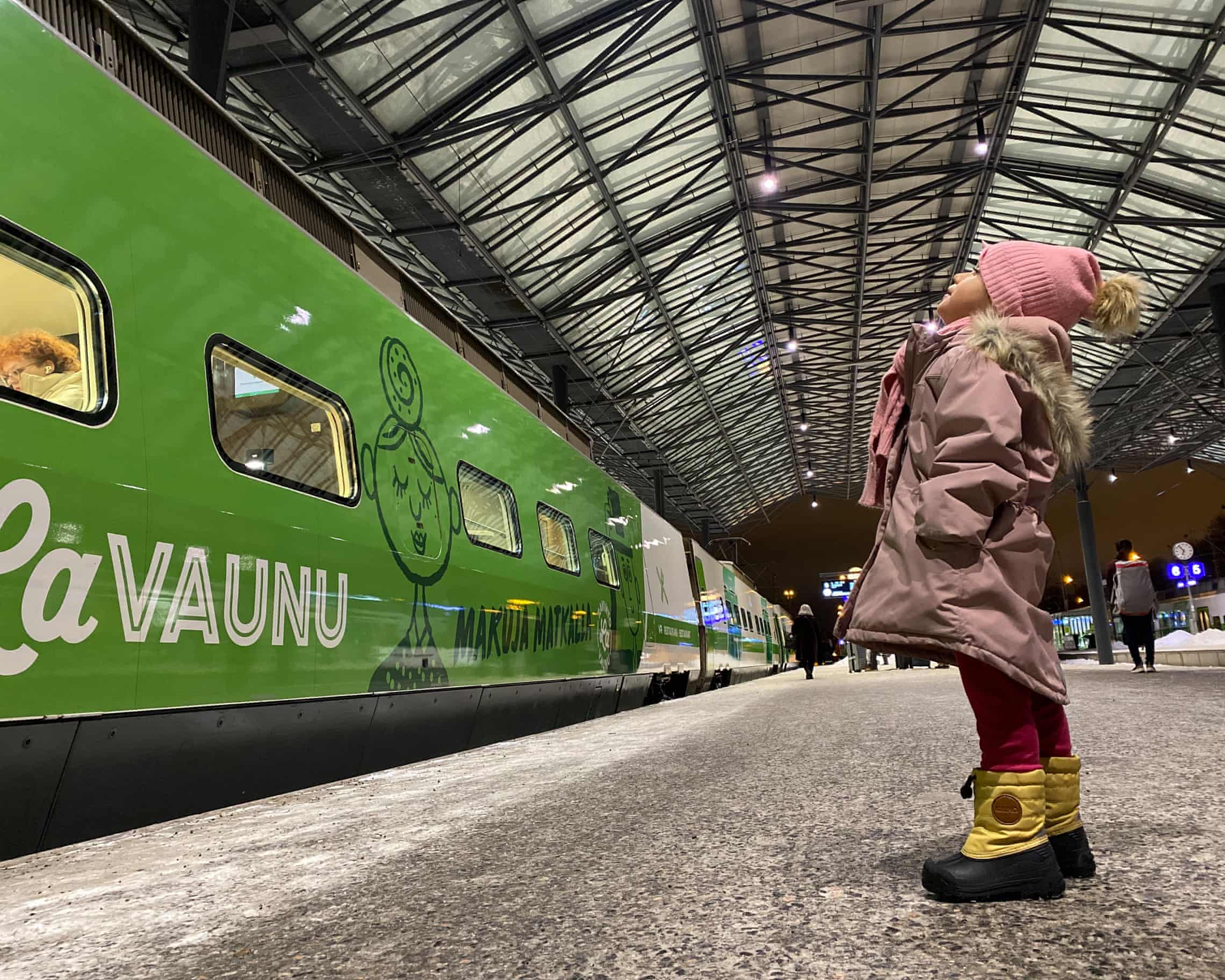
The Santa Claus Express sleeper ready to leave Helsinki station on its journey north to Rovaniemi in Finnish Lapland.
When Suzanne and John were small, we somehow acquired a large poster of Finnish Lapland that purported to show the way to Santa’s headquarters. I had always assumed Santa lived at the North Pole, but I was beginning to learn about marketers with other ideas.
Natasha Geiling and Kayla Randall have the story at the Smithsonian magazine, starting with Alaska’s claim: “It wasn’t the actual North Pole. But the fact that it was over 1,700 miles from it, smack in the heart of interior Alaska, was a minor detail.
“When Bon and Bernice Davis came to Fairbanks in early April 1944, they weren’t looking for the North Pole. As they drove their rental car out of town, they had something else on their mind: finding 160 acres on which to make their homestead, something Alaska law allowed if they used the area for trading or manufacturing purposes. … In the summer, nearby streams might attract grayling fish and waterfowl, but in the snow-covered month of April, it was hard to see that potential. The area did boast one unique quality: consistently cooler temperatures, about seven to ten degrees colder than anywhere else in interior Alaska. …
“With its proximity to both the highway and Fairbanks, the Davis’ homestead soon attracted neighbors. … By the early 1950s, the homestead had also attracted the attention of the Dahl and Gaske Development Company, which purchased the land — nearly in its entirety — in February 1952. … If they could change the homestead’s name from ‘Davis’ to ‘North Pole,’ they reasoned, toy manufacturers would flock from far and wide. …
“Things didn’t go according to plan — even with its location right on Richardson Highway, the Alaskan North Pole was too remote to sustain manufacturing and shipping. However, part of Dahl and Gaske’s vision eventually did take shape at a local trading post, which became one of several places that claimed to be Santa Claus’ home during the 20th century. Now a tourist destination, the town of North Pole in Alaska calls itself the place ‘where the spirit of Christmas lives year round’ and boasts the Santa Claus House, a holiday-themed family business.
“The real Santa Claus — the historical figure upon which the legend is based — never lived anywhere near the North Pole. Saint Nicholas of Myra was a fourth-century bishop who lived and died far from the Arctic Circle, in what is now Turkey. Born into a wealthy family, Nicholas is said to have loved giving gifts. …
“Santa’s red robes and gift-giving habits were based on Saint Nicholas, but his chilly home base is the invention of cartoonist Thomas Nast, whose famous depiction of Santa Claus in a December 1866 issue of Harper’s Weekly set the precedent for our modern image of the jolly fellow. Before Nast, Santa had no specific home, though by the 1820s, he was already associated with reindeer and, by extension, the frigid climes in which those reindeer live.
“In 1866, Nast’s cartoon ‘Santa Claus and His Works‘ featured the words ‘Santaclaussville, N.P.’ alongside Santa performing the tasks people now associate him with, from making toys to making his list (and checking it twice, of course). The ‘N.P.’ stood for North Pole, where Nast had placed his workshop and residence. …
“In 1949, [Santa’s home] took physical form for the first time, 13 miles from Lake Placid, New York. While trying to keep his daughter occupied during a long drive, Julian Reiss, a New York businessman, reportedly told her a story about a baby bear who went on a great adventure to find Santa’s workshop at the North Pole. Reiss’ daughter demanded he make good on his story and take her to the workshop. …
“He teamed up with the artist Arto Monaco — who also helped design Disneyland in California — to create a physical version of Santa’s workshop on 25 wooded acres around Lake Placid. Santa’s Workshop in North Pole, New York, with its novel depiction of Santa’s magical workplace, brought visitors by the thousands. …
“Other businesspeople found success drawing tourists with the Santa Claus legend without borrowing the Arctic landmark. America’s first theme park, now Holiday World & Splashin’ Safari in Santa Claus, Indiana, actually operated as ‘Santa Claus Land‘ until 1984. …
“[Paul Brown — who today runs Alaska’s Santa Claus House along with his wife, Carissa] acknowledged that other places that claim equal ownership to Santa’s legend. ‘From a competitive standpoint, if you want to call it that, Rovaniemi, Finland, would be our biggest competition.’
“Rovaniemi — the administrative and commercial capital of Lapland, Finland’s northernmost province — wasn’t much of a tourist destination before Santa Claus came to town. Lapland had served as a sort of nebulous home base for Santa Claus in the European tradition ever since 1927, when a Finnish radio host proclaimed to know the secret of Santa’s hometown. He said it was in Korvatunturi, a mountainous region in Laplan. … Like the North Pole of Nast’s creation, however, Korvatunturi was real in theory but not necessarily to be visited.
“Santa’s home later moved over 225 miles south to Rovaniemi, thanks to an American visitor. During World War II [Rovaniemi burned] to the ground, leaving Lapland’s capital city in ruins. From those ashes, Rovaniemi rebuilt itself according to design plans that dictated its streets spread like reindeer antlers through the city. In 1950, on a tour of postwar reconstruction, former first lady Eleanor Roosevelt paid Rovaniemi a visit, allegedly saying she wanted to see Santa Claus while in the Arctic Circle. The town hastily constructed a cabin, and Santa’s Village in Rovaniemi was born. But tourism to Rovaniemi really took off in 1984. …
“From North Pole, Alaska, and North Pole, New York, to Rovaniemi, Finland, the mythology of where Santa Claus lives creates an economy. [But] Brown, for his part, sees himself as safeguarding the legend of Santa Claus. ‘We are very protective of the magic of Christmas and allowing kids to have that for as long as they can have it,’ Brown said. ‘Just like Santa is the embodiment of joy and goodwill, we think of ourselves as one of the embodiments of the spirit of Santa.’ ”
More at the Smithsonian, here. Check out a trip on Lapland’s Santa Express at the Guardian, here.

 Suzanne's Mom's Blog
Hannah writes, “My mom took me to Santa’s workshop in North Pole, NY, when I still believed. It was an incredible trip. I still remember feeding the reindeer…”
LikeLike
For me, Hannah, that totally makes up for the commercial aspect.
LikeLike
Wonderful post
LikeLiked by 1 person