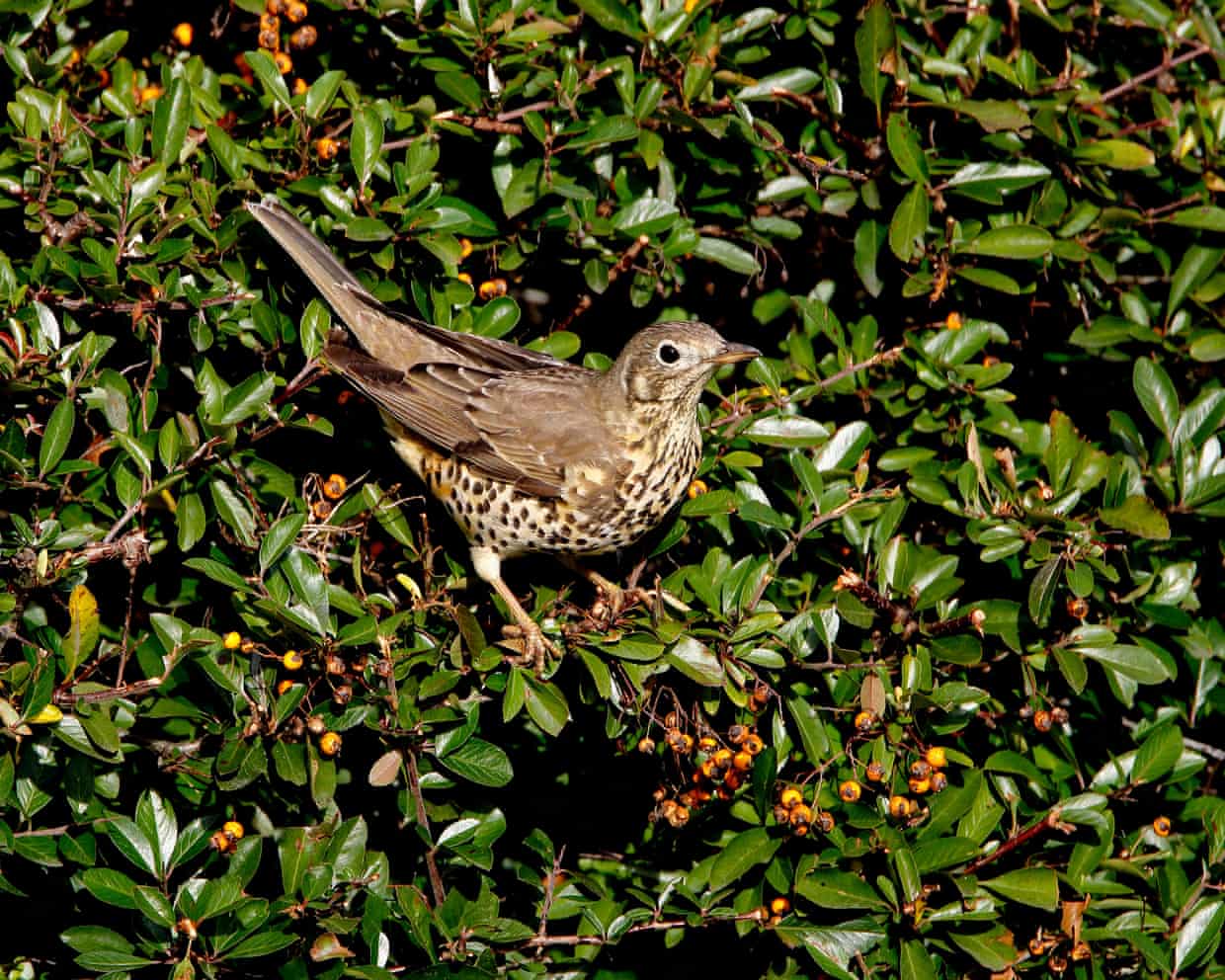
Photo: Nature Picture Library//Alamy.
A mistle thrush (Turdus viscivorus) in a bush in an industrial estate in North Wales, UK, November 2025.
Today I want to combine two Guardian articles about birding because they are closely related. The first one, by David Batty, highlights a study on how being around birds can improve your mental health. The second is on the Merlin app, which can help connect you.
The mental health study, “led by academics from King’s College London, [found] that everyday encounters with birds boosted the mood of people with depression, as well as the wider population.
“The researchers said the findings suggested that visits to places with a wealth of birdlife, such as parks and canals, could be prescribed by doctors to treat mental health conditions. They added that their findings also highlighted the need to better protect the environment and improve biodiversity in urban, suburban and rural areas in order to preserve bird habitats.
“The study, published in the journal Scientific Reports, tracked 1,292 participants’ everyday encounters with birds [in 2024] via a smartphone app called Urban Mind. …
“The artist Michael Smythe, of Nomad Projects, which helped King’s College London develop the smartphone app for the study, said the research also posed questions about the link between health inequalities and access to nature, with other research showing deprived areas often had less green spaces than affluent areas.
“Nomad Projects co-founded Bethnal Green Nature Reserve Trust, which built a pond last summer that Smythe said had attracted an ‘enormous diversity of birds.’
“ ‘It’s a very therapeutic complex, biodiverse, abundant space within a massive housing estate between four artery roads,’ said Smythe. ‘It’s now a place where people go en masse every day just to relax.’ ”
Then there’s Patrick Barkham‘s piece on a phone app that a lot of us have been using for more than a year: Merlin.
“Merlin is having a moment. The app, developed by the Cornell Lab of Ornithology in New York, which listens for birdsong and identifies the species singing, has been downloaded 33m times, in 240 countries and territories around the world. … Every month, there has been a 30% increase in new users of the app, whose sound identification function was launched in 2021.
“Merlin has been trained to identify the songs of more than 1,300 species around the world, with more birds added twice a year. Different songs make distinct patterns on spectrograms and Merlin is trained to recognize these different shapes and attribute them to a species. …
“Angela Townsend from Bedfordshire began using Merlin after going on a nightingale walk one spring and being overwhelmed by the range of bird-voices in the evening chorus. She has found it has steadily built up her bird knowledge. …
“Mary Novakovich, author of My Family and Other Enemies, is another recent adopter. She has found it particularly useful when traveling across Croatia, where her parents are from. ‘I love putting a name to a face and a name to the sound,’ she says. “It really brings you closer to the natural world. …
“Merlin is not flawless, however. The first time Kasper Wall, 12, tried it in his Norfolk garden, it detected a northern cardinal and a brown-headed cowbird – North American species not found in Britain.
“ ‘I think it was figuring out where we live,’ says Wall, who enjoys using it even though he is now an extremely knowledgeable birder. ‘A couple of weeks ago we were looking at a large group of goldcrest and it came up with a firecrest. I thought, “Oh, there must be a firecrest in here too” and 30 seconds later we saw one, which was the first I’d ever seen. I like it and it’s very good but I wouldn’t say that it’s better than the best people at identifying bird-calls. …
“Wall enjoys fooling Merlin with his uncanny impressions of a curlew, barn owl and greenshank.
“[Naturalist Nick] Acheson doesn’t use Merlin. He welcomes it, but points out it can replace learning. ‘Anything that gets people out, thinking about and reacting to nature is a great thing,’ he says. ‘But there’s certainly a risk that people don’t learn and just abdicate responsibility for learning to Merlin.’
“He has noticed a glitch where Merlin interprets a certain type of chaffinch call as a redstart, leading to people being absolutely adamant that there is a rare bird in their garden. … John Williamson, who works as a guide for Norfolk Wildlife Trust, has found Merlin repeatedly identifying high-pitched calls as a spotted flycatcher, a bird that is very unlikely to be found in the middle of Hickling Broad nature reserve’s large reedbeds. …
“That said, Williamson finds it a ‘good tool’ and welcomes how it is encouraging new people to enjoy birdsong. … ‘I find it impressive that an app can empower people to go out into nature, he says.”
More on Merlin at the Guardian, here, and on mental health through birding, here.
I love birds myself, although at the moment I am really put out with goldfinches. They strip the feeder of seeds in a day, aggressively pushing out other birds, and they mess up my little balcony with droppings. But I’ll get over it. What is your relationship with birds?

 Suzanne's Mom's Blog
Downloaded the app, works really well! Thanks!
LikeLike
Awesome! I am so glad!
LikeLiked by 1 person
I’ve been meaning to use Merlin but somehow never have. Maybe this will be the year.
LikeLike
I find it sometimes doesn’t hear anything even though I do. It’s puzzling.
LikeLiked by 1 person