Feeds:
Posts
Comments

Posts Tagged ‘birdsong’

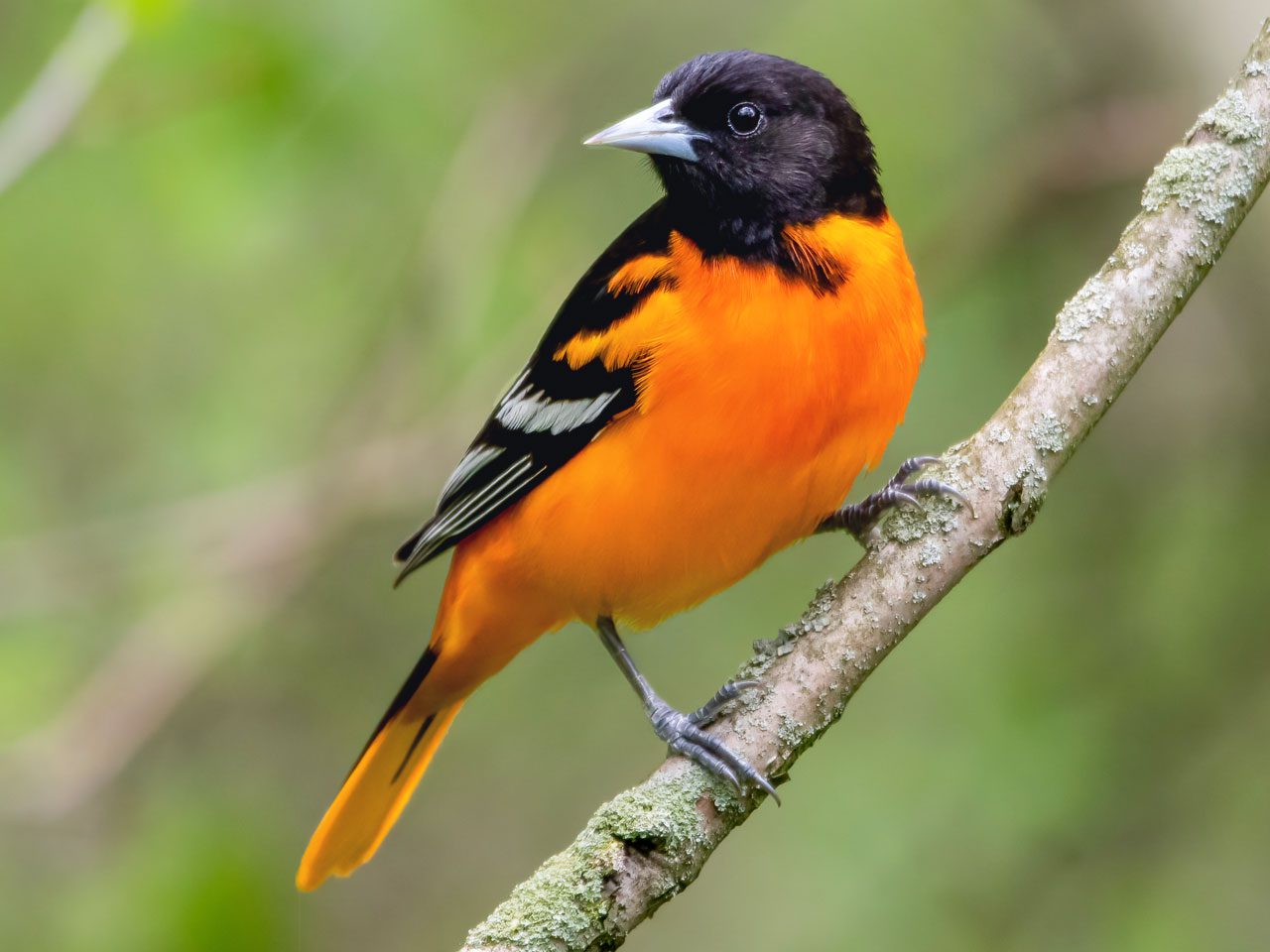
Photo: Matthew Plante / Macaulay Library.
The Baltimore Oriole is a bird I can never get enough of. I found this picture at birds.cornell.edu. The last Baltimore Oriole I saw was thanks to the Merlin app telling me it was somewhere near.

Have you used the free Merlin app to identify birds? I really love it. Among other things, it has helped me recognize some birdcalls by myself. The red-bellied woodpecker, for example, which I would describe as a squawk and a gargle.

Sandra Laville writes at the Guardian, “The Merlin bird ID app will allow users to feed real-time bird identifications into one of the world’s biggest citizen-science biodiversity projects in an update it is hoped will aid conservation of at-risk birds.

“Since 2021, the free Merlin app, created by the Cornell Lab for Ornithology, has used machine learning to provide an almost instantaneous sound-identification service for birdsong, along with an image for each bird identified. In future, the detections of bird species recorded by people will be automatically collected on the global online database eBird, which contains more than 2bn bird observation records.

“In the UK, the total bird population has fallen by more than 70 million in the last 50 years, according to the British Trust for Ornithology. The Guardian has created an audio soundscape that recreates the abundance of birdsong the public would have heard in 1976, compared with today. …

“Cornell also runs the eBird platform, which was created in 2002 to gather information from citizen scientists of their millions of bird observations, building one of the world’s biggest environmental science platforms.

“Jessie Barry, one of the leaders of the Merlin project, said: ‘The eBird mobile app will soon have the ability to upload recordings, which can be recorded in Merlin. Upcoming feature developments will make an even better link to the eBird systems so that we can use the data from what users “hear” with Merlin to monitor bird populations. …

“At present, the app can identify 2,066 bird species, including most birds in the US, Canada and Europe, and the more common and widespread species in India and across Central and South America. …

“The Merlin app is cited by some as an opportunity to connect more people to nature and help enhance conservation work. But there are some concerns that the app can misidentify birds, and the European Bird Census Council recommends not using Merlin in official breeding bird surveys. The EBCC has set up a monitoring group to coordinate, align and integrate acoustic bird monitoring across Europe.

“Moira Forsyth, a Merlin user who lives in the Muir of Ord in Scotland, said she used the app along with other forms of identification. ‘We have been astonished to discover we had a much wider range of birds here than we thought,’ she said. ‘Armed with the app, the RSPB book of Scottish birds, my trusty old copy of Collins Complete British Wildlife and the binoculars we keep on the kitchen windowsill, we are getting a bit better at this.’

“Prof Richard Gregory, of the RSPB, said: ‘It is super-positive that it is increasing in popularity and use, and especially to a new, wider and different group of people.’ …

“Gregory warned, however, that the app still made mistakes in identification and had identified his dachshund as a mallard. ‘If you aren’t an expert, you wouldn’t necessarily know there was an error,’ he said. ‘It is interesting to hear that Cornell is making changes which mean that recordings from Merlin will go to eBird more easily, so that’s great if the species recognition is correct [but] a problem for conservation when it is not.’

“Barry said research teams who regularly used these types of data sources would address challenges with the data quality. ‘Our ability to understand changes in bird populations will be better served with more data to work with than if we don’t collect it at all.’ ”

More at the Guardian, here.”
Read Full Post »

Photo: Nature Picture Library//Alamy.
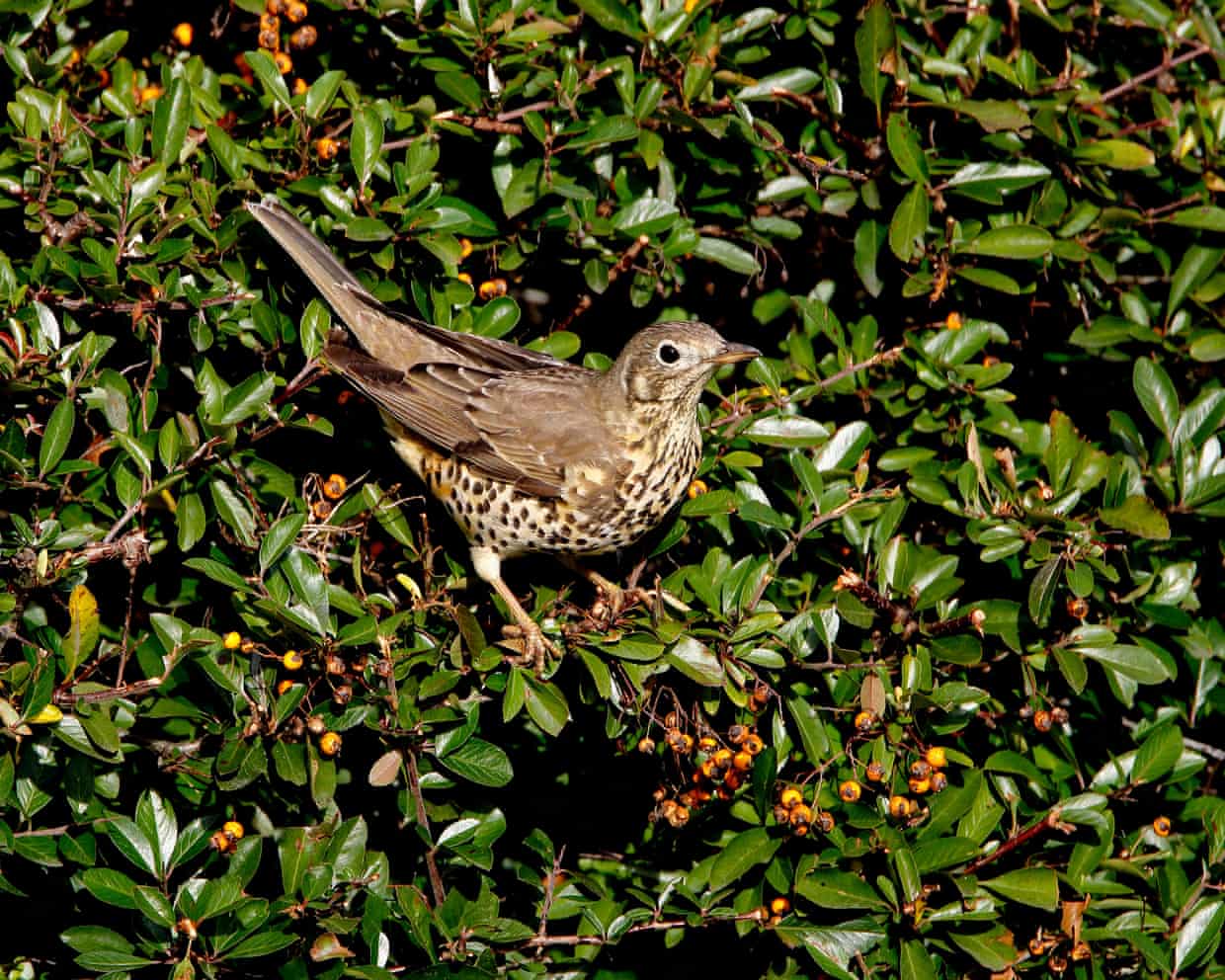
A mistle thrush (Turdus viscivorus) in a bush in an industrial estate in North Wales, UK, November 2025.

Today I want to combine two Guardian articles about birding because they are closely related. The first one, by David Batty, highlights a study on how being around birds can improve your mental health. The second is on the Merlin app, which can help connect you.

The mental health study, “led by academics from King’s College London, [found] that everyday encounters with birds boosted the mood of people with depression, as well as the wider population.

“The researchers said the findings suggested that visits to places with a wealth of birdlife, such as parks and canals, could be prescribed by doctors to treat mental health conditions. They added that their findings also highlighted the need to better protect the environment and improve biodiversity in urban, suburban and rural areas in order to preserve bird habitats.

“The study, published in the journal Scientific Reports, tracked 1,292 participants’ everyday encounters with birds [in 2024] via a smartphone app called Urban Mind. …

“The artist Michael Smythe, of Nomad Projects, which helped King’s College London develop the smartphone app for the study, said the research also posed questions about the link between health inequalities and access to nature, with other research showing deprived areas often had less green spaces than affluent areas.

“Nomad Projects co-founded Bethnal Green Nature Reserve Trust, which built a pond last summer that Smythe said had attracted an ‘enormous diversity of birds.’

“ ‘It’s a very therapeutic complex, biodiverse, abundant space within a massive housing estate between four artery roads,’ said Smythe. ‘It’s now a place where people go en masse every day just to relax.’ ”

Then there’s Patrick Barkham‘s piece on a phone app that a lot of us have been using for more than a year: Merlin.

“Merlin is having a moment. The app, developed by the Cornell Lab of Ornithology in New York, which listens for birdsong and identifies the species singing, has been downloaded 33m times, in 240 countries and territories around the world. … Every month, there has been a 30% increase in new users of the app, whose sound identification function was launched in 2021.

“Merlin has been trained to identify the songs of more than 1,300 species around the world, with more birds added twice a year. Different songs make distinct patterns on spectrograms and Merlin is trained to recognize these different shapes and attribute them to a species. …

“Angela Townsend from Bedfordshire began using Merlin after going on a nightingale walk one spring and being overwhelmed by the range of bird-voices in the evening chorus. She has found it has steadily built up her bird knowledge. …

“Mary Novakovich, author of My Family and Other Enemies, is another recent adopter. She has found it particularly useful when traveling across Croatia, where her parents are from. ‘I love putting a name to a face and a name to the sound,’ she says. “It really brings you closer to the natural world. …

“Merlin is not flawless, however. The first time Kasper Wall, 12, tried it in his Norfolk garden, it detected a northern cardinal and a brown-headed cowbird – North American species not found in Britain.

“ ‘I think it was figuring out where we live,’ says Wall, who enjoys using it even though he is now an extremely knowledgeable birder. ‘A couple of weeks ago we were looking at a large group of goldcrest and it came up with a firecrest. I thought, “Oh, there must be a firecrest in here too” and 30 seconds later we saw one, which was the first I’d ever seen. I like it and it’s very good but I wouldn’t say that it’s better than the best people at identifying bird-calls. …

“Wall enjoys fooling Merlin with his uncanny impressions of a curlew, barn owl and greenshank.

“[Naturalist Nick] Acheson doesn’t use Merlin. He welcomes it, but points out it can replace learning. ‘Anything that gets people out, thinking about and reacting to nature is a great thing,’ he says. ‘But there’s certainly a risk that people don’t learn and just abdicate responsibility for learning to Merlin.’

“He has noticed a glitch where Merlin interprets a certain type of chaffinch call as a redstart, leading to people being absolutely adamant that there is a rare bird in their garden. … John Williamson, who works as a guide for Norfolk Wildlife Trust, has found Merlin repeatedly identifying high-pitched calls as a spotted flycatcher, a bird that is very unlikely to be found in the middle of Hickling Broad nature reserve’s large reedbeds. …

“That said, Williamson finds it a ‘good tool’ and welcomes how it is encouraging new people to enjoy birdsong. … ‘I find it impressive that an app can empower people to go out into nature, he says.”

More on Merlin at the Guardian, here, and on mental health through birding, here.

I love birds myself, although at the moment I am really put out with goldfinches. They strip the feeder of seeds in a day, aggressively pushing out other birds, and they mess up my little balcony with droppings. But I’ll get over it. What is your relationship with birds?

Read Full Post »

Photo: Mia McPherson/ On the Wing Photography.
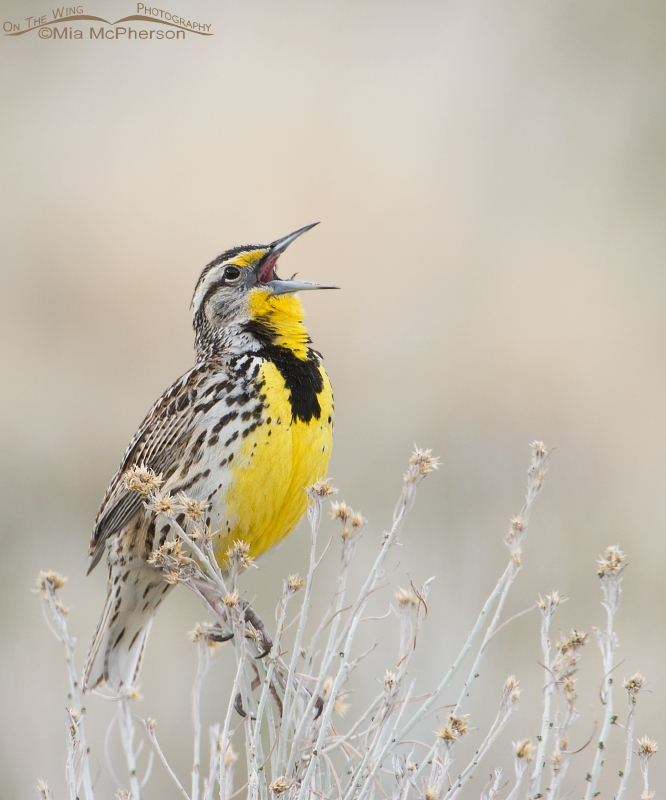
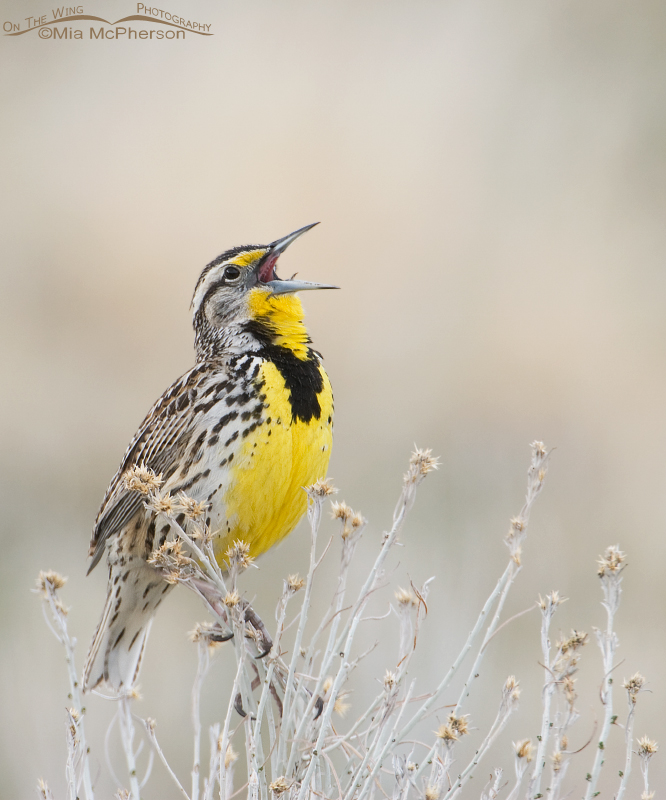
Western Meadowlark singing.

Doctors are starting to recommend meditation to lower blood pressure in older people. When meditation was first suggested to me, I scoffed in my usual know-it-all way (what my husband used to call my “stranglehold on the truth”), but as I researched different kinds of meditation on the web, I gradually became a believer.

One of the ways meditation experts get you to focus on the here and now is to have you pay attention to each of your five senses in sequence, as in one five-minute meditation from the Washington Post. Others add that listening specifically to birdcalls can be therapeutic.

At the Post, Richard Sima says, “Looking to improve your mental health? Pay attention to birds. Two studies published last year in Scientific Reports said that seeing or hearing birds could be good for our mental well-being. …

“Research has consistently shown that more contact and interaction with nature are associated with better body and brain health.

“Birds appear to be a specific source of these healing benefits. They are almost everywhere and provide a way to connect us to nature. And even if they are hidden in trees or in the underbrush, we can still revel in their songs.

” ‘The special thing about birdsongs is that even if people live in very urban environments and do not have a lot of contact with nature, they link the songs of birds to vital and intact natural environments,’ said Emil Stobbe, an environmental neuroscience graduate student at the Max Planck Institute for Human Development and author of one of the studies.

“Recent research also suggests that listening to recordings of their songs, even through headphones, can alleviate negative emotions. …

“In one study, researchers asked about 1,300 participants to collect information about their environment and well-being three times a day using a smartphone app called Urban Mind.

“The participants were not explicitly told that the researchers were looking at birds — the app was also collecting data about other vitals such as sleep quality, subjective assessment of air quality, and location details. But the 26,856 assessments offered a rich data set of what is associated with mental well-being in real time in the real world.

“By analyzing the data, the researchers found a significant positive association between seeing or hearing birds and improved mental well-being, even when accounting for other possible explanations such as education, occupation, or the presence of greenery and water, which have themselves been associated with positive mental health.

“The benefits persisted well beyond the bird encounter. If a participant reported seeing or hearing birds at one point, their mental well-being was higher, on average, hours later even if they did not encounter birds at the next check-in.

Ryan Hammoud, a PhD candidate at the Institute of Psychiatry, Psychology & Neuroscience at King’s College London and an author of the study, called it a ‘time-lasting link.’

“Intriguingly, the birds benefit both healthy participants and those who have been diagnosed with depression. …

“A second study found that listening to short — just six-minute — audio clips of birdsong could reduce feelings of anxiety, depression and paranoia in healthy participants.

“ ‘Listening to birdsong through headphones was able to hit the same pathways that might be beneficial toward mental well-being,’ said Hammoud, who was not involved in the second study. …

“Researchers asked 295 online participants to self-assess their emotional states and to take a cognitive memory test. Then they randomly assigned the participants to listen to birdsongs or traffic noise, of more or less diversity. The researchers then had the subjects remeasure their emotional and cognitive states.

“Participants who listened to more diverse birdsongs (featuring the acoustic acrobatics of eight species) reported a decrease in depressive symptoms in addition to significant decreases in feelings of anxiety and paranoia. And those who listened to less diverse birdsongs (two bird species) also reported a significant decrease in feelings of anxiety and paranoia. …

“By contrast, listening to more or less diverse traffic noise worsened symptoms of depressive states.

“The research shows the ‘healing aspects of nature, or also the not-so-positive effects of urban surroundings,’ said Stobbe, an author of the second study. …

“Birds help us feel more connected with nature and its health effects, Stobbe said, and the more connected we are to nature, the more we can benefit from those effects.

“One hypothesis on nature’s salubrious effects, known as the attention restoration theory, posits that being in nature is good for improving concentration and decreasing the mental fatigue associated with living in stressful urban environments. Natural stimuli, such as birdsong, may allow us to engage in ‘soft fascination,’ which holds our attention but also allows it to replenish.

Nature — and birdsong — also reduce stress. Previous research has found that time spent in green outdoor spaces can lower blood pressure and cortisol levels, Hammoud said.

“It is not yet understood how birdsong affects our brains, but neuroimaging studies have found brain responses of stress reduction to other forms of nature exposure.”

More at the Post, here.

Read Full Post »

In Suriname, a country that borders Brazil on the south and the Atlantic Ocean on the north, there’s an unusual sport that only men engage in — from businessmen in suits to tough-guy boxers. It involves songbirds.

Anatoly Kurmanaev reports at the New York Times, “Every Sunday just after dawn, while much of the city sleeps, a group of men gather on the overgrown lawn of a public park in a quiet neighborhood in the capital of Suriname, South America’s smallest country. They huddle together, and hush.

“They have bird cages, each carrying a songbird — a picolet, a twa-twa or a rowti, as the species are known here. Over the next few hours, the men will lean in, silent and focused, and listen to the birds as referees note the duration of each burst of singing, and rate each songster’s performance on a chalk board.

“The audience is engrossed, but wins and losses are greeted by handlers with the same quiet collegiality that has marked the morning.

“Birdsong competitions, a sort of a Battle of the Bands between trained tropical birds, are a national obsession in Suriname. …

“ ‘Some people like football or basketball,’ said Derick Watson, a police officer who, on his days off, helps organize the competitions with a cigar in his mouth. ‘This is our sport. It’s a way of life.’ …

“The yearly bird song championship, which culminates in final rounds that are broadcast on national television in December, draws around a hundred competitors that square off for trophies and a moment of national glory. …

“The most accomplished birds, with renowned stamina, sell in Suriname for up to $15,000, a fortune in the poor former Dutch colony, which gained independence in 1975. But part of the sport’s appeal is that at entry level, it is accessible to anyone, with young untrained birds available for just a few dollars in pet shops.

‘It’s a tradition,’ said Arun Jalimsing, a Surinamese pet shop owner and one of champions of last year’s competition. ‘We grew up with it. When my father gave me money to buy a bicycle, I went and bought a bird.’ …

“Training a songbird requires expertise, but also immense patience and perseverance. To build the birds’ singing endurance, aficionados spend years stimulating them through interaction, regulating their diets and putting them in proximity with female or male partners, according to elaborate training strategies meant to elicit courtship or competitive behavior from each songbird. …

“Suriname is a diverse country, a legacy of the Dutch colonial system, which brought enslaved people and indentured laborers from around the world to work sugar, coffee and banana plantations. … The bird enthusiasts support different political parties and often live in separate, ethnically-defined neighborhoods.

“Suriname’s few decades since independence have been turbulent. … Yet politics, race, class and other differences that have bred confrontations in other arenas seem not to intrude on the collegiality of the songbird owners’ community.

“ ‘Everybody is friends when they come here,’ said Marcel Oostburg, a bird aficionado and a senior official at Suriname’s National Democratic Party, which dominated the country for decades before being ousted in a tense election last year. ‘We never talk politics here.’ ”

More at the New York Times, here.

Read Full Post »