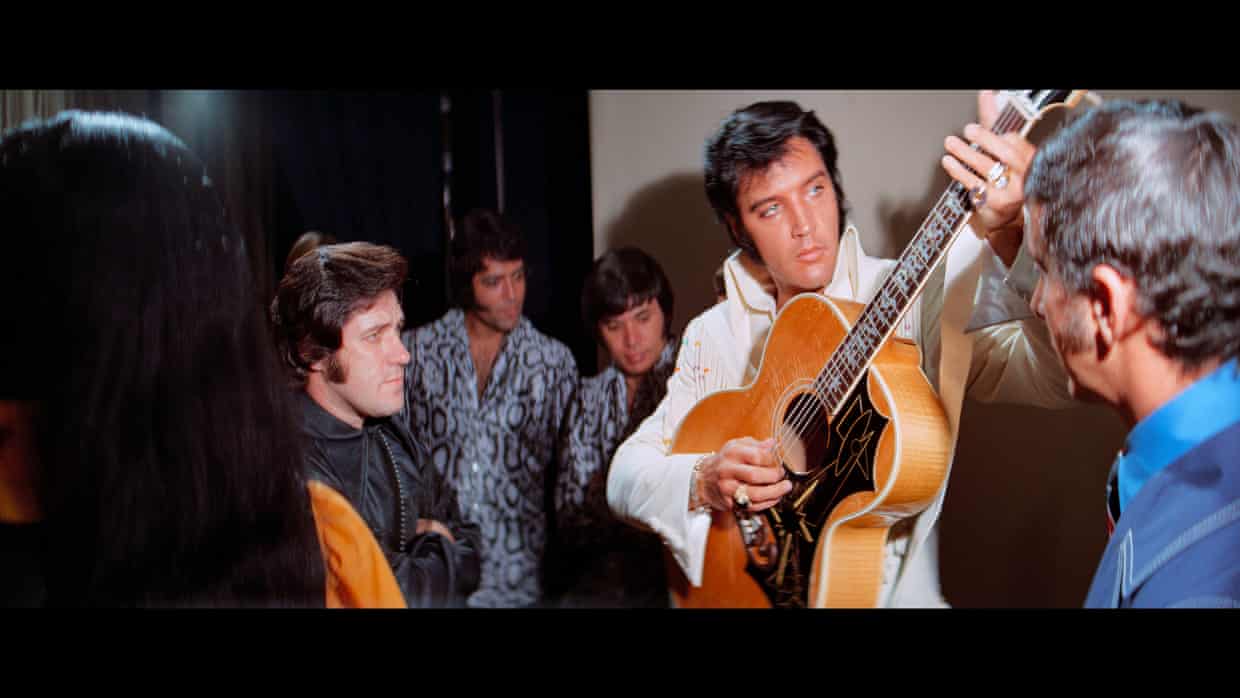
Photo: Neon.
Which of the many versions Elvis presented to the world do you think of when you hear the name Elvis Presley? I confess I can’t limit myself to only one. Whether it’s the kid who was fascinated by Black Gospel music or the bloated addict in Las Vegas, I remain a fan.
At the Guardian recently, Jim Farber interviewed movie director Baz Luhrmann about a new Elvis movie, and boy, does this article make me want to see it!
“In the spring of 1972, a film crew trailed Elvis Presley everywhere he went to capture a pivotal moment in his career – his first tour in nearly a decade. Ironically, one of the most crucial things that happened during that project occurred way off camera. ‘We really wanted to get an interview with Elvis on film,’ said Jerry Schilling, a confidant and employee of the King who at that time was working for the company behind the movie. ‘But he was tired when we were going to do it and for whatever reason we never wound up getting anything on camera.’
“They did, however, get Presley to talk casually on tape for about 40 minutes, during which he said things he never put on record before. That was enough to raise concerns for his notoriously censorious manager, Colonel Tom Parker, who insured that little of that talk saw the light of day during his lifetime.
“Now, more than five decades later, significant parts of that audio tape are finally being heard in a new film by Baz Luhrmann, who four years ago directed the global blockbuster biopic Elvis. His follow-up, titled Epic: Elvis Presley in Concert, is far from the conventional concert movie its title implies, thanks in key part to that interview. The tape ‘was our lightbulb moment,’ said Lurhmann by Zoom from his office in LA. ‘Because Elvis was off camera when it was taped, I think he was really unguarded and really open hearted. We thought, “What if we use this in the film so that Elvis tells his story himself?” ‘
“Quotes from that interview wound up functioning as the film’s thematic spine, connecting a mad swirl of images, voice overs and editing derring-dos that turn the movie into what the director calls ‘a dreamscape poem of Elvis.’ …
“The story he told here began as a kind of accident. While making the first Elvis movie, Luhrmann heard rumors about unseen footage from two important concert films from the early 70s, Elvis: That’s the Way It Is and Elvis on Tour. Using the considerable resources he had at his disposal, he sent researchers into Warner Bros’ vaults, improbably located in underground salt mines in Kansas. There, they found 59 hours of never-before-seen film negatives.
“Combining that with rare Super 8 footage from the Graceland Archives and other bits he came across, Luhrmann and his team were able to spiff up the footage, then painstakingly match to it sound sterling enough to achieve the look and fidelity worthy of the Imax treatment. …
“His performance in the film proves even more arresting than the look or sound, which may come as a surprise to some viewers given the time frame. Two years before the earliest footage here was filmed, Elvis managed a creative resurrection on his 1968 TV special with a performance that wholly resuscitated the spark and edge of his early years. Its success went a long way towards making up for the long period in the 60s when his image and spirit were drained by his roles in a string of laughably rote Hollywood films. …
“His performances from 1970, swirled with the tour footage from 72, show both the depth of Elvis’s personal dynamism and the range of his vocal command. Those karate chop moves, big collars and grand gestures that later became satiric here thrill. Key to that was the star’s rapport with the army of musicians, backup singers and orchestral accompanists that support him. The first thing that hits you is the sheer velocity of the music they make together. Performances of rockers like Polk Salad Annie and Burning Love are bullet-train fast. Gospel numbers, like ‘Oh Happy Day’ and ‘How Great Thou Art’ show Elvis’s operatic range while R&B standards like ‘You’ve Lost That Lovin’ Feeling’ bear his soul. Throughout we see how Elvis directs the band and the singers, altering the arrangements as they go to build up and tear down a song in mounting waves. ‘It’s all happening in the moment,’ Luhrmann said. ‘It’s not a show where they go through twelve numbers and hit all the marks. He makes it up as he goes along.’
“That comes through most clearly in the rehearsal footage included in the film. ‘That’s where you see that Elvis was the most underrated producer in music,’ Schilling said. ‘He’s fixing the musicians, fixing the backup singers, and fixing the music overall. Elvis wasn’t just a great artist, he was a great listener.’
“Case in point is an extended version of ‘Suspicious Minds’ where Elvis’s patterns of calls and responses with his backup singers, the Sweet Inspirations, so delight them they giggle with joy. ‘It wasn’t like it was Elvis and then the back-up singers and the band,’ Schilling said. ‘He saw himself as part of the band.’
“The most valuable player in their ranks has to be guitarist James Burton, whose licks and leads consistently toughen the beats and elaborate the melodies. … Schilling said, ‘He’s the most humble guy and yet the most talented.’
“Another aspect of Elvis revealed by the footage is his eager banter with the crowd. At one show he jokingly introduces himself as Fats Domino; At another he takes a swig from a woman’s cocktail on a front table to her delight. Lurhmann believes Elvis consciously devised such moment to counteract the common view of him as ‘a Greek God with the voice of Orpheus. Being goofy and funny was his way of disarming the audience and letting them know he is, in fact, a human being.’ ”
Lots more at the Guardian, here. No firewall. Donations welcomed.


Not a fan, but I admire his contribution to music.
LikeLike
And here I assumed you’d already seen the movie. I know what a film buff you are!
LikeLiked by 1 person
Can’t see them all. 😉
LikeLiked by 1 person
Thanks for the tip. This sounds so so good! So glad this footage and the recording have been resurrected.
LikeLiked by 1 person
Me, too!
LikeLiked by 1 person
Ditto
LikeLiked by 2 people
I was obsessed with Elvis as kid, my mom loved him too, so we always watched the movies and listened to his albums, my love will never fade!❤
LikeLike
You make me giggle!
LikeLiked by 1 person