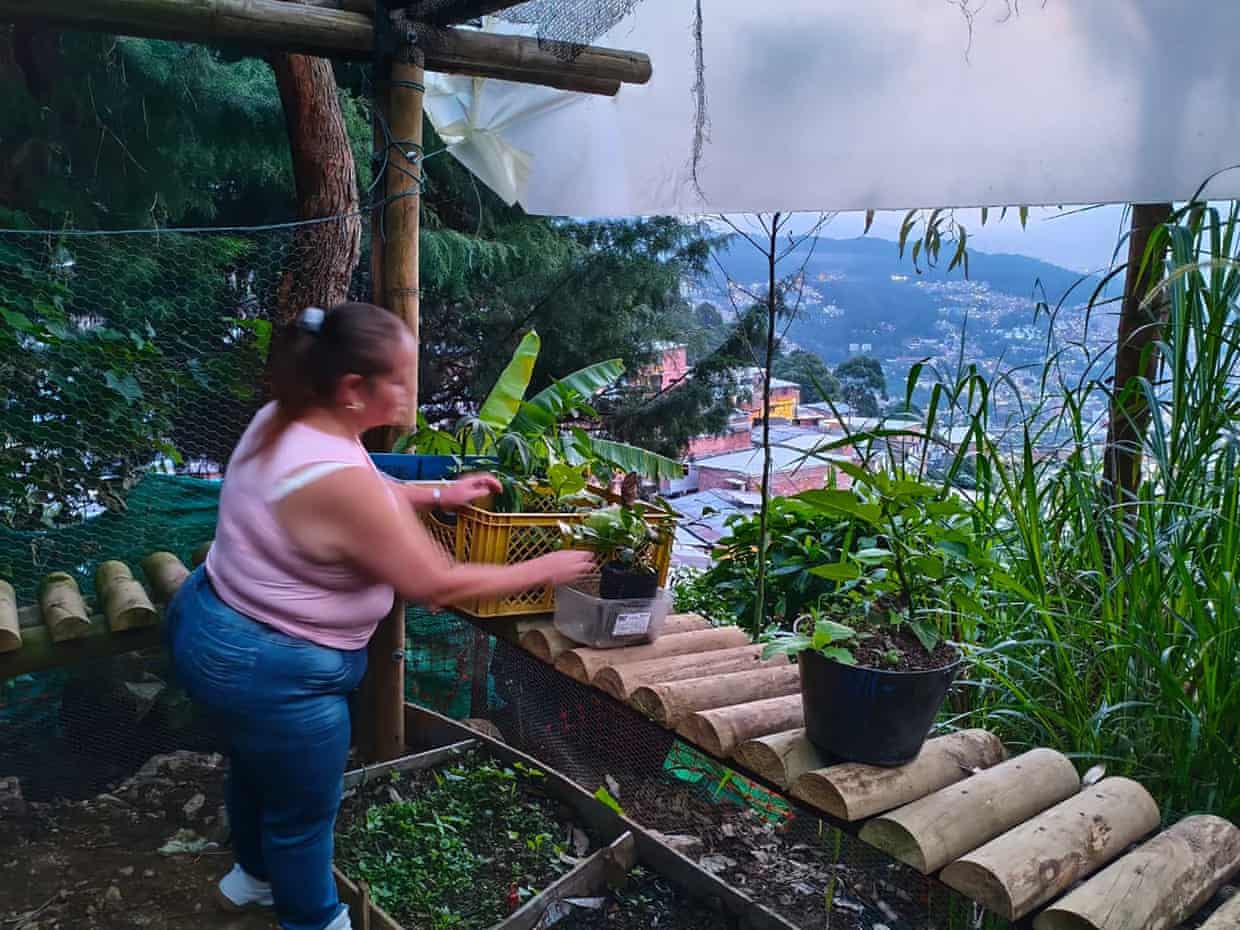
Photo: Suzanne Bearne.
Above, Nancy Elena Quiros Correa, who says the climate in Medellín, Colombia, has become hotter and wetter. Many neighbors collect containers to store rainwater for washing clothes and flushing toilets.
Remember my recent post about storing rainwater in garden fences (here)? Well, ingenuity is not limited to the Netherlands. People around the world are realizing that climate change calls for storing water. In Medellín, Colombia, violent gangs are no longer getting all the attention, and residents are free to work on the normal challenges of life.
Suzanne Bearne explains at the Guardian.
“In his home on a steep hillside in the neighbourhood of Golondrinas in Medellín, Róbinson Velásquez Cartagena stands proudly next to two large tanks of water – a rainwater harvesting system he designed and built to help reduce the risk of flooding and landslides.
“It is one of the nature-based solutions that Velásquez and others in the community have proposed as part of a disaster risk and climate crisis adaptation plan for Comuna 8, a growing informal settlement of 150,000 people in Colombia’s second-largest city. …
“Neighborhoods such as this, where brick houses with corrugated metal roofs are densely stacked on unstable ground, are susceptible to landslides and floods. In 1987, a devastating landslide killed 500 people in the area.
“Organizations and residents such as Velásquez Cartagena came together and, in 2020, began to develop the Local Agreement for Inclusive Climate Action, in line with the Medellín city council’s Climate Action Plan. …
“The plan was formally launched in August 2023 by several organizations, including Medellín’s disaster risk management department (DAGRD), the housing and habitat committee for Comuna 8, and Heriot-Watt University in the UK. …
“The plan comprises eight measures to address climate risks, including managing rainwater, reforestation to control erosion and sedimentation on hillsides and in ravines, and establishing eco-gardens and agroforestry systems. While the city aims to implement similar plans across all 21 comunas, challenges remain in securing government support and funding for grassroots initiatives.
” ‘I started the rainwater harvesting system because I wanted to prove that it can reduce the risk of disasters by reducing the water that runs on to the streets, which can flood when it rains,’ says Velásquez Cartagena, a community leader. … His system collects water from the rooftop drainage and stores it in containers; he then uses the water for his washing machine and toilet.
“Originally a disaster-management scheme, the plan was expanded by the community to [outline] climate risks and vulnerabilities, a heat map, past floods and landslides, responsible stakeholders and action points.
“ ‘In the plan, there are nature-based solutions, with several that are not that expensive or hard to make,’ says Velásquez Cartagena. …
“In the El Pacifico neighbourhood, Nancy Elena Quiros Correa oversees a small 9 metre by 3 metre (30ft by 10ft) plot that was set up as a community tree nursery last year.
“ ‘The nursery will prevent rocks from falling, soak up water when it rains, and increase biodiversity,’ she says. …
“Other projects include a rainwater-harvesting system installed at a local community center last year and an ecological restoration garden.
” ‘The garden will restore nature and stabilize the land,’ says Harry Smith, a professor in global urbanism at Heriot-Watt University, who has worked with Comuna 8 on environmental projects for the past 10 years. ‘But it also stops one of the problems they have there, which is land invasion as people continue to build new homes on land that has been sold illegally by armed groups.’
“While the plan was being approved, the community ‘hit the ground running,’ says Smith. ‘They wanted to do some pilot projects to show that they don’t need to wait for the municipality to come along and do things.’
“Velásquez Cartagena is working with community leaders to produce a user-friendly guide to the plan, with engaging graphics, that can be printed and shared on social media. …
“Juan David Moreno, the head of the technical team at DAGRD, says: ‘The work in Comuna 8 was a pilot, and we developed it for the rest of the communities. … In some communities, you have different needs,’ says Moreno. ‘We assessed the terrain, the community needs and the different hazards. … The main lesson from Comuna 8 was that we needed to work closely with the people, as they live in the territories and know the local hazards.’ …
“Despite all of their work, Quiros Correa still has reservations about what the plan will achieve. ‘I now have a more realistic view of the local government actions. Everything that we have achieved here has involved fighting and negotiating with the local government.’ ”
More at the Guardian, here. What is your community doing? In our town, anyone who builds hard surface like a macadam parking lot is now responsible for controlling water runoff.


More gardens and more water reclamation sounds great. We should reinstall our water barrel. PS In English we spell Columbus with a U. In Spanish it’s Colón, hence Colombia. : )
LikeLike
Uh-oh. Thank you for that!
LikeLiked by 1 person
De nada. 😉
LikeLiked by 1 person
Yes, sounds great! Lovely what we can do when we put our minds to it.
LikeLiked by 1 person