Feeds:
Posts
Comments

Posts Tagged ‘rainwater’

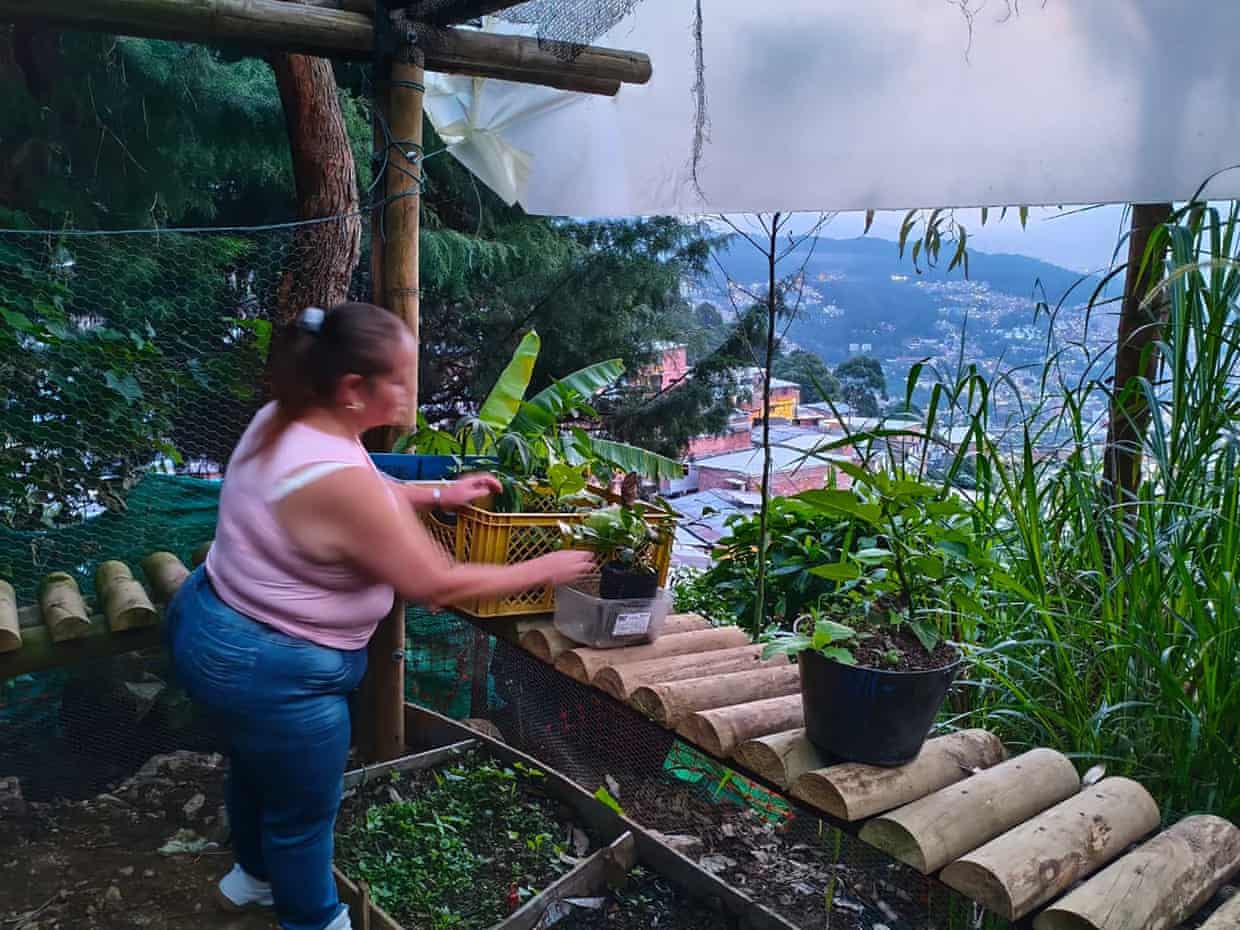
Photo: Suzanne Bearne.
Above, Nancy Elena Quiros Correa, who says the climate in Medellín, Colombia, has become hotter and wetter. Many neighbors collect containers to store rainwater for washing clothes and flushing toilets.

Remember my recent post about storing rainwater in garden fences (here)? Well, ingenuity is not limited to the Netherlands. People around the world are realizing that climate change calls for storing water. In Medellín, Colombia, violent gangs are no longer getting all the attention, and residents are free to work on the normal challenges of life.

Suzanne Bearne explains at the Guardian.

“In his home on a steep hillside in the neighbourhood of Golondrinas in Medellín, Róbinson Velásquez Cartagena stands proudly next to two large tanks of water – a rainwater harvesting system he designed and built to help reduce the risk of flooding and landslides.

“It is one of the nature-based solutions that Velásquez and others in the community have proposed as part of a disaster risk and climate crisis adaptation plan for Comuna 8, a growing informal settlement of 150,000 people in Colombia’s second-largest city. …

“Neighborhoods such as this, where brick houses with corrugated metal roofs are densely stacked on unstable ground, are susceptible to landslides and floods. In 1987, a devastating landslide killed 500 people in the area.

“Organizations and residents such as Velásquez Cartagena came together and, in 2020, began to develop the Local Agreement for Inclusive Climate Action, in line with the Medellín city council’s Climate Action Plan. …

“The plan was formally launched in August 2023 by several organizations, including Medellín’s disaster risk management department (DAGRD), the housing and habitat committee for Comuna 8, and Heriot-Watt University in the UK. …

“The plan comprises eight measures to address climate risks, including managing rainwater, reforestation to control erosion and sedimentation on hillsides and in ravines, and establishing eco-gardens and agroforestry systems. While the city aims to implement similar plans across all 21 comunas, challenges remain in securing government support and funding for grassroots initiatives.

” ‘I started the rainwater harvesting system because I wanted to prove that it can reduce the risk of disasters by reducing the water that runs on to the streets, which can flood when it rains,’ says Velásquez Cartagena, a community leader. … His system collects water from the rooftop drainage and stores it in containers; he then uses the water for his washing machine and toilet.

“Originally a disaster-management scheme, the plan was expanded by the community to [outline] climate risks and vulnerabilities, a heat map, past floods and landslides, responsible stakeholders and action points.

“ ‘In the plan, there are nature-based solutions, with several that are not that expensive or hard to make,’ says Velásquez Cartagena. …

“In the El Pacifico neighbourhood, Nancy Elena Quiros Correa oversees a small 9 metre by 3 metre (30ft by 10ft) plot that was set up as a community tree nursery last year.

“ ‘The nursery will prevent rocks from falling, soak up water when it rains, and increase biodiversity,’ she says. …

“Other projects include a rainwater-harvesting system installed at a local community center last year and an ecological restoration garden.

” ‘The garden will restore nature and stabilize the land,’ says Harry Smith, a professor in global urbanism at Heriot-Watt University, who has worked with Comuna 8 on environmental projects for the past 10 years. ‘But it also stops one of the problems they have there, which is land invasion as people continue to build new homes on land that has been sold illegally by armed groups.’

“While the plan was being approved, the community ‘hit the ground running,’ says Smith. ‘They wanted to do some pilot projects to show that they don’t need to wait for the municipality to come along and do things.’

“Velásquez Cartagena is working with community leaders to produce a user-friendly guide to the plan, with engaging graphics, that can be printed and shared on social media. …

“Juan David Moreno, the head of the technical team at DAGRD, says: ‘The work in Comuna 8 was a pilot, and we developed it for the rest of the communities. … In some communities, you have different needs,’ says Moreno. ‘We assessed the terrain, the community needs and the different hazards. … The main lesson from Comuna 8 was that we needed to work closely with the people, as they live in the territories and know the local hazards.’ …

“Despite all of their work, Quiros Correa still has reservations about what the plan will achieve. ‘I now have a more realistic view of the local government actions. Everything that we have achieved here has involved fighting and negotiating with the local government.’ ”

More at the Guardian, here. What is your community doing? In our town, anyone who builds hard surface like a macadam parking lot is now responsible for controlling water runoff.
Read Full Post »

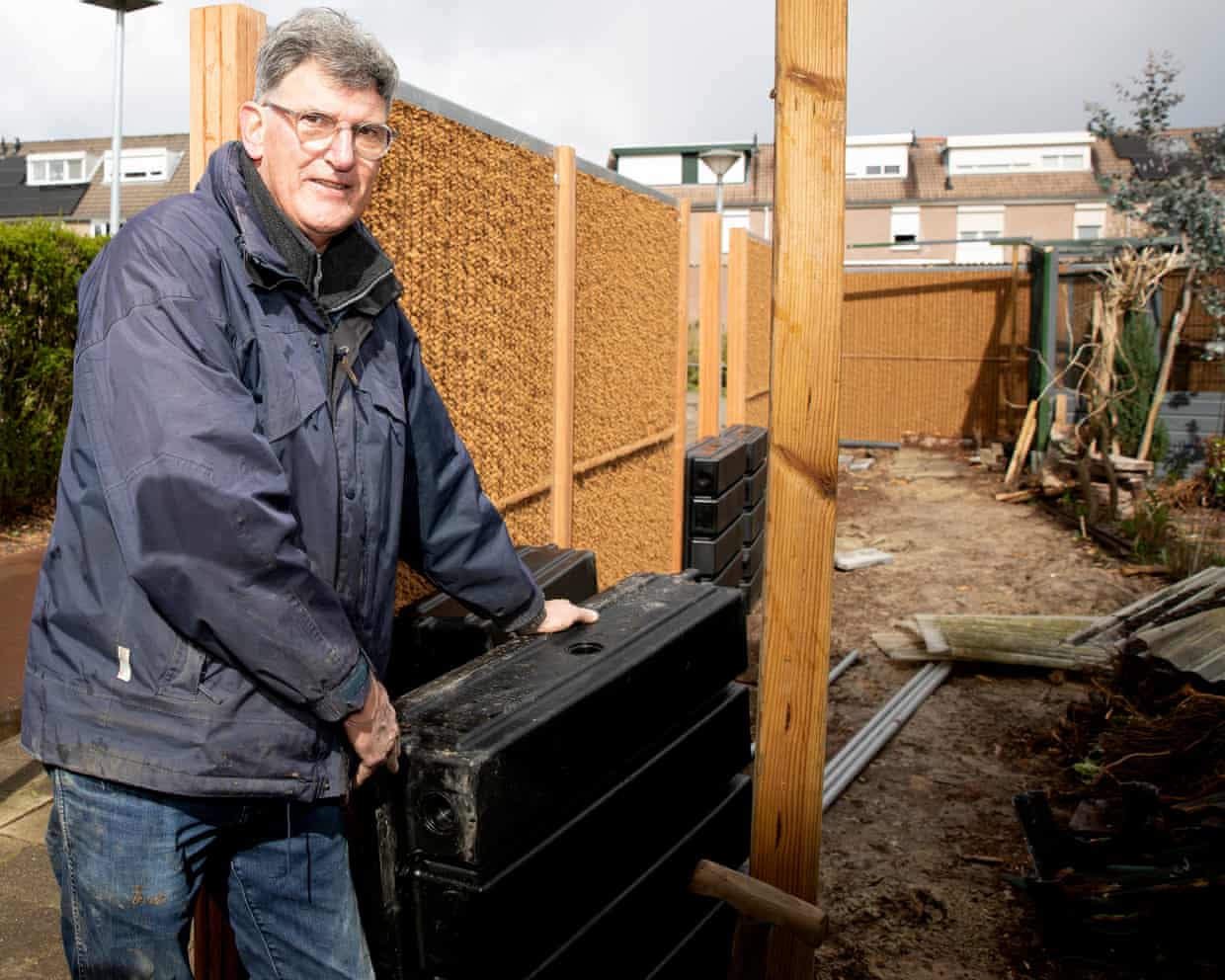
Photo: Judith Jockel/The Guardian.
In the Netherlands, Harry den Hartigh installs a fence that also serves as a rainwater store.

Not to stereotype, but the Dutch strike me as exceptionally good problem solvers. (Maybe the bloggers at Cook and Drink can give an informed opinion.) Most of us know how they built their country on a delta and how today advise other places threatened with flooding.

Senay Boztas writes at the Guardian that the Netherlands is now experimenting with a new way to control water … until it’s needed.

“Good fences make good neighbors – but rain fences could make even better ones,” says Boztas. “That is the hope of housing corporations in the Netherlands, which are adopting rainwater storage in their garden fences.

“In a tidy neighborhood in Veldhoven, where the social housing provider, Woonstichting ’thuis, is installing its first such rain fence, one couple, Theo and Willy Bolder, are already seeing an increase in their popularity. ‘People are all coming round to ask what it costs,’ said Willy Bolder.

“Outside, between rattan fence panels, a series of plastic blocks have been linked to the drainage from their roof. Together, they will store up to 2,160 liters [571 gallons] of water – reducing pressure on the drains during downpours and preserving rainwater for the garden in times of drought.

“ ‘The rain is getting heavier and heavier nowadays, and if you have a cloudburst the drainage isn’t good and it comes up through the toilet,’ she said. …

“Theo added that the hotter summers were threatening the trees and their quality of life. ‘I always go fishing in a lake, it’s always full of water, but last summer it was completely dry,’ he said. …

“The couple are not the only ones to feel the effects of the climate crisis in this low-lying country. … Weather extremes are now more likely. The Netherlands was shocked by floods in Limburg in 2021, when … the River Geul burst its banks.

“Rik Thijs, deputy mayor for public space, greenery and water in nearby Eindhoven, said private and public initiatives were needed to adapt to the changing weather. ‘Our sewage system cannot cope with the rainfall that is coming, and we cannot increase its capacity, so we need to do things differently,’ he said. …

“This might mean plans to bring an old river, the Gender, back to the surface, ‘wadi‘ pools that can hold water during heavy rain, and incorporating green roofs and rainwater storage into housing developments. ‘The Netherlands is very vulnerable because we are, of course, one large delta,’ he said.

“The country’s vulnerability to water was graphically illustrated by the North Sea flood of 1953, when at least 1,800 people died, tens of thousands of animals drowned and there was huge damage to property and farmland. While the disaster, in the province of Zeeland, inspired the Delta Works sea defenses, it also left its mark on the Dutch entrepreneur Harry den Hartigh, whose company, SunnyRain Solutions, installed the storage system in the Bolders’ garden. …

” ‘I was born in Zeeland and my parents experienced the flood disaster,’ said den Hartigh. … In his youth, he also saw how Zeeland struggled to source enough fresh water for agriculture owing to brackish water from the sea, and this inspired his rainwater storage system. …

“Despite the Netherlands’ reputation for rain, it has increasing concerns about water shortages in the summer, and overheating cities. Jannes Willems, assistant professor in urban planning at the University of Amsterdam, said simple solutions at scale could make a difference. ‘Rainwater harvesting is a very easy fix,’ he said. ‘We have a water system that was built to discharge water as quickly as possible.’

“But with flood events and rain bursts, the sewers simply cannot cope. ‘You can better let it infiltrate the soil through green measures, bringing back natural elements in cities. And then, in times of heatwaves, that can lower temperatures,’ he said. …

“Matthijs Hulsbosch, a property and sustainability manager, said the fences could also make the complex’s 11,000 homes more resilient. … ‘We can fix leaks, but it might be better to prevent them through these kinds of ideas – and save a great deal of money and inconvenience.’

“Willems said it also represented a change to the idea that a country that reclaimed a fifth of its land from the sea could always bend nature to its will. ‘Fifty years ago, the Dutch water system was a good example of modernist thinking: being able to master nature,’ he said. ‘With green infrastructure, the Dutch are trying to rebrand that narrative and bring back a natural state,’ “

More at the Guardian, here.

Read Full Post »

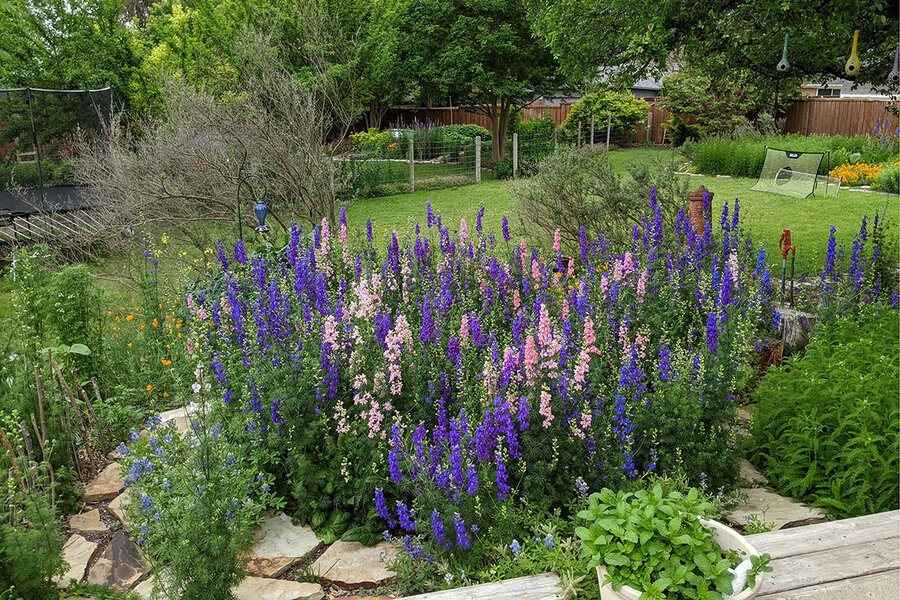
Photo: Kyle Peavey.
Kyle Peavey’s backyard in Richardson, Texas. He collects water in a 1,100 gallon rainwater tank to grow his flowers and vegetables.

One way that people are conserving natural resources these days is by being more thoughtful about the water they use in their homes and gardens.

To some extent this is going back to the old ways. On a recent Zoom panel discussing rural America, Montana Senator Jon Testa recalled how conservative with water his mother had to be when he was growing up. He said she could wash a sinkful of dishes with one cup of water.

Sen. Testa’s mother wouldn’t have been thinking about climate change, but she knew scarcity. Here is a report from Tara Adhikari at the Christian Science Monitor on conserving water today.

“In one Texas suburb, a battle of rainwater harvesting tanks is on. During a neighborhood garden tour in May, Kyle Peavy spotted Richard Townsend’s 260-gallon tank and decided to go even bigger. Just two months later, Mr. Peavy installed his own rainwater harvesting system – four times the size. 

“ ‘I’m both proud and slightly envious,’ says Mr. Townsend of Mr. Peavy’s system.

“The two neighbors use the tanks to water their backyard gardens. And while plants like rainwater better than sink water, the men installed these water systems for another reason besides gardening. Both see rainwater harvesting as a practical way to respond to water scarcity. They’re not alone.  

“Rainwater harvesting dates back more than 4,000 years to early Roman and Mayan civilizations. In its simplest form, it involves collecting water as it falls from the sky into barrels, so the water can be saved for later use. Today, this ancient solution is seeing a resurgence among homeowners, businesses, school districts, and at least one church. 

“Among green solutions to climate change, rainwater harvesting stands out in its potential to address two sides of a water paradox – flooding that destroys critical infrastructure, as well as drought conditions that threaten freshwater supplies. 

“ ‘We know that some areas are going to become drier. We know that storms are going to become bigger. And thinking about any practice that can help us address multiple of these issues is really important,’ says Sarah Sojka, associate professor of physics and environmental studies at Randolph College in Lynchburg, Virginia. 

“As Americans across the United States turn back to one of the oldest methods in the book, there’s a sense of empowerment that comes from knowing one small action can have a ripple effect. One small tank might just inspire something bigger.

“Typically, when rainwater falls on a roof, it is routed through a gutter system out into the yard or driveway and eventually into the road. Along the way, the water picks up pesticides and road contaminants, before flowing into curbside cuts that direct it into a nearby stream or lake. 

As the urban landscape has become more and more built up, the number of impermeable surfaces, such as paved roads, has increased, forcing larger quantities of water – and pollutants – into local waterways. …

“Rainwater harvesting tanks divert that flow path, reducing the amount of water that hits local systems all at once. As stored tank water replaces tap water for outdoor use, the draw on the municipal supply is reduced, and water that soaks in through the ground eventually helps to replenish baseline flow.

“But it’s not just an old-new way to water. It’s also a new way to think about water as more than an unending supply that spews from the tap. In drier climates especially, rainwater harvesting can provide a visual reminder of natural cycles, which can precipitate the ultimate goal: an actual reduction in water use. …

“Although Mr. Townsend doesn’t consider himself a ‘green warrior,’ he wants his children to understand these cycles. The rainwater tank, which shows natural ebbs and flows, helps him share greater water consciousness with his children. …

“Although one rainwater harvesting tank is unlikely to change local water quality and supply, when implemented at scale, the tanks can aid in overall water conservation – and local governments are taking notice. 

“To encourage widespread adoption, cities across the U.S. are subsidizing the costs of tank installation, which can range from a few hundred to several thousand dollars. Tucson, Arizona, started its rainwater harvesting rebate program in 2012, after residents had been living under drought conditions for over a decade. In Arizona, water is sourced from groundwater and the Colorado River, which was put under a drought contingency plan in 2019. …

“ ‘Americans just really like being self-sufficient, and … at its core, this is self-sufficiency,’ says Jaimie Galayda, a rebate participant who now works for Tucson Water. …

“When rainwater is collected, says [Fouad Jaber, a professor and water resources extension specialist at Texas A&M University] it reduces the amount of water used from the municipal supply, which comes from local waterways. And if used for outdoor purposes, the water will soak into the ground, eventually feeding back into local bodies of water. …

“St. Louis has a different problem, but rainwater harvesting is helping just the same. Like many older cities, St. Louis has a combined sewer system, meaning storm pipes connect with wastewater pipes. Normally, all the water is treated before entering the Mississippi River, but large storms overwhelm the system, creating direct overflow into the river. And when large quantities of water enter all at once, the water quickly swells out into the surrounding communities.  

“Large rainwater cisterns like the one at Jubilee Community Church help to divert the water before it overflows. In 2018 the church installed a 150,000-gallon cistern with funding and other support from St. Louis’ municipal sewer district and The Nature Conservancy. Rain flows off the church’s roof to the underground catchment, then irrigates a large garden and orchard, which includes tomatoes, cucumbers, beets, figs, and even juju berries.  

” ‘Building the rainwater tank with the garden on top is a way of reinvesting in the community, says Andy Krumsieg, the church’s pastor. ‘This is a very sustainable project because it will keep water out of the sewer system forever … and it created a tool for urban agriculture.’ “

More at the Monitor, here.

Read Full Post »