Feeds:
Posts
Comments

Posts Tagged ‘delta’

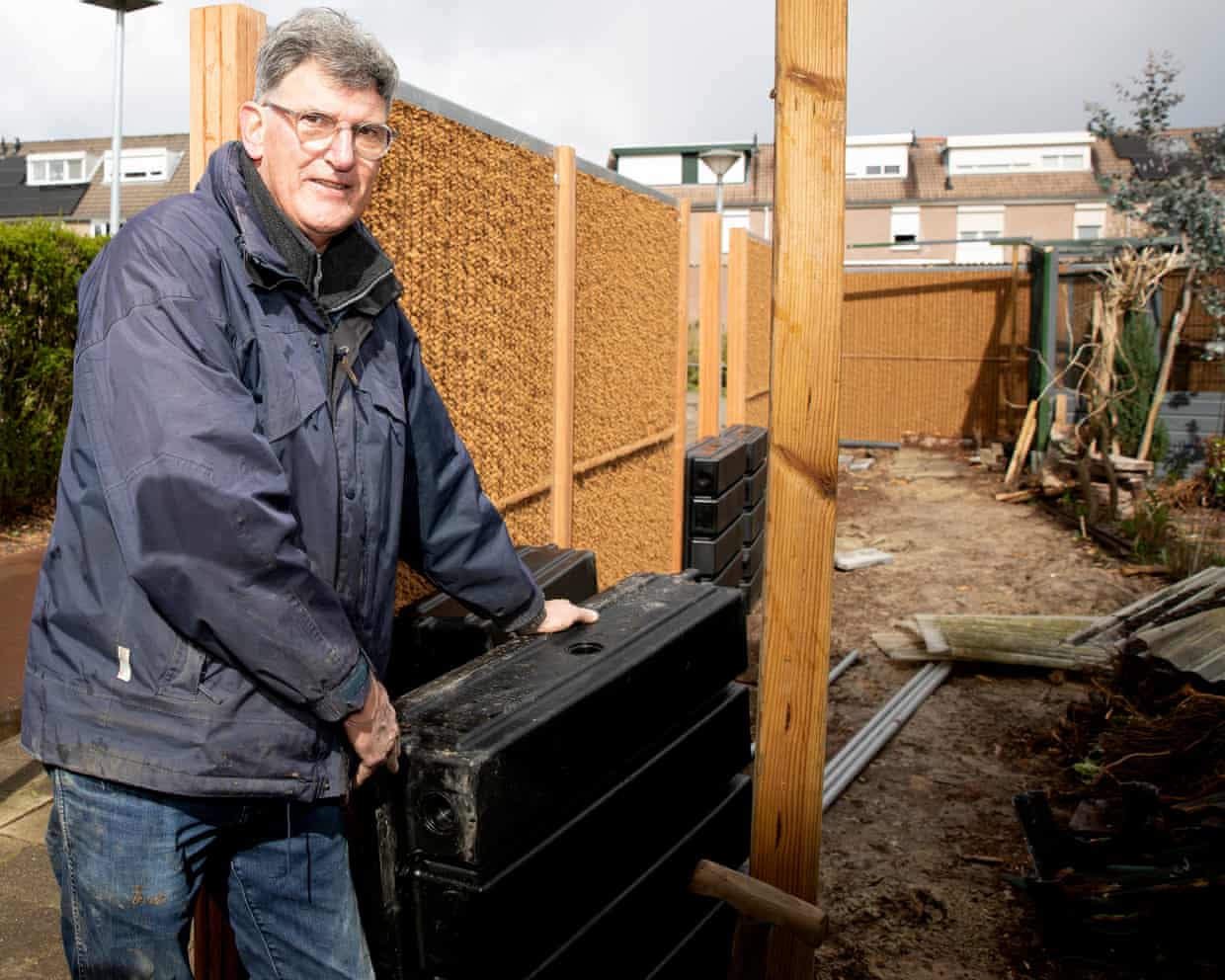
Photo: Judith Jockel/The Guardian.
In the Netherlands, Harry den Hartigh installs a fence that also serves as a rainwater store.

Not to stereotype, but the Dutch strike me as exceptionally good problem solvers. (Maybe the bloggers at Cook and Drink can give an informed opinion.) Most of us know how they built their country on a delta and how today advise other places threatened with flooding.

Senay Boztas writes at the Guardian that the Netherlands is now experimenting with a new way to control water … until it’s needed.

“Good fences make good neighbors – but rain fences could make even better ones,” says Boztas. “That is the hope of housing corporations in the Netherlands, which are adopting rainwater storage in their garden fences.

“In a tidy neighborhood in Veldhoven, where the social housing provider, Woonstichting ’thuis, is installing its first such rain fence, one couple, Theo and Willy Bolder, are already seeing an increase in their popularity. ‘People are all coming round to ask what it costs,’ said Willy Bolder.

“Outside, between rattan fence panels, a series of plastic blocks have been linked to the drainage from their roof. Together, they will store up to 2,160 liters [571 gallons] of water – reducing pressure on the drains during downpours and preserving rainwater for the garden in times of drought.

“ ‘The rain is getting heavier and heavier nowadays, and if you have a cloudburst the drainage isn’t good and it comes up through the toilet,’ she said. …

“Theo added that the hotter summers were threatening the trees and their quality of life. ‘I always go fishing in a lake, it’s always full of water, but last summer it was completely dry,’ he said. …

“The couple are not the only ones to feel the effects of the climate crisis in this low-lying country. … Weather extremes are now more likely. The Netherlands was shocked by floods in Limburg in 2021, when … the River Geul burst its banks.

“Rik Thijs, deputy mayor for public space, greenery and water in nearby Eindhoven, said private and public initiatives were needed to adapt to the changing weather. ‘Our sewage system cannot cope with the rainfall that is coming, and we cannot increase its capacity, so we need to do things differently,’ he said. …

“This might mean plans to bring an old river, the Gender, back to the surface, ‘wadi‘ pools that can hold water during heavy rain, and incorporating green roofs and rainwater storage into housing developments. ‘The Netherlands is very vulnerable because we are, of course, one large delta,’ he said.

“The country’s vulnerability to water was graphically illustrated by the North Sea flood of 1953, when at least 1,800 people died, tens of thousands of animals drowned and there was huge damage to property and farmland. While the disaster, in the province of Zeeland, inspired the Delta Works sea defenses, it also left its mark on the Dutch entrepreneur Harry den Hartigh, whose company, SunnyRain Solutions, installed the storage system in the Bolders’ garden. …

” ‘I was born in Zeeland and my parents experienced the flood disaster,’ said den Hartigh. … In his youth, he also saw how Zeeland struggled to source enough fresh water for agriculture owing to brackish water from the sea, and this inspired his rainwater storage system. …

“Despite the Netherlands’ reputation for rain, it has increasing concerns about water shortages in the summer, and overheating cities. Jannes Willems, assistant professor in urban planning at the University of Amsterdam, said simple solutions at scale could make a difference. ‘Rainwater harvesting is a very easy fix,’ he said. ‘We have a water system that was built to discharge water as quickly as possible.’

“But with flood events and rain bursts, the sewers simply cannot cope. ‘You can better let it infiltrate the soil through green measures, bringing back natural elements in cities. And then, in times of heatwaves, that can lower temperatures,’ he said. …

“Matthijs Hulsbosch, a property and sustainability manager, said the fences could also make the complex’s 11,000 homes more resilient. … ‘We can fix leaks, but it might be better to prevent them through these kinds of ideas – and save a great deal of money and inconvenience.’

“Willems said it also represented a change to the idea that a country that reclaimed a fifth of its land from the sea could always bend nature to its will. ‘Fifty years ago, the Dutch water system was a good example of modernist thinking: being able to master nature,’ he said. ‘With green infrastructure, the Dutch are trying to rebrand that narrative and bring back a natural state,’ “

More at the Guardian, here.

Read Full Post »

The organization Daughters for Earth believes women are key to solving the climate crisis.

Here’s a nonprofit I just learned about that’s working to, among other things, restore the Colorado River with a diverse environmental team. It’s called Daughters for Earth.

From the website: “The Colorado River has not connected to the sea for a generation, and its Delta is dying out. This once lush region of 3,000 square miles teeming with plant, bird, and marine life lived only in the memory of older community members.

“Most had abandoned hope that nature would ever return. … [The plan is to] help the Sonoran Institute (SI) revive, enhance, and maintain 751 acres of this area and reconnect the Colorado River to the sea. By reintroducing water, landscapes, wildlife, and communities thrive together.

“Led by Edith Santiago, who has 22 years of experience in the restoration of wetlands, this project comprises a diverse team of biologists, ecologists, hydrologists, community planners, environmental educators, and economists. Women hold over 50% of these positions.

“[The team aims to] monitor the water and surrounding wildlife and conduct restoration activities that include irrigation, weeding, fire prevention, vigilance, and signage to prevent vandalism. It will also help grow native species at the SI nursery near the Delta. Producing vegetation closer to restoration activities prevents plant damage and reduces transportation time.

“Environmental education and outreach activities are essential to inspire the local community to help restore and conserve the Colorado River Delta. SI will achieve this through an online course about wildlife and vegetation, guided visits to restored areas, talks, presentations, and workshops. Building a training and multiple-use site will serve as a gathering and educational spot for the community.

“SI has already engaged people through the visitor center at Laguna Grande, guided tours, and ‘Family Saturdays.’ Through these programs, nearly 26,000 people have reconnected with the river.

The recovery and stewardship of the Delta ultimately depend on the commitment of people who live in the region.

“Having local community groups, leaders, and government agencies participate in the restoration work, operate plant nurseries, manage restoration sites, and welcome guests is a significant part of this project. With a flowing river and a steady stream of visitors, the conservation site will become the heart of an economy based on working with nature, and a living, learning laboratory for the one million residents of Mexicali.

“The long-term plan is to restore and protect 30,000 acres of habitat. Another prime goal is to connect the river and sea for an average of 146 days a year.

“Through education and social media, it aims to reach more than 400,000 people who will get to know the endangered beaver and many of the 380 bird species in the Delta. It will continue implementing virtual and in-person activities with students from kindergarten through college, families, national and international media, and donors. …

“SI’s work has been crucial to adopting agreements between the United States and Mexico that have become a global example of collaboration. The Minute 319 and 323 accords between the two governments support the complete restoration of the Colorado River Delta.

“By advancing agreements governing the river, restoration can succeed in the Delta as people connect with their natural resources.” More at Daughters for Earth, here.

From the nonprofit’s Who We Are page: “Our planet and people are in crisis. Around the world, we face massive climate change due in large part to the destruction of Earth’s lands, waters, and wildlife, and women are being severely impacted. They are also on the frontlines fighting to protect our future.

“Women-led initiatives are combating this global crisis, making strides in protecting and regenerating the Earth, and ultimately transforming their communities. Yet, this work and leadership is often not seen, heard, appreciated, or funded.

“Daughters was co-founded by female leaders in the women’s rights, environmental and philanthropic sectors who came together to address the marginalization of women in climate change action. It is a campaign of One Earth, an organization working to accelerate collective action to solve the climate crisis through groundbreaking science, inspiring storytelling, and an innovative approach to climate philanthropy.”

Hat tip: Priscilla Stuckey on Mastodon.

Check out this urgent grandma rap on YouTube: “Grandmothers are calling for all daughters to rise.”

Read Full Post »

This was such a nice story. It’s about idealistic young adults who join Teach for America , get sent to poor, rural areas, and decide they like the simpler life. When they settle down, they bring new energy and business — while receiving in return local wisdom and friendship.

Bret Schulte writes from Helena-West Helena, Arkansas, for the NY Times, “If you are from around here, you know Doug Friedlander is not.

“Born in New York City and reared on Long Island, Mr. Friedlander is Jewish and vegetarian and has a physics degree from Duke.”

He and others who fell in love with the Delta “arrived through Teach for America and stayed beyond their two-year commitment.

“Mr. Friedlander is now the ambitious director of the county’s Chamber of Commerce. He frets over the kudzu that is devouring abandoned buildings. He attends Rotary Club meetings, where he sidesteps the lunch offerings for carnivores. He organizes workshops to modernize small businesses and pushes tourism and the development of a decimated downtown along the banks of the Mississippi. …

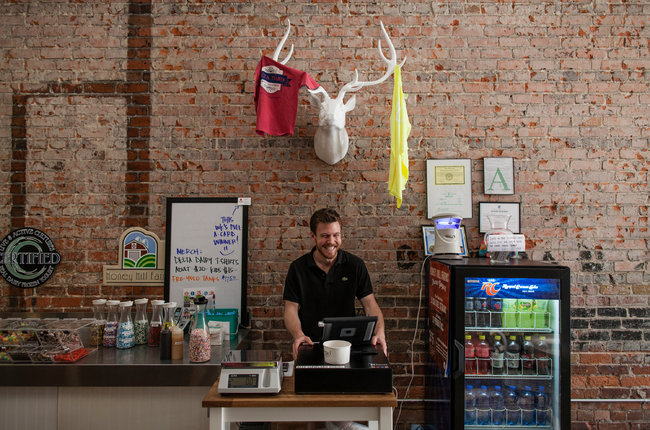
“Matty Bengloff, 28, is one of [the new] people. He grew up in an apartment on the Lower East Side of Manhattan. Now he owns a three-bedroom home in Cleveland, as well as a hip new yogurt shop called Delta Dairy, with his fiancée, Suzette Matthews. …

“Residents cured Mr. Bengloff of his Yankee ways. Soon after arriving in the South with Teach for America, Mr. Bengloff was in a school speaking to a receptionist. When he could not hear the man’s words, Mr. Bengloff asked, ‘What?’ The receptionist said: ‘I can tell you’re not from around here. When you don’t understand something, you say, “Excuse me, sir?” Or, “Sir?” ‘ ”

More.

Photo: William Widner for the NY Times
Matty Bengloff, who grew up in Manhattan, in his frozen yogurt shop in Cleveland, Miss. The unofficial motto is “Keep Cleveland Boring.”

Read Full Post »