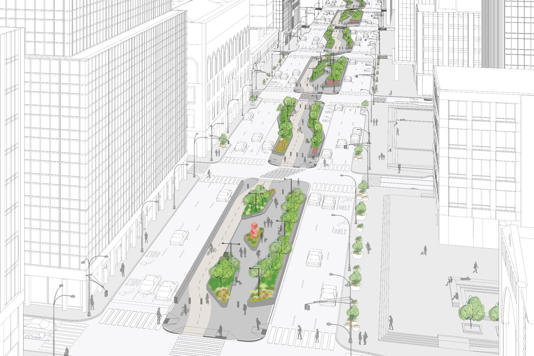
Photo: Starr Whitehouse Landscape Architects and Planners.
Architects have submitted two designs for a park on a section of New York’s Park Avenue. This is the scheme with a bike lane.
Back in the day, when I was going to high school and living during the week with my mother’s sister, Park Avenue was not much of a park. I remember daffodils in spring, but they were surrounded by an iron fence.
Today I learn that there are plans to make big changes. At Markets Today (via MSN), Christopher Bonanos shares his opinions about a proposed park project.
“Two summers ago, the city announced that it was taking a good hard look at (as every politician seemed to phrase it) ‘putting the park back in Park Avenue.’ … A century ago, the median down the middle of Park Avenue was much more welcoming than it is today, a place with seating and substantial plantings where you’d consider spending time.
“Starting in the 1920s, the city added a traffic lane on each side by paring the median down to a narrow strip, creating a pleasant but not useful viewing garden. In 2024, the city announced a call for proposals wherein those two lanes would be reclaimed from traffic for leisure and greenery. It was a once-in-a-century opportunity, because the aged Metro-North tunnel running under the avenue is being reconstructed, allowing its roof above to be rethought. …
“The rebuilt mall, the announcement said, would extend from 46th Street, where it emerges from the pass-throughs at the Helmsley Building, up to 57th Street. Each half of Park Avenue would go from four lanes to three. [Recently] we got a first look at plans produced by the firm Starr Whitehouse, and here they are. …
“The biggest difference between the two design schemes is a protected bike lane that snakes its way up the western side of the median, present in one rendering and absent from the other. The proposed park is, unlike its 1910s forebear, not symmetrical or uniform in shape. Carve-outs for left-turn lanes alter its form on every other block. … Bollards at the ends of each section will permanently keep errant (or malicious) drivers out of the median.
“That said, there’s somewhat less greenery and more paving than you might expect: The center islands have no plants at the corners, for example. …
“The best aspect of all: There’s seating! God bless everyone involved for rejecting the tools of hostile architecture and incorporating built-in masonry benches. That makes sense, given that office workers’ lunchtime and smoke breaks are a major use case for this project. They do set up the prospect of clashes between camped-out people and the police (and maybe Park Avenue office tenants’ security teams, too) over those spaces, and at the risk of sounding cynical, you can bet that the cops will prevail. But perhaps those conflicts will not arise as often as you’d expect. Judging by the newish seating in the plaza a few blocks away between Grand Central Terminal and One Vanderbilt, it will not be permanently occupied by unhoused people.
“The bike lanes are, at least when seen at the macro level of these renderings, not quite refined yet. They’re going to need a lot of visual cues and signage to keep walkers, cyclists, and cars out of one another’s way. The bike path runs through the crosswalks, and disabled or slow-moving pedestrians, or those who are simply inattentive, will have to contend with riders zinging through at high speed. If the bike lane is sharply delineated with curbs, that will help a lot. …
“One question that comes up is what knock-on effects will arise from shearing off car lanes. Some of the car trips now using them will simply disappear, as they do every time the inverse of induced demand, known as ‘reduced demand,’ kicks in. … To me, looking at both proposals, the plan that’s all park seems much more workable at a day-to-day ground level. I’d offer that the bike lane might instead be set on the outside edge of Park Avenue, at the sidewalk curbs, away from the median, even if that means shaving a couple of feet off the park to make room. Or we could perhaps shift the bikers over one short block to Madison Avenue. …
“An easy guess is that, if all of this turns out to be popular and successful, similar changes will happen all the way to 96th Street. … The question then becomes whether affluent residents of Park Avenue on the Upper East Side will approve of the greenery more than they will grumble about constraints upon their cars and drivers.
“Given that this is far too businesslike a city to ever go all out and turn an avenue into a full-on park — that is, to build our own version of the Rose Kennedy Greenway — it’s going to be a real public asset.”
More at MSN, here.


Oh, excellent! Cities need more spaces like this.
LikeLiked by 1 person