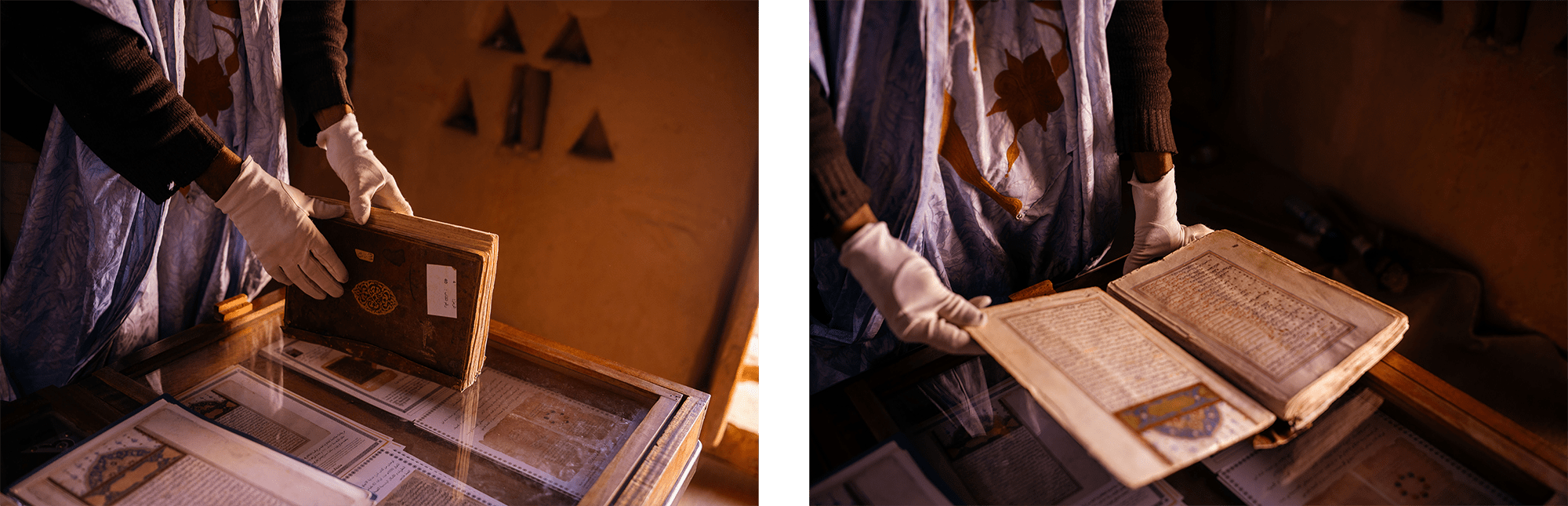
Photo: Kang-Chun Cheng.
Habott opening a book on Sufism interpretation in the family library.
I had to do a little research before sharing today’s article about a family’s work to preserve ancient manuscripts. I’m sorry to say that my geography is weak, and I didn’t know where to find Mauritania.
According to Wikipedia, Mauritania is a country in Northwest Africa, situated in the middle of Mali, Senegal, Algeria, and Western Sahara. Its full name is the Islamic Republic of Mauritania.
At the Dial recently, Kang-Chun Cheng described the history of the manuscripts and focused on why climate change and desertification is threatening them.
“Dressed in a boubou, a traditional Arab robe, ” Cheng writes, “Mohammed Abdullah Ould Gholam Habott, 51, puts on gloves before delicately handling the ancient manuscripts. He opens a book about Sufism, a mystical practice within Islam, and then another about its interpretation. Gingerly, he thumbs through the pages of Arabic script.
“Habott is the custodian of his family’s library and has been for 24 years. The size of a large sitting room, the library contains more than 1,000 pieces of Quranic manuscripts, legal texts and scientific writings –– some of the oldest in West Africa — ranging from mathematics to astronomy. It’s one of three such libraries still open to the public in Chinguetti, an ancient desert village in northern Mauritania.
“Established around 777 AD, Chinguetti — meaning ‘spring of horses’ in the extinct Azayr language — is home to roughly 4,800 people. The unforgiving environment makes survival feel like a concession; temperatures can exceed 43 degrees Celsius [109.4 F] during the day, then plummet down to 10 degrees after the sun sets. …
“Designated as a UNESCO World Heritage site in 1996, Chinguetti once served as an important trading outpost for the Mediterranean Timbuktu caravan route and a resting spot for religious pilgrims en route to Mecca. Small libraries were built to maintain and organize holy writings left behind by generations of transient pilgrims. Today, tourists and researchers travel great distances to look at them.
“Books are stored in storage cabinets, on open shelves and in wood and glass display cases. With few windows, the libraries are kept relatively dark and the texts out of the hot sun, but the rooms are far from temperature controlled. These simple preservation methods may not be enough to withstand changes to the desert climate.
“Temperatures here are rising up to 1.5 times faster than the global average, rainfall is plummeting, and sandstorms are becoming more common. While the texts are relatively safe in the arid desert air, the fates of the libraries themselves are precarious. Desertification threatens to bury towns. With fewer trees and vegetation, sand can more easily migrate onto the streets. In some places, dunes reach window height and pour into people’s homes.
“The libraries in Chinguetti are owned and overseen by families, custodial positions passed down through generations. From a young age, Habott was captivated by stories that his grandfather told him of pilgrimages to Mecca and traveling to Andalusia, Spain, to purchase Moorish texts. His family’s library has existed since the 1800s and, as the eighth custodian, Habott tells me he felt proud of the culture and heritage the libraries carried. …
“His two sons, aged 12 and 18, don’t share this dream. Chinguetti’s remoteness and lack of resources (access to electricity only stabilized in 2013) mean there are very few economic opportunities. Many young people have little incentive to stay; the city’s population has been steadily declining for years as youth travel elsewhere for blue-collar work and a larger life. …
“ ‘An ocean of sand is coming,’ Habbott says from the dry coolness of his library. ‘I ask Allah to keep this family going.’ ”
A nice collection of photos may be enjoyed at the Dial, here. No firewall.
In case, like me, you had never heard of the Dial, here’s what they say about themselves: “We created The Dial in 2023 to make space for daring writing unconstrained by geography. English-language journalism is growing perilously small in voice, in ambition and in subject. We see an opportunity to publish stories from the point of view of those on the ground — with the world itself as our center of gravity, rather than Brooklyn. We trained as editors at The New York Review of Books, Politico’s European newsroom and the Atlantic.” I like the sound of their goals!


Yes, good goals but so sad to read about the rapid rate of climate change.
LikeLike
Desertification is such a creepy thing to think about, like a horror movie.
LikeLike
Yes!
LikeLiked by 1 person