Photo: Nina Westervelt/Bloomberg via Getty Images.
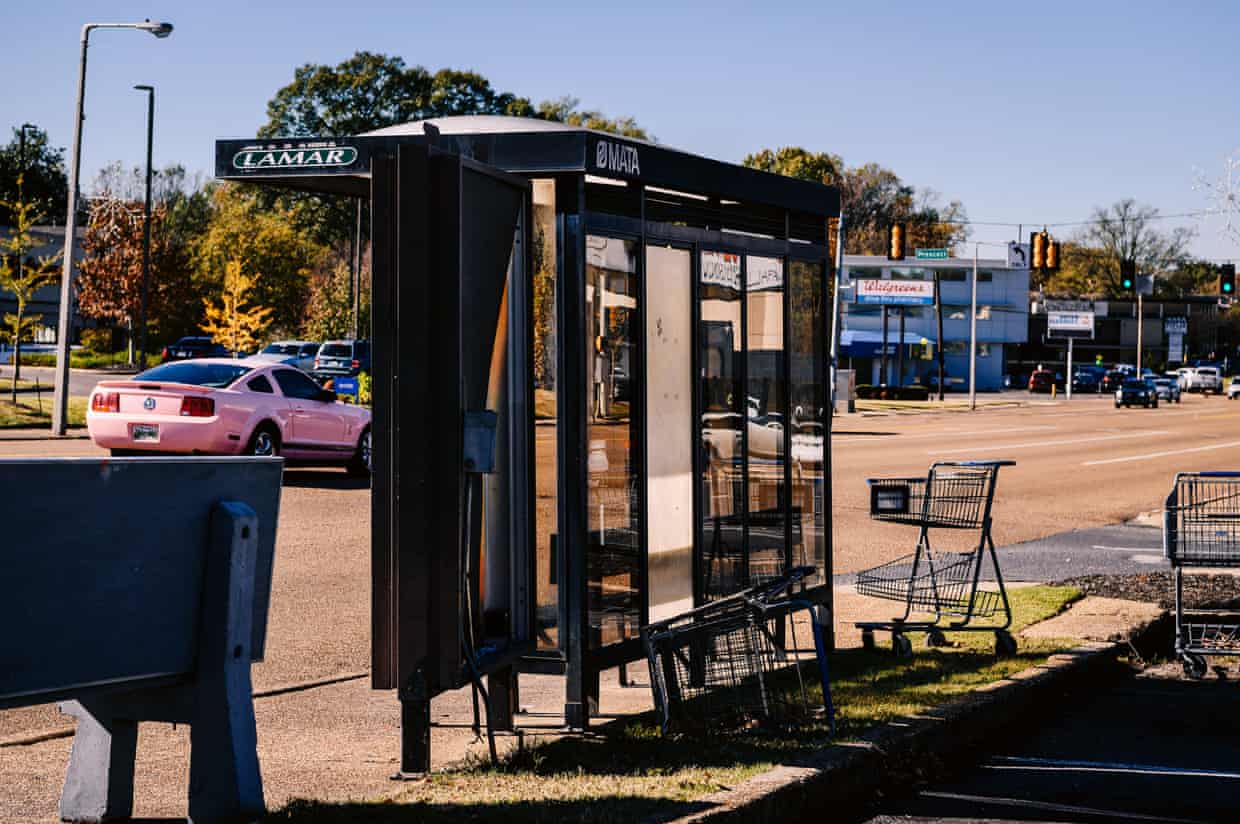
A bus stop in Memphis, Tennessee, where transit issues make it hard to shop for groceries.
You’ve heard of “food deserts,” places without a convenient market, especially a market with fresh produce. Now consider how people without easy access or a car can get to a store located at a distance.
Lela Nargi writes at the Guardian, “Zen’Yari Winters’ job, at a pet shop in East Memphis, Tennessee, should be a 20-minute trip from her house. She leaves herself three hours to get there. ‘The bus is always, always late,’ she said – if it shows up at all.
“It’s not just her work commute that’s affected by the time-consuming guessing game that is riding with the Memphis Area Transit Authority (Mata). The only full-service grocer in the Chelsea-Hollywood area where she lives closed in 2025. To shop for food in person, she could take two buses for a 13-mile (20km) trip to Walmart. But she risks waiting at bus stops for hours with perishables – or shelling out about $24 for an Uber back.
“So instead, every two weeks, she buys at least $35 worth of groceries online to avoid a $6.99 fee for a smaller order and pays a $7 monthly delivery charge not covered by her Supplemental Nutrition Assistance Program (Snap) benefits. …
“Winters is just one of 16 million Americans without cars and one of almost 25 million living in a ‘transit desert‘ where the public transportation supply is lower than demand. For them, accessing healthy, affordable food is both an inconvenience and an extravagance. …
But cities such as Memphis; Providence, Rhode Island; and Duluth, Minnesota, have gone in the opposite direction and cut service.
“These actions were driven by what Art Guzzetti, the vice-president of policy, mobility, technical services and innovation at advocacy group American Public Transportation Association, calls a ‘transit fiscal cliff’ affecting some cities as $70bn in Biden-era funds to prop up Covid-beleaguered transit systems runs out. This is all while food insecurity rises across the US. …
“That cliff has forced some transit agencies to economize by rerouting buses and cutting back on their frequency. They’re also getting rid of stops, which Sierra Arnold, a microeconomist at Xavier University in Cincinnati, found led to fewer purchases of healthier foods. …
“Rhode Island’s state transit authority cut service on 45 of its 63 routes in September 2025, to save money on low-ridership lines. Sherman Pines, a Newport resident, said this happened on top of a Covid-era budget-saving measure that reduced service in his town during the non-touristy, non-summer months, making bus service unreliable. A nearby supermarket allows residents to walk groceries home in store carts. But Pines called the store ‘horrible, pricey, small’ – anyone who wants to travel farther afield contends with long waits for a city bus and at least one transfer.
“An added hazard: too few bus shelters. That’s just hard on an elderly person to stand there for 30 minutes or 45 minutes, it’s raining, it’s snowing,’ Pines said.
“The epidemiologist Ric Bayly documented these sorts of experiences in a 2025 Tufts University-led study on Rhode Island’s bus-food connection. He found that even with double the time to travel to and from a grocery store, less than half of residents had healthy food access via bus as opposed to a car, leaving him to conclude that ‘public transit is just a terrible way to get food,’ he said. ‘It’s just so difficult to deal with the weather, the weight, the carrying, the trouble you have getting on a bus with a cart of food, [because] the transit authority in Rhode Island allows bus drivers to forbid entry with a food cart.’
“Deborah L Wray, a 70-year-old Providence resident, had her cart rejected from the bus only once. Until recently, Wray could catch the 92 bus every half an hour across the street from home and ride it to Price Rite, the closest supermarket to home. These days, the bus runs every two hours. …
“Price Rite also doesn’t accept the Medicare UCard she uses to buy the healthy foods she needs to eat as someone with diabetes. For that, she takes a different bus to Stop & Shop; she prefers to stretch her Snap benefits by hitting the sales at Market Basket, which is serviced by yet another bus. Some evenings, she eats peanut butter and other shelf-stable items from a pantry box delivered to her building. That’s a short-term fix for ‘when you ain’t got nothing, so us elderly don’t have to eat dog food,’ she said.
“A survey of 100 Duluth residents uncovered similar transportation-related hassles. Covid-reduced bus routes, long wait times, too little space for shopping carts, and bad weather were the primary barriers residents identified in purchasing healthy, affordable foods. The city recently set up a transportation commission in an attempt to improve.
“But changes are ‘sometimes beneficial, and other times they’re not, and we heard many comments that the revamps have actually made things worse,’ said Stephany Medina, a food justice policy developer who worked on the survey. Respondents pointed out that a changed bus stop now required crossing a major highway to reach a supermarket.
“The city of Somerville, a city outside Boston that had a food insecurity rate of 35% in 2025, exemplifies the difficulty in connecting under-resourced communities to the foods they prefer to eat. Residents might use buses to reach food pantries. But ‘the biggest thing we hear is that people would like to be able to get to places that are outside of Somerville, and they’re hard to get to without a car,’ said Alissa Ebel, the city’s healthy communities coordinator. …
“During and after the Covid pandemic, Somerville tested a program called Taxi to Health that gave out vouchers for taxi rides to grocers including Super 88. Vouchers are one form of demand-responsive transit (DRT), a flexible and more cost-efficient alternative to fixed-route bus systems. Another model, called microtransit, launches fleets of smaller vehicles such as vans to connect residents to supermarkets, sometimes on a sliding scale based on income. Students of Kathleen Hoke, a public health law professor at the University of Maryland’s Carey School of Law, developed one such system for Duluth residents in tandem with Medina’s survey.
“Some communities have sought to solve their transit and food problems with mobile grocery stores that let people shop in their neighborhoods, since many people prefer to pick their own groceries. Guzzetti, from American Public Transportation Association, sees promise in having city planners move away from prioritizing cars in new developments. When deciding where to build, ‘make transit access a foremost, high-level consideration in location decisions,’ he said.
“For residents of Memphis, who are stuck with the built environment they already have, a new potential solution is emerging. A privately funded non-profit called MyCityRides is teaching residents how to drive gas-powered scooters to counteract the reality that, as [Kelsey Huse, a local activist and urban planning student] said, ‘the bus is not perfect and cars are expensive.’
“Winters completed a day of scooter school and is practicing her driving. If she passes her motorcycle test, MyCityRides will sell her a scooter for $150 a month paid out over three years. ‘Riding a scooter would be so much cheaper and easier than riding the bus and getting stuck at the bus stop for hours,’ she said.”
Pretty sure scooters won’t help the elderly, but it’s good that some cities are working on this challenge.
A range of other solutions are at the Guardian, here.


Most places in this country evolve around the car, and if you can’t afford one, then life can be very difficult indeed. Hope the
LikeLike
We always lived in walkable communities–until the retirement place. We could really use transit options now.
LikeLiked by 1 person
Somehow, I wasn’t able to finish my comment. My little virtual keyboard froze. It should have been “I hope the scooter works out.”
LikeLike
Can’t see carrying groceries on it.
LikeLiked by 2 people
Maybe with some kind of basket?
LikeLiked by 1 person
In the heat and the cold it’s difficult to wait for the bus. I’ve waited at -20 F in Minneapolis and at 100 F in Austin, TX. Dependable time tables are so important. I like the idea of vans to take people grocery shopping.
LikeLike
I like that, too.
LikeLiked by 1 person