Feeds:
Posts
Comments

Posts Tagged ‘taxi’

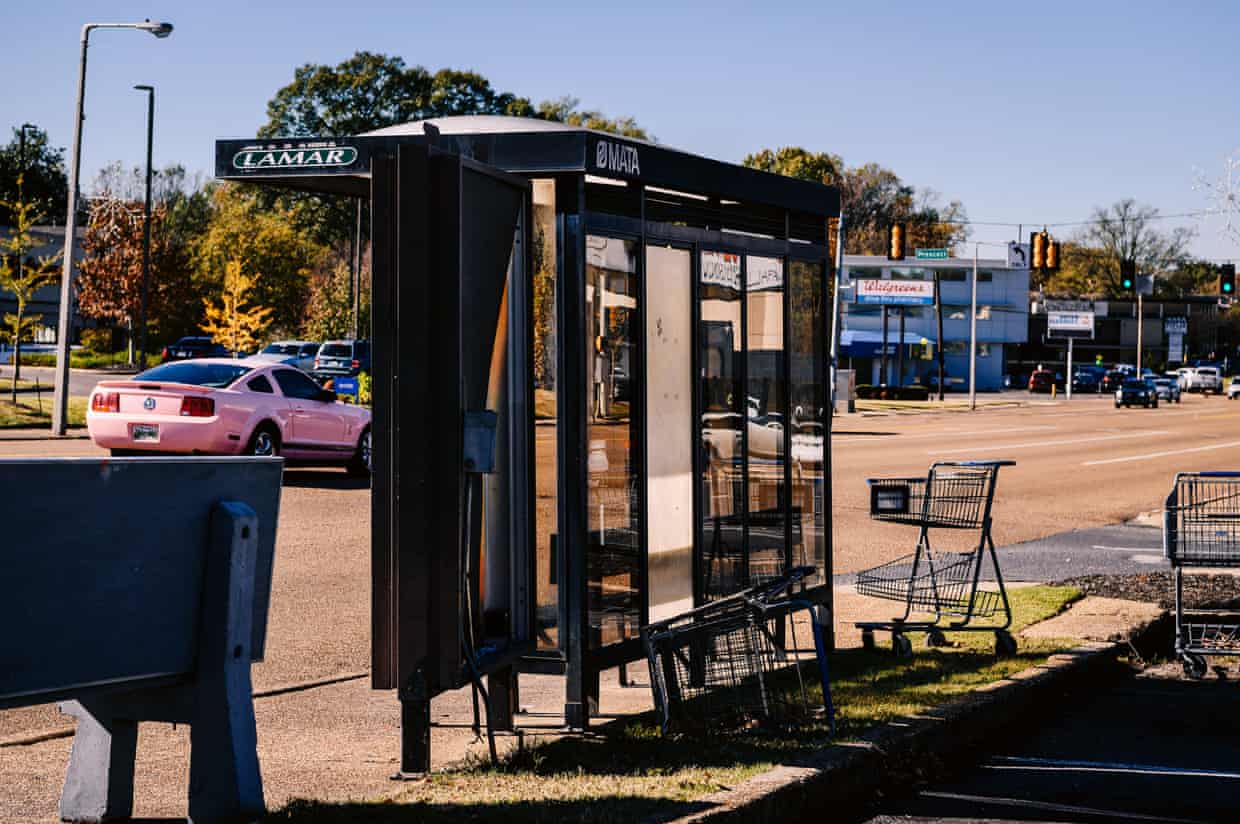
Photo: Nina Westervelt/Bloomberg via Getty Images.
A bus stop in Memphis, Tennessee, where transit issues make it hard to shop for groceries. 

You’ve heard of “food deserts,” places without a convenient market, especially a market with fresh produce. Now consider how people without easy access or a car can get to a store located at a distance.

Lela Nargi writes at the Guardian, “Zen’Yari Winters’ job, at a pet shop in East Memphis, Tennessee, should be a 20-minute trip from her house. She leaves herself three hours to get there. ‘The bus is always, always late,’ she said – if it shows up at all.

“It’s not just her work commute that’s affected by the time-consuming guessing game that is riding with the Memphis Area Transit Authority (Mata). The only full-service grocer in the Chelsea-Hollywood area where she lives closed in 2025. To shop for food in person, she could take two buses for a 13-mile (20km) trip to Walmart. But she risks waiting at bus stops for hours with perishables – or shelling out about $24 for an Uber back.

“So instead, every two weeks, she buys at least $35 worth of groceries online to avoid a $6.99 fee for a smaller order and pays a $7 monthly delivery charge not covered by her Supplemental Nutrition Assistance Program (Snap) benefits. …

“Winters is just one of 16 million Americans without cars and one of almost 25 million living in a ‘transit desert‘ where the public transportation supply is lower than demand. For them, accessing healthy, affordable food is both an inconvenience and an extravagance. …

But cities such as Memphis; Providence, Rhode Island; and Duluth, Minnesota, have gone in the opposite direction and cut service.

“These actions were driven by what Art Guzzetti, the vice-president of policy, mobility, technical services and innovation at advocacy group American Public Transportation Association, calls a ‘transit fiscal cliff’ affecting some cities as $70bn in Biden-era funds to prop up Covid-beleaguered transit systems runs out. This is all while food insecurity rises across the US. …

“That cliff has forced some transit agencies to economize by rerouting buses and cutting back on their frequency. They’re also getting rid of stops, which Sierra Arnold, a microeconomist at Xavier University in Cincinnati, found led to fewer purchases of healthier foods. …

“Rhode Island’s state transit authority cut service on 45 of its 63 routes in September 2025, to save money on low-ridership lines. Sherman Pines, a Newport resident, said this happened on top of a Covid-era budget-saving measure that reduced service in his town during the non-touristy, non-summer months, making bus service unreliable. A nearby supermarket allows residents to walk groceries home in store carts. But Pines called the store ‘horrible, pricey, small’ – anyone who wants to travel farther afield contends with long waits for a city bus and at least one transfer.

“An added hazard: too few bus shelters. That’s just hard on an elderly person to stand there for 30 minutes or 45 minutes, it’s raining, it’s snowing,’ Pines said.

“The epidemiologist Ric Bayly documented these sorts of experiences in a 2025 Tufts University-led study on Rhode Island’s bus-food connection. He found that even with double the time to travel to and from a grocery store, less than half of residents had healthy food access via bus as opposed to a car, leaving him to conclude that ‘public transit is just a terrible way to get food,’ he said. ‘It’s just so difficult to deal with the weather, the weight, the carrying, the trouble you have getting on a bus with a cart of food, [because] the transit authority in Rhode Island allows bus drivers to forbid entry with a food cart.’

“Deborah L Wray, a 70-year-old Providence resident, had her cart rejected from the bus only once. Until recently, Wray could catch the 92 bus every half an hour across the street from home and ride it to Price Rite, the closest supermarket to home. These days, the bus runs every two hours. …

“Price Rite also doesn’t accept the Medicare UCard she uses to buy the healthy foods she needs to eat as someone with diabetes. For that, she takes a different bus to Stop & Shop; she prefers to stretch her Snap benefits by hitting the sales at Market Basket, which is serviced by yet another bus. Some evenings, she eats peanut butter and other shelf-stable items from a pantry box delivered to her building. That’s a short-term fix for ‘when you ain’t got nothing, so us elderly don’t have to eat dog food,’ she said.

“A survey of 100 Duluth residents uncovered similar transportation-related hassles. Covid-reduced bus routes, long wait times, too little space for shopping carts, and bad weather were the primary barriers residents identified in purchasing healthy, affordable foods. The city recently set up a transportation commission in an attempt to improve.

“But changes are ‘sometimes beneficial, and other times they’re not, and we heard many comments that the revamps have actually made things worse,’ said Stephany Medina, a food justice policy developer who worked on the survey. Respondents pointed out that a changed bus stop now required crossing a major highway to reach a supermarket.

“The city of Somerville, a city outside Boston that had a food insecurity rate of 35% in 2025, exemplifies the difficulty in connecting under-resourced communities to the foods they prefer to eat. Residents might use buses to reach food pantries. But ‘the biggest thing we hear is that people would like to be able to get to places that are outside of Somerville, and they’re hard to get to without a car,’ said Alissa Ebel, the city’s healthy communities coordinator. …

“During and after the Covid pandemic, Somerville tested a program called Taxi to Health that gave out vouchers for taxi rides to grocers including Super 88. Vouchers are one form of demand-responsive transit (DRT), a flexible and more cost-efficient alternative to fixed-route bus systems. Another model, called microtransit, launches fleets of smaller vehicles such as vans to connect residents to supermarkets, sometimes on a sliding scale based on income. Students of Kathleen Hoke, a public health law professor at the University of Maryland’s Carey School of Law, developed one such system for Duluth residents in tandem with Medina’s survey.

“Some communities have sought to solve their transit and food problems with mobile grocery stores that let people shop in their neighborhoods, since many people prefer to pick their own groceries. Guzzetti, from American Public Transportation Association, sees promise in having city planners move away from prioritizing cars in new developments. When deciding where to build, ‘make transit access a foremost, high-level consideration in location decisions,’ he said.

“For residents of Memphis, who are stuck with the built environment they already have, a new potential solution is emerging. A privately funded non-profit called MyCityRides is teaching residents how to drive gas-powered scooters to counteract the reality that, as [Kelsey Huse, a local activist and urban planning student] said, ‘the bus is not perfect and cars are expensive.’

“Winters completed a day of scooter school and is practicing her driving. If she passes her motorcycle test, MyCityRides will sell her a scooter for $150 a month paid out over three years. ‘Riding a scooter would be so much cheaper and easier than riding the bus and getting stuck at the bus stop for hours,’ she said.”

Pretty sure scooters won’t help the elderly, but it’s good that some cities are working on this challenge.

A range of other solutions are at the Guardian, here.

Read Full Post »

Photo: Adrian Susec/Unsplash.

Film buffs, it turns out, are not only creative about making movies, they’re creative about ways to screen movies. That’s because a different locale can lend a whole new feeling to the movie-going experience.

Bryn Stole writes at the New York Times, “Some of international cinema’s biggest names gathered on [a Tuesday in February] at the Berlin International Film Festival as the event honored Martin Scorsese with a lifetime achievement award. Before accepting his trophy, Scorsese listened as the German director Wim Wenders gave a laudatory speech to an audience including celebrities and local dignitaries.

“Just around the corner, parked in the middle of a busy thoroughfare, a group of Berlin’s taxi drivers crammed into the back of a worn-out taxi van to watch a double-feature capped by Scorsese’s 1976 movie Taxi Driver.

“Klaus Meier, who has been driving a cab in Berlin since 1985, handed out bottles of soda and beer, popping the caps with the blade of a pocketknife. Irene Jaxtheimer, who runs a taxi company, passed around homemade popcorn. A generator outside the cab powered a modest television, a DVD player and a small electric heater.

“The unconventional screening, just outside a centerpiece event for one of Europe’s most prestigious film festivals, was part of the makeshift TaxiFilmFest. Running through Sunday, it is partly a protest over the miserable state of the taxi industry these days and partly a counterfestival to celebrate the taxi cab’s iconic place in the urban cultural landscape.

“It’s also in objection to an exclusive partnership deal between the festival, known locally as the Berlinale, and the ride-hailing giant Uber to ferry filmmakers between the city’s movie theaters during the event. … Beeping horns from the busy street outside — some of them coming from sleek black Uber vehicles emblazoned with the Berlinale logo — blended with the street scenes from Taxi Driver playing on the tinny television speakers. ‘Ah, I really miss those mechanical fare boxes!’ Meier said as the fares ticked away in the onscreen cab of the movie’s unhinged antihero, Travis Bickle, who drives around mid-’70s New York with growing hatred and menace.

“The back-seat festival is showing only taxi-themed flicks, and the potential repertoire is deep. Meier polled friends and fellow taxi drivers about which films to show, and said he had received dozens of suggestions about movies in which a cab plays a starring role.

“The early feature on Tuesday was Barry Greenwald’s 1982 quirky slice-of-life documentary Taxi! about some odd characters driving cabs in Toronto. The previous evening, a small rotating crowd beat the rain to catch portions of the 1998 French action-comedy Taxi, a lighthearted flick from the director Gérard Pirès about sinister, Mercedes-driving German gangsters, hapless Marseilles cops and a lead-footed rookie cabdriver who turns out to be the only person fast enough to catch the criminals.

“An early hit at the TaxiFilmFestival, which kicked off last Thursday, was Under the Bombs, a Lebanese drama set during the 2006 conflict between Hezbollah and Israel. In the movie, a Beirut taxi driver is hired to drive a woman into the war-torn south of Lebanon in hopes of finding her sister and son. Meier described it as ‘Shakespearean’ and ‘a masterpiece,’ and Berndt said it was clearly the ‘most moving taxi film’ he’d ever seen.

“But the clear favorite among attendees was Jim Jarmusch’s Night on Earth, a quirky, episodic 1991 film about taxi drivers and passengers in five cities around the world. The selection for TaxiFilmFest’s Sunday night finale had yet to be chosen, and Meier said he remained open to suggestions. …

“The festival attendees, squeezed into the back of the van on Tuesday, also reminisced about better days for taxi driving, such as ferrying around American and British soldiers from the occupying Allies stationed in West Berlin. (The French troops, the small crowd agreed, had less cash and rarely hailed cabs.) …

“The days before the fall of the Berlin Wall were ‘blissful times, hard to even imagine anymore,’ said Stephan Berndt.” More at the Times, here.

See also my 2014 post about a theatrical production in a taxi in Iran, here.

By the way, I hated the movie Taxi Driver when I saw it around 1976 — and walked out. Still don’t get what’s to like. You?

Read Full Post »

One thinks of Iran as repressive, and having watched the doomed 2009 revolution unfold on twitter, I believe it is. But Iranian theater people seem to be managing to squeeze in some fun.

I blogged before about the Tehran production in a taxi, here. Now Studio 360 has a story on what might be called extreme improvisation. I take that back. There’s a script. But the actor doesn’t get to see it in advance.

“Actors face stage fright all the time,” says Studio 360, a radio show. “But consider this scenario: you show up to perform a one-person show, and you’ve never seen the script. You don’t know what it’s about because you promised not to do any research. It’s your first performance, and the only one you’ll ever have. The theater’s artistic director hands you a fat manila envelope with a script. And go.

“Also, the audience will decide whether you drink a glass of water that appears to have been poisoned.

“This is the premise of White Rabbit, Red Rabbit, by Iranian playwright Nassim Soleimanpour. ‘I did not know what was in front of me inside that envelope,’ says actor Gwydion Suilebhan. ‘What if this script is going to require that I disrobe? Or insult my mother? Or be rude or self-debasing?’ …

“Soleimanpour pulls his strings from afar, because — although the play has been performed in Toronto, Berlin, San Francisco, Brisbane, Edinburgh, London, and now Washington, DC — he really is in a cage. He doesn’t have a passport and can’t leave Iran, so he has never seen his play performed. ‘Nassim has given up the kind of control that is customary for playwrights,’ says Suilebhan, of working with actors and directors to realize the play. ‘At the same time, because he has put all of these restrictions on how it is to be performed, he has seized certain kinds of control that playwrights normally do not have. So he is literally embodying the ideas of control and submission and manipulation that he’s baked into his script.’ ” More.

Photo of Iranian playwright Nassim Soleimanpour found at the HuffingtonPost

Read Full Post »

I started really paying attention to Iran (and to Twitter, tops for breaking news) on June 20, 2009, when the tragic, short-lived Green Revolution erupted, fueling unrealized hopes for a more democratic country.

Then I read Jason Elliot’s Mirrors of the Unseen (and blogged about it here) about his travels in Iran, and especially about the people he met and the architecture he admired. He came up with a theory about the architecture that related to the builders’ Islamic beliefs, a love of nature, and a concept of sacred proportions. (If you should see the Nova special on how Medieval architects used the Bible to decide on ideal Gothic cathedral measurements, you will get the idea.)

Elliot loved the people he met in Iran and bemoans the way the Western media depict them. In full agreement with Elliot is the British translator of ancient Persian poetry, Dick Davis, who was on PBS NewsHour last night.

But though the Iranian people may be like people anywhere, the government is not. Residents are frequently obliged to be cautious. Which is how theatrical productions in the privacy of a taxi have come about.

Haleh Anvari of the Guardian‘s Tehran Bureau has that story.

Unpermitted Whispers is a 35-minute play that takes place in one of Tehran’s ‘Rahi’ taxis, which traverse the city along fixed, often straight-line, routes. Rahis pick up passengers at major intersections and drop them off anywhere along their set route, making for a convenient method of getting around town and one cheaper than the minicabs available in every neighbourhood of the capital.

“In contrast to the minicabs, which provide door-to-door service, the Rahi system affords passengers much more anonymity, allowing for candid and uninhibited conversation. Tehranis frequently share stories that they have overheard in these communal cabs; for many, they serve as an extension of the private sphere in which Iranians feel safe to talk about issues of the day.

Unpermitted Whispers takes advantage of this unlikely superimposition of public and private to tell the story of three passengers, all women, who are picked up by a male driver at different points along his route. …

“The play’s first scene was performed entirely on the telephone, as we eavesdropped on a conversation of a kind with which many Iranian women are familiar: a young bride wants to go to the theatre with her university friends but needs an alibi as her traditional family and jealous husband will not approve.”

More here.

Update 2/5/14: Turns out NY City has a play in a cab. It’s called “Take Me Home” and is reviewed by Neil Genzlinger, here.

Photograph: Hanna Havarinasab
Unpermitted Whispers is a play by Azadeh Ganjeh performed in a taxi.

Read Full Post »