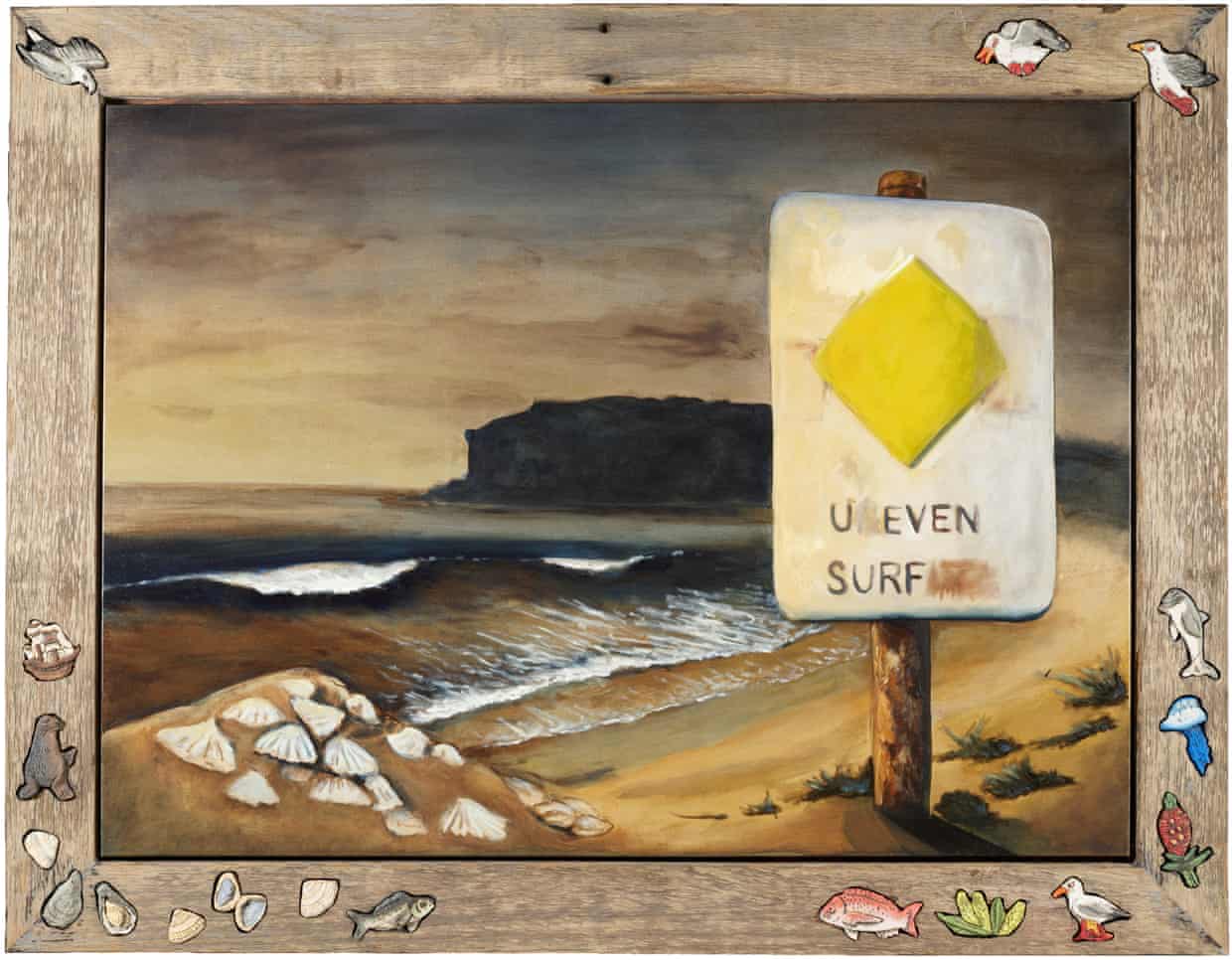
Photo: Diana Panuccio/Art Gallery of New South.
One of the new landscapes of Aboriginal artist Billy Bain — a new development in his career.
Around the world, indigenous people have been pushed and pushed into spaces nobody wants. That is, until the land becomes desirable for new reasons, and then they have to fight to keep it.
As Steve Dow writes at the Guardian, an artist in Australia is intent on reclaiming the beaches for Aborigines.
“As a teenager in the mid 2000s, Billy Bain would ride waves around Sydney’s northern beaches, having traveled the world watching his champion surfer father Rob Bain compete. But even though he was minutes from his home in Avalon, he was often made to feel an unwelcome outsider.
“ ‘I’d be told that I’m not from there, so I need to go in [to shore],’ he says, seeing these warnings as veiled threats of violence. ‘Otherwise, you know, “something’s gonna happen to you.” ‘
“Now 33, the Dharug artist sees simply being an Aboriginal surfer as a way of reclaiming space. ‘[The northern beaches are] quite an isolated and predominantly white place,’ he says.
‘You know, the beach was and still is an Aboriginal space, but in popular culture it has been represented as a very white space.
” ‘There’s obviously the bronze Aussie, which is your typical tan, athletic white male, but it’s not seen as being a space that Aboriginal people inhabit any more.’
“In his studio in Granville in Sydney’s inner west, Bain is preparing for an upcoming solo exhibition at the Art Gallery of New South Wales, ‘By the River.’ The survey will feature new work, including five landscape paintings of the Dyarubbin/Hawkesbury river – a location that connects the Manly born artist with the country of his ancestors.
” ‘Geographically it was actually very close for us,’ says Bain, who has come to see surfing on the northern beaches as a form of cultural return, because the Dyarubbin flows into an estuary at Pittwater. ‘I see the story of the eel and how it spawns out at sea and then it finds its way back up these river systems to be an interesting metaphor for a return. I see myself as having a similar journey.’
“For ‘By the River,’ Bain has made 11 funny, figurative Indigenous family members (and one dog) dressed in bikinis, shorts and even a pair of budgie smugglers painted in Aboriginal colors: red and black with a yellow tie. …
“The figures will be displayed holding aloft a four-meter, long-finned eel – a totem animal and spirit of resilience known in Dharug language as a burra – which Bain has fashioned as a soft sculpture using cloth on a wire and steel frame, adorned by 200 textile elements handwoven by his mother, Kathleen Bain.
“Kathleen, a Dharug woman … would encourage her children to create with all sorts of materials, and Bain would especially love making faces and figures from the wax scraped from his surfboards.
“Bain’s surfer father has also been part of his artistic process. The pair took a small ‘tinny’ boat up the Dyarubbin, bush bashing along the clifftops and finding ancient Aboriginal handprints in caves, to help form the drawings for his five landscape paintings. …
“Ultimately, Bain’s art practice has become ‘a healing thing,’ he says. ‘It’s been such a massive part of learning to express myself.’ …
“Artists don’t exist to change the mind of doubters, but ‘fun, seductive’ humor in art can convey some serious ideas, Bain says. … ‘I do have quite a positive look on the human spirit and people’s ability to be good-natured and embrace other people. I think that’s intrinsic in us as humans.’ ”
If you live in New South Wales, you have until November 8 to see the show.
More at the Guardian, here. No firewall, but please consider supporting their outstanding joyrnalism.


Great idea for Bain to use humor to reclaim the beach. I’m thinking about the dog in the bikini !
LikeLiked by 1 person
And he’s accomplished so much in art despite being colorblind. Shows persistence.
LikeLiked by 1 person