Photo: Christoph Große.
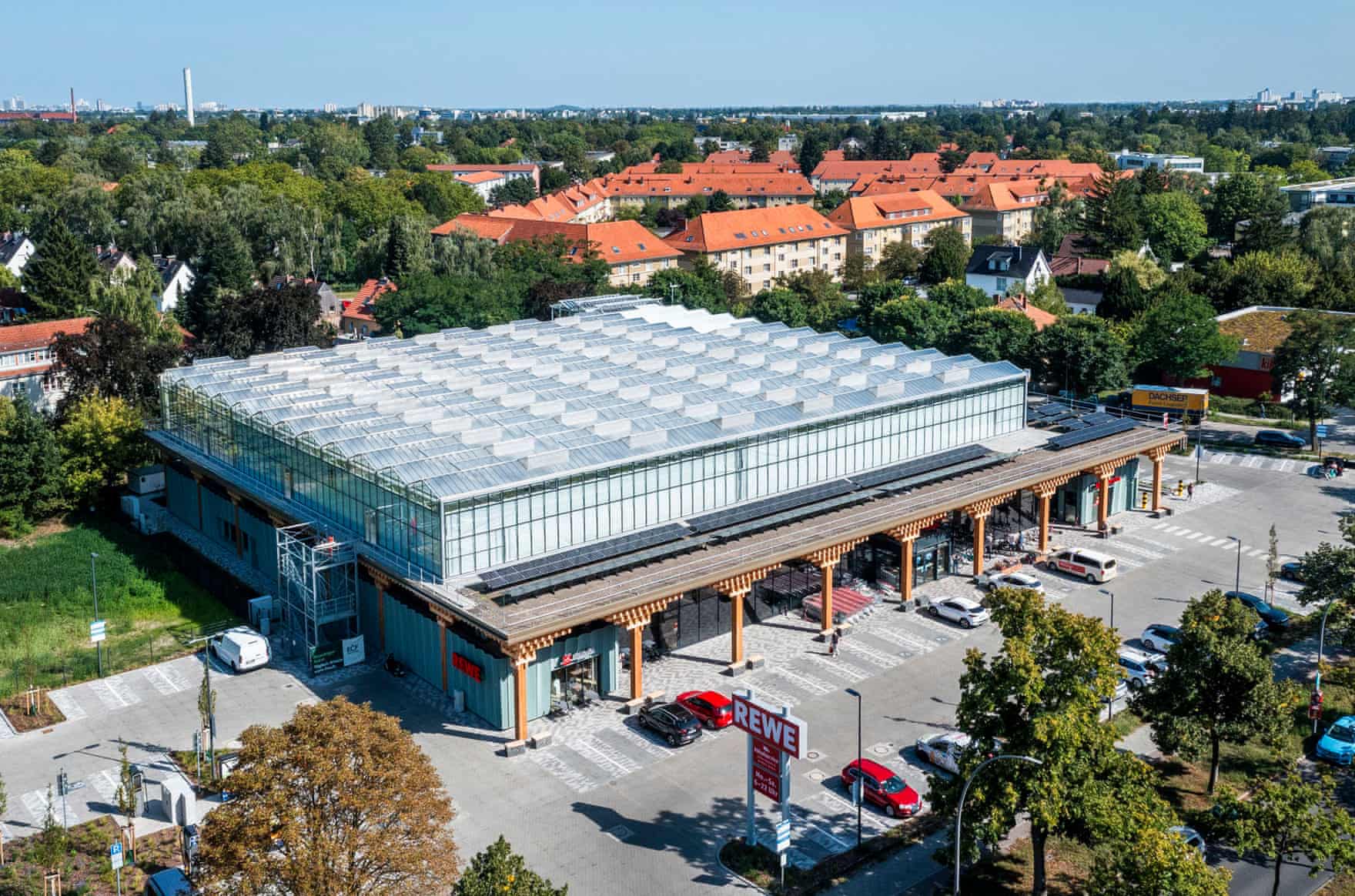
Berlin’s Felix Thomas REWE supermarket with its rooftop farm.
Recognizing how wasteful humans can be in modern times, I find it encouraging that so many urban farms are sprouting up on small pieces of land or otherwise empty roofs. An article in the Guardian notes that it is no longer unusual to find urban vegetables blooming in community plots, families’ backyards, or on a commercial scale on rooftops.
Hannah Docter-Loeb writes, “Walking into the Felix Thomas REWE supermarket in Lankwitz, Berlin, customers are immediately presented with a choice of greens: romaine, rocket, iceberg. But last month, a new option joined the selection: Lankwitz loose-leaf lettuce. A combination of head lettuce, romaine lettuce, Lollo Rosso, and dark green easy leaf lettuce, its yellow packaging makes it stand out in a row of green. … Unlike its neighboring lettuces, which come from regional farms or all the way from Italy, these greens were grown just a few meters away – or rather, a few meters up. ‘Frisch Vom REWE Dach’ or ‘Fresh from the REWE roof,’ the bags read.
“Rooftop farms are nothing new: in cities such as Paris, Hong Kong, Copenhagen and New York, similar farms supply food to adjacent food retailers or even restaurants. This model has the potential to reduce greenhouse gas emissions from transportation (and its associated costs), minimize the urban heat effect, make use of dead space and perhaps even improve the relationship between buyers and their food. …
“REWE provides the space, location, and distribution channels to sell, and ECF designed and manages the greenhouse. The Lankwitz lettuce has become a selling point of sorts: store manager Felix Thomas says one customer traveled more than 50km [~31 miles] just to get their hands on a bag. And the integration of the farm into REWE’s market and corresponding supply chain is novel, says ECF CEO and founder Nicolas Leschke. …
“The greenhouse is heated through the waste heat of cooling aggregates downstairs, and rainwater is the primary source of water for the greenhouse and plant production. Some of the greenhouse is also powered by sustainable energy – primarily solar.
“The operation is meant to be year-round. The farm makes use of hydroponic technologies: the lettuce varieties are grown with very little soil. The whole growing process takes a little over three weeks. Once cut, the greens go straight downstairs to be packaged and sold, both on site and in other stores in the city and region.
” ‘We don’t even have an extra truck on the road that usually is necessary to transport the goods from the producer to the central distribution,’ Leschke said.
“Prajal Pradhan, an associate professor at the University of Groningen in the Netherlands, who recently published a study on urban agriculture in Europe [says] ‘This is a way to go forward, because you can provide fresh vegetables to urban consumers on site.’ However, he stresses, it should not be an alternative to having a personal or community rooftop garden. He says urban agriculture should be inclusive and find ways to include the whole community, a sentiment echoed by study co-author Stepan Svintsov, a remote sensing expert based in Berlin.
“ ‘Getting people together from a dense city and sharing agricultural knowledge among them helps bring the community together,’ Svintsov said. REWE currently offers tours to see the facility from outside, but no one can enter the production rooms.
“There is a large potential for rooftop farms and the like in Europe. Pradhan, Svintsov and their colleagues’ review looks at the biophysical viability for urban agriculture in European cities: seeing how urban rooftop and ground-based areas are well suited for cultivating vegetables. They found that urban agriculture in European cities could produce up to … 28% of the continent’s vegetable demand.”
More at the Guardian, here. No firewall, but please consider a donation or subscription to this outstanding publication.


Leave a comment. Website address isn't required.