Feeds:
Posts
Comments

Posts Tagged ‘rooftop’

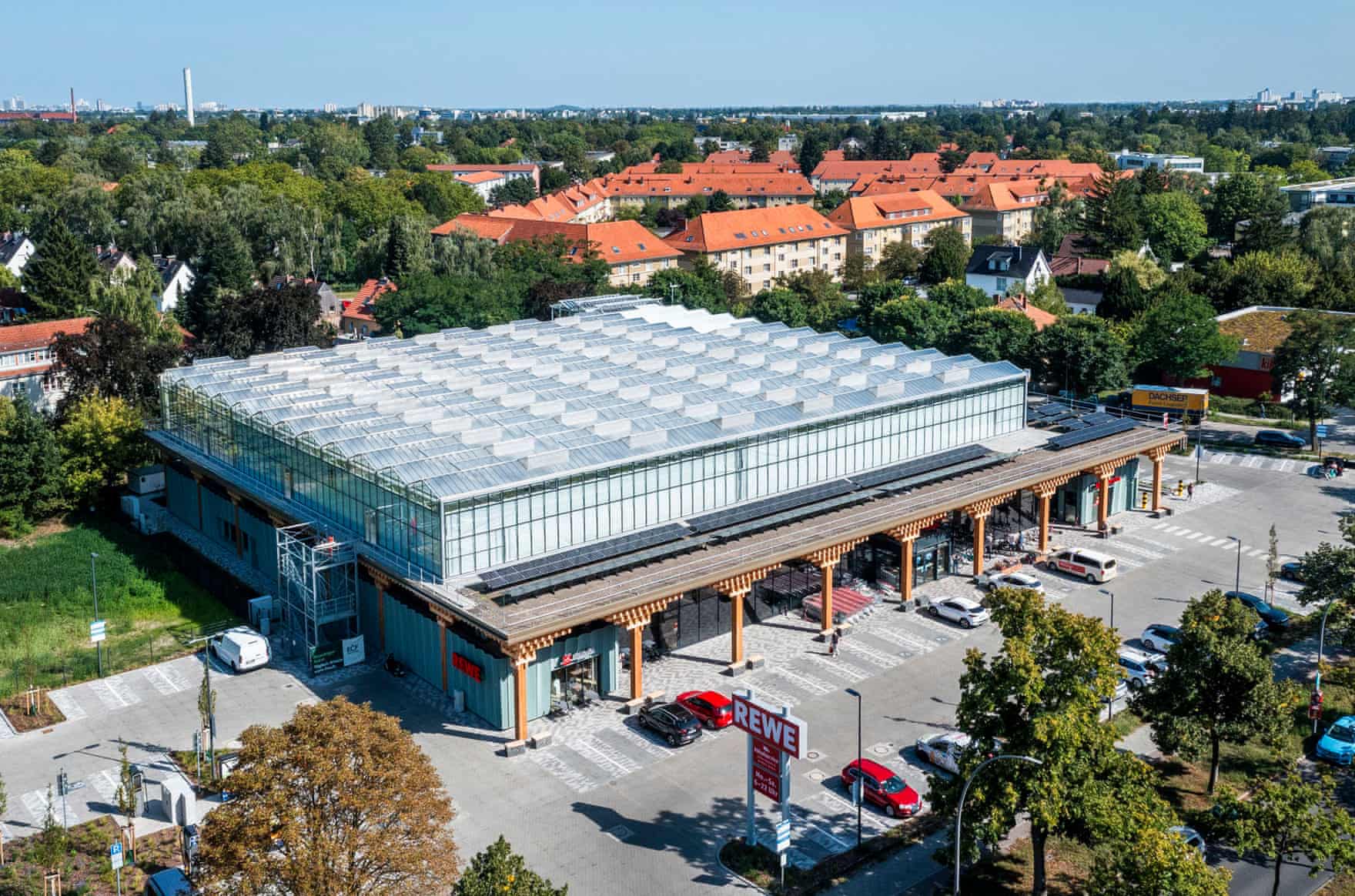
Photo: Christoph Große.
Berlin’s Felix Thomas REWE supermarket with its rooftop farm.

Recognizing how wasteful humans can be in modern times, I find it encouraging that so many urban farms are sprouting up on small pieces of land or otherwise empty roofs. An article in the Guardian notes that it is no longer unusual to find urban vegetables blooming in community plots, families’ backyards, or on a commercial scale on rooftops.

Hannah Docter-Loeb writes, “Walking into the Felix Thomas REWE supermarket in Lankwitz, Berlin, customers are immediately presented with a choice of greens: romaine, rocket, iceberg. But last month, a new option joined the selection: Lankwitz loose-leaf lettuce. A combination of head lettuce, romaine lettuce, Lollo Rosso, and dark green easy leaf lettuce, its yellow packaging makes it stand out in a row of green. … Unlike its neighboring lettuces, which come from regional farms or all the way from Italy, these greens were grown just a few meters away – or rather, a few meters up. ‘Frisch Vom REWE Dach’ or ‘Fresh from the REWE roof,’ the bags read.

“Rooftop farms are nothing new: in cities such as Paris, Hong Kong, Copenhagen and New York, similar farms supply food to adjacent food retailers or even restaurants. This model has the potential to reduce greenhouse gas emissions from transportation (and its associated costs), minimize the urban heat effect, make use of dead space and perhaps even improve the relationship between buyers and their food. …

“REWE provides the space, location, and distribution channels to sell, and ECF designed and manages the greenhouse. The Lankwitz lettuce has become a selling point of sorts: store manager Felix Thomas says one customer traveled more than 50km [~31 miles] just to get their hands on a bag. And the integration of the farm into REWE’s market and corresponding supply chain is novel, says ECF CEO and founder Nicolas Leschke. …

“The greenhouse is heated through the waste heat of cooling aggregates downstairs, and rainwater is the primary source of water for the greenhouse and plant production. Some of the greenhouse is also powered by sustainable energy – primarily solar.

“The operation is meant to be year-round. The farm makes use of hydroponic technologies: the lettuce varieties are grown with very little soil. The whole growing process takes a little over three weeks. Once cut, the greens go straight downstairs to be packaged and sold, both on site and in other stores in the city and region.

” ‘We don’t even have an extra truck on the road that usually is necessary to transport the goods from the producer to the central distribution,’ Leschke said.

“Prajal Pradhan, an associate professor at the University of Groningen in the Netherlands, who recently published a study on urban agriculture in Europe [says] ‘This is a way to go forward, because you can provide fresh vegetables to urban consumers on site.’ However, he stresses, it should not be an alternative to having a personal or community rooftop garden. He says urban agriculture should be inclusive and find ways to include the whole community, a sentiment echoed by study co-author Stepan Svintsov, a remote sensing expert based in Berlin.

“ ‘Getting people together from a dense city and sharing agricultural knowledge among them helps bring the community together,’ Svintsov said. REWE currently offers tours to see the facility from outside, but no one can enter the production rooms.

“There is a large potential for rooftop farms and the like in Europe. Pradhan, Svintsov and their colleagues’ review looks at the biophysical viability for urban agriculture in European cities: seeing how urban rooftop and ground-based areas are well suited for cultivating vegetables. They found that urban agriculture in European cities could produce up to … 28% of the continent’s vegetable demand.”

More at the Guardian, here. No firewall, but please consider a donation or subscription to this outstanding publication.

Read Full Post »

072619-.NYC-rooftop-garden

For the princely sum of $10 a year, a New York senior — my sister, for example — can visit a serene rooftop flower garden any day in the week. And the public can come for free on Sundays.

We made a pilgrimage to the Lotus Garden last Thursday, and it was delightful. The only people who were there at the time were two nannies and two toddlers.

Here is some history from the website. “Once upon a time back in the 1960s, two grand old movie theaters (the Riverside and Riviera) stood on the west side of Broadway, north of 96th Street. Eventually the theaters closed, the building fell into disrepair and was demolished — leaving an empty lot. Would-be gardeners in the neighborhood took over, planting a riot of flowers in the ‘Broadway Gardens,’ while the local politicians, realtors and bankers squabbled over the future of the lot. (Would an Alexanders department store serve the community better than an apartment house?) In the face of fierce community opposition a number of development projects fizzled.

“Determined Upper West Siders organized; local block associations joined the gardeners, along with the City Planning Commission, Community Board 7, and the Trust for Public Land, among others. Out of this emerged a committee, spearheaded by community activists Carrie Maher, a horticulturist, and Mark Greenwald, an architect, which worked with would-be real estate developer William Zeckendorf Jr. on the project for more than a year, persuading him to translate this neighborhood green space into an amenity that would enhance his building’s charm and value.

“Zeckendorf built stairs to the roof from a gate on the street; a cherry picker lofted 3-1/2 feet of topsoil onto the garage roof. Then Carrie and Mark, who headed the garden, laid out winding paths, installed two fish ponds and planted fruit trees and flowering shrubs. At last in the spring of 1983, a group of local residents, including new residents of the Columbia, began to plant flowers and herbs beneath the north facing windows of the Columbia’s tower.  Today 28 families tend garden plots there.  Thus the Lotus Garden, a community garden, came to be built on the roof of the garage of the Columbia condominium, on West 97th Street in Manhattan.” See pictures of the development stages here.

The only drawback I can think of is that the space is not wheelchair accessible. But if you can climb stairs, you are in for a treat. Here are the pictures I took. The peaches on the tree had just started to ripen.

072619-.stairs-to-roof-garden

072619-.Lotus-Garden

072619-peach-tree-Lotus-Garden

Read Full Post »

Photo: Joseph Eid / Agence France-Presse
Painting the word “Peace” in Arabic over 85 rooftops on a Tripoli street for a project led by twin Lebanese street artists over a three-year period.

Nearly everyone wants peace. Nearly everyone expresses that over and over. You would think we would have peace by now. One large-scale expression of the world’s fervent wish in a city badly damaged by conflict took three years to accomplish.

Agence France-Presse reports, “From the street below it’s easy to miss the workers daubing rooftops as part of an ambitious art project in two battle-scarred neighbourhoods of Lebanon’s Tripoli.

“But the Ashekman street art duo behind the project say that once they’re done, the pistachio-green rooftops they are painting will spell out the word ‘Salam’ — Arabic for ‘peace’ — on a scale visible from space.

“The project, three years in the making, is the brainchild of 34-year-old twins Mohammed and Omar Kabbani. …

“They chose a site spanning the Bab Al Tebbaneh and Jabal Mohsen neighbourhoods, which have fought successive rounds of armed clashes in recent years. …

“Peace has been elusive in Sunni-majority Bab Al Tebbaneh and the adjacent Alawite-majority Jabal Mohsen. Fighters from the two areas have battled each other periodically for decades, and the war in neighbouring Syria, pitting a Sunni-dominated uprising against Alawite president Bashar Al Assad, has further stirred existing enmities. …

“Ashekman’s project runs on either side of the infamous Syria Street separating the two neighbourhoods. The duo hired workers from across the divide to help them complete the project.

” ‘All of the workers live here in the neighbourhood, they lived the conflict, some of them got shot,’ Omar Kabbani said.

” ‘Two years ago they were hiding from bullets … now they’re painting their rooftops proudly.’

“The brothers are sensitive to the observation that their project does little to address the most obvious scars of fighting or the area’s desperate poverty, often identified as a catalyst of the violence.

“They say they chose paint that will seal rooftops against rain and reflect ultra-violet rays, cooling the homes below.

“And in order to paint the rooftops, they had to negotiate with residents and often had to clear large amounts of trash and debris. …

“Walid Abu Heit, 29, joined the project as a painter after hearing about it from March, a Lebanese NGO that has worked on reconciliation and rehabilitation in the rival neighbourhoods. …

“He and other workers lugged heavy tubs of paint up seven floors and began plastering a roof with the fluorescent green, which flecked his hands and boots.

” ‘It’s an amazing project,’ he said, smiling and shading his eyes from the blazing sun.

” ‘The word peace, it’s a great word … we haven’t seen it for a long time, now we’re seeing it again.’

Read more here; also at National Public Radio, here.

And ponder the power of artistic twins here, at one of my posts on street artists Os Gemeos. The Greenway’s first giant mural, which they painted, is still my favorite. It makes you think about “The Other” as a sweet little kid.

Read Full Post »

In a Nippon article by Sakurai Shin, translated, we learn about urban bee culture in Central Tokyo.

“The urban bee farm is the work of the nonprofit Ginza Honey Bee Project, or Ginpachi, founded in March 2006 by Tanaka Atsuo.

“It started when Tanaka, who rented out space in Ginza, learned from a beekeeper that it might be possible to raise honeybees on the roof of the Kami Parupu Kaikan building. From this location, Tanaka learned, the bees could gather nectar from Hibiya Park and the grounds of the Imperial Palace, both within a radius of around three kilometers. Bees are highly sensitive to pesticides and other environmental pollutants, but the Imperial Palace is relatively free of agrichemicals. In this sense, Ginza turns out to be a surprisingly good area for beekeeping. …

“In the 10 years since the Ginza Honey Bee Project began on one corner of a Ginza rooftop, the ripple effect has spread to other parts of Tokyo and far beyond. There are now more than 100 urban beekeeping projects nationwide, and more in South Korea, Taiwan, and elsewhere in Asia.

“ ‘Ten years ago, of course, we never imagined the project would have such an impact,’ Tanaka says. ‘I think it’s because people have been able to make it into their own project, reflecting local conditions and responding to local issues.’

“Tanaka also credits the honeybees themselves, emphasizing what human beings can learn from contact with these industrious insects.

“ ‘For example, when I see the bees returning to the rooftop from their flight around Ginza, I can tell from the pollen stuck to them that it’s safflower season, or the tochinoki [Japanese horse chestnut] trees are in bloom. Spending time with the bees puts us in touch with the natural world and its changes. Ginza may seem an unlikely place to be tackling environmental issues, but it’s becoming that sort of neighborhood.’ ”

More here.

This lovely story came to me by way of blogger Asakiyume.

Photo: Nagasaka Yoshiki/Nippon.com

Read Full Post »

This story comes from Heather Dockray at Good magazine (by way of the Huffington Post). It’s about a life-affirming project in Atlanta.

“Good, local, nutritious food shouldn’t be expensive,” she writes, “and shouldn’t only be enjoyed by people who can afford it.  A homeless shelter in Atlanta decided that their residents desperately needed access to healthy food — but instead of sourcing out, encouraged residents to grow their own. Now, the shelter is home to a huge rooftop garden planted by the residents themselves, which is expected to yield hundreds of pounds of great quality greens. …

“While eating discounted snacks might give homeless residents short-term financial benefits, the long-term health consequences are substantial. The Metro Atlanta Task Force for the Homeless, who runs the gardening program, wanted to give homeless people access to food previously considered out-of-reach. Now, residents are responsible for 80 garden beds, producing kale, carrots, chard, and squash, among other vegetables.” More here.

Dockray doesn’t mention how gardening and donating to the shelter makes residents feel, but I am going to guess it builds their self image and confidence.

Photo: Metro Atlanta Task Force for the Homeless

Read Full Post »