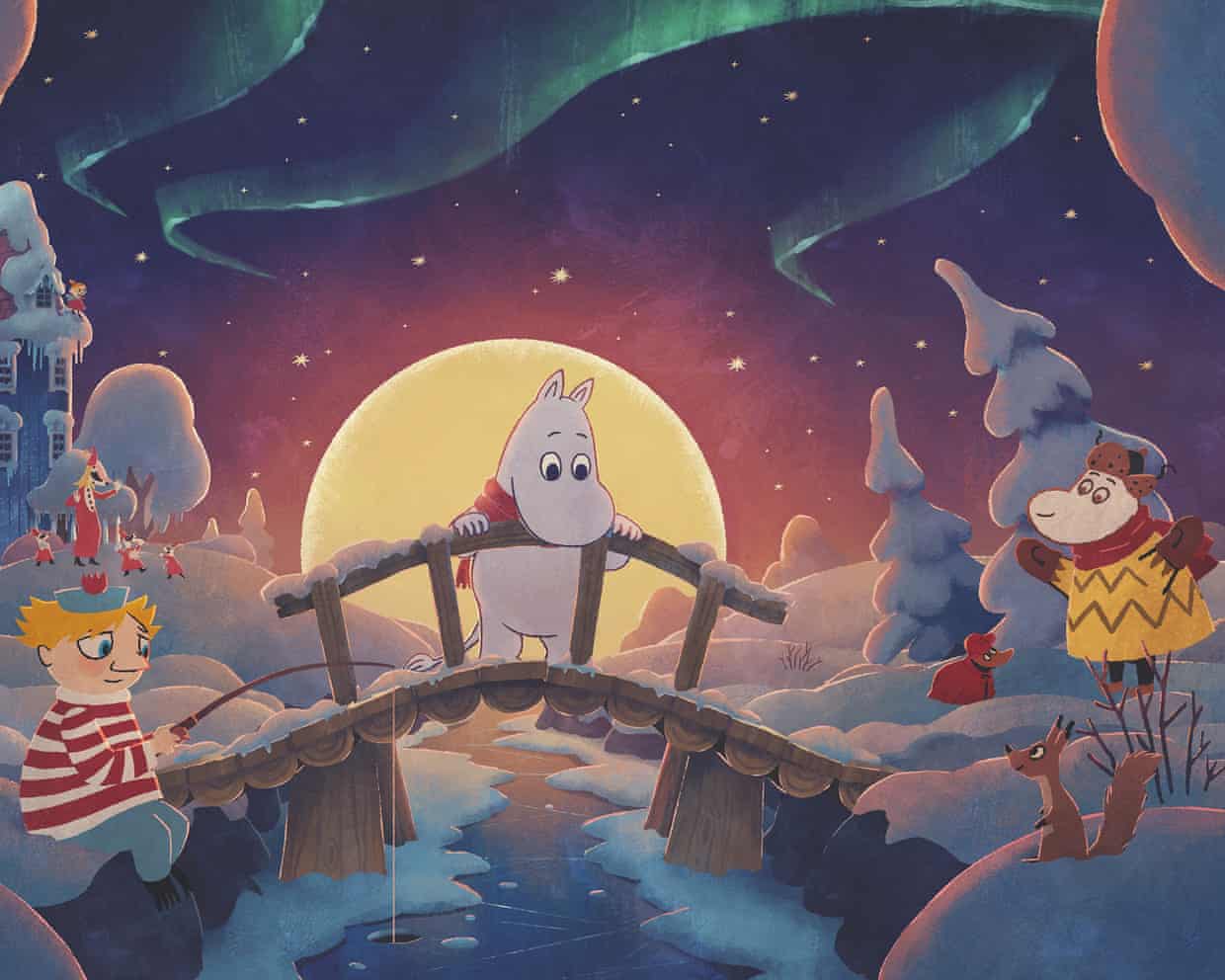
Photo: Hyper Games.
Finnish artist and writer Tove Jansson created the happy/sad Moomintroll children’s books. Hyper Games is using the stories in video games.
I’m always surprised to learn that there are people who never heard of Moomintroll or his multitalented Finnish-Swedish creator, Tove Jansson. I knew about the Moomin cartoons even before I met my Swedish son-in-law. (What I didn’t know was that Jansson wrote books for adults, too, including a novel I discovered recently concerning retirees in Florida. It was translated by someone I once worked with.)
The topic today is about what a video game company is doing with Moomintroll and his family. It could almost lure me into gaming.
Lewis Gordon writes at the Guardian, “Sleepy, happy-sad, and imbued with the mildest peril, Tove Jansson’s Moomin stories may seem an unlikely fit for the action-heavy medium of video games. Rather than embark on swashbuckling adventures, these milk-white, hippo-esque creatures prefer to potter about Moominvalley, only venturing further if the weather conditions are just right.
“Yet a small Norwegian video game studio, Hyper Games, is now on its second exquisitely charming Jansson adaptation. The first, 2024’s ‘Snufkin: Melody of Moomin Valley,’ put players in control of the wily free spirit Snufkin as he dismantled overly ordered nature parks (and evaded authority-loving wardens). The latest, ‘Moomintroll: Winter’s Warmth,’ sees young Moomintroll wake up at night in the dead of winter. With his parents still hibernating, the creature is all alone, thrust into a cold and unfamiliar world.
“On this lonesome journey, Moomintroll must reckon with the idea that his snoozing parents won’t be around for ever. ‘[It is] a brush with mortality,’ says lead writer David Skaufjord, who sees the premise, an adaptation of the 1957 novel Moominland Midwinter as emblematic of a franchise which dares to challenge its younger audience with loss, grief, melancholy and nostalgia. ‘Children’s television can be soft-handed,’ he says. ‘The Moomin stories aren’t.’
“In the first 20 minutes of the game, the freezing temperatures claim the life of a squirrel. But Too-Ticky, the androgynous woman who lives by herself in Moominpappa’s boathouse, takes a philosophical outlook on the animal’s passing. ‘Death is a part of life,’ she says serenely. ‘Something is always changing.’
“So much of Jansson’s work, Moomin or otherwise, finds meaning in life’s transitions: humid summer to crisp autumn; sweltering afternoon to cool evening; the still moments that arrive after a storm. Jansson, a writer, illustrator, and political cartoonist, spent many years on the small islands scattered across the Gulf of Finland, folding these experiences into crystalline descriptions and illustrations of the natural world, which the Moomins live in harmony with.
“Though Hyper Games is based in Norway rather than Jansson’s Finland, its Scandi developers were able to draw on a similarly deep relationship with nature. ‘We have all grown up in a country where there’s six to seven months of winter,’ says Skaufjord, “’nd if you don’t learn to enjoy winter, you basically have a bad time half of the year.’ Like these game makers, the summer-loving Moomintroll must undergo his own snowy acclimatization: in doing so, there is a lesson for him and players – of adapting to, and accepting, one’s new circumstances.
“But ‘Moomintroll: Winter’s Warmth’ makes enjoying such a chilly time of the year easy: you can fling snowballs and create pathways in knee-high drifts. Even shoveling snow is fun, accompanied by satisfying audio-visual puffs of powdery white stuff. There are many more light and breezy interactions like this, carefully calibrated for both non-gamers and young children alike. …
“I’ve been playing ‘Winter’s Warmth’ with my three-year-old daughter: she sits on my lap as I point at things on the screen, her tiny thumb directing Moomintroll about the enchanting world. ‘That’s how it’s supposed to be played,’ says Skaufjord. ‘That’s how I wrote it.’ …
“It may look like an effortless translation, but the approval process with Moomin Characters Ltd, the company whose job it is to oversee Jansson’s original creations, is rigorous, says the game’s art director Marcus Kjeldsen. … For the previous Snufkin game, Skaufjord wrote that the abrasive teenager Little My should react gleefully about getting rich. But, as the approvals team stressed, capitalism is a construct that has not yet graced the bucolic Moominvalley, so the line was tweaked. …
“There is a reason these stories continue to resonate. They have an anti-fascist bent in their unusual and non-traditional configurations of people and family. But there is also a disquieting sense that the unspoiled Moominvalley sits on the brink of great change. Both games deftly capture these timely aspects of Jansson’s treasured work.”
More at the Guardian, here. Please look at the art.

 Suzanne's Mom's Blog