Feeds:
Posts
Comments

Posts Tagged ‘new south wales’

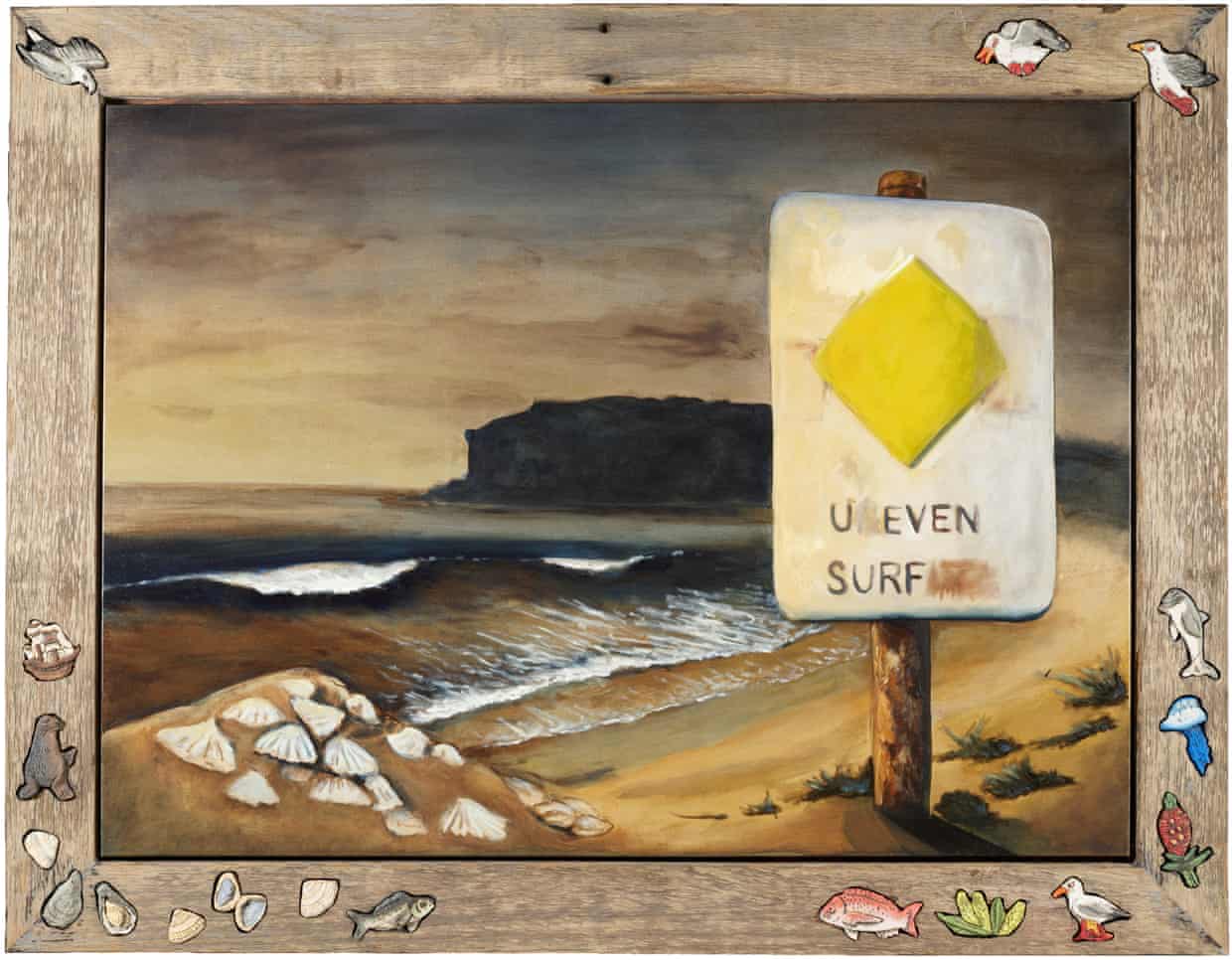
Photo: Diana Panuccio/Art Gallery of New South.
One of the new landscapes of Aboriginal artist Billy Bain a new development in his career. 

Around the world, indigenous people have been pushed and pushed into spaces nobody wants. That is, until the land becomes desirable for new reasons, and then they have to fight to keep it.

As Steve Dow writes at the Guardian, an artist in Australia is intent on reclaiming the beaches for Aborigines.

“As a teenager in the mid 2000s, Billy Bain would ride waves around Sydney’s northern beaches, having traveled the world watching his champion surfer father Rob Bain compete. But even though he was minutes from his home in Avalon, he was often made to feel an unwelcome outsider.

“ ‘I’d be told that I’m not from there, so I need to go in [to shore],’ he says, seeing these warnings as veiled threats of violence. ‘Otherwise, you know, “something’s gonna happen to you.” ‘

“Now 33, the Dharug artist sees simply being an Aboriginal surfer as a way of reclaiming space. ‘[The northern beaches are] quite an isolated and predominantly white place,’ he says.

‘You know, the beach was and still is an Aboriginal space, but in popular culture it has been represented as a very white space.

” ‘There’s obviously the bronze Aussie, which is your typical tan, athletic white male, but it’s not seen as being a space that Aboriginal people inhabit any more.’

“In his studio in Granville in Sydney’s inner west, Bain is preparing for an upcoming solo exhibition at the Art Gallery of New South Wales, ‘By the River.’ The survey will feature new work, including five landscape paintings of the Dyarubbin/Hawkesbury river – a location that connects the Manly born artist with the country of his ancestors.

” ‘Geographically it was actually very close for us,’ says Bain, who has come to see surfing on the northern beaches as a form of cultural return, because the Dyarubbin flows into an estuary at Pittwater. ‘I see the story of the eel and how it spawns out at sea and then it finds its way back up these river systems to be an interesting metaphor for a return. I see myself as having a similar journey.’

“For ‘By the River,’ Bain has made 11 funny, figurative Indigenous family members (and one dog) dressed in bikinis, shorts and even a pair of budgie smugglers painted in Aboriginal colors: red and black with a yellow tie. …

“The figures will be displayed holding aloft a four-meter, long-finned eel – a totem animal and spirit of resilience known in Dharug language as a burra – which Bain has fashioned as a soft sculpture using cloth on a wire and steel frame, adorned by 200 textile elements handwoven by his mother, Kathleen Bain.

“Kathleen, a Dharug woman … would encourage her children to create with all sorts of materials, and Bain would especially love making faces and figures from the wax scraped from his surfboards.

“Bain’s surfer father has also been part of his artistic process. The pair took a small ‘tinny’ boat up the Dyarubbin, bush bashing along the clifftops and finding ancient Aboriginal handprints in caves, to help form the drawings for his five landscape paintings. …

“Ultimately, Bain’s art practice has become ‘a healing thing,’ he says. ‘It’s been such a massive part of learning to express myself.’ …

“Artists don’t exist to change the mind of doubters, but ‘fun, seductive’ humor in art can convey some serious ideas, Bain says. … ‘I do have quite a positive look on the human spirit and people’s ability to be good-natured and embrace other people. I think that’s intrinsic in us as humans.’ ”

If you live in New South Wales, you have until November 8 to see the show.

More at the Guardian, here. No firewall, but please consider supporting their outstanding joyrnalism.

Read Full Post »

Photo: Farmingdale Observer.
Merino sheep are said to show improved wool quality under solar arrays.

Here’s a win-win-win for the environment, sheep grazing, and agrivoltaic farming practices in general. One caveat: you need to place solar arrays on already open land. Cutting down trees to put in solar is actually a loss for the environment as trees are so good at carbon capture.

Bob Rubila writes at the Farmingdale Observer, “In a groundbreaking study that combines renewable energy with traditional farming practices, researchers have observed remarkable changes in 1,700 sheep grazing amidst solar panels. This innovative approach, known as agrivoltaics, is revolutionizing how we think about land use while yielding unexpected benefits for the animals involved.

“A comprehensive three-year study conducted at Wellington Solar Farm in New South Wales, Australia, has revealed fascinating results about sheep and solar panel coexistence. The research team from Lightsourcebp, in partnership with EMM Consulting and Elders Rural Services, monitored 1,700 Merino sheep divided into two groups: one grazing in traditional pastures and another among solar panels.

“The findings challenge conventional assumptions about livestock welfare in modified environments. Sheep grazing between solar arrays showed no negative health impacts. Instead, researchers documented enhanced wool quality with increased fiber strength and growth rates. The solar infrastructure created microhabitats that benefited both the animals and the underlying vegetation.

“ ‘The promising results indicate we’re on the right track,’ explained Brendan Clarke, acting environmental planning manager at Lightsourcebp for Australia and New Zealand. …

“The solar arrays provide critical shelter during extreme weather events, protecting sheep from both intense heat and adverse weather conditions. This protection creates a more stable environment for the animals throughout seasonal variations. The panels’ shade effect helps retain soil moisture, which promotes healthier grass growth and more nutritious forage for the grazing animals.

Interestingly, researchers noted reduced parasite presence in the solar grazing areas, contributing to improved overall animal health.

“This unexpected benefit appears to stem from altered ground conditions beneath the panels, creating an environment less hospitable to [common] parasites. …

“The relationship between energy infrastructure and animal welfare continues evolving as more long-term studies emerge. While some regions face environmental challenges like the dormant volcano showing signs of awakening after 250,000 years, these sheep-solar partnerships represent positive ecological developments.

“The Australian findings align with similar research conducted in France, where INRAE (National Research Institute for Agriculture, Food and Environment) collaborated with renewable energy producers Statkraft and CVE. Their two-year study involving 24 ewes confirmed beneficial effects on flock welfare, improved thermal comfort, and enhanced forage quality.

“ ‘The thermal comfort of the animals improves significantly, and the availability of quality fodder increases, among other benefits,’ noted Véronique Deiss, INRAE researcher. These correlated results across continents suggest universally applicable principles for successful agrivoltaic implementation.

“Beyond animal welfare, agrivoltaics offers economic advantages for both energy and agricultural sectors. Solar farms benefit from reduced vegetation management costs as sheep naturally control grass growth, eliminating the need for mechanical mowing or chemical treatments. For farmers, access to otherwise unused land provides additional grazing opportunities without purchasing or leasing additional property. …

“With these 1,700 sheep demonstrating improved wool quality while maintaining solar farms, agrivoltaics exemplifies how innovation can simultaneously address energy production, land management challenges, and animal welfare – creating sustainable solutions that benefit multiple stakeholders across agricultural and energy sectors.”

More at Farmingdale Observer, here.

Read Full Post »