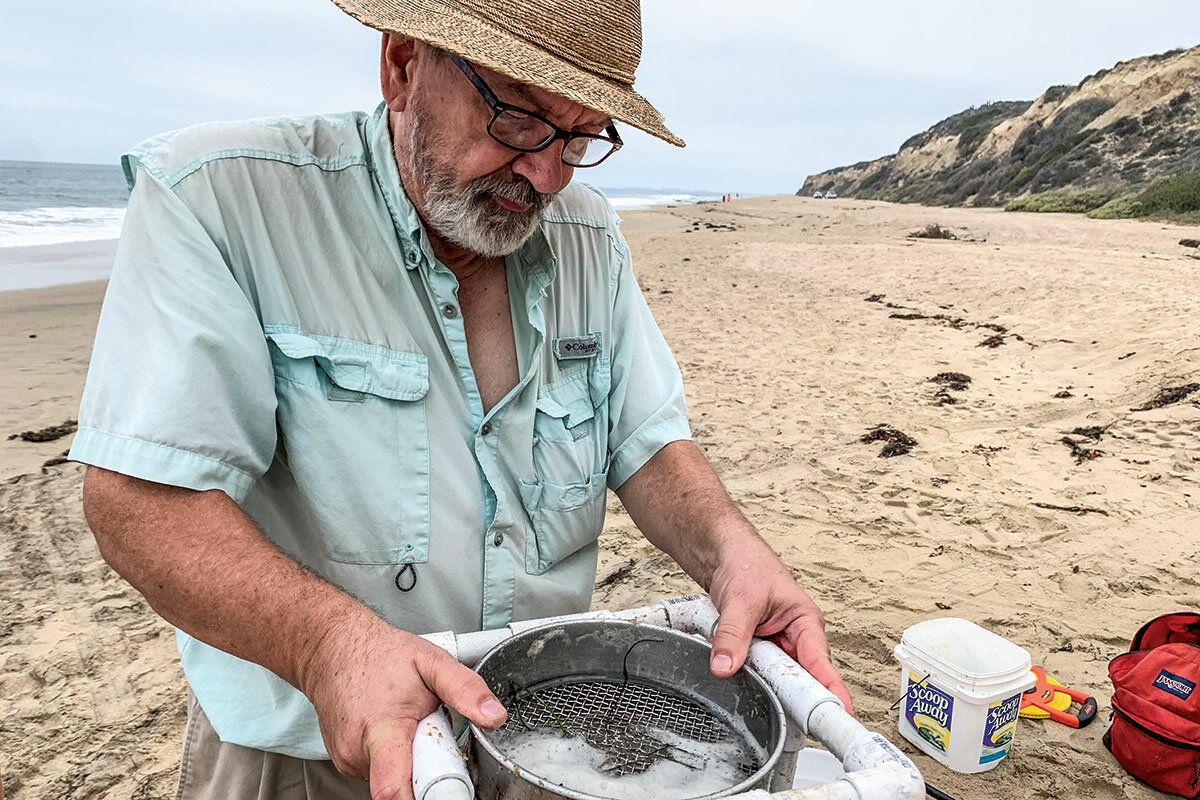
Dr. Mark McReynolds sifts collected sand through a sieve that brings microplastics to the surface.
Everywhere, lately, we read about microplastics showing up in places they are not wanted — on beaches, in lungs, in our food, in used diapers. Rather than succumb to despair, we can follow the lead of the scientists in today’s story. Measure first, then work on a fix.
Clara Germani reports at the Christian Science Monitor from Crystal Cove State Park, California, a “3-mile stretch of sand and tide pools beneath a fortress of 80-foot bluffs, [and a] California tourism poster if there ever was one. Nothing disturbs the pristine, sunny view, except – once you’re aware of them – the nurdles.
“But you have to look close – on-your-hands-and-knees close – to see one. And once you do, you see another and another – so many that you may not think of this, or any beach, the same way again.
“Mark McReynolds is trying to bring into focus these tiny preproduction plastic pellets that manufacturers melt down to mold everything from car bumpers to toothpaste caps. They’ve been escaping factories, container ships, trains, trucks – and public notice – for decades.
“Dr. McReynolds is an environmental scientist with the Christian conservation nonprofit A Rocha International who’d never heard of nurdles three years ago. He’s now joined a global movement studying their trail into the environment. Some – like the Great Nurdle Hunt and the Nurdle Patrol – map nurdles through informal online reporting by citizen scientists around the globe.
” ‘Knowledge opens your eyes. You don’t see plastic bags blowing around [on this beach] because people pick them up,’ says Dr. McReynolds. ‘But, they’re not picking up the stuff that’s 3 millimeters [because] they don’t even know it’s there.’
“The 2- to 3-millimeter, multicolored orbs are a subset of microplastics – plastic particles less than 5 millimeters in size. Nurdles accumulate where water inevitably takes them, and they’ve been found on shorelines of every continent.
“Establishing a baseline count of the presence of nurdles – and, more broadly, any microplastics – is the focus of Dr. McReynolds’ scientific study here. Charting the count, noting tide, current, and weather conditions will show if amounts are increasing, and perhaps at what rate and why. That knowledge, he says, can inform solutions to plastic pollution such as regulation of their use.
“Aided by citizen science volunteers – and his wife, Karen McReynolds, an associate professor of science at Hope International University who offers access to a lab and student help – he conducts a complex monthly microplastic sampling and a twice-annual nurdle hunt.
“Microplastics research and cleanups have ‘exploded’ in the past decade due to new ‘understanding of the apparent health and ecosystem risks,’ says Erica Cirino, whose book Thicker than Water: The Quest for Solutions to the Plastic Crisis is a tale of adventure chasing microplastics around the globe.
“In her travels she’s been struck by how unifying the plastic problem can be for people from diverse groups – from faith-based organizations to surfers and fishers, conservatives to liberals. They don’t all know what to do about it, she says, but ‘a very concrete thing like a [nurdle] hunt or getting your hands dirty is one of the best ways to get people involved.’
” ‘What are you doing? Picking up trash?’ queries a steady stream of beach walkers whenever Dr. McReynolds’ crew trundles onto the beach. …
“[Dr. McReynolds] explains the science of nurdles and microplastics to the curious while keeping an eye on volunteers troweling sand into 5-gallon buckets. Each bucket of sand can yield anywhere from no plastics to as much as 300 pieces to be analyzed in the lab. It sounds small, but the randomized samples can be extrapolated to the rest of the beach. …
“One recent morning he told some beach walkers how nurdles are believed to absorb toxic chemicals, and – because they resemble fish eggs – are eaten by fish and birds and enter the food chain. Almost on cue, a bold seagull hopped up to a laminated photo of nurdles and hungrily pecked at it.
“A scarlet macaw expert by training, and an ordained Mennonite pastor who holds outdoor church services in the nearby San Gabriel Mountains, Dr. McReynolds is an unpaid director of A Rocha’s Southern California operations – which means he’s as much a volunteer as his citizen scientist recruits.
“And it can be a lonely devotion, says his wife Karen, who notes that he possesses ‘bulldog grab-it-and-do-not-let-go’ tendencies to bridge science and faith. His A Rocha colleague, Bob Sluka, says it’s Mr. McReynolds’ ‘pastoral heart’ that drives the Crystal Cove microplastics survey and its potential to spur people ‘to recognize things they are doing in their own life as consumers and change their behavior.’ ” More at the Monitor, here.
As in my recent post about saving salamanders, most often, when people learn they are hurting the environment unawares, they do something about it.

 Suzanne's Mom's Blog