Feeds:
Posts
Comments

Posts Tagged ‘oppression’

Photo: AFP.
Students attend a class
at Afghanistan‘s Radio Begum in 2021. The founder wanted to get the station set up in hopes that the coming Taliban takeover would spare it.

What does it take for women’s voices to be heard? It depends a lot on the local culture but even more on the determination of individual women working together.

Gabe Bullard writes at Nieman Reports, “On March 8, 2021, a new radio station launched in Kabul: Radio Begum, run by women, for women. The timing was deliberate — the station opened on International Women’s Day, and just as the United States military was withdrawing from Afghanistan.

“ ‘I decided to launch this radio station in order to be ready for the day the Taliban takes power,’ said Hamida Aman, the station’s founder. ‘We knew that as soon as they take power, it will be segregation, and again, it will be against women.’

“Five months later, the Taliban retook Kabul and imposed new laws restricting women’s access to schools and their movements in public. Five years later, Radio Begum is still on the air. The station follows the letter of the law, even as restrictions tighten. It doesn’t cover politics or any subjects that are off-limits to public discussion among women under Taliban edicts. Instead, it focuses on health, religion, and providing educational programs to replace the schooling women are now prohibited from receiving. 

“ ‘They banned schools, but not education,’ Aman said.

“Begum may be unique in Afghanistan, but its model is in practice around the world. It is one of many women-run radio stations — from rural India to the Peruvian Amazon — that, although not part of a formal network, share many attributes and goals. 

“Some of these stations, like Begum, are oases of information in areas where women are restricted in what they can access. Others, in countries where the government is less restrictive, provide an antidote to male-dominated media that ignore issues that affect women. And still other stations challenge cultural barriers and break the silence around topics that are rarely if ever discussed. …

“ ‘There is no more public space for women, and it’s kind of a public space,’ Aman said of her station. 

Women have been working to create these kinds of spaces on-air since the earliest years of radio. … ‘Radio bridged, connected, and blurred the boundaries between the private and public spheres and by doing so, spoke to women as housewives, workers, consumers and citizens,’ says a UNESCO report on radio’s position in the world. 

“Modern women-run radio stations have seized on this potential to blur boundaries and adapted it to changing times and to specific locations and audience needs. 

“ ‘If given the opportunity, radio becomes a really important agent of change for women, in particular, especially in cultures where to speak out and to be open and to have an opinion, to have a say, can kill you,’ said Monica De La Torre, a media professor at Arizona State University and author of the book Feminista Frequencies. …

“Even as advancing technology has led to new independent media outlets and expanded ways of sharing and accessing information, radio remains a powerful medium for breaking barriers, broaching taboo subjects, and speaking directly to oppressed or obscured groups in society. The nonprofit that runs Begum, for example, also operates a TV station that broadcasts via satellite from France (where Aman is now based), and it has a smartphone platform as well. Because it’s not within Afghanistan’s borders, the television channel can be more open in its programming, but for Aman, radio will always have a place. ‘It’s cheap and everybody can have access,’ she said.

“Radio remains accessible and portable, even without an internet connection, electricity, or the ability to read. The fact that broadcasts generally come from a local tower gives radio a geographic connection that isn’t inherent to most other media. And through call-in programs, broadcasts aren’t limited to one-way conversations. 

“For Begum, this means women can — within the parameters of government restrictions — ask questions they may not be able to ask elsewhere, as the station’s programs center around life issues, and are interactive, Aman said. Listeners ‘can call us at any time, to talk with our doctors, to talk with our psychologists, to talk with our spiritual counselor to get information about religion,’ she added.

“Even when women don’t have specific questions, there’s value in hearing other women’s voices on these programs, according to Saba Chaman, who was the first director of Radio Begum and has worked for Begum TV since 2024. ‘It provides them with an opportunity to listen to other women, to listen to the way they talk, to listen to the way they start and finish their sentences,’ Chaman said. 

“Operations haven’t been entirely smooth for Begum, however. In February 2025, Taliban officials alleging violations of the law raided the station, arrested two employees, confiscated hard drives, phones, and documents, and shut down the broadcast. The station was back on the air in a few weeks, and the employees were released in a few months.

“ ‘It hurt us a lot. It was really a painful year for us,’ Aman said. ‘But despite all these challenges, we continue our activities.’ 

“Radio also offers another key benefit to its audience: anonymity. Listeners can tune in privately and there’s no record of their activity once they switch off the receiver. Nobody knows who is listening, who is speaking on-air, or who is calling in. The ability to anonymously call a station comes up often in conversations about women’s radio, usually with a similar narrative.

“Station managers have stories of women who call in to share experiences they can’t talk about with the people around them. Other women hearing the stories then realize they’ve had similar experiences. They call, too, and the process repeats, with more women calling in anonymously.  

“ ‘You could call in and maybe disguise your voice a little bit, or maybe share something so intimate and personal because of the medium,’ said De La Torre, the Arizona State University media professor. Because a station is local, a caller knows they will be heard by their community when they dial in to share a story. A listener knows they’re hearing their neighbor’s voice. Each broadcast chips away at a culture of silence.” 

More at Nieman Reports, here.

Read Full Post »

Photo: Ghiath AlHaddad Ayoub/The World.
Comedy is having a moment in Syria as a new wave of artists tests the limits of expression under a new government.

Syria suffered many years of extreme oppression, so the recent overthrow of the Assad government brought hope for change. That doesn’t mean everything is fine, as recent fighting with the Druze ethnic group has shown. Still, it’s time to celebrate any encouraging baby steps.

Shirin Jaafari reports at PRI‘s The World about something that hasn’t been heard in Syria for a long time.

“As the sun set over central Damascus, laughter spilled out from the Karma Café. Inside, a young crowd gathered — some in headscarves, others without. But all were ready to experience stand-up comedy in a free Syria.

“Comedy is having a moment in the country.

“With the fall of the Assad regime, a new wave of artists is testing the limits of expression. Among them is Styria, a stand-up troupe whose name fuses Syria with hysteria, a nod to the absurdity and pain of living under dictatorship. …

“Sharif Homsi, founder of the group, [started] writing comedy long before it was safe. Living under a regime that silenced dissent, he described the past as a kind of suspended state: ‘You’re not allowed to die, but you’re not allowed to live.’

“In 2016, he left for Dubai, trained with Arab comedians, and later returned to his homeland to form Styria. Even then, performing comedy felt dangerous.

“ ‘One wrong word and someone could report you,’ Homsi recalled. ‘You could disappear in a blink.’

“So, the group played it smart, he said, avoiding politics, tiptoeing around religion and carefully crafting jokes about sex and social taboos. But now, with the old red lines shifting, they’re pushing the envelope further.

“At the cafe in Damascus, Homsi took the mic, greeting the audience with humor and ease. His jokes, often about his own frugality or his dad’s job as a dog walker, sparked laughter and a sense of connection. But he didn’t shy away from sharper edges, even referencing the extremist past of Syria’s new leader, Ahmad al-Sharaa. …

“Fellow comedian Ammar Daba, who returned after the regime fell, said the challenge now is not just legal limits, but social ones.

“ ‘It’s exciting and confusing. I don’t know where the lines are,’ he said. 

But Daba thinks comedians have a role to play in this new environment.

“ ‘It is our time, as stand-up comedians, to be the pioneers,’ he said, ‘to tell people that “yeah, you can talk about that! You can talk about that outside of your private rooms and homes. You can say whatever you want even on the streets.” ‘

“The night’s only woman performer, Mary Obaid (aka Meme), steered away from politics, instead poking fun at her own life and body image.

“ ‘Every problem, when spoken out loud, becomes smaller,’ Obaid said. ‘Comedy helps us do that.’

“After the show, a man who only gave his first name, Ibrahim, reflected on the performance.

“ ‘This is what we need here. We need to communicate our fears, our taboos, in a healthy way,’ he said. ‘And this is the best way to discuss those really difficult issues.’

“The crowd spilled into the Damascus night, still laughing and exchanging numbers.

“For Sharif Homsi, the founder of Styria, this is the power of comedy. It can create moments of relief and respite, and it can start conversations that otherwise would not take place.

“ ‘Fifty, sixty people to a hundred sharing a room, laughing about similar things. … If they can laugh together, they can live together.’

“Syrians have been divided for so long, he added. ‘It’s time for that to end.’ ”

More at The World, here.

Read Full Post »

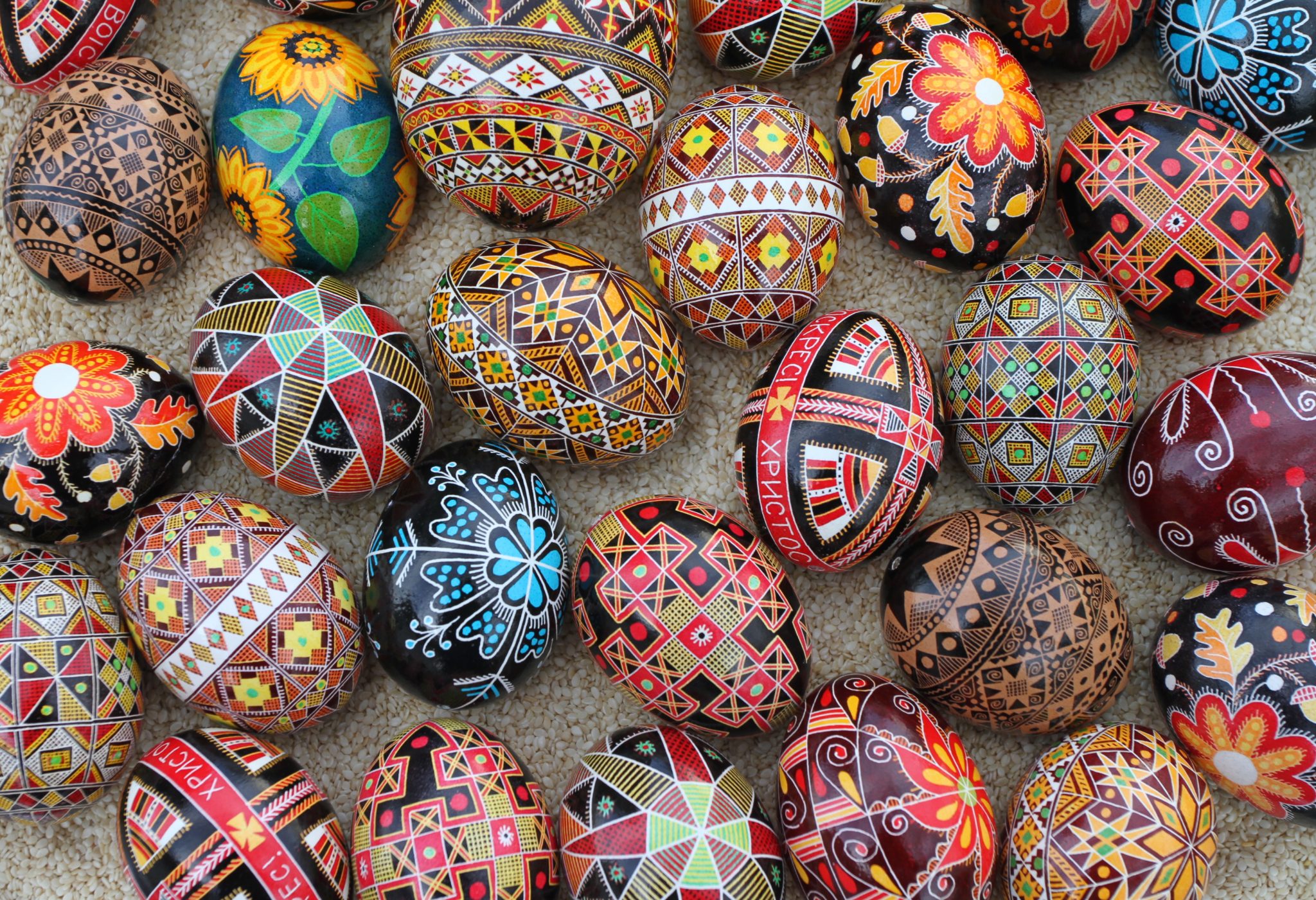
Photo: Luba Petrusha via Wikimedia.
A mix of traditional Ukrainian, diasporan and original pysanky (Ukrainian Easter eggs).

Today’s story shows how artists help a country’s culture survive.

Katya Zabelski writes at Hyperallergic, “Last year, when I was writing my dissertation on the history of Ukrainian folk [art], my research found a repeated pattern: Despite long histories of suppression, erasure, and destruction, Ukrainian people often used folk art as a tool of resistance and a symbol of hope and preservation.

“During the Soviet era, artists found sly ways to incorporate folk art into their work, despite the possibility of serious consequences. During the Euromaidan revolution [of 2013], vyshyvankas (traditional Ukrainian embroidered shirts) became extremely popular and are now a part of daily fashion. …

“Now, over 100 days since the war began, there is a resurgence of Ukrainian folk art symbols throughout media, art, and everyday Ukrainian life. And for the first time, the international community is using Ukrainian folk art to show solidarity with the Ukrainian people. …

Pysanky are one of the most recognizable Ukrainian folk art forms. The decorative eggs are an indigenous art associated with Carpatho-Rusyn women in Western Ukraine; they were often planted in the ground to encourage fertility and growth. The legend goes that the fate of the world depended on the pysanka.

Each year, an evil monster, chained to a mountain cliff, sent his henchmen to see how many [decorated eggs] were created in the land. If the number of pysanky was high, then the monster’s chains would tighten up.

“If the number of pysanky went down, then the monster would be unleashed to sow destruction. As long as Ukrainians continue to create pysanky, the world continues to exist. 

“Sofika Zielyk, a Ukrainian ethnographer and pysanka artist, has organized the exhibition The Pysanka: A Symbol of Hope at the Ukrainian Institute of America in New York. … Once the war is over, the eggs will be taken to Ukraine and planted in the soil, to help rebuild and fertilize Ukraine, in line with the ancient tradition. …

“Olya Haydamaka is a Kyiv-based illustrator whose work is influenced by traditional clothing. As a response to the Russian invasion, Haydamaka has created multiple illustrations of women in traditional clothing acting as protectors and healers of Ukraine. In ‘Чернігів. Сильне коріння. (Chernihiv. Strong Roots.)’ (2022), Haydamka responds to the particularly brutal attacks on Chernihiv in northern Ukraine. The woman wears a traditional embroidered vyshyvanka with exaggerated embroidered sleeves, along with a traditional red coral namysto (necklace). The iconic St. Catherine’s Church levitates in the air, with deep red roots dangling under it. This piece not only highlights Ukrainian folk clothing but also elevates the clothes to be otherworldly and ‘healing.’ …

“Danylo Movchan, a contemporary painter from Kyiv, created ‘Struggle’ (2022) in response to news that 25 paintings by Maria Pryimachenko, Ukraine’s most loved folk artist, had been destroyed. In this work, Movchan painted a Pryimachenko-inspired creature in yellow and blue, with a tongue that attacks a dark figure to the right of the composition. …

“It was not just Ukrainian artists who were impacted by the destruction of Pryimachenko’s works. The international community has also used her illustrations to show solidarity with the Ukrainian people. The group Justice Murals, which uses the medium of murals to inspire change and action, partnered with the Ukrainian Institute to project Pryimachenko works on buildings in California. Murals featuring Pryimachenko’s work were showcased in Oakland and San Francisco, with a text that read: ‘Art bombed by Putin. Boycott Russia.’ 

“The international music community is also seeking inspiration from Ukrainian folk art. Florence Welch of Florence and the Machine has recently released a new music video entitled ‘Free,’ featuring the British actor Bill Nighy. In parts of the video, Nighy and Welsh can be seen seated in front of a backdrop of petrykivka-style flowers, painted by Ukrainian artist Katerina Konovalova. At the end of the music video, Florence Welsh makes the connection between the title, the Ukrainian folk art paintings, and the war by dedicating the song to ‘the spirit, creativity, and perseverance of our brave Ukrainian friends.’ ” 

More at Hyperallergic, here. No firewall, but memberships welcomed.

Read Full Post »