Feeds:
Posts
Comments

Posts Tagged ‘pacific’

Photo: California Academy of Sciences.
A potentially new species discovered.

Looking ahead at some of the activities scheduled in my retirement community, I see that in February we can attend a lecture by Prof. Peter Girguis, co-director of the Harvard Microbial Sciences Initiative.

The announcement in our app says, “In this presentation, I will take you on a trip through the deep sea, learning about the extraordinary animals and microbes that thrive therein and about their adaptations to this environment. We will also touch on humankind’s relationship with the ocean, the birth of deep-sea biology, and the technological innovations that first took humans into the deep and how we still have time to turn the tide.”

Sounds pretty good, huh? And I think today’s article will have been the perfect preparation for the talk.

Chandelis Duster reported recently at National Public Radio [NPR] that “scientists believe they have discovered at least 20 new species in a deep part of the Pacific Ocean.

“The discoveries were found after researchers from the California Academy of Sciences retrieved 13 reef monitoring devices that had been placed in deep coral reefs in Guam, which had been collecting data since 2018. The devices, known as autonomous reef monitoring structures or ARMS, were placed up to 330 feet below the surface, an area of the ocean that receives little light.

“Over two weeks in November, scientists retrieved 2,000 specimens, finding 100 species in the region for the first time. Luiz Rocha, California Academy of Sciences Ichthyology curator, told NPR after more analysis is completed, scientists expect to discover more than 20 new species. Rocha was also part of the diving exhibition that placed and retrieved the devices.

” ‘It’s probably going to be higher than that because one of the things we do is we confirm everything with genetics. So we sequence the DNA of the species before we even really make absolutely sure that they’re new,’ Rocha said. ‘And during that process sometimes what happens is what we thought was not a new species ends up being a new species because the genetics is different.’

“He estimates that some of the potential new species could include crabs, sponges, ascidians or sea squirts, as well as new gorgonians, a type of coral.

Deep coral reefs live in an area of an ocean, nicknamed the ‘twilight zone,’ which receives little sunlight.

“Known as the mesopelagic zone, it is a difficult area for some scientists to reach because of pressure and requires specialized diving equipment. Rocha’s team studied the ‘upper twilight zone,’ which sits at 180-330 feet below the surface.

“Finding new species in that part of the ocean was not a surprise for Rocha, who said he and his team were expecting to make new discoveries. But Rocha said he was surprised to see a hermit crab, which usually make their homes in abandoned snail shells, attached to a clam.

‘When they first showed me the picture of it, I’m like, “What, wait, what is that?” I couldn’t even tell what animal it was. And then I realized, oh, it’s a hermit crab, but it’s using a clamshell,’ he said. ‘The species has a lot of adaptations that allows it to do that, and it was really cool and interesting.’

“Rocha and his team have also started a two-year expedition to retrieve 76 more deep reef monitoring devices across the Pacific Ocean, including in Palau and French Polynesia.

“Although studying deep coral reefs may be difficult and challenging, Rocha said it’s crucial to learn more about the reefs and their habitat.”

More at NPR, here.
Read Full Post »

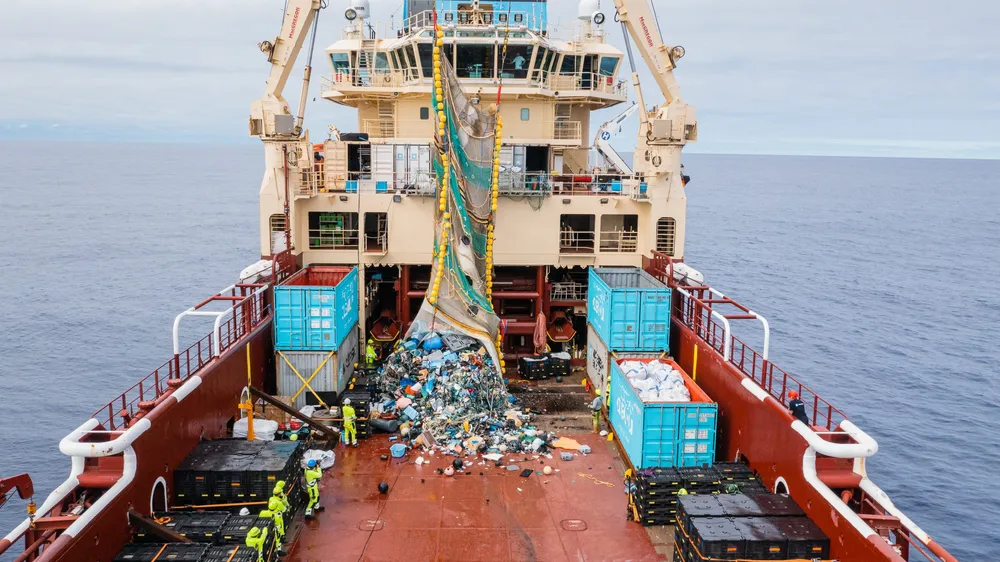
Photo: Ocean Cleanup.
Ocean Plastic doing its 100th cleanup in the Great Pacific Garbage Patch, where an estimated 100,000 tons of plastic have accumulated.

Today I’m sharing an organization’s website describing its work to clean up plastic in the Pacific Ocean. Ocean Cleanup uses the natural circulation of currents to sequester the garbage in several hotspots so they can remove it.

Excerpts from the website: “Plastic [in the Pacific] accumulates in five ocean garbage patches, the largest one being the Great Pacific Garbage Patch, located between Hawaii and California. To solve it, we not only need to prevent plastic from accumulating into the ocean, but also clean up what is already out there. Floating plastics trapped in the patches will keep circulating until they break down into smaller and smaller pieces, becoming harder to clean up and increasingly easier to mistake for food by sealife. …

“The Great Pacific Garbage Patch [GPGP] poses a severe threat to marine life, ecosystems, and human health. Animals often mistake plastic for food, while ghost nets — making up 46% of the patch — cause deadly entanglements. As plastic floats at sea, [it] can enter the food chain through bioaccumulation, potentially contaminating seafood. Beyond ecological and health impacts, microplastics also disrupt oceanic carbon sequestration, with estimated annual losses ranging from 15 to 30 million metric tons of carbon. …

“After the Transpacific Yacht Race [in 2025], sailors helped our research team in two key scientific areas: sailors tagged GPS buoys to megaplastics found at sea, allowing us to track their movement, and mounted ADIS [our Automated Debris Imaging System] on their boats to help identify plastic hotspots.

“After years of engineering development and strategic partnership agreements, the Ocean Cleanup became the first ever organization to remove plastic pollution from the GPGP – and it remains the only one to this day.

“We captured our first plastic from the GPGP in 2019, and by 2021, our technology was proven. Since then, we’ve removed hundreds of tons of trash from the GPGP — mostly plastic coming from fishing gear.

“In 2022, we began … upgrading components while continuing cleanup. …

“Since 2024, [we’ve] begun working on optimizing our efficiency even more. Through hotspot hunting, we can address our cleanup efforts in areas with higher quantity of plastic, while decreasing our environmental impact.

“The circulating currents in the garbage patch move the plastic around, creating natural ever-shifting hotspots of higher concentration. With the help of computational modeling, we predict where these hotspots are and place the cleanup systems in these areas.

“Our floating systems are designed to capture plastics ranging from small pieces, just millimeters in size, up to large debris, including massive, discarded fishing nets (ghost nets). After fleets of systems are deployed into every ocean gyre, combined with inflow source prevention, the Ocean Cleanup aims to remove 90% of floating ocean plastic by 2040.

“It is estimated that 100,000 tons of plastic float in the GPGP. We work with renowned partners to repurpose our catch into meaningful products – to prevent plastic ending up in the natural environment.

“We aim to rid the oceans of plastic in the most responsible way possible. Our mission is intended to benefit the ocean and its inhabitants, so we place protection of the marine environment and mitigation of any negative impact of our operations at the forefront of our ocean cleaning operations.

“[Our] ocean cleaning technology has deterrents, cameras, escape aids, and other features to minimize risk to marine wildlife. We also have trained independent observers on board the vessels each trip to monitor any interactions with protected species (such as turtles or whales) in the area. Monitoring data has confirmed that our operations are having only minimal effects on the environment.”

Learn more about their plastic-capture techniques at the Ocean Cleanup, here.

Read Full Post »

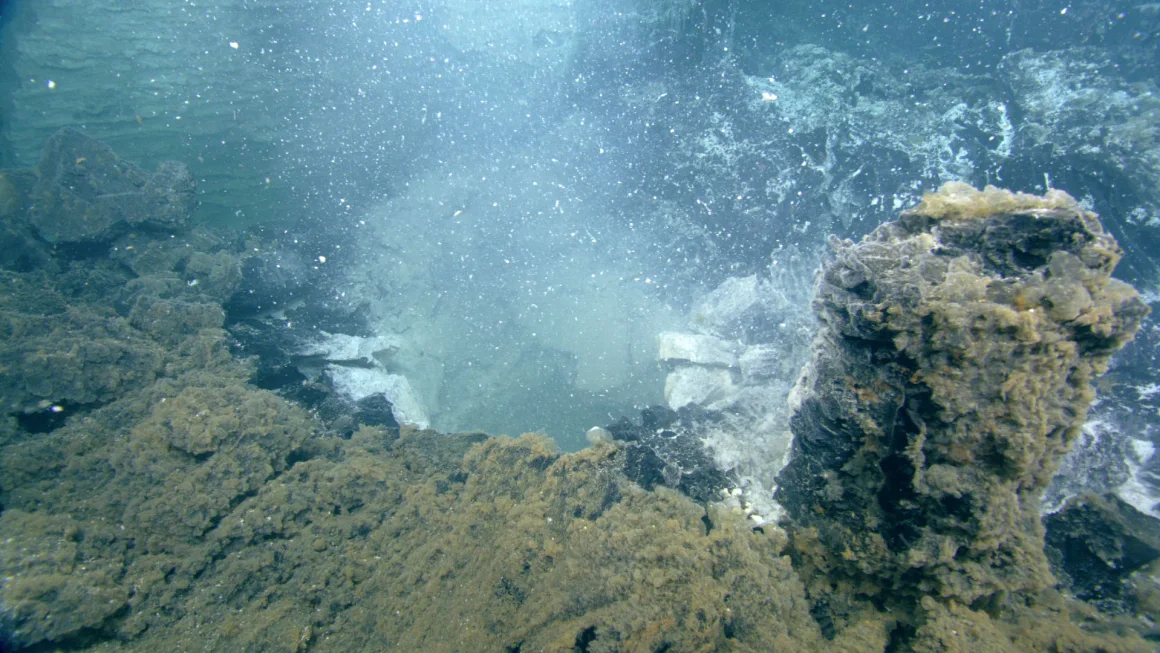
Photo: UW/NSF-OOI/CSSF-ROPOS via CNN Science.
White clouds of microbial waste billow from the seafloor — the result of a volcanic eruption. 

Rachel Carson thought it would be hard for humans to pollute the oceans because they were so vast. I guess she was wrong about that, but the oceans’ vastness does make them likely to remain a source of wonder and discovery — mysterious no matter how much we study them.

Today’s example of deep-sea wonder comes from the New York Times, where Maya Wei-Haas reports that scientists have witnessed a volcanic eruption that had never been experienced in person.

“Andrew Wozniak, a chemical oceanographer at the University of Delaware,” she writes, “struggled to process what his eyes were taking in. Dr. Wozniak was parked on the bottom of the Pacific Ocean beneath nearly 1.6 miles of water in Alvin, a research submersible. As far as he could see lay a mostly barren expanse of jet-black rock.

“Just a day before, at this same spot, a vibrant ecosystem had thrived in the sweltering waters of the Tica hydrothermal vent, about 1,300 miles west of Costa Rica. Creatures inhabited every inch of the rocky seafloor, writhing in a patchwork of life. The crimson tips of giant tube worms waggled in the current, tangling around clusters of mussels. Buglike crustaceans scuttled through the scene while ghostly white fish languidly prowled for their next kill.

“Now, only a single cluster of tube worms remained in the blackened terrain, all dead. A haze of particulates filled the water as glints of bright orange lava flickered among the rocks.

“ ‘My brain was trying to understand what was going on,’ Dr. Wozniak said. ‘Where did things go?’

“Eventually it clicked: He and the sub’s other passengers were witnessing the tail end of a submarine volcanic eruption that had entombed the flourishing ecosystem under fresh lava rock.

“This was the first time scientists had witnessed a clearly active eruption along the mid-ocean ridge, a volcanic mountain chain that stretches about 40,000 miles around the globe, like the seams of a baseball. The ridge marks the edges of tectonic plates as they pull apart, driving volcanic eruptions and creating fresh crust, or the layer of the Earth we live on, beneath the sea. About 80 percent of Earth’s volcanism happens on the seafloor, with the vast majority occurring along the mid-ocean ridge. …

“Observing such an event live offers a unique opportunity for scientists to study one of our planet’s most fundamental processes: the birth of new seafloor, and its dynamic effects on ocean chemistry, ecosystems, microbial life and more.

“ ‘Being there in real time is just this absolutely phenomenal gift — I’m really jealous,’ said Deborah Kelley, a marine geologist at the University of Washington who was not part of the research team.

“Dr. Wozniak and colleagues sailed on a ship, the R/V Atlantis, before setting out in the Alvin sub. Their original goal was to study carbon flowing from the Tica vent, funded by the National Science Foundation. Hydrothermal vents are like a planetary plumbing system, expelling seawater that’s heated as it seeps through the ocean floor. The process transports both heat and chemicals from Earth’s interior, helping regulate ocean chemistry and feeding a unique community of deep marine life.

“The dive on [on that May] Tuesday morning started like any other. Alyssa Wentzel, an undergraduate at the University of Delaware who joined Dr. Wozniak aboard Alvin, described the enchantment of sinking into the darkness of the ocean depths on the 70-minute journey to the seafloor. As the light vanished, bioluminescent jellies and tiny zooplankton drifted by.

“ ‘It was magical,’ she said. ‘It really takes your words away.’

“But as they approached the site, a darker magic set in as temperatures slowly ticked upward and particles filled the water. The usual dull gray-brown of the seafloor was capped by tendrils of inky rock that glimmered with an abundance of glass — the result of rapid quenching when lava hits chilly water.

“As particulates clouded the view from Alvin, Kaitlyn Beardshear of the Woods Hole Oceanographic Institution, the pilot in command of the day’s journey, slowed the sub, keeping close watch on the temperatures. As they ticked up, so too did concerns for safety of the submersible and the crew. Eventually, the pilot made the call to retreat. …

“The team learned after returning to the ship that sensitive microphones, called hydrophones, aboard the Atlantis had detected the volcanic eruption earlier in the day. It registered as a series of low frequency booms and campfire-like crackle.

“This was the third known eruption at the Tica vent since its discovery in the 1980s. Over the decades, Dan Fornari, a marine geologist at Woods Hole, and his colleagues have closely monitored the site, tracking changes in temperature, water chemistry and more. …

“In 1991, he and his colleagues had arrived at Tica within days of an eruption’s start. It might even have still been active, he said, but they saw no flashes of lava to confirm. This time, he said, there’s no doubt of what the Alvin crew saw. ‘This has been the closest that we ever come to witnessing the initiation of an eruption’ along the mid-ocean ridge, he said.

“The team is continuing to study the volcanic activity. Given safety concerns, they’re collecting data and taking photographs remotely from the Atlantis.

“The data will help researchers unravel the mysteries of deep-sea volcanism and the role it plays in marine ecosystems. ‘All of this has to do with understanding this holistic system that is Earth and ocean,’ Dr. Fornari said. ‘It’s so intertwined, and it’s both complex and beautiful.’ ”

More at the Times, here.

Read Full Post »

Photo: Wikimedia.
Devastation on the island nation Vanuatu (near Australia) after Cyclone Pam in March 2015. Vanuatu is one of the countries most vulnerable to climate change. Already this year it was hit by two Category 4 cyclones, blamed on global warming.

Today’s story by Michael Birnbaum at the Washington Post could be subtitled The Mouse That Roared. That’s because a tiny nation vulnerable to climate change is pushing the world’s highest court to take a stand.

“The small Pacific island nation of Vanuatu won a major victory to advance international climate law [in March] after it persuaded the U.N. General Assembly to ask the world’s highest international court to rule on the obligations of countries to address climate change.

“The request for an advisory ruling from the International Court of Justice is expected to clarify the legal obligations of countries to address climate change — and to create a path for them to be sued if they fail to do so. The U.N. effort was a significant outcome for Vanuatu, an archipelago nation of 320,000 people that is suffering from climate-change-driven natural disasters. In recent weeks, it was hit by two Category 4 cyclones, the severity of which its leaders blamed on global warming. Thousands of people are still living in shelters.

“The country has used its moral authority and ability to stage action at the United Nations to achieve outsize results on climate issues. The U.N. General Assembly approved the measure by acclamation, with neither the United States nor China standing in the way of the effort despite uncertainty in advance whether they would seek a formal up-or-down vote.

“[The] decision was also a measure of how much global attitudes about the urgency of addressing climate change have shifted in recent years. A similar effort in 2011 by two other island nations, Palau and the Marshall Islands, failed at the United Nations. This time, Vanuatu obtained co-sponsorship from more than 120 countries, including Britain, France, Germany and other industrialized nations with a long history of high emissions.

“ ‘It is a matter of basic survival for us,’ Vanuatu Climate Change Minister Ralph Regenvanu said in an interview.

‘We can’t do anything economically and politically because we don’t have any power. What we can use is our sovereignty as a United Nations member state.’ …

“Having the International Court of Justice weigh in creates a ‘pretty clear pathway to recognizing that states have a duty not only not to violate fundamental human rights, but states have a duty to avoid transboundary harm through activities under their control,’ said Carroll Muffett, president of the Center for International Environmental Law, a D.C.-based nonprofit that works to use international law to address ecological issues.

“He compared an advisory ruling to consulting a lawyer while being engaged in behavior that falls in a legal gray zone.

“ ‘It’s like when you send a note to your lawyer, and you get a lawyer’s note back saying what you’re doing is illegal,’ he said. ‘It puts you on notice that you could be held accountable for your actions.’ …

“As Vanuatu gained support for the U.N. action, it was careful to try to build consensus, with its leaders saying they are not suing anyone nor seeking to create new international obligations. Instead, they say, they are seeking to clarify how preexisting international agreements apply to climate change. …

“Neither the United States, which is the world’s largest historical emitter, nor China — which is soon poised to overtake the United States on that count — opposed the measure. The two superpowers have been competing for influence among Pacific island nations as they seek to project power across that ocean, giving the small countries outsize leverage despite their minuscule economies and populations.

“But even as the United States stood aside and allowed the referral to be approved without objection, a U.S. diplomat also said the Biden administration believes diplomacy is a better way to achieve action on climate issues than inside a courtroom.

” ‘Launching a judicial process, especially given the broad scope of the questions, will likely accentuate disagreements and not be conducive to advancing our ongoing diplomatic and other processes. In light of these concerns, the United States disagrees that this initiative is the best approach for achieving our shared goals,’ diplomat Nicholas Hill told the General Assembly after the measure was approved, speaking on behalf of the State Department.

“Vanuatu’s policymakers said they had tried to craft their work in a way that would win broad acceptance.

“ ‘We have deliberately tried to make this as noncontentious as possible,’ Regenvanu said. ‘Once we get the question before the court, then the process of submissions begins, and there might be a slight change of tactic there. Because obviously we want the highest level ambition in that opinion.’

“The effort began four years ago in a classroom at the University of the South Pacific in Fiji. Law students there decided that an advisory opinion from the International Court of Justice could be an effective tool to advance climate justice. They worked to convince their governments to follow suit.

“Vanuatu has also promoted a global fossil fuel nonproliferation treaty, advocating a total phaseout of oil, coal and gas as quickly as possible. And it has been a leader on international efforts to create a system to compensate the worst-hit countries for ‘loss and damage’ from climate change.”

More at the Post, here.

Read Full Post »

Although I didn’t get to see it in person, I was excited to learn from Timmons Roberts by way of Erik that the indigenous Hawaiian canoe Hōkūleʻa was making a stop in Rhode Island.

Lars Trodson writes at the Block Island Times, “The island welcomed the crew of the Polynesian catamaran Hōkūle‘a [June 21] at a ceremony held at the Block Island Maritime Center in New Harbor. The crew was greeted with songs sung by the students from the Block Island School, as well as greetings and tribal gifts from Loren Spears, an educator and former Council Member of the Narragansett Tribe of Rhode Island. Capt. Kalepa Baybayan of the Hōkūle‘a also offered brief remarks.

“The Hōkūle‘a is traveling around the world to teach about ocean conservation. ‘We live on a blue planet,’said capt. Baybayan. ‘Without the blue there would be no green.’ …

“Block Island is the Hōkūle‘a’s  only stop in Rhode Island.”

From the Hōkūleʻa website: “Our Polynesian voyaging canoes, Hōkūleʻa and Hikianalia, are traveling over 60,000 nautical miles around the earth, bringing people around the world together to set a course for a sustainable future.

“We are sailing like our ancestors have for a thousand years—using wayfinding. On board, there is no compass, sextant, or cellphone, watch, or GPS for direction. In wayfinding, the sun, moon, and stars are a map that surrounds the navigators. When clouds and storms make it impossible to see that map, wave patterns, currents, and animal behavior give a navigator directional clues to find tiny islands in the vast ocean. …

“Everyone can be the navigator our earth needs. Every person on earth can help navigate us to a healthy future where our Island Earth is safe and thriving again. …

“We are asking kids, families, governments, communities, and businesses to share how they mālama honua—take care of our Island Earth.  Please visit our Mālama Honua map, and help us grow the movement by adding stories of hope that can inspire and educate us all. …

“Hōkūleʻa, our Star of Gladness, began as a dream of reviving the legacy of exploration, courage, and ingenuity that brought the first Polynesians to the archipelago of Hawaiʻi. The canoes that brought the first Hawaiians to their island home had disappeared from earth. Cultural extinction felt dangerously close to many Hawaiians when artist Herb Kane dreamed of rebuilding a double-hulled sailing canoe similar to the ones that his ancestors sailed.

“Though more than 600 years had passed since the last of these canoes had been seen, this dream brought together people of diverse backgrounds and professions. Since she was first built and launched in the 1970s, Hōkūle’a continues to bring people together from all walks of life. She is more than a voyaging canoe—she represents the common desire shared by the people of Hawaii, the Pacific, and the World to protect our most cherished values and places from disappearing.”

Lots more at www-dot-hokulea-dot-com.

Photo: Block Island Times

Read Full Post »

What is going on with the oceans? Warming trends are bringing sea creatures further north and for longer periods.

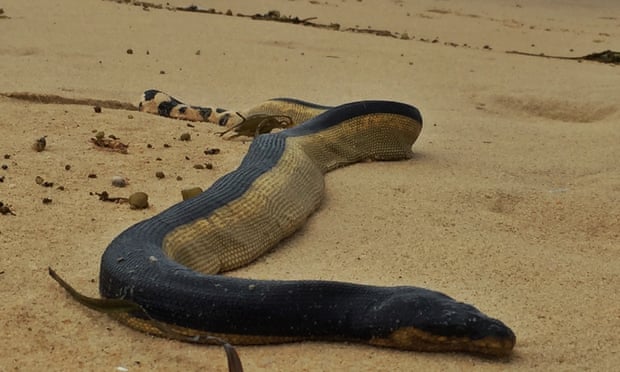
In January, Oliver Milman reported at the Guardian about a sea snake with a suggestive name (“Why you yellow-bellied sea snake, you …!”) that has suddenly shown up in California.

“California beachgoers have been urged to steer clear of a species of highly venomous sea snake following a third, and unprecedented, instance of an aquatic serpent washing up on to the state’s beaches.

“A 20-inch yellow-bellied sea snake was discovered on a beach near San Diego … The sighting was the third reported instance since October of the species, which prefers the tropical waters of the Pacific and Indian oceans, washing up on California’s beaches.

“The only previous verified sighting of a washed-up yellow-bellied sea snake was in 1972. Experts believe the snakes have ridden a warm current of water, fueled by the exceptionally strong El Niño climatic event, farther north than they have ever previously ventured. …

“ ‘It’s been an incredibly interesting year for southern California. We’ve seen tuna and marlin and tropical bird species such as red-footed boobies,’ said Greg Pauly, curator of herpetology at the Natural History Museum of Los Angeles County. …

“Yellow-bellied sea snakes are fully aquatic snakes capable of swimming vast distances. Although they are highly venomous, their targets are small fish and it’s thought they have yet to cause a recorded human death. However, Pauly said people should keep their distance if they encounter another washed-up snake.

“ ‘They are fairly docile and it’s unlikely for someone to be envenomated,’ he said. ‘It’s rare for them to bite people, it’s usually fishermen who are carelessly pulling up fishing nets.’ ”

More here.

Photo: Carolyn Larcombe/Wandiyali Images
Seen in California after el Niño, yellow-bellied sea snakes usually live in the deep waters of the Pacific and Indian oceans. 

Read Full Post »