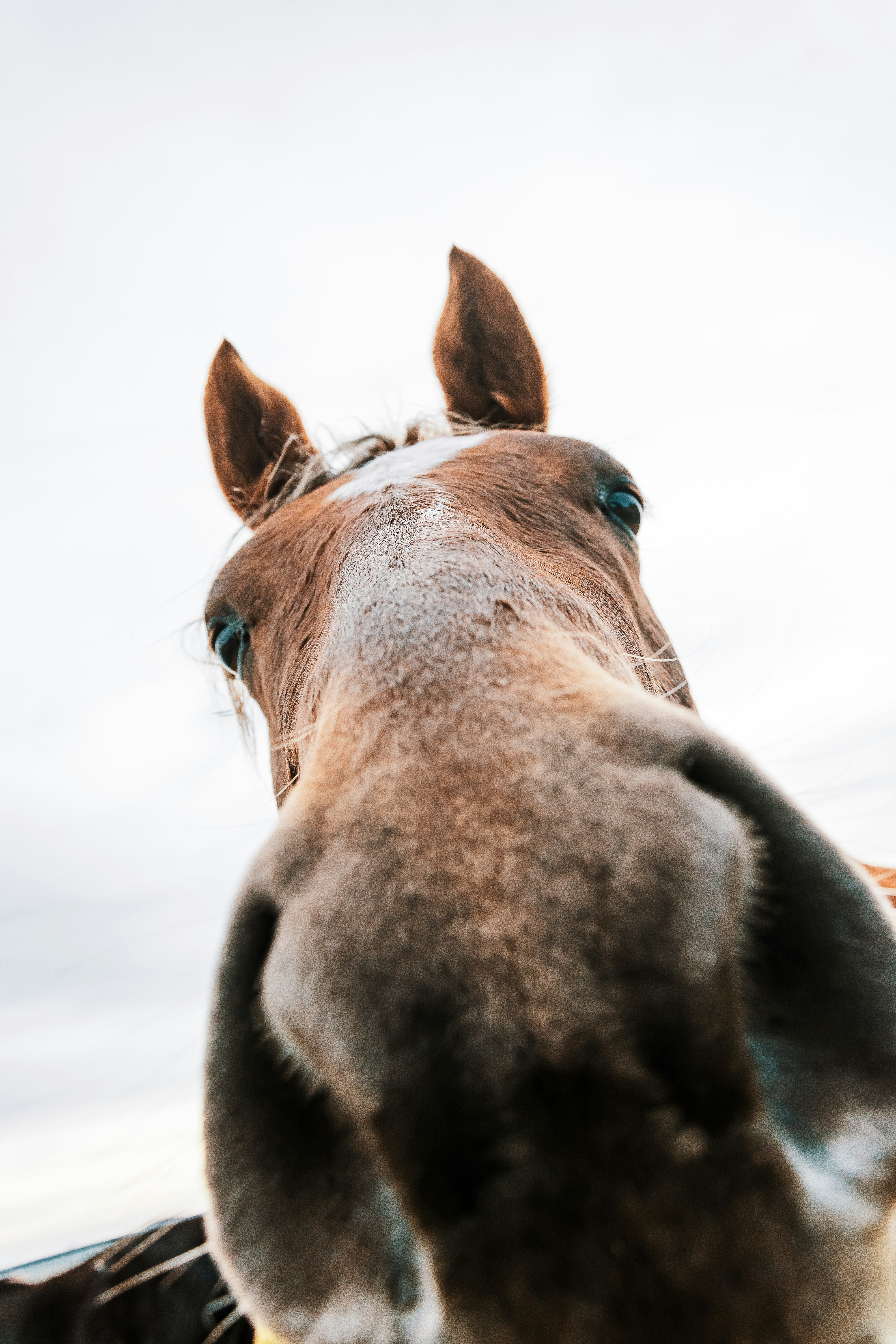
Photo: Rafael Hoyos/Unsplash.
What if horses could speak? What if they already do?
Who remembers Mister Ed, the television series in the early 1960s? The usual bad things were going on in the world at the time, but anyone who needed an escape could indulge in the adventures of a talking horse. Special effects in tv had not advanced very far at the time, but somehow the producers created the illusion that Mister Ed’s lips were moving as if using human speech.
And of course, he often whinnied.
Today we learn from National Public Radio that the dual-layer whinny of real horses is almost as surprising.
Ari Daniel writes that the researcher “Élodie Briefer grew up in the countryside near Geneva — and horses have long been a part of her world. …
“She recalls, ‘I can’t remember at which age I started, but maybe 6 or 7 years old. I did [a] few competitions, but I was never a big fan of that. I would prefer to go for a walk with the horse and enjoy.’
“All this time with horses means that Briefer, now an animal behavioral scientist at the University of Copenhagen, has heard a lot of whinnying over the years. She never noticed anything out of the ordinary until a little more than a decade ago when she was working on a project that involved comparing how different animals, including horses, express themselves vocally.
” ‘The first time I really listened to a horse whinny that I had recorded,’ she says, ‘I was confused because I thought there were two horses — as if there [were] two voices at the same time.’
“Briefer created a visual representation of the sound file, called a spectrogram, to inspect the whinny more closely. And that’s when she saw two frequencies occurring at the same time: one high and one low.
“In a paper appearing in the journal Current Biology, Briefer and her colleagues present a set of experiments that reveal how horses manage to create these two tones simultaneously. It’s a complex feat that seems to be made possible by the anatomy of their vocal tract.
“Briefer was perplexed by what she observed in the whinny for a couple of reasons. First, larger animals tend to produce lower vocalizations, and the high-pitched part of the horse whinny seemed too high for such a big creature. Second, a fair number of birds can produce two simultaneous frequencies like this. But among mammals, ‘it’s quite uncommon, at least when it appears all the time in one type of sound,’ says Briefer. …
“Briefer first went to a Swiss stud farm (where her sister, who’s a co-author on the study, works). She threaded a small camera down the noses of 10 breeding stallions until it was just above the larynx. It’s the same procedure that’s routinely conducted on these animals as part of their physical checkups, so they were accustomed to it.
“Briefer then played the stallions the sound of a female whinnying, or in certain instances, she paraded a mare in front of them. … She noticed how the vocal folds of the larynx vibrated (just like when we speak) to produce the low-frequency part of the whinny.
“In addition, just above the larynx, horses have strong cartilage. The video revealed the cartilage constricting, creating a small opening that likely produced a whistle — the high-frequency part of the whinny.
“Briefer had her first evidence that two different parts of the horse’s vocal anatomy were likely operating in tandem to produce the whinny’s two distinct frequencies.
“Next, Briefer’s colleagues connected with a butcher in France, a country where people eat horses. ‘I know it’s not the same in every country,’ she says, ‘but there it’s quite common.’
“The butcher provided the team with half a dozen horse larynges. ‘And then you blow air through it to reproduce the sounds,’ says Briefer.
“They successfully generated both the low and high tones in the excised larynges, confirming the results on the stud farm. Then, when they blew helium through them, the low pitch was unaffected, but the high pitch shifted higher. That’s what Briefer and her colleagues were expecting, since helium doesn’t affect the pitch of vocal fold vibrations, only that of whistles.
“CT scans provided 3D portraits of the same larynges, revealing ‘a small kind of cavity just above the vocal fold that hadn’t been documented before,’ explains Briefer. That could be where the air is forming a vortex, which then makes the whistle.’ More work needs to be done to confirm that mechanism.
“Finally, the team tracked down several stallions with a rare disease called recurrent laryngeal neuropathy, which tends to paralyze one of the vocal folds fully or in part. They recorded these animals’ whinnies. The low tone was partially absent, but the high pitch was unaffected.
” ‘That was another confirmation that the high pitch is not produced by vocal fold vibration,’ says Briefer. Briefer concludes that a whinny is a unique blending of vocal fold vibration that generates the low pitch and a whistling above the larynx that produces the high pitch. …
” ‘What I really liked in this paper is that they used a very comprehensive experimental approach that combined different techniques and that all converge [on] the same results, says Mathilde Massenet, a bioacoustician at the University of California, Los Angeles, who has worked with Briefer in the past but didn’t participate in the new research.
“As for why horses might be producing these two-toned whinnies, Briefer’s earlier work suggests they appear to encode different pieces of emotional information. ‘The [high-frequency] one indicates whether the emotion is pleasant or unpleasant,’ she says. ‘And then the [low-frequency] one indicates whether the emotion is intense or not.’
“Massenet says that discerning how complex sounds like the whinny are produced can help yield insights into what it is that animals are communicating. ‘Understanding the vocal behavior is important for us to have a better idea of how healthy’ a population of animals is, she says.”
More at NPR, here.


