Feeds:
Posts
Comments

Posts Tagged ‘doctor’

Photo: Toby Melville/Reuters.
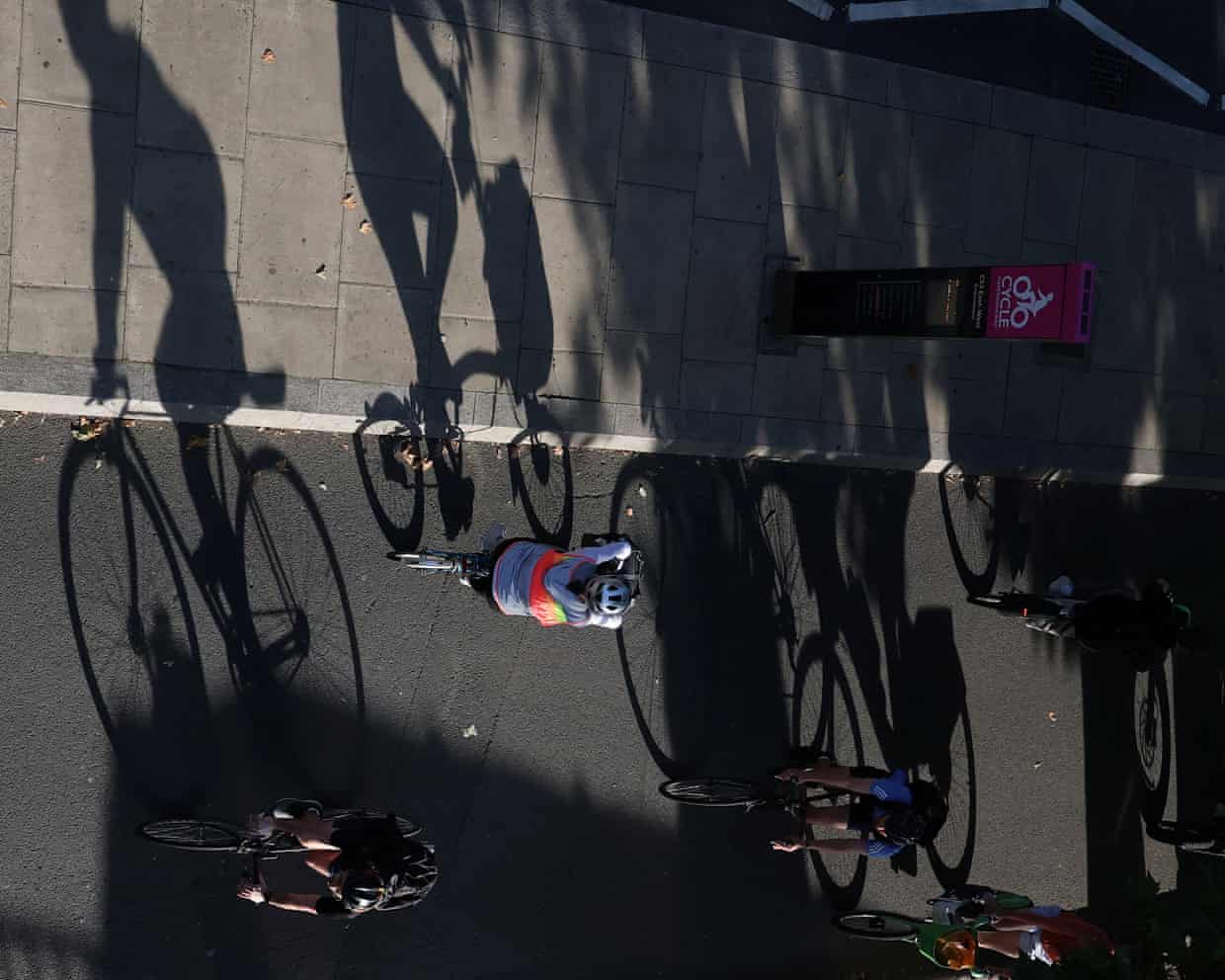
Cycle lanes such as these in London are among the interventions that have helped reduce levels of particulate pollution and nitrogen dioxide by more than 20% since 2010, according to a new analysis.  

Cyclists have really led the way, haven’t they, in making cities more livable. Whatever their personal motivations for demanding more bike lanes — for exercise or saving money or whatever — they have benefited us all with cleaner cities. Electric cars are playing a role, too.

A recent analysis featured at the Guardian shows how cleaner ways to get around have affected health.

Ajit Niranjan writes, “London, San Francisco and Beijing are among 19 global cities that have achieved ‘remarkable reductions’ in air pollution, analysis has found, having slashed levels of two airway-aggravating pollutants by more than 20% since 2010.

“The analysis found interventions such as cycle lanes, uptake of electric cars and restrictions on polluting vehicles had helped to drive the improvements.

“Beijing and Warsaw topped the ranking for cleaning up fine particulate pollution (PM2.5), reducing levels by more than 45%, while Amsterdam and Rotterdam saw the greatest improvement in nitrogen dioxide (NO2), with cuts of more than 40%.

“San Francisco was the only US city that cut levels of both pollutants by more than 20%, according to the analysis [by BreatheCities.org and others] of nearly 100 cities around the world. China and Hong Kong are home to nine of the 19 cities, with European cities making up the rest.

” ‘This report shows that cities can achieve what was once thought impossible: cutting toxic air pollution by 20-45% in a little over a decade,’ said Cecilia Vaca Jones, executive director of Breathe Cities, one of the organizations behind the report. …

“Burning fossil fuels releases toxic gas and harmful particles that are among the biggest threats to human health. …

“The report, shared exclusively with the Guardian, looked at air quality in cities in the C40 and Breathe Cities networks – mostly large cities, but also some smaller ones such as Heidelberg in Germany – and found ‘substantial reductions’ can be achieved within 15 years through deliberate action.

“It highlighted examples of action that had helped to clean the air, such as China’s rapid switch from combustion engine cars to electric ones, the expansion of cycle lanes in dense European cities, London’s restrictions on dirty vehicles and Warsaw’s shift away from coal and wood home heating. It did not explore the causal chain to distinguish between air quality improvements from local policies versus national ones. …

“Last year, a report found nearly every country on Earth has dirtier air than doctors recommend breathing. Just seven countries that met the World Health Organization’s guidelines for PM2.5 last year, according to IQAir, a Swiss air quality technology company. There are no safe levels of PM2.5, but doctors estimate millions of lives could be saved each year by following their guidelines.

“Breathing polluted air affects our health through every stage of our lives, said [Dr Gary Fuller, an air pollution scientist at Imperial College London, who was not involved in the report] ‘from low birth weight babies and asthma in children to cancer and heart problems in adult life.

“ ‘In the last 10 years, we have learned that air pollution is linked to cognitive decline and dementia in old age,’ he added. ‘All of these illnesses exert a massive toll on families, hamper our economies – as people are off work ill or looking after others – and exert a direct cost on our health services. All of these illnesses are preventable.’ ”

Yesterday I read that the war-related gas prices are pushing more people to use trains. I hope they catch on. I always preferred to commute to work by train. More at the Guardian, here.

Read Full Post »

Photo: Victoria Onelien/Special to the Christian Science Monitor.
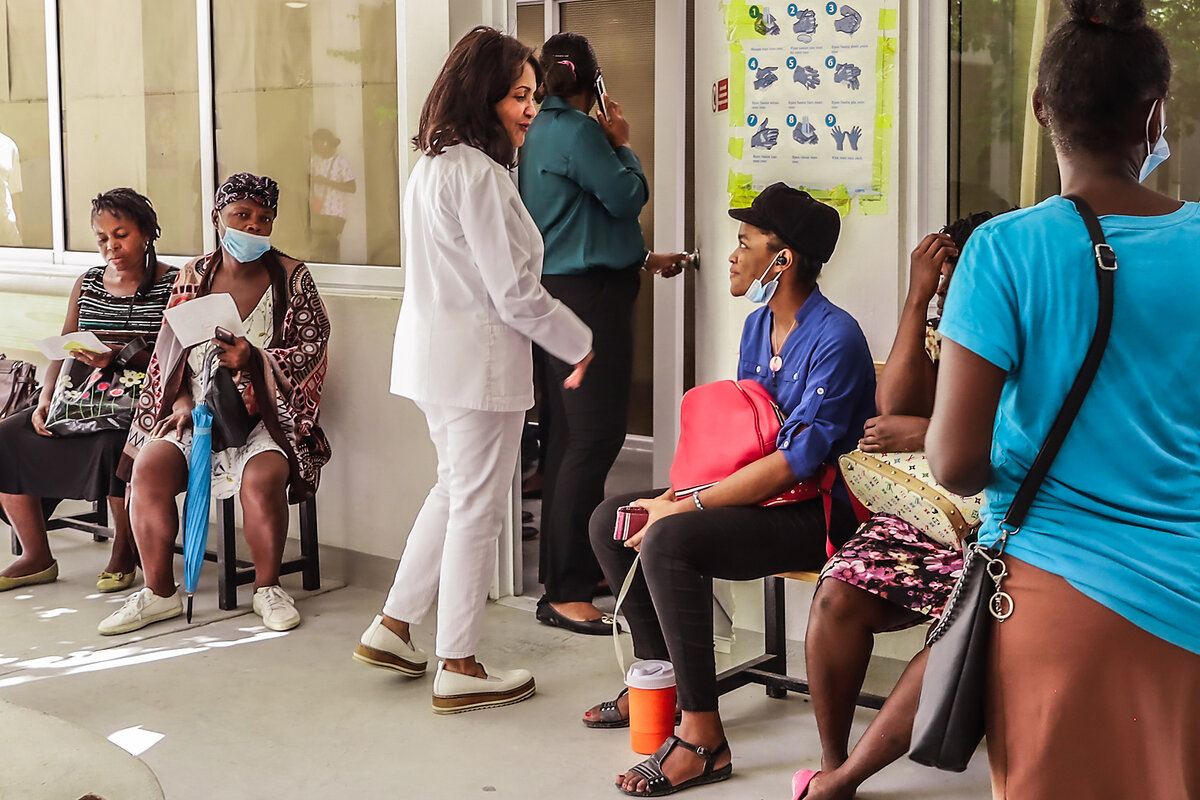
Dr. Marie-Marcelle Deschamps walks through the medical area of the Gheskio center, welcoming patients, in Port-au-Prince, Haiti, in July.

It’s hard to imagine that in a country ruled by armed gangs like Haiti, a doctor keeps doing her work “without fear.” Would we be without fear if our country were taken over by armed gangs?

Linnea Fehrm writes at the Christian Science Monitor, “Marie-Marcelle Deschamps was speaking at a conference in Washington last spring about her work running one of Haiti’s most innovative hospitals when the startling news started spilling in: Criminal gangs were releasing incarcerated people from a prison in Port-au-Prince, police stations and government buildings were under attack, and the international airport was shuttered. …

“ ‘Every day that I can’t go back is a catastrophe for me,’ she said with a sigh, speaking from her hotel room in Miami several weeks later, where she was anxiously awaiting the possibility of flying back to Haiti. ‘I can’t sleep at night. My staff are struggling, people are dying.’ …

“Dr. Deschamps is co-founder and deputy executive director of Gheskio, a hospital in Port-au-Prince known by its French acronym, where she has worked for the past 42 years. It’s not a typical clinic; it looks beyond physical health to tackle issues such as education, women’s leadership, job training, and community-building. …

“The doctor has guided the organization through earthquakes, epidemics, state coups, and political unrest. But when she finally returned to Port-au-Prince in April, she says she was faced with the most severe crisis she has ever seen. Hundreds of thousands of Haitians had fled their homes due to insecurity, many of whom began flooding her hospital in search of safety and treatment. Some people arrived close to starving, others with gunshot wounds, she says. …

“Gheskio is in downtown Port-au-Prince, adjacent to an enormous, gang-controlled area known as the City of God. The dusty access roads are teeming with heavily armed gangs, whose ranks have been reinforced by people who have escaped from prison. They regularly block the roads and kidnap people from passing cars. …

“Only a handful of hospitals have survived the past year’s violence in Port-au-Prince, according to Jean Bosco Hulute, head of UNICEF’s health program in Haiti. About a five-minute drive from Gheskio is the State University of Haiti Hospital, the largest health facility in the country. For more than four months this year, it was under gang control; doctors and patients were chased off the grounds and wards were looted of everything from medical supplies to ceiling fans. 

“Gheskio receives some funding and equipment from UNICEF, requiring Mr. Hulute to occasionally visit. These trips require ‘careful planning and authorization from the head office’ for safety purposes, he says.

“ ‘Dr. Deschamps, however,’ he says with a chuckle, ‘she just takes her car and drives there.’ 

“She holds weekly meetings with local community representatives, helping to earn respect for her organization’s work – even among gang leaders. When armed men on the street see her hospital ID, they let her pass, she says. …

“Today, the Gheskio grounds are like an oasis amid Haiti’s political and security-related chaos. Dr. Deschamps says she comes here to regain her strength, surrounded by green lawns, verdant gardens, and birds chirping from towering palm trees. …

“Shortly after founding Gheskio, Dr. Deschamps was selected by a group of Haitian and American doctors to study in the U.S. There, she trained under Dr. Anthony Fauci, who would later become a household name during the COVID-19 pandemic.

“ ‘He always had a positive attitude, so we were similar in that way. It has become a strategy in my life to team up with positive people.’ “

Just think of the comfort that her attitude must give to patients!

More at the Monitor, here. No paywall. Subscriptions are reasonable.

Read Full Post »

As long as health insurance is out of reach for so many, creative approaches to coverage are likely to keep sprouting up.

I knew a doctor 30 years ago who took care of elderly single people for life — and inherited their houses. He ended up with a lot of houses.

More recently, CBSNewYork/AP reported that “a new program lets uninsured New York City artists exchange their art for medical services.

“Tony-Award winning actor Lin-Manuel Miranda and rapper and radio personality Roxanne Shante helped launch the ‘Lincoln Art Exchange’ at Lincoln Hospital in the Bronx” early this year.

“Under the program, artists will earn ‘health credits’ for every creative service they perform. In exchange they’ll be able to obtain doctor’s visits, laboratory tests, hospitalization, emergency care, dental care and prescriptions at Lincoln.” Read more at CBS Local.

I would be interested in other unusual examples of how people are accessing care today.

Photograph: nyc.gov

Read Full Post »

Dr. Paul Farmer, the subject of a great Tracy Kidder book called Mountains Beyond Mountains, has spent many years delivering medical care — and working to alleviate poverty — in remote areas of Haiti. His nonprofit organization, Partners in Health, takes the word “partners” seriously. The teams do not tell the locals what is good for them but makes a point of learning from them and helping them get what they need.

In recent years, Farmer has been in demand in other countries, too. One focus area has been Rwanda. I liked a recent Boston Globe article on the approach to building a Partners in Health hospital there.

“The designers quickly realized that the challenge was not simply to draw up plans, as they had first thought, but rather to understand the spread of airborne disease and design a building that would combat — and in some cases sidestep — the unhealthy conditions common to so many hospitals.

“Learning from health care workers that hospital hallways were known sites of contagion, poorly ventilated, and clogged with patients and visitors, MASS Design decided that the best solution would be to get rid of the hallways. Taking advantage of Rwanda’s temperate climate, they placed the circulation outdoors, designing open verandas running the lengths of the buildings. …

“When it came to building, MASS Design looked at the Partners in Health model of involving local poor communities in health care, and realized that they could apply the same ideas to the construction process. The hospital was built entirely using local labor, providing food and health care for the workers. Unskilled workers received training that would help them get more work; and skilled laborers, notably the Rwandan masons who built the hospital’s exterior from carefully fitted together local volcanic stone, refined their craft and found themselves in demand all over the country. The construction process also beefed up local infrastructure — new roads and a hydroelectric dam — creating more jobs and literally paving the way for future projects.”

To paraphrase what Farmer often says, the biggest challenge to health is poverty. Read more.

Update on the designers from the June 19, 2012, Boston Globe.

Read Full Post »