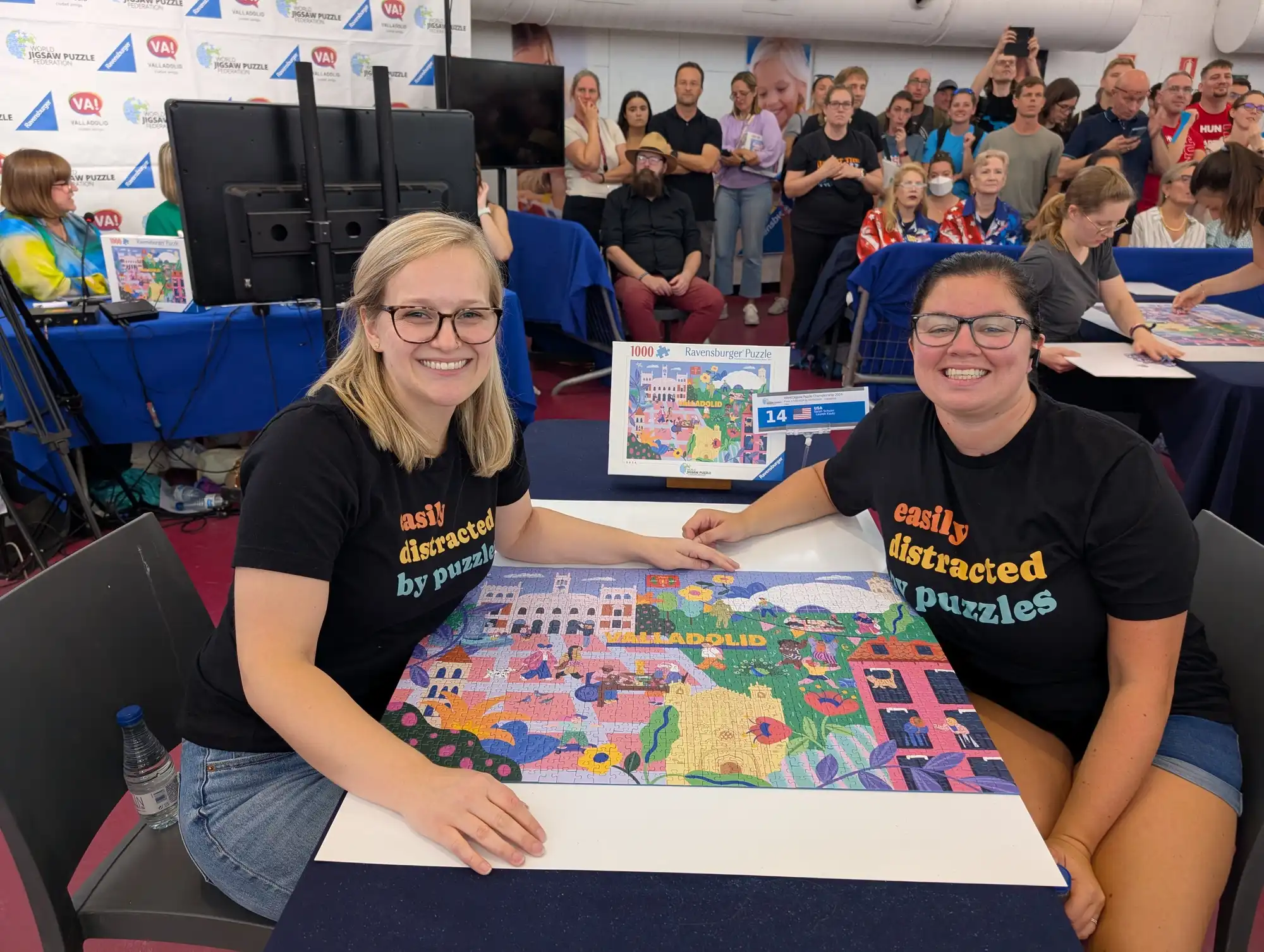
Photo: Sarah Schuler.
Sarah Schuler (left) and Lauren Kautz (right) took home 15th place out of 747 other pairs at the World Jigsaw Puzzle Championship in Spain.
Where I live, there are some very serious puzzle mavens, and I can tell it keeps their brains sharp. Now I learn that some aficionados take those sharp brains to puzzle competitions.
Cathy Wurzer and Aleesa Kuznetsov at Minnesota Public Radio (MPR) interviewed a puzzler from Minnesota who had just won some glory in Spain.
Here’s the part of the transcript from the aficionado telephone interview.
Cathy Wurzer/MPR
“Tickets went live today for one of the largest jigsaw puzzling competitions in the world, and it’s right here in St. Paul at the Winter Carnival. Someone you will definitely see there is Minnesotan Sarah Schuler, and she actually just got back from the World Jigsaw Puzzle Competition in Spain. …
“I’ve got to say, Sarah, I always thought that working jigsaw puzzles was supposed to be relaxing. But I didn’t realize that there are people like yourself who compete, and you’re incredibly good and fast at it. Walk me through how this happened to you. …
Sarah Schuler
“People don’t really know about it. I feel like a lot of Minnesota does puzzle, but not as many people do competitive jigsaw puzzling. …
Wurzer
“I understand that you were competing with a thousand other puzzlers from around the world. What was that like?
Schuler
“It is electric. I know that sounds kind of wild when it’s coming down to jigsaw puzzling, but to be in a room with a thousand other people that have such a passion and love for the same hobby that you do is just such an amazing feeling. …
Wurzer
“Did you make it into the finals? …
Schuler
“I made it in all three categories. There are team competitions, which is a team of up to four people, pairs, which is just two people working on a puzzle, and then individuals, which is just yourself. …
Wurzer
“Give me a sense as to how fast you can go when you’re really clicking.
Schuler
“I typically finish a 500-piece puzzle between 45 minutes to an hour. The fastest people in the world can finish it in 26 minutes. …
Wurzer
“Oh my gosh. I can’t even conceive of it. … How do you tackle a puzzle as a team?
Schuler
“Really the most important thing is communication. You can definitely go into it with a plan, but in a jigsaw puzzle competition, typically you don’t get to see the image until they do ‘five, four, three, two, one, go.’ So you can’t really plan ahead like, if it’s an image with tigers on it, I’m going to take the tigers, I’m going to take the water, I’m going to take these purple flowers. … My team, we have someone that we have do the edge pieces — pretty much dedicated to doing that from the beginning. And then the rest of us just call out like, if we’re seeing a pink carriage and a white horse, they’ll say, ‘Oh, I’m going to take all these white pieces and put together the horse.’ …
“The edge is very important, but sometimes we don’t do it first. So as you practice and do more puzzles, you’ll learn when it’s quicker to do the edge last. …
Wurzer
“Then you’ve got to go fast. … It’s almost like you develop, I would think, some kind of an eye or a sense of where you’re going, larger picture, to go fast.
Schuler
“I feel like a lot of people have different methods … Some people will take a long time and look at the box image and sear that into their brain so they don’t have to keep looking at the box. Some people never look at the box, or they just quickly look at it once and go, OK, I get the idea. Some people hold up the piece to the box and find exactly where it goes and puts it down in the puzzle. So lots of different strategies. …
Wurzer
“I think when you think of a puzzler, you think of someone who might be older, but you’re in your 20s. So how did you get into competitive puzzling?
Schuler
“As you were talking about earlier, Winter Carnival is the largest puzzle competition in the country. … I started going to that to watch my mom and my uncle compete on a team, and eventually one of their team members left their team. And they put me in when I was maybe 12, 13, and that was my first time doing a puzzle contest. And I just fell in love with it.”
More at Minnesota Public Radio, here.

 Suzanne's Mom's Blog