Feeds:
Posts
Comments

Posts Tagged ‘St Paul’

Photo: Rich Ryan.
Actor Comfort Dolo played the character Helene in Mixed Blood Theatre’s production of The Jungle in St. Paul, Minnesota. 

How do immigrants in refugee camps process their experiences, and how do the rest of us benefit from what they learn about cooperation? One way is through theater.

Myah Goff wrote at Sahan Journal in April about the St. Paul Art Crawl and a refugee play presented by the Mixed Blood Theatre.

“For immigrant and refugee communities, telling stories becomes a means of survival in the disorientation of being uprooted from home — a way to endure, to remember and to imagine a future beyond displacement. 

“In 2015, stories were the currency of the ‘Jungle,’ a refugee camp in Calais, France, where thousands sought refuge at the height of the European migrant crisis. 

“This weekend, Mixed Blood Theatre is bringing the Jungle to the stage, while artists across the Twin Cities are keeping cultural stories in motion at the St. Paul Art Crawl, a local record shop and the Minnesota History Center. 

“In 2015, as millions of refugees fled war and persecution across the Middle East and North Africa, a makeshift encampment known as the Jungle re-emerged in Calais, a port city in northern France. 

“While the world watched the European migrant crisis from afar, London playwrights Joe Robertson and Joe Murphy drove to the camp in a car packed with supplies. 

“ ‘It was a town, in a way — a shanty town,’ Robertson said. ‘They were building restaurants and cafes, schools and mosques, a marketplace and legal advice centers. There were lots of volunteers coming to build women and children’s centers, and we were like, “Well every town needs a theater.” ‘

“Within weeks, the duo fundraised for a geodesic dome, gathered donated lights and staging, and returned to Calais to live in a tent alongside residents for seven months.

“As migrants faced uncertainty, displacement and made frequent attempts to cross into the United Kingdom, a robust arts community began to take shape inside the Good Chance Theatre.

Residents staged stand-up comedy, music, storytelling, kung fu, circus acts and theater performances. 

“ ‘It was a place where people could share and express who they were and what was happening to them in this strange and challenging moment,’ Murphy said. ‘But also a place to go and have fun, and escape those things.’ 

“The Jungle — a site that Robertson described as a ‘miraculous place’ for the way its residents showed up for one another — was demolished by French authorities in 2016, leaving a void that Robertson and Murphy felt a responsibility to fill. …

“Murphy said, ‘That injustice propelled us into thinking about telling that story with some of the people we’ve met in the Jungle camp, alongside other actors.’ 

“This weekend, their play The Jungle makes its regional premiere at Minneapolis’ Mixed Blood Theatre, directed by Mark Valdez

“ ‘There’s this lovely moment in the play where the police show up and the people of the Jungle just kneel,’ Valdez said. ‘It’s this peaceful resistance that we will all recognize [after our recent experience with ICE] and hopefully this play makes space for us to think about how to work together now to ensure better policies in a system that is deeply broken.’

“The Twin Cities has ‘proven that we care for our neighbors and that we will take care of each other,’ Valdez added. ‘The European refugee crisis took place 10 years ago and there’s something about that distance that gives us enough space to look at our current issues without feeling the direct heat of what we’re going through right now.’ ” 

More at Sahan Journal, here.
Read Full Post »

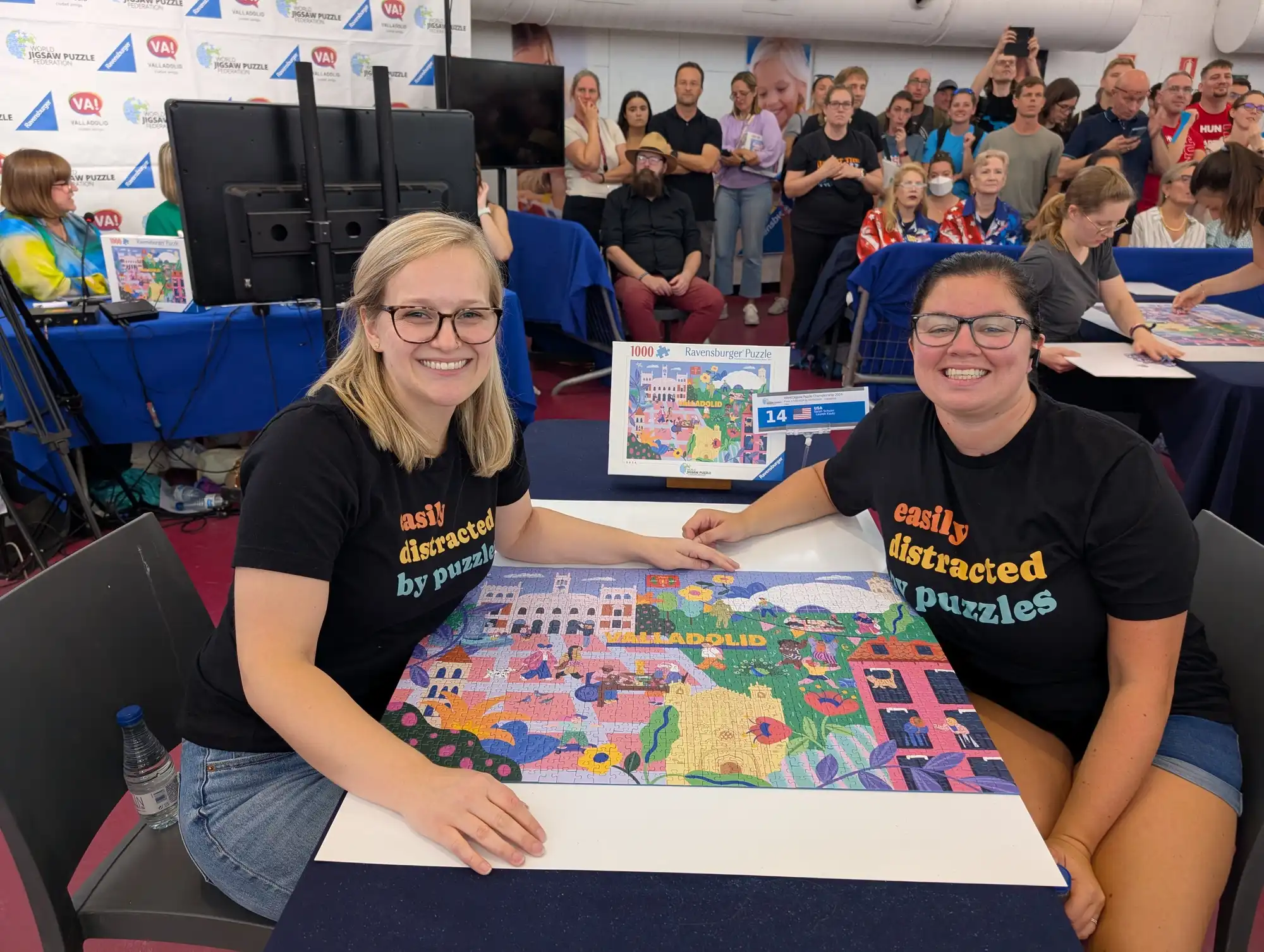
Photo: Sarah Schuler.
Sarah Schuler (left) and Lauren Kautz (right) took home 15th place out of 747 other pairs at the World Jigsaw Puzzle Championship in Spain.

Where I live, there are some very serious puzzle mavens, and I can tell it keeps their brains sharp. Now I learn that some aficionados take those sharp brains to puzzle competitions.

Cathy Wurzer and Aleesa Kuznetsov at Minnesota Public Radio (MPR) interviewed a puzzler from Minnesota who had just won some glory in Spain.

Here’s the part of the transcript from the aficionado telephone interview.

Cathy Wurzer/MPR
“Tickets went live today for one of the largest jigsaw puzzling competitions in the world, and it’s right here in St. Paul at the Winter Carnival. Someone you will definitely see there is Minnesotan Sarah Schuler, and she actually just got back from the World Jigsaw Puzzle Competition in Spain. …

“I’ve got to say, Sarah, I always thought that working jigsaw puzzles was supposed to be relaxing. But I didn’t realize that there are people like yourself who compete, and you’re incredibly good and fast at it. Walk me through how this happened to you. …

Sarah Schuler
“People don’t really know about it. I feel like a lot of Minnesota does puzzle, but not as many people do competitive jigsaw puzzling. …

Wurzer
“I understand that you were competing with a thousand other puzzlers from around the world. What was that like?

Schuler
“It is electric. I know that sounds kind of wild when it’s coming down to jigsaw puzzling, but to be in a room with a thousand other people that have such a passion and love for the same hobby that you do is just such an amazing feeling. …

Wurzer
“Did you make it into the finals? …

Schuler
“I made it in all three categories. There are team competitions, which is a team of up to four people, pairs, which is just two people working on a puzzle, and then individuals, which is just yourself. …

Wurzer
“Give me a sense as to how fast you can go when you’re really clicking.

Schuler
“I typically finish a 500-piece puzzle between 45 minutes to an hour. The fastest people in the world can finish it in 26 minutes. …

Wurzer
“Oh my gosh. I can’t even conceive of it. … How do you tackle a puzzle as a team?

Schuler
“Really the most important thing is communication. You can definitely go into it with a plan, but in a jigsaw puzzle competition, typically you don’t get to see the image until they do ‘five, four, three, two, one, go.’ So you can’t really plan ahead like, if it’s an image with tigers on it, I’m going to take the tigers, I’m going to take the water, I’m going to take these purple flowers. … My team, we have someone that we have do the edge pieces — pretty much dedicated to doing that from the beginning. And then the rest of us just call out like, if we’re seeing a pink carriage and a white horse, they’ll say, ‘Oh, I’m going to take all these white pieces and put together the horse.’ …

“The edge is very important, but sometimes we don’t do it first. So as you practice and do more puzzles, you’ll learn when it’s quicker to do the edge last. …

Wurzer
“Then you’ve got to go fast. … It’s almost like you develop, I would think, some kind of an eye or a sense of where you’re going, larger picture, to go fast.

Schuler
“I feel like a lot of people have different methods … Some people will take a long time and look at the box image and sear that into their brain so they don’t have to keep looking at the box. Some people never look at the box, or they just quickly look at it once and go, OK, I get the idea. Some people hold up the piece to the box and find exactly where it goes and puts it down in the puzzle. So lots of different strategies. …

Wurzer
“I think when you think of a puzzler, you think of someone who might be older, but you’re in your 20s. So how did you get into competitive puzzling?

Schuler
“As you were talking about earlier, Winter Carnival is the largest puzzle competition in the country. … I started going to that to watch my mom and my uncle compete on a team, and eventually one of their team members left their team. And they put me in when I was maybe 12, 13, and that was my first time doing a puzzle contest. And I just fell in love with it.”

More at Minnesota Public Radio, here.

Read Full Post »