Feeds:
Posts
Comments

Archive for the ‘Uncategorized’ Category

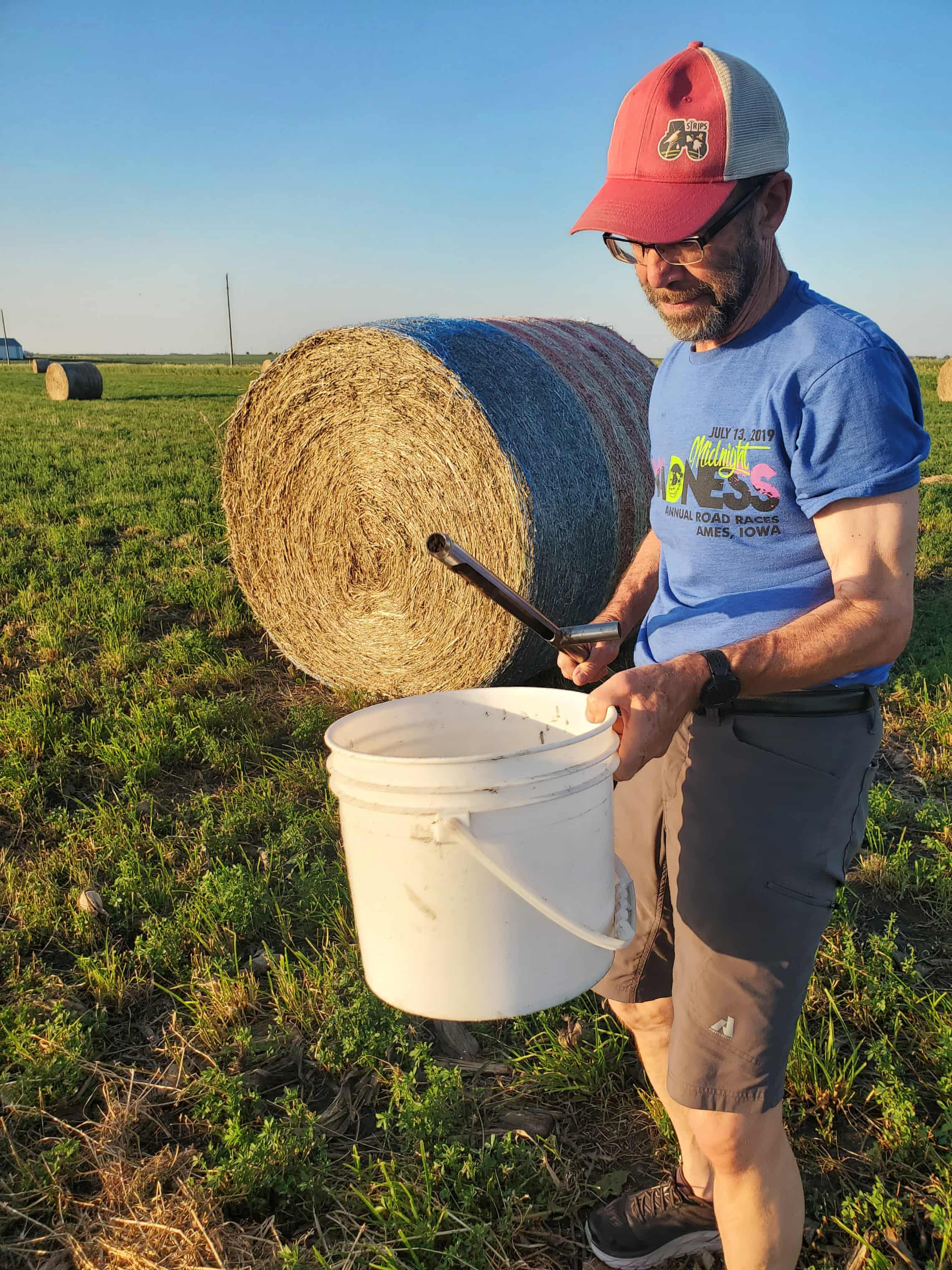
Photo: Lee Tesdell.
Behind farmer Lee Tesdell in the photo are rolled-up strips of prairie sod containing native plants that help improve his land’s resistance to climate change. 

There are so many things we have taken for granted in our natural world. Consider weeds. We might have noticed that various flying things liked their blossoms, but we didn’t like them.

That is, until we started noticing that we wouldn’t have much food if those flying things didn’t pollinate plants.

Now some farmers who used to kill weeds are bringing them back. As Rachel Cramer reports at the Guardian, strips of native plants (weeds) on as little as 10% of farmland can reduce soil erosion by up to 95%.

“Between two corn fields in central Iowa,” she writes, “Lee Tesdell walks through a corridor of native prairie grasses and wildflowers. Crickets trill as dickcissels, small brown birds with yellow chests, pop out of the dewy ground cover. …

“This is a prairie strip. Ranging from 10-40 metres (30-120ft) in width, these bands of native perennials are placed strategically in a row-crop field, often in areas with low yields and high runoff. Tesdell has three on his farm.

“He points out several native plants – big bluestem, wild quinine, milkweed, common evening primrose – that came from a 70-species seed mix he planted here six years ago. These prairie plants help improve the soil while also protecting his more fertile fields from bursts of heavy rain and severe storms, which are becoming more frequent.

“ ‘To a conventional farmer, this looks like a weed patch with a few pretty flowers in it, and I admit it looks odd in the corn and soy landscape in central Iowa,’ … he said. ‘I’m trying to be more climate-change resilient on my farm.’ …

“Prairie strips also help reduce nutrient pollution, store excess carbon underground and provide critical habitat for pollinators and grassland birds. Thanks to federal funding through the USDA’s conservation reserve program, they’ve taken off in recent years.

“But the idea started two decades ago with Iowa State University researchers and Neal Smith National Wildlife Refuge managers. Lisa Schulte Moore, a landscape ecologist and co-director of the Bioeconomy Institute at Iowa State University, who was integral to the research, knows that large patches of restored and reconstructed prairie are vital, especially for wildlife, but she argues that integrating small amounts of native habitat back into the two dominant ecosystems – corn and soya beans – can make a big difference. …

“In north-central Missouri, farmer Doug Doughty has been adding and expanding conservation practices, like no-till, for decades. He also has a few hundred acres of prairie enrolled in the USDA’s conservation reserve program. This past winter, he added prairie strips, as part of a plan to tackle nutrient pollution. High levels of nitrates and phosphorus can wreak havoc on aquatic habitats and the economies that depend on them. There are also health risks for people. Nitrates in drinking water have been associated with methaemoglobinaemia or ‘blue baby syndrome,’ and cancer. …

“During an outreach event in the Iowa Great Lakes region, Matt Helmers uses a rainfall simulator to demonstrate runoff and erosion with different conservation practices. He’s one of the prairie strips researchers and director of the Iowa Nutrient Research Center at Iowa State University. …

“During a big rain storm, each prairie strip in a field acts like a ‘mini speed-bump,’ said Helmers. A thick wall of stems and leaves slows down surface water, which reduces soil erosion and gives the ground more time to soak up water. Below ground, long roots anchor layers of soil while absorbing excess water, along with nitrates and phosphorus.

“Farmer Eric Hoien says he first heard about the conservation practice a decade ago, right around the time he was becoming more concerned about water issues in Iowa. But the final push to add 24 acres of prairie strips came from something Hoien saw in an plane above the Gulf of Mexico.

“ ‘I looked down and for what was probably 20 minutes, it was just like the biggest brown mud puddle I’d ever seen. And so I knew that, that stuff they say about the dead zone, from 30,000 ft, was real,’ Hoien said. …

“Hoien says prairie strips offer other benefits close to home. Neighbors often tell him they appreciate the wildflowers and hearing the ‘cackle’ of pheasants. He also enjoys hunting in the prairie strips and spotting insects he’s never seen before.

“The strips are hugely beneficial for pollinator populations, which have been dropping around the world. Researchers point to a combination of habitat loss, pesticide exposure, parasites and diseases, along with warmer temperatures and more severe weather events due to climate change.

“ ‘If we can help them have a place to live and something to eat, they can be better equipped to cope with those kinds of stress that they’re inevitably going to encounter in their environments,’ says Amy Toth, who is also part of the prairie strips research team and an entomology professor at Iowa State University. Research shows both the diversity of pollinator species and overall numbers are higher in prairie strips compared to field edges without native plants.

“And strips of native plants aren’t just good for pollinators. Researchers, including Schulte Moore, found a nearly threefold higher density of grassland birds on fields with prairie strips. She says that grassland birds have declined more than any other avian group in North America since 1970. …

“Schulte Moore says a group of forward-thinking, innovative farmers and partnerships with non-profits, foundations, universities and agencies in the midwest have helped prairie strips gain traction, but then a ‘monumental shift’ happened with the 2018 Farm Act, when prairie strips became an official practice in the federal conservation reserve program.” More here.

Pray that these federal conservation programs are not already slashed.

And for more on the prairie’s vast potential, read about Buffalo Commons, a movement launched by my husband’s classmate and his wife in the 1980s, here.

Read Full Post »

Photo: Nashville Airport.
Singer Songwriter Joe West is the “house band” for the Nashville International Airport. He’s the son of Sarge and Shirley West, the first and only African American Country and Western Duo.

Remember when going to the airport was fun and even exciting? It’s sad that all the protective measures needed now have made the experience excruciatingly tiresome. Nowadays when I think of wanting to visit someone by plane, I hesitate.

Among the attributes of airports that today’s travelers object to is noise, and today’s story is about how some airports are making an effort to change that unpleasantness.

Dee-Ann Durbin has the story at the Associated Press.

“Background music,” she writes, “is no longer an afterthought at many airports, which are hiring local musicians and carefully curating playlists to help lighten travelers’ moods.

London’s Heathrow Airport built a stage to showcase emerging British performers for the first time this summer. The program was so successful the airport hopes to bring it back in 2025. Nashville International Airport has five stages that host more than 800 performances per year, from country musicians to jazz combos. In the Dominican Republic, Punta Cana International Airport greets passengers with live merengue music.

“Tiffany Idiart and her two nieces were delighted to hear musicians during a recent layover at Seattle-Tacoma International Airport.

“ ‘I like it. There’s a lot of people here and they can all hear it,’ said Grace Idiart, 9. ‘If their flight got delayed or something like that, they could have had a hard day. And so the music could have made them feel better.’

“Airports are also carefully curating their recorded playlists. Detroit Metro Airport plays Motown hits in a tunnel connecting its terminals. Austin-Bergstrom International Airport in Texas has a playlist of local artists compiled by an area radio station. Singapore’s Changi Airport commissioned a special piano accompaniment for its giant digital waterfall.

“Music isn’t a new phenomenon in airport terminals. Brian Eno’s ‘Music for Airports,’ an album released in 1978, helped define the ambient music genre. It’s minimalist and designed to calm.

“But Barry McPhillips, the head of international creative for Mood Media, which provides music for airports and other public spaces, said technology is enabling background music to be less generic and more tailored to specific places or times of day.

“Mood Media – formerly known as Muzak – develops playlists to appeal to business travelers or families depending on who’s in the airport at any given time. It might program calmer music in the security line but something more energizing in the duty-free store. …

“There’s a science to Mood Music’s decisions on volume, tempo, even whether to play a song in a major key versus a minor one, he added. ..

“At the same time, many airports are going low-tech, hiring local musicians to serenade travelers and give them a sense of the place they’re passing through.

“Chicago’s O’Hare and Midway airports have more than 100 live performances each year. Phoenix’s Sky Harbor International Airport began a live music program five years ago and now has two stages featuring local artists.

“Tami Kuiken, the manager of airport music in Seattle, said the Seattle-Tacoma airport launched its live music program about a decade ago after a city commissioner heard live music at the airport in Austin, Texas.

“ ‘The idea was like, “Man, why doesn’t Seattle have music? We’re a music city too,’ Kuiken said. …

“It decided to try live musicians for a 12-week trial. It was so successful that the airport now features live musicians daily and is building new performance spaces.

“ ‘People’s anxiety levels are very high when they’re traveling,’ Kuiken said. ‘The feedback that we started getting was that once they got through the checkpoint and they were greeted with music, all of a sudden their anxiety and stress levels dropped.’ …

“When Colorado Springs Airport announced a live music program in March, more than 150 musicians applied. It now hosts two two-hour performances each week.

“David James, a singer and guitarist who plays at Seattle’s airport about once a week, said waking up in time for a daytime gig took some adjustment. But he’s gained new fans from all over the world.

“ ‘I get really sweet responses from people all the time, saying, “That was so soothing to be able to just sit and listen to [music],” ‘ James said. …

“Country stars like Blake Shelton and Keith Urban have come through Nashville’s airport and interacted with local musicians, said Stacey Nickens, the airport’s vice president of corporate communications and marketing. Shelton even gave one his guitar.

“Otto Stuparitz, a musicologist and lecturer at the University of Amsterdam who has studied airport music, said airports should think carefully about their selections. Music that’s meant to be actively listened to – like live music or catchy pop songs – can be very distracting in an already chaotic environment, he said. He has noticed some airports – especially in Europe – turning off piped melodies altogether. …

” ‘A well-crafted audio strategy is one that people aren’t particularly cognizant of,’ he said. ‘They just know they’re having a good time and that it’s appropriate.’ ”

I think that watching musicians playing live would create a more relaxing ambiance for me than canned recordings by whatever Musak calls itself now. How about you?

More at AP, here.

Read Full Post »

Photo: SÜPRMARKT.
SÜPRMARKT is the reason a district in Los Angeles went from a food desert to a vegan oasis.

What a difference healthful eating can make! We all know someone who became healthier after changing diet. Unfortunately, communities that grocery chains have abandoned have almost no access to fresh fruits and vegetables or other healthful, nourishing food. In a “food desert,” people may live off fast food or whatever the local gas station or convenience store has on offer.

Nabou Ramu recently wrote at the Guardian about the difference that a vegan market made in what had been a Los Angeles food desert.

“The plate is her canvas,” writes Namu about a Los Angeles resident. “Imani Cohen never wants her dish to look too brown nor too starchy. She gravitates toward foods bright with luminous colors such as greens, purples and orange, during her weekly Saturday visits to the farmer’s market – a ritual she’s kept for herself and family as a way to be intentional [about food]. …

“Growing up in south central Los Angeles a lot of exotic vegetable ingredients Cohen’s mother loved to cook with were not always readily available in the neighborhood. …

“It’s why in 2020 her longtime homegirl, Olympia Auset, started a pop-up, SÜPRMARKT, in front of artist and educator Ben Caldwell’s storefront, KAOS in Los Angeles’ Leimert Park neighborhood to combat the existing food desert that dehydrates south central Angelenos. In July 2024, SÜPRMARKT upgraded into a brick and mortar oasis and became the first vegan grocery store in south central Los Angeles.

“Auset was disappointed that there were only three grocery stores within Crenshaw’s six-mile radius. She started SÜPRMARKT because she hated that residents had to travel miles into Manhattan beach, Marina Del Rey or Westchester to hunt for high value produce.

“ ‘It’s out of our way,’ said Auset, 33, who studied public relations and sociology at Howard University.

“Places such as Simply Wholesome, a Black-owned whole food store, has been a staple on Slauson Avenue and Overhill Drive but are more of an earth pharmacy and health restaurant. …

“SÜPRMARKT is accessibly located … inside a 1,908 sq ft free-standing home. Upon arrival, patrons are greeted by a patio with ample seating. Inside resembles ‘a cozy residential house.’ …

“The market offers a well-stocked selection of fresh, organic fruits and vegetables, including perfectly ripe mangoes, onions, yams, chard and dairy. Their open kitchen allows one to eat clean foods from their menu such as the signature ‘Everyday People’ salad, cornbread, cabbage and vegan gumbo. Customers are also able to purchase items using funds through government- and community-assistance programs.

“Gaining access to vegan processed foods for SÜPRMARKT was difficult for Auset, who said she faced racism and discrimination. One distributor laughed in Auset’s face questioning, ‘vegan ice cream on Slauson?’ Then denying her service citing the neighborhood ‘unsafe.’

“ ‘I have had people do a lot of really weird things when we were going through our permit process,’ Auset said.

“She wants to raise awareness of these problems to make access smoother for people who are attempting to make a healthier oasis in the communities needed most.

“Nearly one in five Angelenos – or roughly 2 million people – are food insecure … defined by the US Department of Agriculture (USDA) as a lack of access to enough food for an active, healthy life. …

“Residents in the four neighborhoods along the Crenshaw district – West Adams, Windsor Hills-View Park and Baldwin Hills – are more than likely to eat fast food and get food from liquor stores or [convenience stores] due to the lack of access to fresh ingredients in the area, according to a study done by students at the University of Southern California.

“ ‘I focus on food injustice and food access because I feel like it’s one thing that we have the ability to solve,’ said Auset.

“However, Cohen suggests that the locals’ inner priorities define what food they have to eat in their hood. As the ‘Hood Healer’ she pushes people in the neighborhood she grew up in to eat with the same self-love she does, and put their health first.

“Diets are ‘impacting our productivity,’ she said. ‘We are functioning under high stress. Let’s start working on changing our diets.’

“She points to the Crenshaw Farmers Market, operated by Food Access LA, that serves a large swath of south central Los Angeles. The market features regional farmers, food and artisan vendors who bring a diverse selection of local produce as well as sprouts, breads, nuts, baked goods and delicious prepared food. …

“The Baldwin Hills Crenshaw farmers market exists at the Crenshaw Mall bringing sustainable food systems that benefit low-to-moderate income residents of Los Angeles and supporting California’s small- and mid-sized farms and local small businesses, their website says.

“ ‘These markets are not well supported,’ said Cohen, who began a social media movement on Instagram ‘Farmers Market Saturday’ where she promotes and connects people to the farm-to-table experience and connect locals with Black farmers. …

“For Auset, quality food is about one thing – keeping people alive.

“ ‘Statistics are not just numbers, they’re actual people. I don’t want to go to my friend’s funeral when we’re 40,’ she said.”

More at the Guardian, here.

Read Full Post »

Photo: North Carolina office of state archaeology.
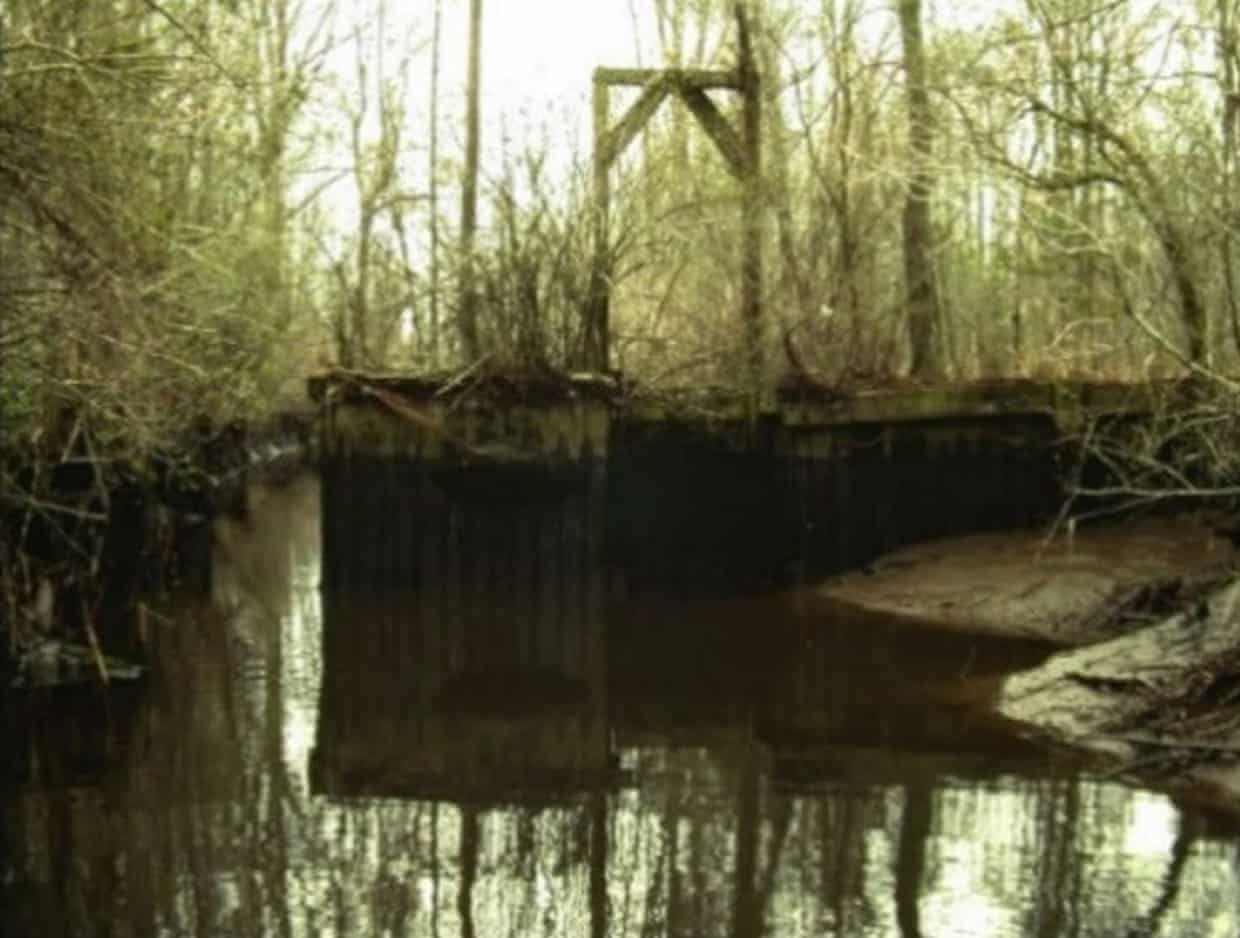
A rice gate, seen here in 1986. At Eagles Island, North Carolina, in the late 1700s, the enslaved Gullah Geechee people began creating ingenious rice fields. 

If the people described in this archaeological report used brilliant rice-growing techniques while enslaved, imagine what they might have done if they had been free! But, alas, slavery destroys lives of the enslaved and their descendants for generations, as Pat Conroy documented in The Water is Wide, his memoir about teaching.

In an in-depth article at the Guardian, Adria R Walker writes about recent archaeological discoveries concerning the Gullah Geechee people of the American South.

“As a former deputy state underwater archaeologist, Mark Wilde-Ramsing can’t help but look down. While rowing around North Carolina’s Eagles Island, at the tip of the Gullah Geechee corridor, he noticed signs of human-made structures, visible at low tide. Though he’d retired, he was still active in the field and knew his former agency hadn’t recorded the structures – which meant he had come across something previously undocumented. …

“Wilde-Ramsing knew the area had once been full of rice fields. His neighbor, Joni ‘Osku’ Backstrom, was an assistant professor in the department of environmental sciences at the University of North Carolina-Wilmington whose specialty was shallow-water sonar, and he had the skills and technology to explore the area. Using a sonar device, the duo detected 45 wooden structures in the river, and the remote sensing tool allowed Backstrom and Wilde-Ramsing to acoustically map the canal beds. …

“Spanning 2,000 acres (809 hectares) of the northern end of Eagles Island, the 45 irrigation devices were developed by enslaved people, who would later come to be known as the Gullah Geechee. The devices were used to control water flow for the rice fields in conjunction with earthen dams and levees, Wilde-Ramsing said.

Their existence provides further evidence of the engineering and technological skills that Gullah Geechee people used for rice cultivation, beginning in the late 1700s at the latest.

“Backstrom and Wilde-Ramsing documented their findings in a study published earlier [in 2024]. ‘The use of the island for this endeavor prior to the Civil War, in large part rested on the shoulders of transplanted and enslaved Africans and their descendant Gullah Geechee tradition,’ the study reads.

“The team’s discoveries, which came after two years of research in and around Eagles Island, have helped further shed light on the ingenious, skilled work of the Gullah Geechee people. Though Gullah Geechee people have been studied for centuries, Backstrom and Wilde-Ramsing’s research is the first to focus on their irrigation systems. The research couldn’t come soon enough: Eagles Island is environmentally vulnerable, both because of climate change and ongoing development. The duo registered their sites with the state, making development more difficult as a means to ensure the protection of cultural artifacts.

“ ‘The whole area was originally swamp. It was cleared mostly in the post-colonial, early 1800s period for tidal rice cultivation because that area was freshwater,’ Wilde-Ramsing said. ‘They were able to actually use, regulate, introduce the water and drain it with the tides.’ …

“The work the Gullah Geechee people did would have been exhaustive. Wilde-Ramsing says it required removing the cypress forests, then building dams and levees. Growing rice necessitated the use of water, so they created long wooden boxes, or ‘trunks,’ with gates on either side, that allowed them to let the water in by opening the gates. …

“The enslaved populations throughout the Gullah Geechee corridor – which spans the coasts of North Carolina to upper Florida – were isolated in such a way that they developed and maintained a culture different from that of most plantations.

“ ‘[They were] from coastal regions of west Africa, an area that had similar environs to those along the southern Atlantic seaboard centering on Georgia and the Carolinas, where rice agriculture was a mainstay of the economy,’ the study reads. …

” ‘I didn’t quite realize the role that rice played. It rivaled cotton during the 1840s and 50s,’ Backstrom said. ‘It was all over Europe and the US and it was all run by African Americans. A lot of it was developed based on their skills. I’m just happy that it’s coming to light and they’re getting their – I won’t say new – but recognition that this was an amazing thing, amazing work.’

“Even though Wilde-Ramsing and Backstrom’s discovery likely won’t permanently stop either development or climate change, not least because the island is owned by multiple private entities, the existence of historic, cultural artifacts can ensure that the Gullah Geechee structures are at least documented instead of simply being razed and forgotten.

“The researchers have been in communication with East Carolina University’s maritime program, and the school plans to send a contingent to the site to study some of the characteristic types. People from the school will be able to work on noting the various structures, trying to figure out how they operated and taking samples. Backstrom said that they’ve also been in contact with researchers at George Mason University in Fairfax county, Virginia, including a professor who had ancestors [from the area].

“In terms of further discovery, a mix of approaches best suits the complicated terrain. ‘We’re thinking about using drone imagery,’ Backstrom said. ‘We have some preliminary drone footage, which gives us access to these areas at dead low tide, areas that we had a lot of difficulty with, even with a very small vessel.’ The area is remote, full of tight nooks and crannies. It’s ‘particularly challenging because of the tides and the timing,’ he said. The different combinations of drone imagery and sonar mean the researchers aren’t limited by turbidity in the water.

“Backstrom hopes to go to west Africa, specifically to Senegal or the Senegambia region, where many Gullah Geechee people were from, to learn about the history of rice farming, including the roles women and children played. Children, for instance, tasted the water to ensure too much saltwater wasn’t being let in, and women helped in the actual cultivation of the rice, using skills from their home countries that were passed down throughout generations.”

More at the Guardian, here. No firewall. Donations help save reliable news.

Read Full Post »

Photo: David L. Ryan/Globe Staff.
Maya Lin’s landscape artwork in Kendall Square in Cambridge. It’s an “undulating wave field” in front of the Volpe Transportation building on Binney Street.

For most of us, sculptor Mia Lin first came to our attention when she was chosen to create the Vietnam war memorial in Washington, DC. The solemn listing of the names of the dead on black granite was a brilliant idea, endlessly moving.

Until now Lin had never created landscape art in Massachusetts, so people were surprised to learn that in fact she had had an impressive earthwork in busy Cambridge since 2023.

Scott Kirsner writes at the Boston Globe, “What if someone spent $1.3 million on a work of art, installed it in one of the busiest parts of Cambridge, and forgot to tell anyone?

“That’s effectively what happened with a piece called ‘The Sound We Travel At,’ by the New York City artist Maya Lin. She is best known for works like the Vietnam Veterans Memorial in Washington, D.C., and the Civil Rights Memorial in Montgomery, Ala. …

“But she also makes works of landscape art … and that’s what was created in Kendall in 2023. You can find it on Binney Street as you head toward Boston, to the left of a new 13-story building that houses the Volpe National Transportation Systems Center, a research center run by the US Department of Transportation. Sandwiched between a row of trees and lampposts is a series of 11 grass-covered, wave-like mounds of earth.

“Apropos of the Volpe Center’s work … the artwork outside is a physical representation of the Doppler effect. You know: the phenomenon of a sound, like a train’s horn, changing in pitch as it races past you. Some of the rippling mounds in Lin’s work represent sound waves that are approaching the viewer, and some of them represent sound waves that are receding from the viewer. Visitors are invited to walk atop, or even sit on, the work.

“There’s so much construction work in Kendall Square right now that I only noticed the artwork in November 2023, when I was visiting the Volpe Center to write a piece. … A year later, I noticed that there’s still no sign, and it doesn’t appear on the website of either the Volpe Center or the Maya Lin Studio. I couldn’t find a single museum curator or former curator in town who knew about it. …

“The artwork is part of a 14-acre site that MIT’s real estate management arm acquired from the federal government in 2017, and is redeveloping to include housing, retail, office space, parks, and a new community center. Part of that deal involved MIT building a newer home for the Volpe Center, and any time a new federal building goes up, half of one percent of the building’s cost goes to art. (That’s even true when MIT is footing the construction bill, as it was in this case.)

“Paul Ha, the director of MIT’s List Visual Arts Center, helped make the connection to Lin for the project. He was one of the few people in the local art world I could find that was aware of its existence. Ha had worked with Lin on a major exhibit when he was running the Contemporary Art Museum in St. Louis. …

“Aprile Gallant of the Smith College Museum of Art says, ‘I do believe this is Lin’s first landscape piece in Massachusetts, so it is a milestone.’ That museum hosted a major exhibit of Lin’s works in 2022, when a library that she’d designed opened on campus. …

“Did ‘The Sound We Travel At’ fall through the cracks, in a neighborhood peppered with cranes and construction fencing, and tech and biotech workers who go from garages to offices perhaps two or three days a week?

“ ‘We felt that way,’ says James Ewart, manager of the Maya Lin Studio.

“But according to the government’s General Services Administration, by the time spring rolls around, a sign will finally be installed next to the artwork.”

More on the Maya Lin project at the Globe, here.

Read Full Post »

Photo: Kyle Mellott via Heather Divoky.
Catastrophic flooding swallowed up buildings of Asheville’s River Arts District. Despite ongoing floods and fires in the US, government disaster relief is facing big cuts.

My childhood friend Ursula, an artist in Asheville, North Carolina, lost much of her own and her late father’s artwork to Hurricane Helene last year. As I consider the Hyperallergic article below, I can’t help thinking that in addition to individuals who helped victims (like blogger Deb), government disaster relief (like FEMA, now on the chopping block), was indispensable.

Rhea Nayyar wrote, “Southeastern states are reeling from catastrophic loss and damages after Hurricane Helene tore a deadly path of devastation from Florida’s Big Bend region up through inland Georgia, the Carolinas, and Tennessee. In the mountains of western North Carolina, the city of Asheville was particularly hard hit by flooding … obliterating the cherished River Arts District (RAD) — a creative hub home to studios, galleries, community spaces, and other artist-run small businesses.

“ ‘Two-thirds of the district has been destroyed,’ said Jeffrey Burroughs, president of the River Arts District Artists Association, in an interview with Hyperallergic. Hosting over 350 local artists and craftspeople, the RAD complex comprises 27 buildings that span just over a mile of the eastern riverside. The southernmost string of buildings along Foundy Street, including the enormous Marquee warehouse which was once a bustling marketplace for artisans and antique dealers, are ‘gone,’ according to Burroughs. …

“ ‘Marquee is rubble, the nearby winery has washed away … It’s completely apocalyptic,’ Burroughs said. He recalled overseeing artwork, art supplies, and cans of beer being carried off by the [water] itself, saying that it was like ‘watching the spirit of Asheville being washed away.’

“A little further north at Pink Dog Creative on Depot Street, Asheville artist Heather Divoky, a marketing co-chair for RAD, told Hyperallergic … ‘This will absolutely reshape RAD — we’re going to be forever changed,’ Divoky said. ‘We’re all in complete shock right now. I don’t know how many of us can come back.’

“Down the street, Trackside Studios reported that flood waters reached the ceiling of the first floor where about 40 of the 60 studio artists maintain their practice. Co-owners Julie Bell and Michael Campbell were out of state during the storm, and have since become a communications switchboard as they have reliable internet access and power. Bell noted to Hyperallergic that Trackside Studios had recently completed a months-long renovation prior to the storm to restore the building’s historic appearance. …

“ ‘It’s so dangerous to clean up after these types of disasters because the mud is full of debris, mold spores, sharp objects, and dead fish. It’s neither safe nor sanitary,’ she said. …

“Miles east of RAD, artist, tax expert, and Hyperallergic contributor Hannah Cole reported that her studio along the Swannanoa River tributary had been entirely upheaved by floodwaters.

“ ‘The building is totaled,’ Cole told Hyperallergic, noting that 20 years worth of artwork and supplies were ‘effectively put in a blender for hours’ in a mixture of water, mud, heavy furniture and tools, and other debris carried in by the river.

“ ‘Some level of flooding is normal during big storms, but this has never happened before,’ Cole continued, adding that when she paid a risky visit to the studios after Helene, the water lines were up to the ceiling.

“Ruby Lopez Harper, executive director of the Craft Emergency Relief Fund (CERF+), which imparts safeguarding advice for natural disasters and offers emergency relief and preparedness grants to artists across the United States, told Hyperallergic that ‘recovery is going to take years.’

“ ‘We tell artists to store their things in waterproof bins and other such protective measures … None of that is going to help when your home is underwater,’ she said, explaining that no one had predicted this. …

“But on the ground, both Burroughs and Cole expressed that it’s impossible to even think so far ahead while they and their loved ones are still focused on securing potable water. However, Burroughs and the other RAD board members are conceptualizing an action plan to get stipends for artist relief, recovery funds for RAD, and a clean-up effort to remove the dangers and debris onsite.

“ ‘My husband and I moved here in 2020 after I was suffering from long COVID,’ Burroughs said. ‘There is nothing like this area, this community, anywhere else in the country. We will come back stronger.’ ”

More at Hyperallergic, here.

Read Full Post »

Photo: Shefali Rafiq.
Students celebrate a classmate’s birthday at an informal school, or
pathshala, set up by police officer Than Singh (center), in a Delhi, India.

Today’s story is about one compassionate person in India who wanted to make a difference in children’s lives. Shefali Rafiq and Saqib Mugloo wrote the photo essay for the Christian Science Monitor.

“It wasn’t until Than Singh came along that learning became a favorite pastime for the children who typically roam Delhi’s streets begging, rifling through garbage, or engaging in petty crimes.

“In 2015, the Delhi police officer started a pathshala, or place of learning, where he teaches 80 students a day in a temple set up near the Red Fort. ‘It was heartbreaking to see children scavenging for plastic bottles in the trash,’ he recalls. ‘That’s when I decided to do something.’

“More than half of India’s children are malnourished, and about 30% of those ages 6 to 18 do not attend school. Mr. Singh, who grew up poor in northwestern Rajasthan state, is determined to change these statistics. ‘My dream is to see every underprivileged child in school,’ he says with a broad, charming smile, adding that he is confident that, with God’s help, he will make it happen.

“He starts his day early, patrolling the busy lanes of Old Delhi, the capital’s historic heart, as part of his duties. But every day after work, he holds classes at his pathshala, where students eagerly await him. Among them are Ajay Ahirwar and Neelu Ahirwar (no relation).

“Ajay says he aspires to become a high-ranking officer in the government so that he can improve the conditions of his family and those living like him. Neelu is fond of her teacher and the pathshala. ‘I would rather be here, even on holidays, than at home,’ says the young girl, who aspires to become an officer in the Indian Police Service.

“Initially, only four children attended Mr. Singh’s pathshala. He contributed money from his salary to buy books, notebooks, pencils, and schoolbags. Nine years down the line, he has now taught hundreds of children.

“ ‘Beyond basic lessons, I try to instill manners and discipline in these students,’ Mr. Singh says. ‘Even if they come to this school just for a meal, I’ll be happy because, seeing others, they may also want to study.’

“Mr. Singh organizes extracurricular activities, too, including cricket. For those children who do attend school in the city, he celebrates good exam results at his pathshala. ‘I just want these children to stay away from all the bad influences they’re vulnerable to,’ he says, referring to the crimes that affect Delhi.

“ ‘Our aim in the world is to spread goodness and happiness.’ ”

More at the Monitor, here. Wonderful photos. No firewall.

Read Full Post »

Photo: Samuel Bloch.
Saimaa ringed seals are very sensitive to disturbance, and it is forbidden to deliberately approach them without a permit.

I once wrote here about one of John’s a Ukrainian employees who told me that in Soviet days it was dangerous to read certain books. People read The Master and Margarita, for example, under the library table with a flashlight if no one was around.

I don’t think we are there yet, but I do have a sense that a whole segment of our society will be living an alternate life and trying not to draw attention. That might include people who care about wildlife and global warming, like the Finns in today’s story.

Phoebe Weston writes at the Guardian, “Eight hours shoveling snow in -20C [-4 F] might not sound like the ideal day out, but a committed team of volunteers in Finland are working dawn to dusk building enormous snow drifts for one of the world’s most endangered seals.

“The Saimaa ringed seal was once common around Lake Saimaa in the south-east of the country, but only 495 of them remain.

“The seals make ‘snow caves’ inside snow drifts where they raise their young and protect them from the elements and predators such as red foxes – but as the climate warms, the snow is disappearing. To save these rare seals, 300 volunteers spend days shoveling snow into piles [23 feet long] around the edge of the frozen lake. Last winter they made 200, and the seal population is growing as a result. …

Volunteers meet at first light and work until dusk. [Vincent Biard, a PhD student and volunteer from the University of Eastern Finland] describes the day as ‘kind of fun,’ and adds, ‘you actually have an impact, which is nice. If we don’t do it, then they would just go extinct quite quickly.’ …

“Saimaa seals are less than 1.5 metres long and each one has a unique fur pattern – individual to each animal, like human fingerprints. In the late 1980s their population dwindled to its lowest point, with fewer than 200 left, driven by hunting and deaths caused by fish traps. Accidental deaths in fishing nets remain a challenge.

“Now, the seals are fully protected but the threat of the climate emergency looms large. Between 1925 and 2002, the maximum thickness of the ice decreased by 1.5cm [~i/2 inch] a decade. In mild winters the ice caves can collapse, leaving the pups exposed, with up to 30% of them dying.

“Human-made snow drifts are larger and ‘more durable than natural snow drifts,’ says [Jari Ilmonen, coordinator of Our Saimaa Seal Life, which is an EU-funded program]. …

In the future, ice cover is expected to disappear before the pupping season has ended.

“There have already been some winters where there has not been enough snow to create an artificial drift. In some cases the seals have been known to breed elsewhere, but with no snow ‘just a few would hang on,’ says Ilmonen.

“However, scientists from the University of Eastern Finland are working on plan B. They are creating artificial dens, or nest boxes, that mimic the real thing, with preliminary research showing the seals use them for resting, giving birth and nursing their young. The nest boxes could be used in ice-free winters, researchers say. …

“There are about 40 dens on the lake, where three pups have already been born, but Ilmonen wants to get more out there. ‘If you think that there are maybe 500 seals and maybe 100 pups born each year, you’d need a lot of the boxes,’ he says.

Find more of the Guardian’s age of extinction coverage here, and follow the biodiversity reporters Phoebe Weston and Patrick Greenfield in the Guardian app for more nature coverage.

More at the Guardian, here. No firewall, but voluntary subscriptions support responsible news.

Read Full Post »

Photo: Mark Viales/Al Jazeera.
Luis May Ku, 49, poses with his hands painted in Maya blue outside his home in Dzan, Yucatan, Mexico, on September 9, 2024.

Today’s article is about how the preparation of an ancient paint color was lost to history — and about how a contemporary Mayan’s persistence brought it back.

Mark Viales has the story at Al Jazeera.

“Surrounded by dense jungle and beneath intertwining canopies of towering trees, Luis May Ku, 49, trudges ahead through shoulder-height bushes searching for a rare plant. The oppressive 40-degree Celsius (104 Fahrenheit) heat dulls the senses, and the air, thick with humidity, clings to our skin, causing beads of sweat to form and trickle down.

“After scouring the thickets, May, an Indigenous Maya ceramicist, stumbles upon a shrub similar in shape and texture to others around him, but insists this one is special. He touches the soft, sprawling leaves and tells me it is wild ch’oj (‘indigo plant’ in Mayan, anil in Spanish) – or Indigofera suffruticosa – which is a key ingredient to create the revered Maya blue pigment.

“ ‘It took years before I found it – indigo – and most people from Yucatan believed it to be extinct on the peninsula,’ May says with a pensive look, lifting his sombrero made from interwoven huano palm leaves to wipe his brow with the back of his hand. …

“ ‘The Yucatan Peninsula is going through its worst drought in decades,’ he says. ‘Let’s rest, and I’ll tell you how I recreated Maya blue.’ …

“The bright azure color can still be seen among the ruins at the world-famous archaeological site of Chichen Itza in Yucatan on murals more than 800 years old.

“Only a handful of blue pigments, such as lapis lazuli or Egyptian blue, were created by ancient civilizations. Still, these were predominantly dyes or minerals, while Maya blue required a chemical combination of organic and inorganic substances. Before synthetic versions of blue pigment arrived during the Industrial Revolution, the color was exceedingly rare and often more expensive than gold in Europe. The semiprecious lapis lazuli stone originated in the mountains of Afghanistan and was only accessible to the wealthy. Yet, in the New World, blue pigment was plentiful and thrived.

“When the Spanish arrived in the 15th century, they exploited Maya blue, along with all the treasures they stole from Mesoamerican civilizations. The Spanish controlled the prized colorant until the late 17th to early 18th centuries when synthetic substitutes began to arrive. Common knowledge of Maya blue then disappeared until its rediscovery in the 20th century.

“In 1931, American archaeologist H.E. Merwin first found ‘a new pigment’ on murals within the Temple of The Warriors at Chichen Itza. It was given the name ‘Maya blue’ a few years later (1942) by American archaeologists R.J. Gettens and G.L. Stout. Research paused during World War II, and it was not until the 1950s that powder diffraction analysis revealed the Maya blue pigment had been made by mixing clay, palygorskite (a rare fibrous clay) and indigo. In 1993, Mexican historian and chemist Constantino Reyes-Valerio published a recipe to recreate the color using palygorskite, montmorillonite (a soft clay) and indigo leaves.

“Modern-day scientists value the mysterious paint because its unique resilience to the elements has kept it in near-perfect condition on pre-Columbian murals, artifacts and codices, even a millennium later. …

“It took scientists a long time to understand the formula, and studies are continuing. …

“May was born in Dzan, a village of 6,000 people in the western part of Yucatan about 100 kilometres (62 miles) south of the state capital city, Merida. Most of the peninsula is flat and pocketed with cenotes formed in the aftermath of the cataclysmic meteor that wiped out the dinosaurs. Yet in the municipality of Ticul, which includes Dzan, the land rises somewhat, giving way to the Puuc (‘hills’ in Maya) region, which has been inhabited since around the 7th century BC.

“Several important pre-Columbian Maya cities dot the area, such as the World Heritage Site of Uxmal, an ancient Mayan city with beautiful Puuc-style architecture. The buildings in the ruins have smooth, vertical walls with features such as columns, elaborate friezes, decorated masks and curved snakes, mostly representing the rain god, Chaak, and the feathered serpent deity, Kukulkan, respectively.

“The region remains famous today because of its high-quality pottery and clay sculptures, especially the town of Ticul, nicknamed ‘The Pearl of the South’ [3.1 miles] from Dzan. The area is also a source of palygorskite – found in caves – which some potters use to grind and mix with other clays to make pottery more durable. Here, May cut his teeth in ceramics as a student among some of the most renowned artisans in Mexico and eventually began his journey to recreate Maya blue.

“ ‘I dreamt of working as my ancestors did with clay and natural pigments,’ he says, tapping a finger on his temple. He reminds me that, like most people in his village, his mother tongue is Maya, and emphasizes that he is proud to work like his forefathers in creating Maya blue.

“May was 17 years old when he started sculpting wood while studying Maya Culture at the Autonomous University of Yucatan, taking inspiration from Maya architecture around his region. One of his passions was capturing faces with distinct Maya features. About 20 years later, he followed in the footsteps of ceramicists from Ticul and began sculpting with clay and learned from other ceramicists about adorning pottery with organic pigments such as red and white.

“However, he was also fascinated to learn that they also used synthetic pigments – like blue. On a visit to the Maya ruins in Bonampak, Chiapas, he was captivated by murals painted with a beautiful turquoise colour. May discovered that the sky-blue pigment was held sacred by his ancestors and used during rituals. After questioning his colleagues further, he learned that the knowledge needed to create this color in its traditional form had been lost in Yucatan, leading him towards a path of rediscovery of ancient techniques. …

“On January 9, 2023, May announced on social media that researchers in Italy and Mexico had validated his formula. It was the first time the world had seen Maya blue made with traditional methods in Yucatan for almost two centuries.

“David Buti, a researcher at the Institute of Heritage Science of the National Research Council in Perugia, Italy, and Rodolfo Palomino Merino, a professor of physics and mathematics at the Autonomous University of Puebla, Mexico, sent him PDFs with scientific breakdowns of their analyses. Merino’s work came through first in August 2022, with a 95 percent probability that May’s formula was genuine. In 2023, Buti’s analysis verified that it was 100 percent Maya blue. Both academic institutions confirmed that his samples, which contained palygorskite, calcium carbonate and indigo, caused an ‘intercalation between the indigo molecules’ – a chemical reaction – resulting in an authentic Maya blue.

“ ‘I was ecstatic,’ May says. ‘My ancestors used Maya blue exclusively in ceremonial practices, and even then, it was in limited supply. It was the color of the gods, and only the elite were permitted to use it.’

“ ‘As a child, my father and grandfather taught me that consistent hard work pays off. Never giving up and trying your best, even if you do not succeed, are typical Mayan values.’ “

Lots more at Al Jazeera, here. No firewall.

Read Full Post »

Photo: Jackie Molloy for KFF Health News.
Hilda Jaffe, 102, in her apartment in New York. Jaffe enjoys doing puzzles, reading, volunteering, and attending cultural events.

I have always thought that a city like New York, with many kinds of public transportation and easy walking to whatever you need, is the best kind of place to grow old. The problem for most of us is that we may still need a car to do the simplest things long after we can’t drive.

Here’s a story about a thriving 102-year-old doing her errands without assistance in New York. I’m convinced that part of her good fortune is not having to drive.

Judith Graham writes at the Washington Post, ” ‘The future is here,’ the email announced. Hilda Jaffe, then 88, was letting her children know that she planned to sell the family home in Verona, New Jersey. She’d decided to begin life anew on her own in a one-bedroom apartment in Hell’s Kitchen in Manhattan.

“Fourteen years later, Jaffe, now 102, still lives alone — just a few blocks from the frenetic lights and crowds that course through Times Square.

“She’s the rarest of seniors: a centenarian who is as sharp as a tack, who carries grocery bags in each hand when she walks back from her local market, and who takes city buses to see her physicians or attend a matinee at the Metropolitan Opera.

“Jaffe is an extraordinary example of an older adult living by herself and thriving. She cleans her own house, does her own laundry, manages her own finances, and stays in touch with a far-flung network of family and friends via email, WhatsApp and Zoom. Her 78-year-old son lives in San Jose. Her 75-year-old daughter lives in Tel Aviv.

“I’ve spoken with dozens of seniors this past year for a series of columns on older Americans living alone. Many struggle with health issues. Many are isolated and vulnerable. But a noteworthy slice of this growing group of seniors maintains a high degree of well-being. …

“Sofiya Milman is the director of human longevity studies at the Institute for Aging Research at Albert Einstein College of Medicine. She studies people known as ‘superagers’ age 95 and older. ‘As a group, they have a very positive outlook on life’ and are notably resilient, like Jaffe, she told me.

“Qualities associated with resilience in older adults include optimism, hopefulness, an ability to adapt to changing circumstances, meaningful relationships, community connections and physical activity, according to a growing body of research on this topic.

“Jaffe has those qualities in spades, along with a ‘can-do’ attitude. ‘I never expected to be 102. I’m as surprised as everybody else that I am here.’ …

“She credits her genetic heritage, luck and her commitment to ‘keep moving,’ in that order. … Asked to describe herself, she quickly responded with ‘pragmatic.’ That means having a clear-eyed view of what she can and can’t do and making adjustments as necessary.

“Living alone suits her, she added, because she likes being independent and doing things her way. ‘If a problem comes up, I work it out,’ Jaffe said. …

“There are only some 101,000 centenarians in the United States, according to the most recent Census Bureau data. Of this small group, 15 percent live independently or conduct their lives independently while living with someone, according to Thomas Perls, the founder and director of the New England Centenarian Study, the largest study of centenarians in the world. …

“About 20 percent of centenarians are, like Jaffe, free of physical or cognitive impairments, Perls said. An additional 15 percent have no age-related illnesses, such as arthritis or heart disease. …

“Every day, Jaffe tries to walk 3,000 steps — outside if the weather is good, or inside, making laps in her hallway, if the weather is bad. Her diet is simple: bread, cheese and decaffeinated coffee for breakfast; a sandwich or eggs for lunch; often chicken and a vegetable or restaurant leftovers for dinner. She never smoked, doesn’t drink alcohol and sleeps an average of eight hours each night.

“Even more important, Jaffe remains engaged with other people. She has subscriptions to the Metropolitan Opera, the New York Philharmonic and a chamber music series. She participates in online events and regularly sees new exhibits at four of New York’s premier museums, where she has memberships. She’s in regular contact with family members and friends.

“Jaffe also belongs to a book club at her synagogue on Manhattan’s Upper West Side and serves on the synagogue’s adult education committee. For more than a decade, she has volunteered several times a week as a docent at the New York Public Library’s main branch on Fifth Avenue. …

“When I asked about the future, Jaffe said she doesn’t worry about what comes next. She just lives day to day.

“That change in perspective is common in later life. ‘Focusing on the present and experiencing the here and now becomes more important to older adults,’ said Laura Carstensen, founding director of the Stanford Center on Longevity, who has studied emotional changes that accompany aging for decades. …

“Jaffe certainly understands the value of facing forward and letting go of the past. Losing her husband, Gerald Jaffe, in 2005 after 63 years of marriage was hard, she admitted, but relinquishing her life and most of her belongings in New Jersey five years later was easy. …

“ ‘It was so exciting for me, being in New York,’ she continued. ‘Every day you could do something — or nothing. … In a house in New Jersey, I would be isolated. Here, I look out the window and I see people.’ ”

More at the Post, here.

Read Full Post »

Photo: Odelyn Joseph/AP.
A woman runs to take cover from gunfire during clashes between police and gangs in Port-au-Prince, a city where a theater company perseveres.

There’s something about theater people and defiance. Something that keeps them from giving in to the ways things are when things are bad. I’ve blogged here about the anti-government theater of Belarus and here about Ukrainians offering theater in the subway, away from Russian bombs.

In today’s post, Tom Phillips and Etienne Côté-Paluck report at the Guardian about Haiti.

“In a dimly lit rehearsal room in a city under attack, Jenny Cadet raised an imaginary pistol and fired a single make-believe bullet at her director.

“ ‘Life is a theatre. I am a theatre. We are a theatre. The world is a theatre,’ proclaimed the 31-year-old Haitian actor, turning to the audience as she uttered the tragicomedy’s final lines.

“Moments later, real-life shots rang out outside the stage school in Port-au-Prince – the latest act of violence in an increasingly terrifying drama that has forced tens of thousands of people to flee their homes here in the past fortnight alone.

“ ‘Every day [there’s shooting],’ sighed the play’s director, Eliezer Guérismé, as his company took a break from their read-through to the all-too familiar sound of gunfire. ‘But even with the shooting, we keep on working because that’s our mission. We don’t want to stop.’

As gangs tighten their grip over a city now almost entirely outside of government control, Guérismé, 39, said he saw drama as a key way of interrogating and denouncing the social and political crisis. …

“Theatre was also ‘an act of rebellion and resistance’ and a way of fostering renewal, given the politically charged violence into which Port-au-Prince has been plunged since the 2021 assassination of Haiti’s president Jovenel Moïse.

“ ‘People need to see the reality that they are living up on stage … theatre is the mirror of society … Everything we hear in this city – the sound of the bullets that are very, very present – we try to put on stage,’ the director said. …

“Nearly 4,000 people have been killed since the start of the year, according to the UN, as rifle-carrying gang fighters have advanced across the capital, opening fire on government buildings and burning homes.

“A US-backed policing mission has so far failed to restore order and in recent days the violence has intensified further with gangsters even attacking Pétion-Ville, one of the last supposedly safe enclaves in the hills over Port-au-Prince. … Foreign diplomats and aid workers are fleeing by helicopter amid calls for a UN peacekeeping mission to be deployed.

“ ‘It feels like the end of Port-au-Prince,’ Guérismé admitted this week. “Every day people are leaving their neighborhoods.’

“The Haitian director recognized that continuing to rehearse his latest production was a perilous business in a city where residents’ movements grow more restricted by the day.

“One of his troupe’s actors commutes to the drama school each day from Carrefour, a gang-run area to the city’s south which is effectively off-limits to outsiders. ‘I know he’s taking a risk to come. He’s taking a huge risk… Living in Port-au-Prince today requires a superhuman effort,’ Guérismé said. …

“But Guérismé was determined to fight on. … ‘It’s my country. It’s my homeland. It’s my city’ … and I have responsibilities,’ the director said as his group prepared for Port-au-Prince’s annual ‘En Lisant’ theatre and performing arts event. ….

“Philippe Violanti, the French dramatist who wrote Guérismé’s latest tragicomic play, had planned to fly to Port-au-Prince to see his work staged for the first time. But Violanti was forced to cancel after flights into the capital were suspended because three US aircraft were hit by gunfire while taking off or landing.

“Six of the seven foreign artists invited to the festival – from Guadalupe, French Guiana, France, Belgium and the US – have pulled out. Performances for primary and secondary school children have been dropped from the program. Some rehearsals are being held online.

“Guérismé said the mood was grim, but he believed it was essential Haiti’s acting community did not throw in the towel.

“ ‘The festival will not be postponed. We will go ahead,’ he vowed. ‘This is the time to make a gesture of hope – to affirm that life is here.’ ”

More at the Guardian, here.

Read Full Post »

Photo: Melanie Stetson Freeman/CSM.
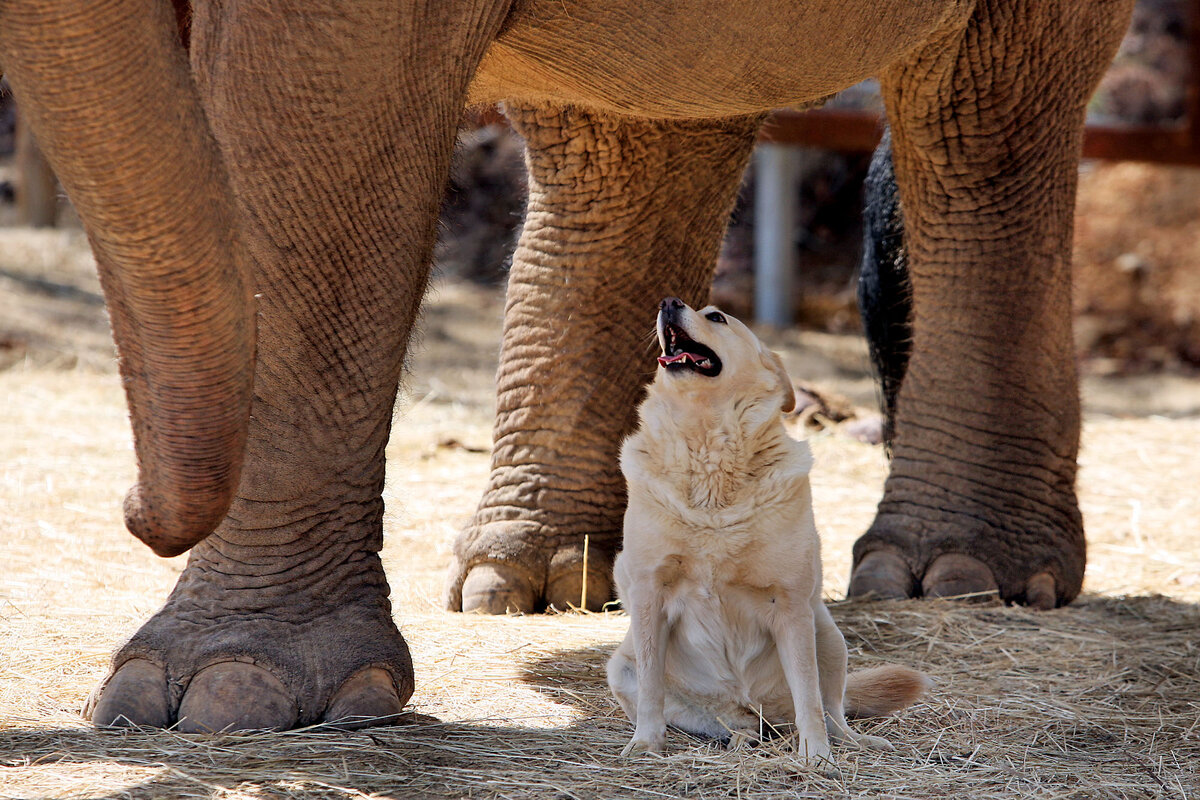
The friendship between Bella, a stray dog, and Tarra, a resident of the Elephant Sanctuary in Tennessee, exemplifies feelings that are not unusual in the animal kingdom.

If you have ever heard Sy Montgomery on Boston Public Radio or read any of her wonderful books about animals, you will know that there is at least one scientist who believes critters have feelings. (FYI: with the exception of the Bobbitt worm, Sy Montgomery loves them all.)

Other scientists also have noticed that animals have feelings. At the Christian Science Monitor, Stephanie Hanes reports on research showing that many “animals exhibit signs of experiencing emotions and being self-aware.”

“This past April,” she writes, “a group of biologists and philosophers unveiled the New York Declaration on Animal Consciousness at a conference at New York University in Manhattan. The statement declared that there is ‘strong scientific support for attributions of conscious experience to other mammals and to birds.’ It also said that empirical evidence points to ‘at least a realistic possibility of conscious experience’ in all vertebrates and many invertebrates, including crustaceans and insects. 

“Researchers have found myriads of indications of perception, emotion, and self-awareness in animals. The bumblebee plays. Cuttlefish remember how they experienced past events. Crows can be trained to report what they see. 

“Given these findings, many believe there should be a fundamental shift in the way that humans interact with other species. Rather than people assuming that animals lack consciousness until evidence proves otherwise, researchers say, isn’t it far more ethical to make decisions with the assumption that they are sentient beings with feelings?

“ ‘All of these animals have a realistic chance of being conscious, so we should aspire to treat them compassionately,’ says Jeff Sebo, director of the Center for Mind, Ethics, and Policy at New York University. ‘But you can accept that much and then disagree about how to flesh that out and how to translate it into policies.’

“Sasha Prasad-Shreckengast is trying to get into the mind of a chicken. This is not the easiest of feats, even here at Farm Sanctuary in Watkins Glen, a scenic hamlet in the rolling Finger Lakes region of upstate New York. For decades the sanctuary has housed, and observed the behavior of, farm animals – like the laying hens Ms. Prasad-Shreckengast is hoping to tempt into her study.

“Chickens, it turns out, have moods. Some might be eager and willing to waddle into a puzzle box to demonstrate innovative problem-solving abilities. But other chickens might just not feel like it.

“Ms. Prasad-Shreckengast also knows from her research, published this fall in the Journal of Applied Animal Welfare Science, that some chickens are just more optimistic than others – although pessimistic birds seem to become more upbeat the more they learn tasks.

“ ‘We just really want to know what chickens are capable of and what chickens are motivated by when they are outside of an industrial setting,’ Ms. Prasad-Shreckengast says. ‘They have a lot more agency and autonomy.’ …

“In other words, how do chickens really think? And how do they feel? And, to get big picture about it, what does all of that say about chicken consciousness?

“In some ways, these are questions that are impossible to answer. There is no way for humans, with their own specific ways of perceiving and being in the world, to fully understand the perspective of a chicken – a dinosaur descendant that can see ultraviolet light and has a 300-degree field of vision.

“Yet increasingly, scientists like Ms. Prasad-Shreckengast are trying to find answers. What they are discovering, whether in farm animals, bumblebees, dogs, or octopuses, is a complexity beyond anything acknowledged in the past. …

“Researchers have found myriads of indications of perception, emotion, and self-awareness in animals. The bumblebee plays. Cuttlefish remember how they experienced past events. Crows can be trained to report what they see. …

“Ms. Prasad-Shreckengast’s study takes place in the wide hallway of Farm Sanctuary’s breezy chicken house. Unlike in pretty much any other chicken facility, the birds here come and go as they please from spacious pens.

“Following up on her previous research, she has designed a challenge that she hopes will appeal to most of her moody chickens. It is a ground-level puzzle box, with a push option, a pull option, and a swipe option. Birds are rewarded with a blueberry when they solve a challenge. …

“The idea of consent – which is a basic, foundational principle in the study of human behavior – is also a hallmark of animal studies here at Farm Sanctuary. To the uninitiated, this might sound absurd, with images of chickens signing above the dotted line. But it is not actually all that rare. Studies of dogs, dolphins, and primates all depend on the animals agreeing, in their own way, to participate. …

“Spearheaded by Kristin Andrews, professor of philosophy and the research chair in animal minds at York University in Canada, the idea emerged from conversations she had with two colleagues, Jonathan Birch, a philosopher at the London School of Economics and Political Science, and Jeff Sebo, director of the Center for Mind, Ethics, and Policy at New York University. …

“ ‘People were dimly aware that new studies were identifying new evidence for consciousness – not only in birds, but also reptiles, amphibians, fishes, and then a lot of invertebrates, too,’ says Dr. Sebo. ‘But there was no central, authoritative place people could look for evidence that the views of mainstream scientists were shifting.’ …

“For instance, trees communicate, and fungal networks send messages throughout a forest. Species such as sea turtles and bats use electromagnetic fields, a force we cannot even perceive, to guide their movements and migrations. Snakes see infrared light, birds and reindeer see ultraviolet light, and dolphins use sound waves to navigate underwater. …

“For generations, the dominant perspective has been that the human perspective is the best view in the house, with the most complex and complete picture of reality.

“But there hasn’t been a species studied over the past 20 years that hasn’t turned out to exhibit pain. There hasn’t been a species that hasn’t turned out to be more internally complicated than people expected, Dr. Andrews says. …

“ ‘That word, “consciousness,” is the problem,’ Dr. Andrews says. ‘The thing that everybody in the field agrees on is that consciousness refers to feeling – ability to feel things. … But then if you start asking people to give a real, concrete definition of consciousness, they’re not able to do it.’ …

“For the purposes of the declaration, researchers said, they focused on what is called ‘phenomenal consciousness.’ This is the idea that ‘There is something that it’s like to be a particular organism,’ explains Christopher Krupenye, professor of psychological and brain sciences at Johns Hopkins University. … Basically means that an animal experiences the world not as a machine, but as a being. Phenomenal consciousness is what you are experiencing right now in your body with the sight of words on a page as you read this article.”

There are numerous species described in the article at the Monitor, here. Don’t miss the playful bees.

No firewall. Subscriptions solicited.

Read Full Post »

Photo: Jacob Posner/Christian Science Monitor.
Felipe Polido, co-founder and head of technology at Reframe Systems, explains how the company uses robots and simplified processes in construction.

Innovations of the kind we continue to need in areas such as medicine, housing, and carbon reduction will probably rely more on entrepreneurs and businesses than on government for years to come.

I won’t be the one to begrudge any visionary a reasonable profit. In fact, the only thing that worries me about today’s story is the reduced need for human workers. See what you think.

Jacob Posner writes at the Christian Science Monitor about one company aiming to do so by benefiting others.

“A growing number of startups are trying to reinvent the U.S. homebuilding industry, with big goals of making it both more efficient and more climate-friendly. It is a disruption that many say is past due. The construction industry is not only struggling to meet housing needs but also is one of the country’s largest emitters of greenhouse gases. …

“Massachusetts-based Reframe Systems is among the new companies hoping to change one of the nation’s largest industries. Reframe is developing a ‘next generation’ modular construction method to build high-efficiency housing. Employees follow instructions on iPads to install plumbing and electrical components into robot-made walls, then transport these modules to construction sites, where they are stacked into multifloor units.

“But the challenges are myriad. Despite a huge influx of investor funding, the share of housing stock built through high-tech modular construction remains small. …

“[Recently a crowd] gathered to see a robot build a house. In a concrete-and-steel factory in Andover, Massachusetts, yellow-vested consultants, sustainable builders, and possible investors strain to see past a clear fence. Behind the barrier, a giant blue arm jutting from the floor comes to life.

“Its sensor-covered hand analyzes a pile of wood before emitting a loud hiss, then carefully suctions a two-by-four. Rotating at the shoulder and extending its elbow, the robot methodically delivers the plank to a partially completed wall.

“On the other side of the factory – about the size of a hangar for small planes – a few human workers are on their lunch break. They are employees of a three-year-old company called Reframe Systems, which is one of a growing number of startups across the United States scrambling to reinvent the homebuilding industry. …

“More than 100 startups have entered the industry in the past two decades, according to estimates by Tyler Pullen, a senior technical adviser at the Terner Center for Housing Innovation at the University of California Berkeley. He says there are likely more than 200 construction innovation companies currently doing business in the U.S.

“Like many of these, Reframe is focused on a new form of modular construction to upend one of the county’s largest industries. The company aims to create affordable, net-zero houses, which generate the same or more energy than they consume. Reframe CEO Vikas Enti says he can deliver a hefty return to investors – all while making a significant dent in the housing and climate crises. The next step, he says, is to build a factory that can produce 500 apartment units per year using lessons learned from his small, pilot factory in Andover. Then, he hopes to build a network of facilities across the country, varying their sizes to meet the demands and needs of their region. …

“So far, Reframe has completed one two-bedroom house. …

“The current model for modular construction – using assembly-line technologies to build homes – has its origin in the period after World War II. … But federal support for the movement dwindled, and in recent years, modular construction companies have mostly focused on the luxury housing market and sustainability-focused buyers. …

“The need for companies like Reframe is clear, modular boosters say.

“Energy consumed by residential buildings is responsible for around 15% of all U.S. emissions. Fossil fuels warm most of the country’s roughly 145 million apartment units and houses, in addition to keeping their stoves running and heating water. …

“Reframe was founded by roboticists who used to work at Amazon. Following instructions on iPads, its human employees insert plumbing and electrical wiring into the robot-made walls, turn them into ‘modules,’ and bring them to construction sites, where they are stacked into multifloor, highly energy-efficient homes. Because the iPad instructions are akin to a Lego or Ikea manual, Reframe can employ fewer high-cost, high-skill laborers.

“Having most of the needed professionals – electricians, plumbers, architects, engineers – under the same roof solves a problem of communication Mr. Pullen sees as endemic to the traditional construction industry. Every different professional involved must work together, but they are all ‘masters of their own kingdom,’ he says.

“While not all companies offer net-zero buildings like Reframe, Mr. Pullen says building in a factory setting lends itself to tighter structures that hold their temperature better. Plus, factory construction results in less waste. Companies know what they need to order for hundreds of projects at once; in traditional building, ad hoc orders require far more trucks and often leave behind excess material like piping and drywall.”

More at the Monitor, here. No paywall.

Read Full Post »

Photo: Andrea Lightfoot via Unsplash.

For Valentine’s Day this year I thought I would post about the love people have for pets. The article I found at Yale University’s human relations website is a little research-y, but it shows just how far back in history humans have felt that kind of love.

“The human love of pets is a powerful and global phenomenon. For many pet owners, their furry (or scaly) domestic companions transcend any simple categorization of non-human animal. Indeed, research shows that it is a growing global trend for pet owners to consider their animals to be full members of their families; to dote upon them as they would children or romantic partners, both emotionally and financially; and to thereby develop strong bonds of dependency, love, and support.

“Gray and Young (2011) conducted a broad cross-cultural study of human–pet dynamics around the world utilizing … a stratified random sample of 60 culturally, linguistically, and geographically diverse societies represented in eHRAF [Human Relations Area Files] World Cultures. Their study revealed that ‘dogs, birds, and cats were the most common pets, followed by horses, other hoofed mammals such as water buffalo, rodents, nonhuman primates, and pigs.’ … Attitudes and sentiments towards the domesticated animals vary, with many societies attaching spiritual meaning to their birds, cats, or dogs. …

“The emotional connection between pets and their owners is worthy of cross-cultural attention. For example, it has been discovered that dogs are able to read emotional cues from the faces of their owners and to respond accordingly. Other recent studies have shown that people tend to have more compassion for animals who are suffering than for adult humans in similar circumstances, treating the hurt dogs akin to helpless infants who need protection. Based on global data, researchers in this telling social experiment concluded that, by and large, subjects ‘did not view their dogs as animals, but rather as “fur babies” or family members alongside human children.’

“As to the origins of human-pet relationships, anthropologists suggest that our propensity for keeping pets, as well as our finely honed empathy for their emotional state, stems from the process of animal domestication in early human history, beginning with dogs and continuing to horses, sheep, goats, and others:

” ‘In each case, humans had to learn to put themselves in the minds of these creatures in order to get them to do our bidding. In this way our senses of empathy and understanding, both with animals and with members of own species, were enhanced. Our special relationship with animals is revealed today through our desire to have pets (McKie 2011).’ …

“Evidence of ancient burials from eHRAF Archaeology supports recognition of a longstanding bond between humans and animals far back into prehistory. For example, in ancient Egypt (5000-2000 BCE), Rice finds that, ‘amongst the graves at Helwan are examples of the burials of dogs and donkeys; as these do not seem to be the subject of cult or religious observance, it may be that they were family pets, since the Egyptians always kept animals about them, as members of their households’ (1990: 131). Similarly, on the other side of the world, the purposeful interment of animals in prehistoric settlements is known throughout the American Southwest and northern Mexico. According to Woosley and McIntyre, at the Wind Mountain site in New Mexico dating back to 2000-600 BP, the animals buried included dogs, bears, turkey, golden eagles, hawks, mourning doves, and scarlet macaws (1996: 281).

“Edmund Leach’s seminal work, Animal Categories and Verbal Abuse (1964), presents the human relationship to animals in terms of social distance. Attitudes towards different animals reflect our familiarity with them, so that the most familiar or ‘closest’ to ourselves are subject to ritual provisions or prohibitions because they are considered ‘taboo.’ They are also most worthy of human-like care and devotion. This is why people generally avoid eating the animals that they might also keep in their homes as pets. …

“The dynamic of intimacy in the human relationship to animals recurs in the ethnographic literature. The closeness of human-animal relationships is evident around the world with instances of beloved species being cared for as fondly and tenderly as human babies.”

Check out more at Yale’s Human Relations Area Files, here. No paywall.

Read Full Post »

Image: The Dial.

I read a lot of murder mysteries. They are not the only type of book I like, but I like the puzzles and sometimes even the writing. So I was drawn to today’s article on the emergence of an unlikely crew that has gotten involved in solving tough cases.

Julia Webster Ayuso wrote recently at the Dial about forensic linguists.

“On the evening of October 16, 1984, the body of four-year-old Grégory Villemin was pulled out of the Vologne river in Eastern France. The little boy had disappeared from the front garden of his home in Lépanges-sur-Vologne earlier that afternoon. His mother had searched desperately all over the small village, but nobody had seen him.

“It quickly became clear that his death wasn’t a tragic accident. The boy’s hands and feet had been tied with string, and the family had received several threatening letters and voicemails before he disappeared. The following day, another letter was sent to the boy’s father, Jean-Marie Villemin. ‘I hope you will die of grief, boss,’ it read in messy, joined-up handwriting. ‘Your money will not bring your son back. This is my revenge, you bastard.’

“It was the beginning of what would become France’s best-known unsolved murder case. The case has been reopened several times, and multiple suspects have been arrested. Grégory’s mother, Christine, was charged with the crime and briefly jailed but later acquitted. Jean-Marie also served prison time after he shot dead his cousin Bernard Laroche, who had emerged as a prime suspect. …

“More than three decades after Grégory’s murder, police brought in a team of Swiss linguists from a company called OrphAnalytics to examine the letters and their use of vocabulary, spelling and sentence structure. Their report, submitted in 2020, and part of which was leaked to the press, pointed to Grégory’s great-aunt, Jacqueline Jacob. The results echoed earlier handwriting and linguistic analysis that had led to Jacob and her husband’s arrest in 2017. (The couple was freed later that year over procedural issues.)

“While the new evidence has not yet been presented in court, some believe it could help to solve the case that has haunted an entire generation. It has also shone a spotlight on the little-known field of forensic linguistics. In France, the use of stylometry — the study of variations in literary styles — has largely been confined to academic circles. The Grégory case is the first time it has been applied in a major criminal investigation.

“The use of forensic linguistics in the case was initially treated with skepticism. … The general prosecutor at the Court of Appeal of Dijon, Philippe Astruc … cautioned: ‘To imagine that it will suddenly be settled with a single report is an illusion.’

“ ‘The press didn’t understand it, and the lawyers are saying it can’t work,’ Claude-Alain Roten, CEO of Orphanalytics, told me over the phone from his office in Vevey, a Swiss town on Lac Léman. But he assured me his results are reliable. ‘We came to similar conclusions to the conclusions they had already reached by other means,’ he said, adding that OrphAnalytics last year completed another report commissioned by the general prosecutor of Dijon, who oversees the Villemin investigation, analyzing an additional anonymous letter. ‘It gives us a very precise idea of who the person who wrote the letter is.’

“According to forensic linguists, we all use language in a uniquely identifiable way that can be as incriminating as a fingerprint. … The term ‘forensic linguistics’ was likely coined in the 1960s by Jan Svartvik, a Swedish linguist who re-examined the controversial case of Timothy John Evans, a Welshman who was wrongfully accused of murdering his wife and daughter and was convicted and hanged in 1950. Svartvik found that it was unlikely that Evans, who was illiterate, had written the most damning parts of his confession, which had been transcribed by police and likely tampered with. The real murderer was the Evans’ downstairs neighbor, who turned out to be a serial killer.

“Today, the field is perhaps still best known for its role in solving the ‘Unabomber’ case in the United States. Between 1978 and 1995, a mysterious figure sent letter bombs to academics, businessmen and random civilians, killing three people and injuring at least 24. The lone bomber was careful not to leave any fingerprints or DNA traces, evading the authorities for 17 years and triggering one of the longest and most expensive criminal investigations in U.S. history. But in 1995, he made a crucial mistake. He told the police he would pause his attacks on the condition that a newspaper publish his 35,000-word anti-technology manifesto.

“When the document appeared in the Washington Post, the New York Times and Penthouse magazine, several people — including the perpetrator’s brother— reached out to say they recognized the writing style. Meanwhile, FBI linguist James Fitzgerald and sociolinguist Roger Shuy, who had been studying the bomber’s letters, had identified patterns in his language that helped narrow the list of suspects: Spellings such as ‘wilfully for ‘willfully’ and ‘clew’ for ‘clue’ pointed to someone from the Chicago area, for example. Eventually, the linguistic evidence was strong enough to issue a search warrant for the home of a reclusive mathematician named Theodore Kaczynski, raised in Chicago but living in rural Montana, where investigators found copies of the manifesto and homemade bombs. …

“At OrphAnalytics, Roten, who has a PhD in microbiology, explains that algorithms identify patterns in syntax much like in a DNA sequence. The difference, he tells me, is ‘there are very few errors in genome sequences, which is not the case when we compare texts,’ he said. Unlike with DNA, which a perpetrator can’t control, the author of a poison-pen letter is likely to try to obscure his writing style, for example by trying to sound less educated or to seem foreign.

“Still, linguists argue that style is almost impossible to hide because many of the choices we make are unconscious. Someone may decide to spell a word wrong, but forget to modify less noticeable details, such as their use of punctuation. ‘People say a lot about themselves when they’re trying to hide their writing,’ said Roten.”

More at the Dial, here. No firewall.

Read Full Post »

« Newer Posts - Older Posts »