Feeds:
Posts
Comments

Ancient Clam Gardens

I don’t know about you, but I really enjoy the verbal style some indigenous people use when speaking of traditional ways or of ancestors. If it is not disrespectful to say so, it transports me to a place in the imagination where wizards and Hobbits reside — different from my own place in a way that feels both magical and close to Nature.

In Vancouver, Adrienne Matei writes for the Guardian, “On winter nights for the past six years, a group of 20 people have rustled through dark, coniferous woods to emerge on a Canadian beach at the lowest possible tide, illuminated by a correspondingly full moon.

“An elder offers a greeting to the place and a prayer, then the team of researchers, volunteers, and First Nations ‘knowledge holders’ lights a warming fire and begins its work. At sites outlined by stones placed hundreds or even thousands of years ago, some begin raking, or ‘fluffing,’ the top three inches of the beach, loosening rocks and mud — and a remarkable number of old clam shells.

“When the tide comes back in, it will flush out any rotting organic matter, changing ‘some places that are compact and smelly into a good clam beach again.’ says Skye Augustine, a member of the Stz’uminus First Nation.

“This spot was once a clam garden, an ancient indigenous form of mariculture that coastal First Nations people have used for millennia. It is estimated that they once numbered in the thousands along the Pacific north-western coast, though ruins are all that’s left of most. In collaboration with the W̱SÁNEĆ and Hul’q’umi’num nations, Augustine has spearheaded the first formal clam garden rehabilitations at two sites in the Gulf Islands, in British Columbia, with dozens more to follow.

‘My elders articulated to me that if we want to bring our beaches back to life again, we need to bring people back on to them to care for them as they have been cared for in the past.

” ‘That became my inspiration for my education and career,’ she says. ‘How do we make this clam garden thing happen?’

“For millennia pre-colonization, clam gardens epitomized sustainable food security for Pacific north-western coastal nations from northern Washington to south-eastern Alaska. Modern studies have found that clam gardens have historically been up to 300% more productive than unmodified beaches, that their clams grew larger and faster than average, and that the clams did not exhibit any signs of resource stress from over-harvesting.

“To create the beaches, indigenous people built rock walls parallel to a beach’s low tide line, which would trap sediment and flatten the slope of the shore. With continuing tending, such as tilling to improve aeration and the removal of predators like sea stars, these gardens increase or create habitat for butter, littleneck, and horse clams, as well as crabs, chitons, seaweeds, and other useful species.

“Recent carbon dating has revealed that the oldest clam garden known to science was built about 3,500 years ago. …

“ ‘It has always been our duty to be the stewards of the land,’ says group member Nicole Norris, a knowledge holder for the Hul’q’umi’num and an aquaculture specialist. ‘It is the exact same land my ancestors walked. … From the work that we’ve done, we’ve seen the greater ecosystem return – some of the people who live in the local communities have talked about the return of certain birds and plants, and that’s been heartwarming,’ she says.

“In addition to providing food, clam gardens have historically provided the opportunity for ‘grandparents, aunties, and uncles to spend time at the beach with their grandchildren and younger generations, not only teaching about how to tend the environment … but sharing stories, language, spiritual ties to the place,’ says Melissa Poe, who specializes in the social and cultural dimensions of ecosystems at the University of Washington.”

More at the Guardian, here.
To Reduce Evictions

In Massachusetts, the Covid-related eviction moratorium will expire October 17 with no plan to help tenants who have lost their jobs and can’t pay rent. The C.D.C. moratorium is in effect, but with many stipulations. Landlords need relief, too, but there has to be a better way than eviction court, where it will all end up. It’s especially worrisome given some new research showing many tenants lose in court because they haven’t received notice of their court date and therefore don’t go.

Clyde Haberman at the New York Times revisits the possibilities of a tenant-to-ownership program.

“Even before the coronavirus pandemic rang down the curtain on much of the U.S. economy, times could be tough for the roughly 110 million Americans living in rental housing. … Nearly four million eviction petitions were filed each year. On any given night as many as 200,000 people were without a home.

“In the pandemic, losing shelter is an ever-present threat on a far bigger scale, by some estimates potentially affecting upward of 30 million cash-strapped tenants. A calamity of that magnitude has been averted, for now, under a moratorium on evictions imposed through 2020 by the Centers for Disease Control and Prevention. But equitable and compassionate solutions to America’s chronic housing problems will clearly remain an elusive goal long after the coronavirus is conquered.

“One method with promise is explored in this video from Retro Report. … The underlying premise is a familiar one: giving people a genuine stake in their apartments and houses by turning renters into owners. The video focuses on two situations separated by half a century: in San Francisco, where the idea was not able to get off the ground, and in Minneapolis, where it has taken flight, albeit with an uncertain future.

“The San Francisco story dates to the late 1960s on Kearny Street, in a neighborhood known as Manilatown because of its many immigrants from the Philippines. There, the three-story International Hotel was home to 150 people, principally Filipino laborers who rented rooms for about $50 a month, about $380 in today’s dollars. In 1968 the hotel’s owners handed tenants eviction notices. …

“After nine years of turmoil and with the courts’ blessing, the owners evicted the hotel residents in 1977. … But the outcome could have been different. A year before the evictions, San Francisco’s mayor, George R. Moscone, suggested a new approach, proposing that the owners sell the hotel to the residents, who were to get the necessary money through a government loan. ..

“The mayor’s idea never really got rolling. … But the concept behind the Moscone plan had resilience, and in 1980 it became embodied in legislation passed in the District of Columbia: the Tenant Opportunity to Purchase Act, or Topa. It gave tenants or allied developers the right to be first in line to buy any building about to be sold by its landlord. Once tenants made clear they were interested, the landlord had to give them time to make an offer and raise the funds.

“Studies show that several thousand units of affordable housing in D.C. were preserved this way, for less than it would have cost to build new housing. …

“One place that has made the idea a reality is a low-rise complex in Minneapolis that houses 40 families. As recounted by Retro Report, the landlord sought to push out the tenants so that he could sell the buildings. But while lawyers duked it out, the residents took action, forming a collective to buy the complex, aided by city officials and an activist group called United Renters for Justice. The sale, for $7.1 million, was completed in May. A nonprofit group put up the money as a loan, and will manage the property for three years while the residents pay back the debt.

“Tenant leaders like Chloe Jackson expressed confidence in their ability to keep up the payments. Still, success is not assured, especially when millions across the country are out of work. If people who lose their jobs can’t cover the rent, why would they be in a better position to repay a loan?

“Some landlords have their own concerns. They are hardly real-estate giants. On the contrary, they are so-called ‘mom and pop’ owners with maybe a building or two. But they account for nearly half of all rental units in the United States. …

“What will happen once the C.D.C.’s eviction moratorium ends is anyone’s guess. Even before the pandemic, millions of Americans were crushed by their rent burden. … That is one reason Ms. Jackson embraces her new status, inherent risks notwithstanding. Yes, the loan must be repaid, she said. ‘But we are thinking as owners, our mind-set is as owners, and we’re ready to do it.’ ”

More here.

Swimming Camels

In India, camels that had to cross waterways frequently developed over generations an uncamel-like ability to swim. Now, with more threats to their environment, the future of the trait is in doubt.

Romita Saluja writes at the Guardian, “Ayub Amin Jat treats his camels like his children. But then his camels are no ordinary ungulates: they are a unique breed of camels that swim.

“Amin Jat’s semi-nomadic ancestors have kept these camels in the Indian state of Gujarat for hundreds of years. Known as kharai camels, their name is derived from the local word khara, meaning saline. During the rainy season, they swim along the Gulf of Kutch, an inlet of the Arabian Sea, to small forest islands and graze on mangroves and other saline-loving plants. …

“Immediately after grazing, they drink the rainwater collected in the depressions of the islands. When there isn’t enough water, the herders take them to neighbouring villages to feed them.

“But kharai camels are disappearing. Although exact numbers are hard to find – kharai camels were only recognised as a separate breed in 2015 – local nonprofit Sahjeevan estimates that there were more than 10,000 in Gujarat about a decade ago. Now there are fewer than 4,500. Rapid industrialisation in the mangrove swamps and erratic rainfall are destroying the habitat kharai camels rely on for food, and pushing this unique breed to extinction, warn conservationists.

“My ancestors gave me these camels,” says Amin Jat, 53. “They are like my kids. How can I see them die in front of my eyes?”

“Herders and local conservationists point to the activities of the many salt companies in the mangrove swamps. The companies create salt pans by restricting the entry of tidal water in the mangroves. This dries up the plants and eventually kills them. Power plants, ports and other industries are also responsible for the loss of the camels’ habitat, Sahjeevan says.

“ ‘These companies create mud walls, locally known as bunds, around a portion of land which blocks the tidal water. Without the water, the mangroves die a slow death, making it easier for the machines to uproot them,’ says Mahendra Bhanani, camel programme coordinator at Sahjeevan. ‘One company plundered over 4 sq km of mangrove cover for over a month like this in 2018.’

“The salt companies argue that they bring development and jobs to an area that is nothing more than wasteland. … G A Thivakaran, a scientist at Gujarat Institute of Desert Ecology who specialises in coastal and marine ecology, says that some companies have been going out of their way to get land declared wasteland.

” ‘Until about two decades ago, industries were rampantly destroying mangroves. In 2011, the government framed stricter laws and limited development in mangrove areas. But then the companies found a new workaround. They would block the tidal creek, leading the mangrove to die a natural death in about a year. The land would then be declared a wasteland and [could] easily be claimed by industries,’ he says.

“The Indian government has taken notice of the camels’ decline and in 2015 designated them endangered. … In September last year, herders also won a reprieve from India’s National Green Tribunal, which handles environmental disputes. It asked the Gujarat authorities to check any kind of obstruction in the flow of tidal creeks, and restore mangroves. It also warned against any kind of salt manufacturing activity in certain areas.

“But herders say their fight to protect the mangroves is ongoing. ‘It’s a constant struggle. We get one company removed, another one comes up within a week,’ says Bhanani. …

“Erratic rainfall in the region compounds the problem. Kutch has a variable rainfall and is hit by drought about every three years. ‘Because of the salt content in the mangroves, the camels immediately need to drink water after grazing. So low rainfall spells a crisis for us,’ says Amin Jat. ‘We don’t need big buildings. We just need food and clean water for our animals.’ …

“Amin Jat has never had a permanent home. His family typically moves three times a year in search of grazing grounds for their camels. He belongs to the pastoralist community of Fakirani Jats, whose primary occupation has traditionally been camel breeding. Wherever they settle, the women of the family build houses made of reed grass, jute ropes and wood called pakkhas. They mostly use camels to carry their belongings during their migratory tours but, occasionally, sell off a male camel to sustain them through several months.

“But Amin Jat is not optimistic about the future. ‘If they don’t stop the industries soon, I will send my camels to a slaughterhouse,’ he says.

“ ‘The camels’ extinction would not just be an ecological loss but also a cultural one,’ Bhanani laments. ‘It would fundamentally alter the pastoral lifestyle of the Fakirani Jats and other nomadic communities in the region. Younger male members in their families are migrating to cities and seeking jobs to sustain themselves. Interestingly, some are employed by the same companies that are destroying their camels’ habitat.’ ”

More at the Guardian, here.

Sometimes it’s good to be reminded that there are communities where everybody helps everybody, where one person’s emergency is a call to action. I imagine that the North Dakota farmers who gave up a day to help a neighbor feel as great as the family that benefited. What goes ’round comes ’round.

As Sydney Page reports at the Washington Post, “Lane Unhjem was driving his combine harvester across a field of durum wheat on his North Dakota farm [in September], when suddenly smoke began billowing from the machine. …

“Unhjem’s neighbors saw the fire and raced over, helping him extinguish the blaze and saving the field from ruin. But the shock of the moment, coupled with the thick plumes of smoke Unhjem inhaled, triggered the 57-year-old farmer to go into cardiac arrest.

“ ‘He flatlined three times in the emergency room,’ his daughter Tabitha Unhjem, 31, said.

“Lane Unhjem, who also had a heart attack several years ago, was airlifted about 100 miles from his farm near Crosby, N.D., to a trauma center in Minot, N.D., where he remains in critical condition.

“When other farmers in Divide County, N.D., heard what happened to Unhjem on Sept. 9, they immediately halted their own harvesting.

Nearly 60 of them showed up at Unhjem’s farm, equipped with a range of heavy-duty machinery, to finish his harvest for him.

“ ‘I made a couple phone calls and started getting equipment offered left and right, plus the help to go with it,’ said Jenna Binde, 28, a fellow farmer and family friend of the Unhjems. …

“Dozens of farmers and neighbors congregated at Unhjem’s farm on Sept. 12, bringing with them 11 combine harvesters, six grain carts and 15 semi-trucks. They spent almost eight hours harvesting 1,000 acres — an area comparable to 758 football fields — of durum wheat and canola. …

“What the group accomplished in one day would have taken Unhjem nearly two weeks to complete on his own, estimated Brad Sparks, a neighboring farmer.

“ ‘There were guys there who had their own harvest to do, and they just quit and came to help,’ said Sparks, who was there with his machinery that day. … ‘In this part of the country, any time anybody needs a helping hand, everybody will stop what they’re doing at the drop of a hat and come help.’ …

“ ‘If we hadn’t done it, I don’t know if he would have gotten the crop off in time,’ said Binde, adding that weather affects the quality of the crops. “It was crucial to get it off when we did. It’s one less thing for the family to worry about.’ …

“If the fellow farmers hadn’t stepped up to help, Tabitha Unhjem said, it would have been devastating for them. ‘This farm is our livelihood,’ she said.

“Lane Unhjem grew up on the farm, which has been in his family for more than six decades.

“ ‘This is the farm our dad was raised on and we were all raised on,’ [Unhjem daughter Toni White] said. ‘He has dedicated his whole life to this farm and to this community.’ …

“ ‘He has a long road ahead,’ White said. “We are looking at months of recovery. This is going to be a marathon. She called it a blessing that the other farmers were able to get to her father and the farm so quickly. ‘We were so thankful for that,’ White said.

“But for the farmers, ‘this is just something that comes naturally. This is the farming way of life,’ Binde said. …

“ ‘You can’t truly appreciate it unless you were there,’ [local photographer Don Anderson] said. ‘The ground was rumbling. It’s not only something you felt emotionally, but it was also a physical feeling. It was really something to be proud of.’ ” More at the Post, here.

I remembering reading years ago that, in a business meeting, sitting beside someone you normally disagree with makes you both feel more akin. I know that when I tried it, I felt friendlier toward the other person, less antagonistic.

That insight came to mind recently when I read an article at the Conversation by Liam Cross, a lecturer in psychology at Edge Hill University in the UK.

“It’s often said,” he writes, “we feel a connection to those we are on the same path as or in sync with. … Many metaphors for conflict and resolution seem to revolve around walking or moving together. But maybe we shouldn’t be so surprised by this – research shows that moving in time together with another person can result in positive social consequences.

One study, for example, found that people who walk in step with one another are more likely to cooperate – even if doing so comes at a financial cost to them. Studies have also shown how coordinating your movement with other people – such as tapping to the same rhythm – can lead to greater rapport and the desire to help each other.

“We are also more likely to conform to and obey requests when they come from someone we have coordinated with.

“Given then that we are living at a time in history when many people are marching for equality and an end to discrimination and prejudice, in our latest research project we wanted to find out if walking together could be used as a tool to foster better relationships between polarised groups. And it seems it can – in more ways than you might imagine.

“We tested whether walking in synchrony with a member of a disenfranchised minority group could improve people’s attitudes towards that group. We asked native Hungarians to walk with a Roma person. Roma people are a particularly disenfranchised group in Hungary. …

“One week before coming into the lab, we asked 70 Hungarians to fill in an attitudes assessment towards the Roma online. They were then introduced to a Roma person and spent five minutes walking laps of a large room with them. They did so either synchronously (landing their steps at the same time), or at different speeds.

The study found that following synchronous walking, people rated their Roma co-walker as more likeable, felt closer to them and had more empathy for them. They also showed increased empathy and a reduction in negative attitudes towards the Roma group as whole.

“We then wanted to see if just imagining walking in step could have the same effects. … Research has also shown that imagining having a positive conversation with members of different social groups can help bring groups together akin to actual positive interactions. Previous research has also shown how imagining walking in synchrony with a group of people can increase rapport in line with actually walking together.

“In a follow-up study, 60 Hungarian people came in to the lab and were asked to just imagine walking with a Roma man or woman after a video introduction. They were simply asked to imagine walking either in or out of sync with them. The study found that just imaging walking in synchrony improved intergroup relations akin to actual walking. …

“This kind of bodily synchrony is something we, as humans, have been doing for many thousands of years. From prehistoric cave paintings of our dancing ancestors to the remains of Palaeolithic pipes people have practised moving in time with each other throughout history.

“For coordination to have persisted across culture and time, it likely served some adaptive purpose in terms of evolution. Perhaps one of these purposes was to do with helping people get on the same path and move forward together. It seems then that there might just be something to the idea that we can empathise with others by walking in their shoes.”

More at the Conversation, here.

“Walk Together Children, Don’t You Get Weary,” sung by Mt. Olives Church Choir, Naalya, Uganda.

Chaos and Calm

Can’t help thinking that whatever adds to the current chaos is bad for everything — people, creatures, trees, air. Throughout history and mythologies, chaos is generally not considered a good thing.

What to do?

I like people who seek calm and who, when enmity is abroad in the land, try harder to find commonalities.

Yesterday as I was reading an advice column in the Globe, I saw a situation I recognized. A reader was upset that on social media, her hair stylist had criticized a politician she supports, and she was thinking of switching to a different salon. Maybe even telling her stylist the reason.

To the columnist’s credit, she didn’t think much of her reader’s rigidity.

But I recognized that thought process. Four years ago, I experienced some of the same impulses after reading a social media post. Fortunately, I came out safe on the other side. It didn’t seem like leaving my stylist would have been the action of a grownup, making a break with someone that I liked, that I shared many common interests with, that I never discussed politics with anyway. If I couldn’t build a bridge to someone I enjoyed talking to about recipes, children, Halloween costumes, nature, museums, and elephants, how could I (or the country) ever move beyond the point where we seem so stuck?

And there are other things to consider. I could afford to leave. I had options. She couldn’t afford to find a different job if she wanted to get away from the high percentage of clients whose politics opposed hers. She needed the income.

Another thought: shouldn’t that advice-column reader and I both be thinking about why hairdressers might have the kind of lives and experiences that make them gravitate toward a different kind of candidate or listen to a different kind of station for news? Who am I to say what this hardworking single mom’s life experience tells her?

A writer I admire who has lived on both sides of the current divide has been doing a great job of explaining one side to the other. Her name is Sarah Smarsh, and I heartily recommend the book that introduced me to her, Heartland: A Memoir of Working Hard and Being Broke in the Richest Country on Earth.

I also appreciated her insights in this recent Guardian article about the presidential election, and I’m on my library’s waiting list for her upcoming book on Dolly Parton, She Come By It Natural. Get to know her.

When my grandchildren were old enough for a story but young enough for “The Three Bears,” I often created variations on demand. The youngest granddaughter in particular had a range of complicated story lines she wanted to hear, in which Baby Bear had her name and an older brother bear had her brother’s name.

Because almost everyone likes stories about bears, I’m telling three today. All true.

Alexandra Harvey reported the first story for the Guardian. “When Marven Robinson was a kid, any mention of spirit bears was met with hushed dismissal from the elders in his community, the Gitga’at First Nation of Hartley Bay, British Columbia. Since the 19th century, Indigenous peoples in the area learned to keep the bears with ghostly coats a secret to protect them from fur traders.

“As the ancient legend goes, the Wee’get (meaning the ‘raven,’ known as the creator of the world) turned every 10th black bear white to remind people of the pristine conditions of the Ice Age.

“Spirit bears are white-coated black bears that inherit their pale fur from a rare recessive gene. Known as moksgm’ol, meaning ‘white bear, spirit bears are sacred to the Indigenous people who live in the Great Bear Rainforest. …

“A recent collaborative study by the Kitasoo/Xai’xais and Gitga’at First Nations and academic researchers has revealed that the white bear is rarer and more vulnerable than previously thought.

“Researchers spent eight years combing 18,000sq km of the rainforest, placing lures on barbed wire to collect hair samples from black and spirit bears and map out the presence of the white bear gene. … The study concluded the gene that causes spirit bears is up to 50% rarer than previously thought. Urgently, about half of spirit bear hotspots fall outside of British Columbia protected areas, making their habitats vulnerable to logging, mining and drilling projects.

“Spirit bears have long been present in First Nations traditional song, dance, and storytelling. … Before he saw a spirit bear for himself, Douglas Neasloss, co-author of the study and resource stewardship director for the Kitasoo/Xai’xais Nation, doubted they even existed. When he was 17, he went in search of spirit bears, half in jest, with some friends.

‘I just thought they were pulling my leg,’ Neasloss said. …

“Sure enough, as he was walking through the forest, he saw one of the magical white bears making its way toward him, sun shining through the trees, salmon hanging out of its mouth. From that moment on, he knew they had to be protected. …

Research by University of Victoria scientists found, because of their white color, spirit bears have a unique advantage over black bears when catching salmon since they blend into the daylight. Spirit bears’ propensity for catching salmon helps explain their resilience despite being so rare, says Christina Service, wildlife biologist for Kitasoo/Xai’xais First Nation Stewardship Authority and lead author on the spirit bear study.

“Worryingly, climate change is wiping away salmon stocks, posing a big threat to bears’ food supply. British Columbia’s Pacific salmon populations have declined by over 80% since the 1990s. Neasloss says 2020 has been the worst year yet.

“Equipped with new information about the vulnerability of spirit bears, the question now is how best to protect them. For Neasloss and many others who know the bears intimately, the answer is obvious: Leave it up to the First Nations, the original stewards of the land. … Neasloss is involved in efforts to create a new land designation for the rainforest called an Indigenous Protected Area, a conservation strategy that is gaining traction across Canada. …

“ ‘For the last 150 years, we’ve been on the outside looking in,’ Neasloss says. ‘Drawing a line on the map does not protect an area. The people do.’ ” More at the Guardian, here.

For the second of my three bear stories, I offer one from CNN, where Anna Chernova and Lianne Kolirin wrote, “The perfectly preserved remains of an Ice Age cave bear have been discovered in the Russian Arctic — the first example of the species ever to be found with soft tissues intact. The astonishing find was made by reindeer herders on the Lyakhovsky Islands, which are part of the New Siberian islands archipelago in Russia’s Far North.”

Interesting that indigenous people are involved in that story, too, and that they’re sharing their information with nonindigenous scientists.

There are no indigenous people involved in my third story, as far as I know. According to Travis Anderson at the Boston Globe, a bear has raided a Covid food pantry at a Westhampton, Massachusetts, church. Quoting the church’s website, he writes, “This week the bears decided that they had more need of the food bank than we did, so we’ve had to temporarily disband services.”

The church is looking for a new site.

What a time we are living through! When Covid-19 shuts down businesses, workers often can’t pay rent and become homeless. Even if they believe that a change of government would help their situation, homelessness can make registering to vote impossible. You can’t win.

Except that there are always people willing to help.

For example, as Justin Wm. Moyer wrote recently at the Washington Post, volunteers in DC are standing by to ensure that the disenfranchised get the rights to which they’re entitled.

He wrote, “Tracy Lincoln doesn’t know exactly when she left her native Houston — it’s been months, she says — but she knows she wanted to ‘come and see the world.’ …

“Amid her travels, she needs to vote. She already was registered elsewhere but came to D.C.’s Downtown Day Services Center for the homeless to switch her registration to the nation’s capital. Though she doesn’t have a preferred candidate — ‘you don’t know what they’re like until they get there,’ she says — not voting is not an option. ‘That’s how you make changes,’ she said. ‘You have to hold people accountable.’

“While advocates are registering people to vote in a polarizing election held during a pandemic, they are also registering a population traumatized by, in some cases, years on the streets. It’s these barriers to voting that Pathways to Housing DC, which has registered more than 60 voters since launching the voter drive last month, is trying to overcome. …

“ ‘Our entire mission and model is based on listening to the people we serve. Listening is not always there at the larger societal level,’ said Christy Respress, the Pathways executive director. …

“Some questions on the form could be intimidating to someone without a place to stay. Lincoln doesn’t have a permanent address, but the form asks for the ‘address where you live’ and the ‘address where you get your mail.’ It also asks would-be voters about their citizenship.

“Megan Hustings, managing director of the nonprofit National Coalition for the Homeless, said … the obstacles are immense not just for [her] clients, but for anyone living in poverty. …

“Some states might require identification like Social Security cards or driver’s licenses — documentation homeless people may not have, or that may be too expensive for those living on the street to acquire.

“If cost or access to identification isn’t a problem, lifestyle can be. People living outdoors ‘lose stuff all the time,’ Hustings said. When a homeless encampment is cleared, she said, officials might dispose of belongings without preserving important paperwork.

“Other barriers are psychological. Homeless people may be embarrassed about their ignorance of the process and might not know their polling place or be familiar with candidates and political parties.

“Organizations like Pathways can provide an address for people to receive mail — crucial this fall, when the D.C. Board of Elections will mail every registered voter a ballot — but advocates worry the pandemic has compounded voting problems.

‘I’m concerned with people losing housing because of the pandemic,’ Hustings said. …

“It’s not clear how many homeless people vote, but census data shows most people with lower incomes don’t. In the 2018 midterm election, 31 percent of people nationwide living in a family with income of less than $10,000 a year cast a ballot, compared with 68 percent of those with a family income above $150,000. Eleven percent of those in the lower-income group said they didn’t vote because they had transportation problems, compared with 0.3 percent of those in the higher-income group. …

“Homeless voters are like other voters: unpredictable.

“Sam Gilliard, a 50-year-old veteran and D.C. native who registered at the Day Center on Friday, said he has been homeless for two years. He lost his job in March when the lumber yard where he was working in Northwest Washington went out of business. He sleeps in a garage and plans to get his ballot delivered to a friend’s house.

“Gilliard likes Trump, especially everything the president did ‘before corona,’ he said. He likes that Trump is unfiltered. … Other registrants, like Allen Williams — a chef who lost his job amid the pandemic and was homeless from 2005 until July — favors Biden.

“ ‘I’m so fearful of what happens if we don’t have a new candidate in office,’ he said. …

“And there were those who walked away without registering at all. One woman wearing a headscarf read over the registration form for a few minutes, then shook her head and walked away.

“Maria Gusman, a benefits specialist at Pathways who was registering voters on a recent day, said it’s easy for some to become discouraged when a voter registration form is in their hand.

“ ‘It can be difficult,’ she said. ‘People in politics don’t believe people experiencing homelessness vote. They don’t believe it matters anyway.’ “

But there are more of them every year, alas. We need to pay attention. More here.

Hip-Hop Auction

I don’t know much about hip-hop, or rap, but I thought it was fascinating that it’s been a part of our culture long enough for a Sotheby’s auction of “historic” memorabilia this month.

As Laird Borrelli-Persson wrote at Vogue, “Until now hip-hop, a global lingua franca, has been in use seemingly everywhere but in auction rooms. That’s set to change next week when, on September 15, Sotheby’s presents its first sale dedicated to the subject.

“The broad spectrum of items on offer — everything from teenage love letters written by Tupac Shakur to graffiti writer Buddy Esquire’s sketchbook — demonstrate that hip-hop has always been a multimedia genre. …

“Though hip-hop is an existing collectible category, it didn’t have an auction ‘home.’ Traditionally, explains [Sotheby’s Cassandra] Hatton, this world has been very focused on specific collecting categories, like cars, jewelry, books, and contemporary art. Hip-hop, she says, ‘is the sum of all of its parts, and if you take a part of it out, it’s not itself anymore.’ …

“ ‘What I think is really important here,’ says [Monica Lynch, former president of Tommy Boy Records], ‘is that the overwhelming majority of the people who are consigning to this auction are the artists and creators themselves, and that they are going to be recognized. … If this expands or brings them a new audience, … that’s a great thing.’ …

“Hip-hop’s influence on fashion is enduring. Lynch recalls being seated at a dinner across from [fashion designer] Karl Lagerfeld in the early 1990s and ‘the only thing he wanted to talk about was TLC.’

“The sale includes items designed and worn by MC Sha-Rock and, spectacularly, Salt-N-Pepa’s ‘Push It’ jackets, [also] a number of jackets that were made only for crews or for staff, as in the case of a Carharrt topper with a Shawn Stussy–designed logo made for Tommy Boy employees. …

“Lynch calls attention to the ‘DIY customization’ of many of the pieces, and also to luxury’s ‘strange history with hip-hop.’ (Note Dapper Dan’s Louis Vuitton jacket, circa 1988.)

“ ‘The hip-hop community always adapted,’ she continues. ‘They adopted and adapted. I think Carhartt was pretty shocked when it realized that a huge amount of its customer base was up in Harlem and in the Bronx. Slick Rick was always wearing Clarks Wallabees shoes. I don’t think they were marketing to a Slick Rick, but you know, the hip-hop community took brands that were known with different audiences and flipped them, turned them inside out, and they made them their own.’ …

“The sale will be an introductory experience for some, a nostalgic one for others. Hatton hopes it will be cheering for all. ‘I think something important about hip-hop is that it’s uplifting,’ she says. ‘There are some markets where money is made by making you feel like you’re not good enough, you’re not beautiful enough, or smart enough, or rich enough, or whatever, so the motivation for purchasing certain things is because it will make you look better or smarter or more sophisticated. And hip-hop is very different. It’s very much celebrating who you are and creating something great out of nowhere. That is what to me art is.’ ” More at Vogue.

Forbes reported on how the auction actually turned out, here. According to Jacqueline Schneider, “Five consignors (for lots 12, 36, 80, 81 and 118), with sales totaling $170,226, indicated their intention to donate money to various charities. Sotheby’s itself committed an undisclosed portion of its proceeds to benefit hip-hop programs at the Queens Public Library and Building Beats, a non-profit teaching young people in underserved communities tech literacy and entrepreneurial skills through DJ and music programs.”

At my September 1 post, Hannah commented, “In my anti-racism group one of our members, who studies racism as an academic discipline, has suggested listening –- really listening –- to rap.” I have been trying that.

Call me naive, but I can’t help thinking that the enmity of governments obscures what ordinary people in a country are like and the value that their cultural history holds for the people of other nations. Consider ordinary Iranians for a moment and some wondrous aspects of their ancient empire.

Eve MacDonald, a lecturer in Ancient History at Cardiff University, writes at the Conversation, “It’s simply not possible to do justice to the value of Iran’s cultural heritage – it’s a rich and noble history that has had a fundamental impact on the world through art, architecture, poetry, in science and technology, medicine, philosophy and engineering.

“The Iranian people are intensely aware – and rightly proud of – their Persian heritage. The archaeological legacy left by the civilisations of ancient and medieval Iran extend from the Mediterranean Sea to India and ranges across four millennia. …

“In the 6th century BC, Iran was home to the first world empire. The Achaemenids ruled a multicultural superpower that stretched to Egypt and Asia Minor in the west and India and Pakistan in the east. They were the power by which all other ancient empires measured themselves. Their cultural homeland was in the Fars province of modern Iran. The word Persian is the name for the Iranian people based on the home region of the Achaemenids – Pars.

“Some of the richest and most beautiful of the archaeological and historical heritage in Iran remains there. This includes Parsgardae, the first Achaemenid dynastic capital where King Cyrus (c. 590-529BC) laid down the foundations of law and the first declaration of universal rights while ruling over a vast array of citizens and cultures.

“Nearby is the magnificent site of Persepolis, the great palace of the Achaemenid kings and hub of government and administration. Architecturally stunning, it is decorated with relief sculptures that still today leave a visitor in awe.

“When the Achaemenids fell to the armies of Alexander the Great in the 4th century BC, what followed was great upheaval and also one of the most extraordinary moments in human history. The mixing of Persian and eastern Mediterranean cultures created the Hellenistic Age. …

“With new cities, religions and cultures, this melting pot encouraged the rise of a thriving connectivity that linked urban centres in Iran, Iraq, Afghanistan, Turkmenistan and Syria. … The great city of Seleucia-on-Tigris/Ctesiphon, just south of Baghdad on the Tigris river in modern Iraq, became the western capital and centre for learning, culture and power for a thousand years.

“Hellenistic rulers gave way to Parthian kings in the 2nd century BC and the … Parthian Empire witnessed growing connectivity between east and west and increasing traffic along the silk routes. Their control of this trade led to conflict with the Romans who reached east to grasp some of the resulting spoils.

“It was also a time of religious transition that not only witnessed the rise of Buddhism, but also a thriving Zoroastrian religion that intersected with Judaism and developing Christianity. In the biblical story of the birth of Christ, who were the three kings – the Magi with their gifts for Jesus – but Persian priests from Iran coming to the side of child messiah, astronomers following the comet. …

“The Sasanians ruled a massive geopolitical entity from 224-751 AD. They were builders of cities and frontiers across the empire including the enormous Gorgan wall. … The wall is a fired-brick engineering marvel with a complex network of water canals running the whole length. It once stood across the plain with more than 30 forts manned by tens of thousands of soldiers.

“The Sasanians were the final pre-Islamic dynasty of Iran. In the 7th century AD the armies of the Rashidun caliphs conquered the Sasanian empire, bringing with them Islam and absorbing much of the culture and ideas of the ancient Iranian world. This fusion led to a flowering of early medieval Islam and, of the 22 cultural heritage sites in Iran that are recognised by UNESCO, the 9th century Masjed-e Jāmé in Isfahan is one of the most stunningly beautiful and stylistically influential mosques ever built.

“This was a thriving period of scientific, artistic and literary output. Rich with poetry that told of the ancient Iranian past in medieval courts where bards sang of great deeds. These are stories that we now believe reached the far west of Europe in the early medieval period. …

“Iranian cultural heritage has no one geographic or cultural home, its roots belong to all of us and speak of the vast influence that the Iranians have had on the creation of the world we live in today. Iran’s past could never be wiped off the cultural map of the world for it is embedded in our very humanity.” More at the Conversation, here.

If you’re interested in more about the ancient culture of Iran, try Jason Elliott’s book Mirrors of the Unseen, reviewed at the Guardian, here. A related, equally fascinating, book is Destiny Disrupted, by Tamim Ansary, here. I learned a lot from those books.

P.S. An Iranian-American journalist I follow has been raising funds for healthcare workers in Iran who are dangerously short of personal protective equipment. Click here.

My Neck of the Woods

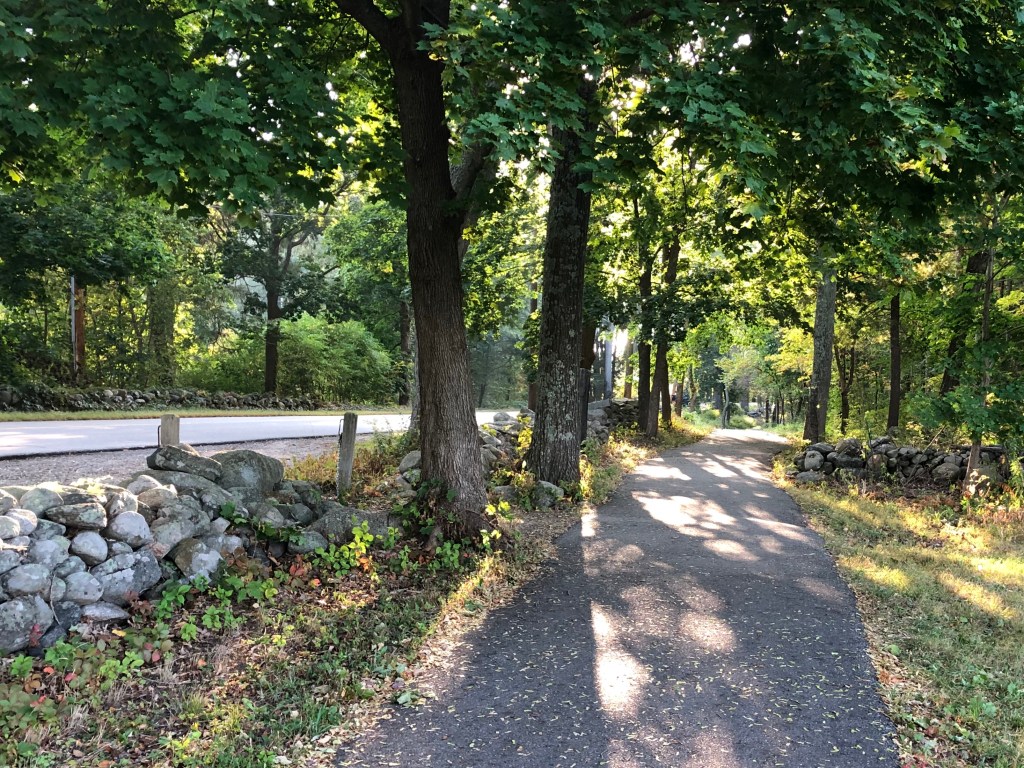
Bike path, Lincoln, Massachusetts

If you’re not traveling, you get to know your own neighborhood really well, both how it looks and sounds and smells, and what people are thinking about.

It can get complicated. People on the same side of an issue can disagree. Today for example, a small group of people is holding a rally to condemn our church, of all things! Another group, which I ordinarily admire, plans a counter-demonstration, even though the church has requested that no one show up to give the extreme talk show host the confrontation video she seeks.

Some days, you just have to turn to nature.

Above is a bike path I especially love. It goes past a farm with pigs and cows. I learned the farm has an honor-system, 24/7 shop in a big, airy barn. The food I got there was great. We had it last night for dinner.

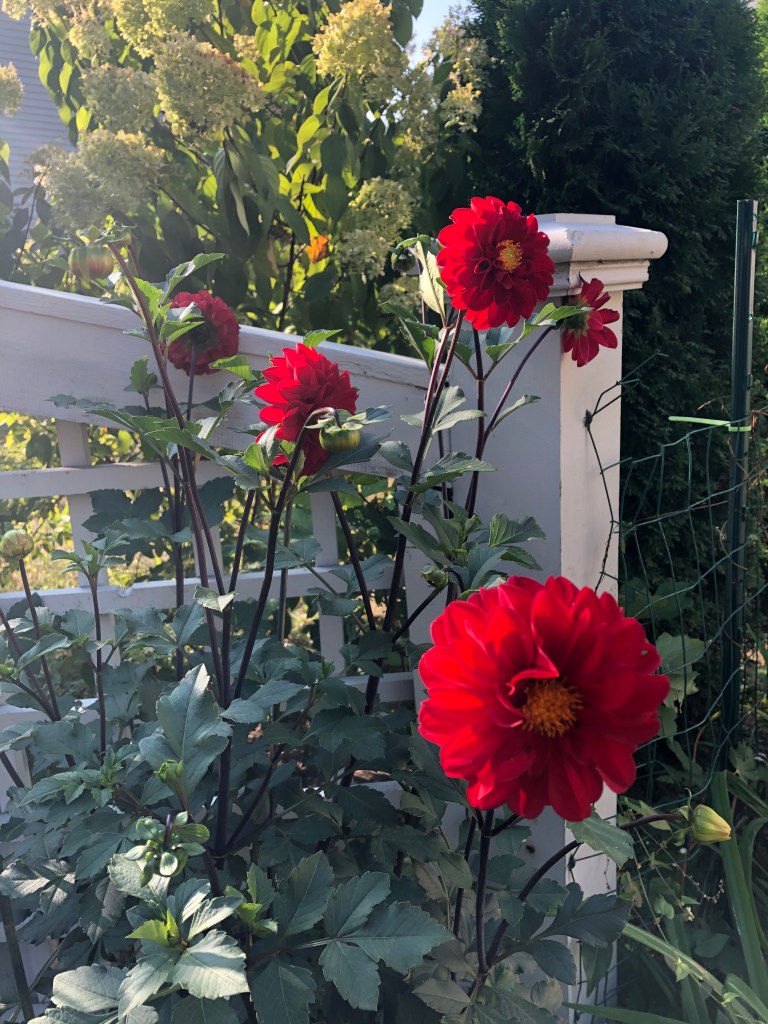
I took the first picture of dahlias, and Kristina took the one from a Western Massachusetts dahlia farm. Did you know you have to bring dahlias in every year and replant them the next year? Whoa!

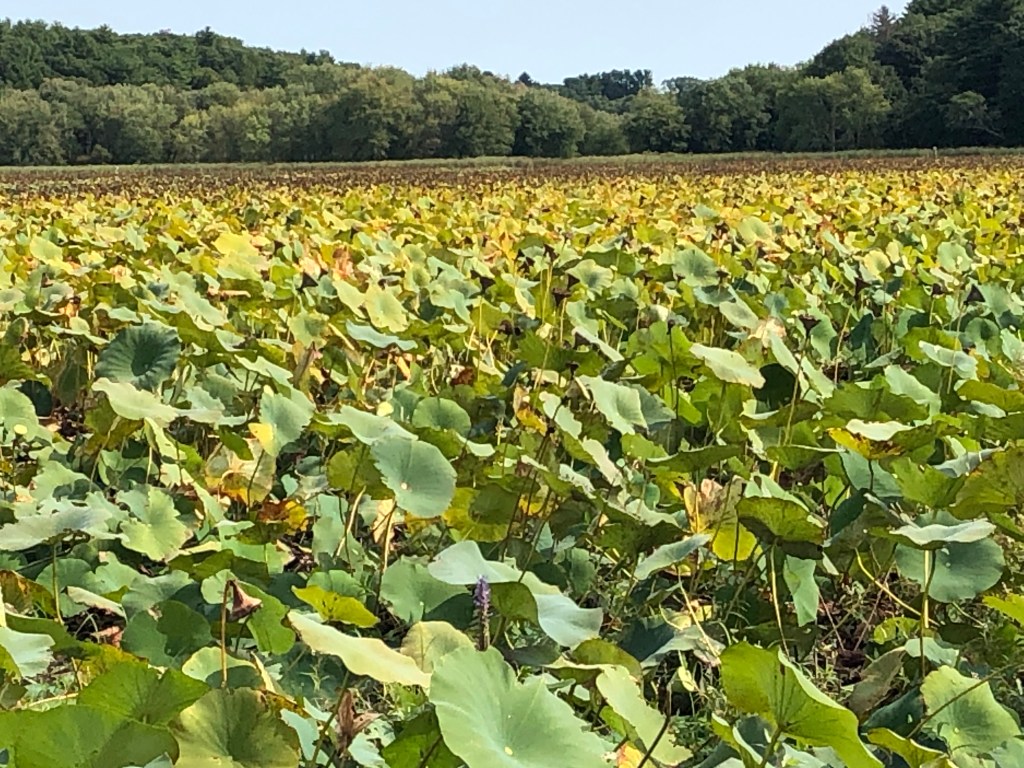
At the nature preserve Great Meadows, I was astonished by lotus leaves as far as the eye can see. Next year, I will definitely come when the plants are blooming.

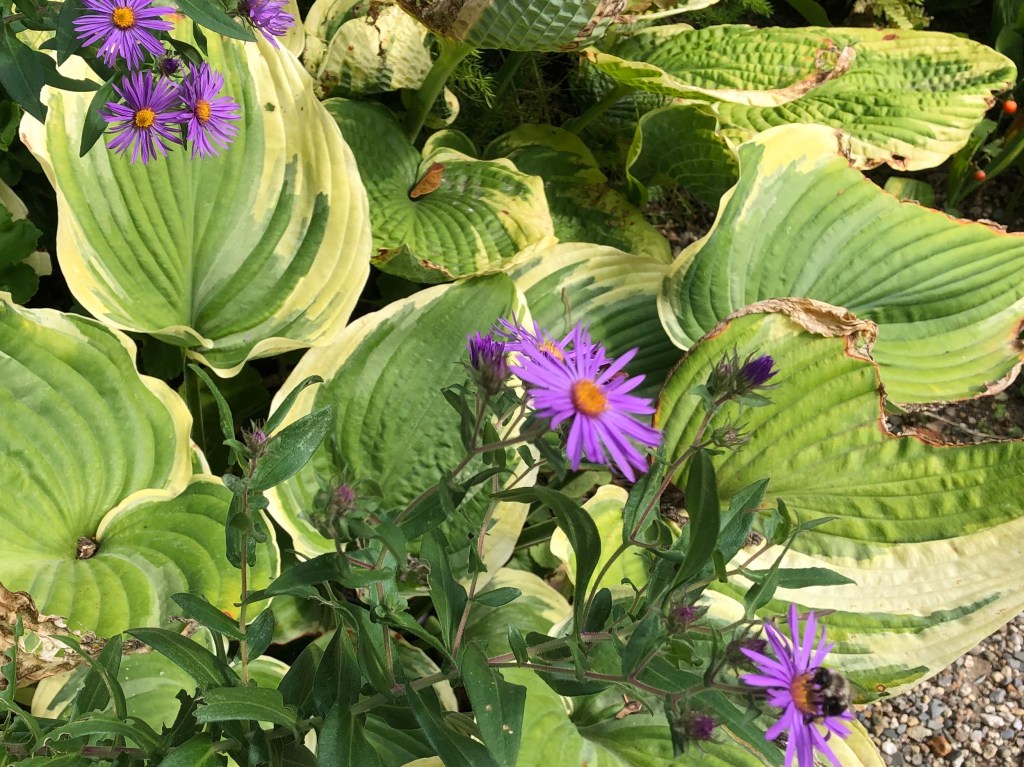
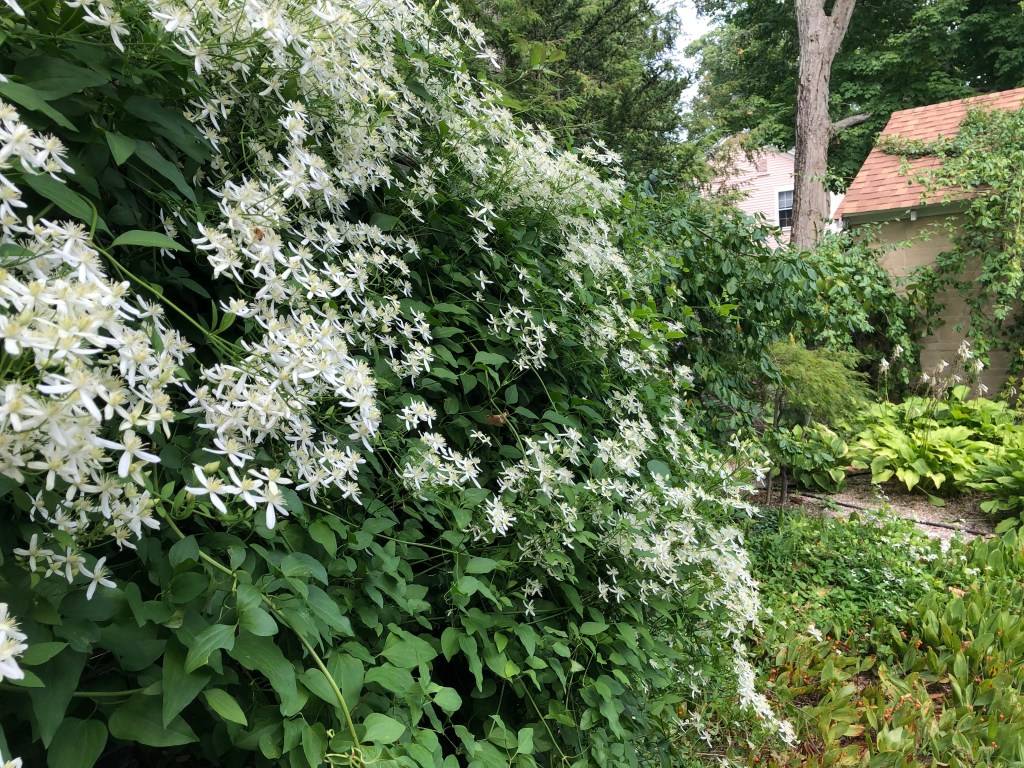
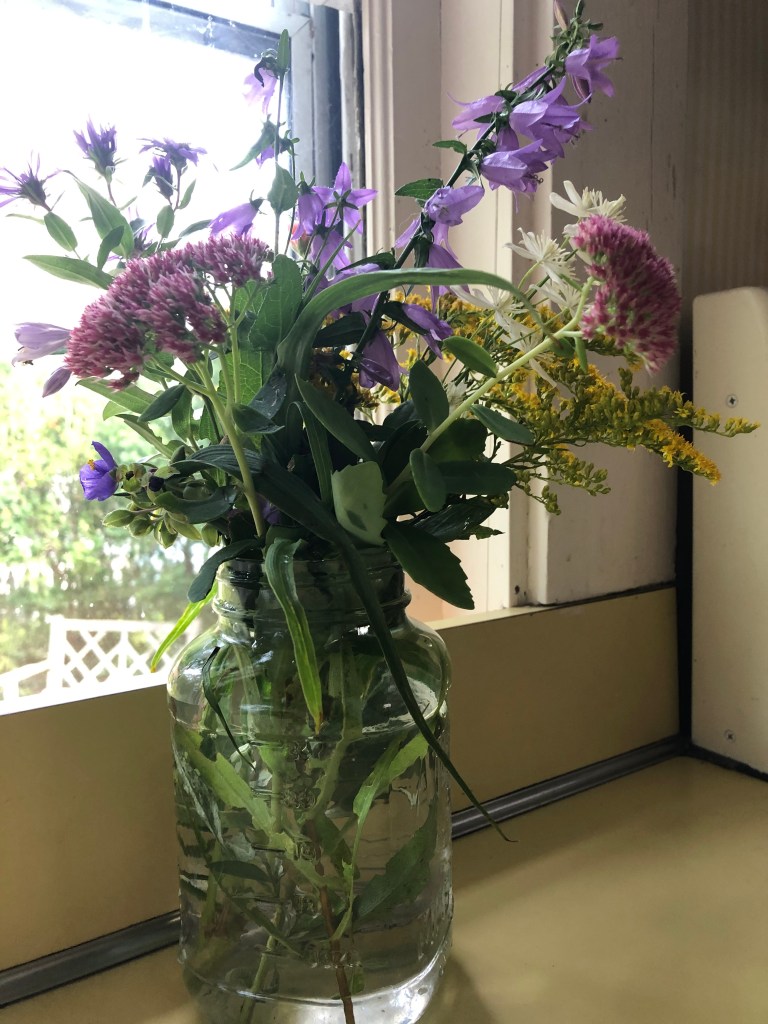
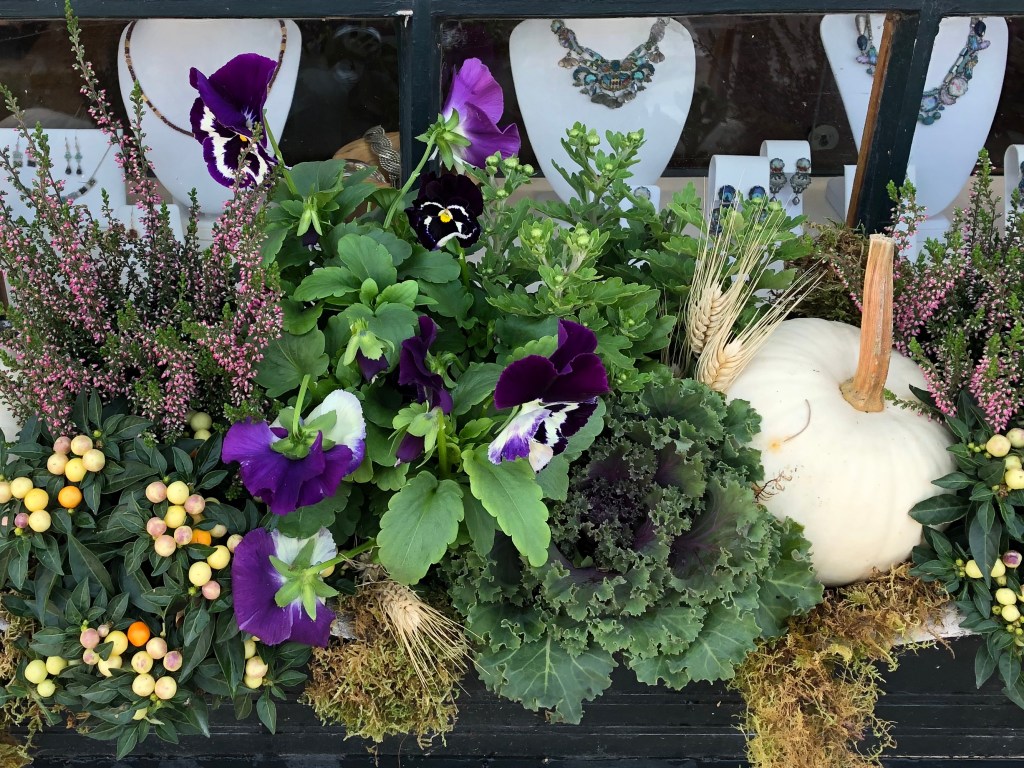
The flowers in the next three photos — asters, clematis virginiana, and a wild bouquet — are mostly from our yard. Then there’s a local jewelry shop, which has wonderful window boxes in every season.

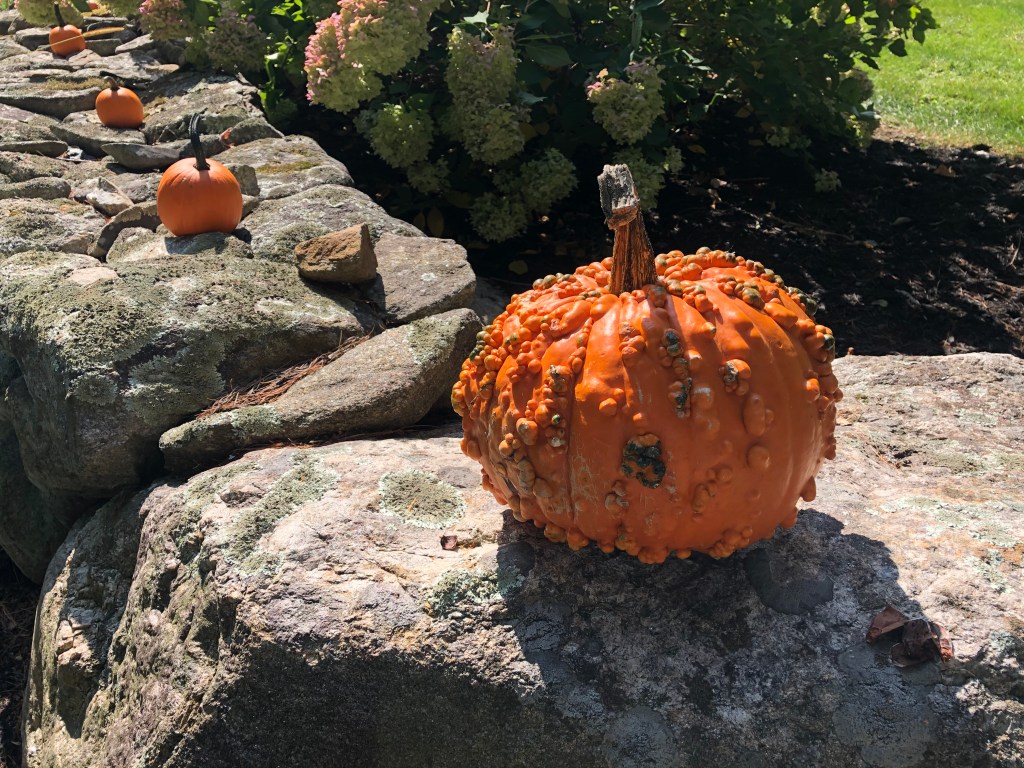
After the pumpkins, there’s a painted door called “Walkies,” by Kayo Burmon, located on the Bruce Freeman bike trail.

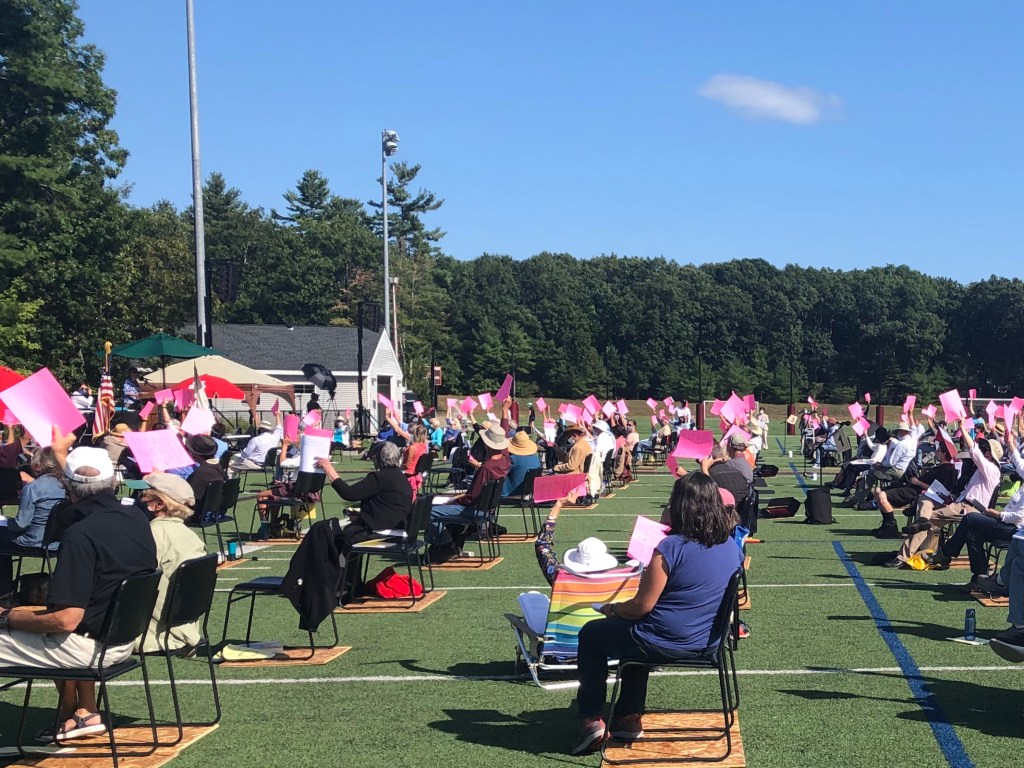
In the picture after that, my neighbors are holding up their pink voting slips at the coronavirus outdoor town meeting. Signs of the times.

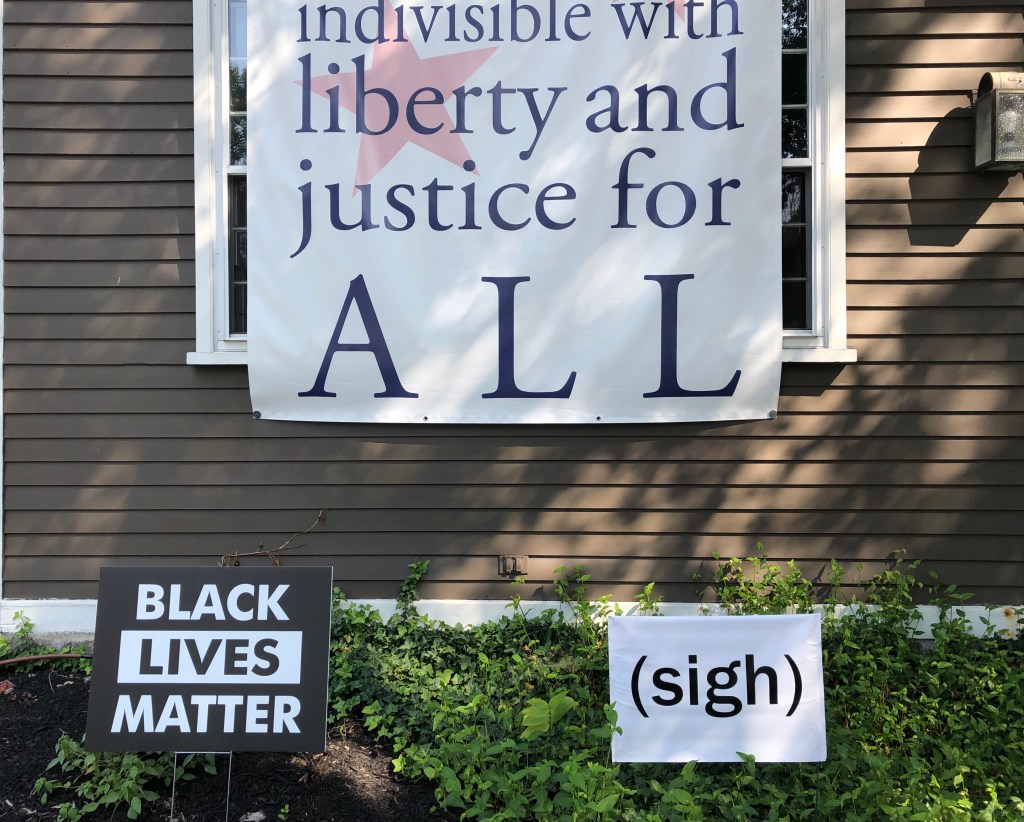
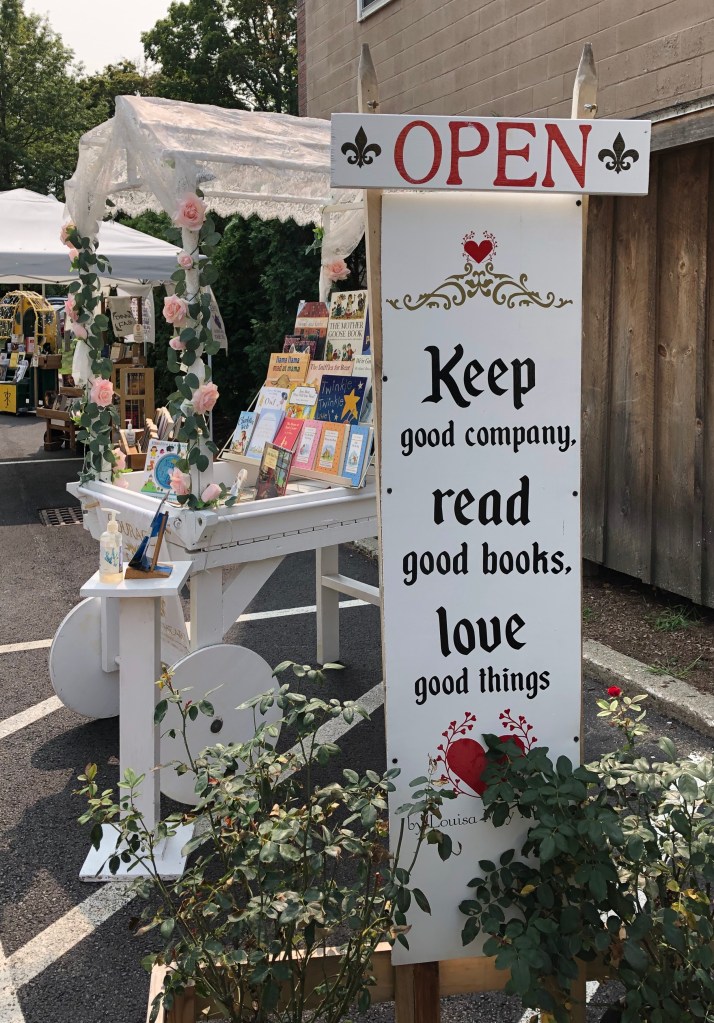
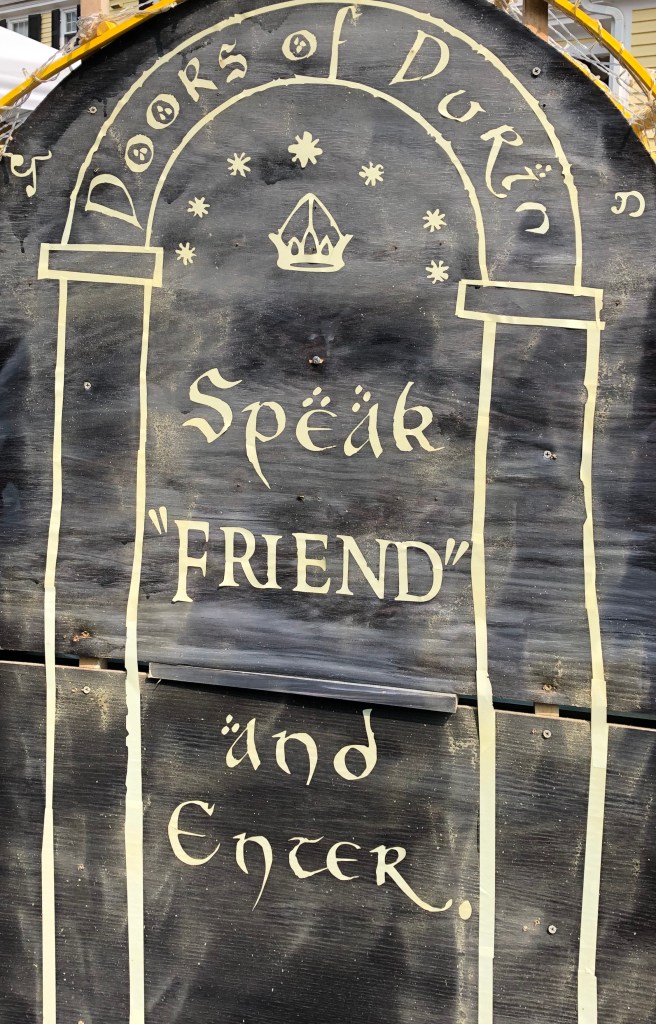
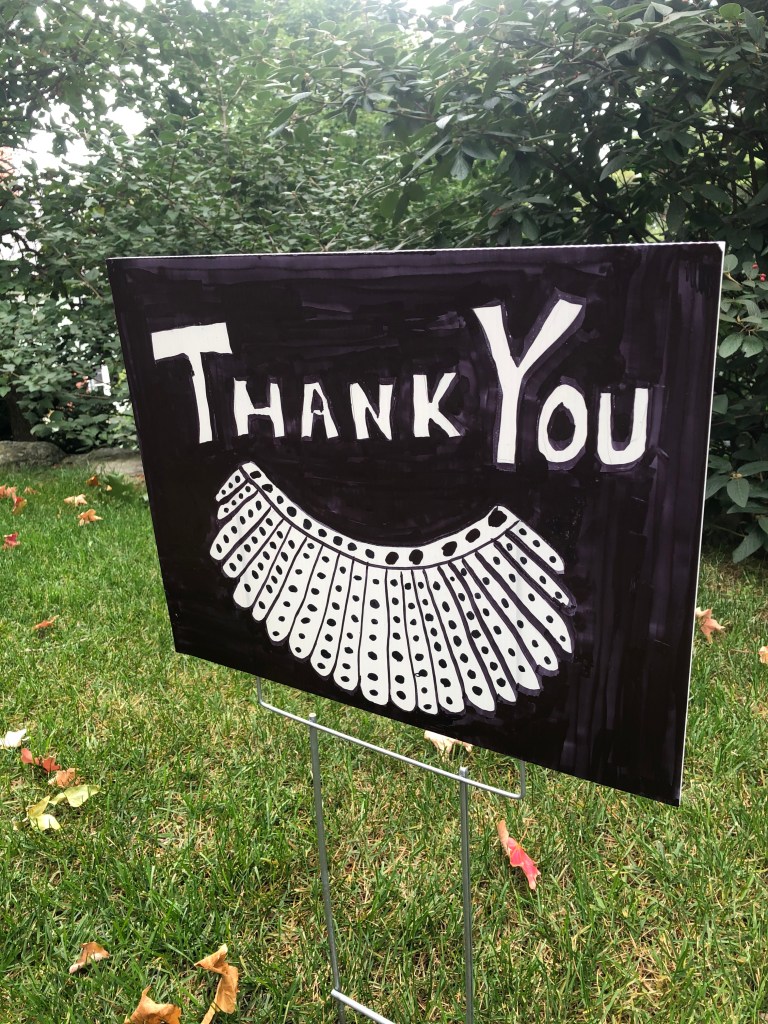
Literal signs of the times, below, need no discussion, although I do wonder if any of you know the code in the sign copied from Tolkien: “Speak, ‘Friend,’ and enter.”

Hospice

I wrote this post one year ago, the day my little sister died. We think of her all the time. In three days, her birthday, we will celebrate her life with ice cream. Today we are also mourning the death yesterday of Erik’s second father, in Sweden, a wonderful man. We are grateful he was able to be at home these last few months. So many memories!

Suzanne's Mom's Blog

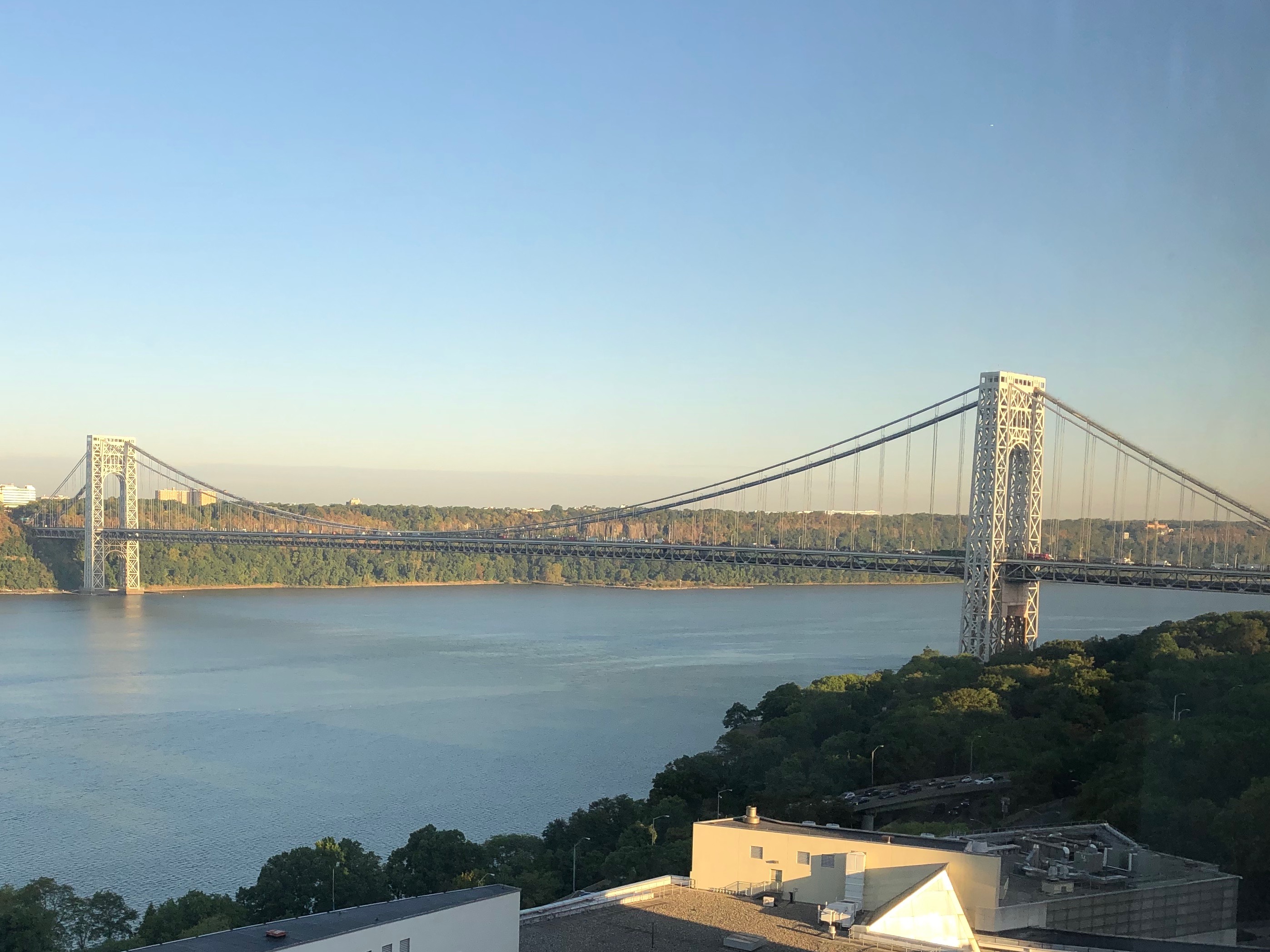
092619.-Geo-Washington-Bridge-from-NYP-windowJPGI have been standing at the hospital window, eating granola and looking west at the George Washington Bridge over the Hudson River as the sun comes up. On the far shore is a town where my siblings and I grew up. I remember when my baby sister came home from the hospital years ago. I got off the school bus and saw this tiny creature with a very red mouth sleeping by the front door in a cradle.

Hello, New Day!

I am with my sister. For her, there will not be many new days. She is in hospice. That is where the brain cancer called glioblastoma lands its victims more often than not. I am feeling so angry at this disease. I told the physician assistant that when you go on the web, it says the cancer is rare. Huh! Everyone I mention it to knows someone who has…

View original post 220 more words

Drive-by Literary Festival

Back when I was a more regular reader of the New Yorker magazine, I used to love a tiny, bottom-of-the-column feature with the heading “There will always be an England.” The blurbs printed there tended to be about quirky individuals or happenings that struck the New Yorker editors as indelibly English. That’s what I thought of when I saw a recent article in the Guardian.

Steven Morris reports, “The book lovers of Appledore, a picturesque fishing village on the north Devon coast, are a resourceful, determined lot.

“When their library faced closure 14 years ago, they helped save it by launching a literary festival, which grew and developed year by year into one of the most popular cultural events in the south-west of England.

“And when the 2020 Appledore book festival was threatened with cancellation because of the Covid crisis, they came up with the bold idea of holding a coronavirus-secure drive-in event, believed to be the first in the UK.

“Over this weekend, hundreds of people will park-up in a field usually used as an archery range to listen from the safety of their cars to talks and readings on topics including politics, cooking, shepherding and gardening.

“If they are not distracted by the stunning views of the sea, they will hear the wise words of science writers, novelists and environmentalists relayed into their cars via their vehicles’ radios. …

“By March, when the UK went into lockdown, 45 authors had been booked for a nine-day festival this September. … Rather than cancel because of coronavirus, the organisers thought outside the box. They contacted a Devon events company, Waggle, which runs drive-in cinemas, and asked if they could do the same sort of thing in Appledore – but with books.

“They have had to reduce the number of events but are able to accommodate up to 120 cars for each session with up to five people in every vehicle. …

“Appledore and the surrounding area have traditionally been known as centres for fishing and shipbuilding rather than for a thriving arts scene. The festival is changing that.

“The area’s remoteness means that many local people have come to rely on the festival for an autumnal fix of culture. [But] navigating the rules and regulations to stage the drive-through festival has been a challenge. …

“Friends Rebecca Flashman and Debbie Moss, from Braunton, north Devon, arrived in an open-topped two-seater car with just enough room for a hamper packed with cucumber sandwiches and sparkling wine.

“ ‘We’re used to coming to open-air classical concerts,’ said Rebecca. ‘But we thought we’d give this a go.’

“Covid means, of course the festivalgoers cannot freely mingle but have to stay within boxes marked out with whitewash. Nevertheless, the atmosphere was warm and convivial.

“ ‘It felt surprisingly intimate,’ added Rebecca. “It’s wonderful to get out and do something cultural in these difficult times.’ …

Tobias Kennedy-Matthews, a local chimney sweep, had been given his ticket to the Harriott gig as a birthday present.

“He loved the chef’s tales about Ready Steady Cook and his culinary trips abroad. ‘It was brilliant. This is my first literary festival. I’ll definitely come again,’ he said.

“The festival founder, children’s author Nick Arnold, who lives in Appledore, said he had always been keen for the festival to be innovative. … ‘I always hoped that by coming up with new and exciting ideas we would attract attention.’

“Harriott had wondered how the audience would engage and how he would know if they had enjoyed his appearance. He needn’t have worried. He walked off not to the sound of applause but to the enthusiastic honking of car horns.”

More at the Guardian, here.
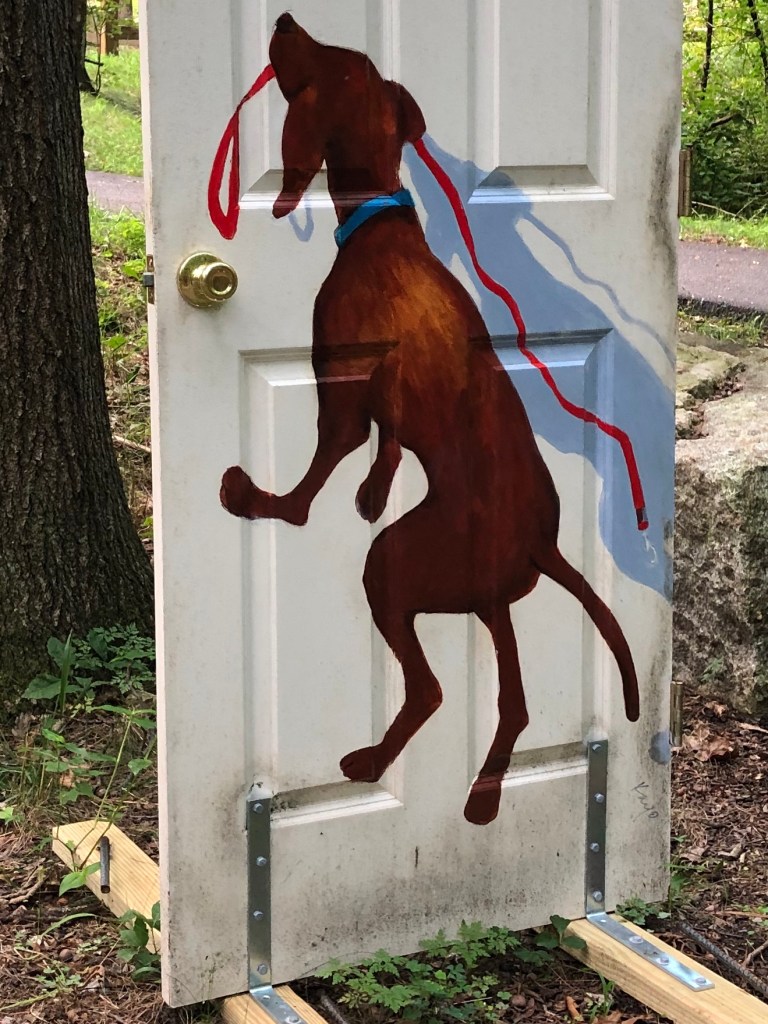
Photo: Jim Wileman/The Guardian
An interview and Q&A with the celebrity chef Ainsley Harriott opened a drive-by literary festival in England. Car horns told him it was a hit.

Erik’s Swedish/Danish niece and nephews live in Copenhagen and went back to school quite a long time ago. The youngest went first, taking his seat in a classroom full of Covid-19 protections. Meanwhile, in other parts of Denmark, outdoor learning is getting increased attention.

Rick Noack writes at the Washington Post, “On a balmy Monday afternoon earlier this month, Sebastian Lukas, 27, watched from across a clearing as his third- and fourth-grade students whittled branches into spearheads with sharp knives.

“His gaze turned to another group, who were supposed to be working on math problems. Two students, perched on a log, scrambled to produce their textbooks, just in time to look busy.

“Lukas began the year teaching in a classroom like any other, in Samso Frie Skole, a school on the Danish island of Samso. But when the novel coronavirus pandemic struck, the school, like many across the country, embraced a new way to hold certain classes: almost entirely outdoors.

“Instead of sitting at desks, Lukas’s students wander through a rambling woodland, lush with trees and crisscrossed by dirt tracks. …

“Some countries, including Germany, have a tradition of outdoor preschools and kindergartens, which have begun to catch on in the United States as well. The pandemic may drive more countries to experiment with the model for older students. …

“Samso, a sparsely populated, energy self-sufficient and carbon-neutral 44-square-mile island that was once a meeting point for Vikings, is a windy, hour-long trip by ferry from the mainland village of Hou.

“The Samso Frie Skole — a private school funded, like many others in Denmark, in large part through public grants — first pondered the move outdoors long before the pandemic. Coronavirus accelerated those plans.

“The new, forested area, surrounded by grain fields, includes old farmhouses, where students will be able to take shelter in bad weather, according to principal Anna Mattsson.

“ ‘It’s going to be a combination of indoors and outdoors,’ she said. The aim is to have students learn outside several times a week, with fluctuations based on weather.

“No one at the school said they were worried about the impending winter.

“ ‘We’re used to it,’ said Rikke Ulk, the chair of the school’s support association. ‘It’s a matter of dressing well.’

“Until the new buildings are ready, students must walk or bike more than a mile from their old classrooms to their new forest school. Teachers haul some of the younger children in carts affixed to bicycles.

“Milling about before one such shuttle ride on a September morning, Noa, 11, said she liked the new school setup. It’s ‘just so beautiful — it makes me happy,’ she said. …

“Some said they preferred certain aspects of learning inside. ‘Sometimes, it’s better just being in the classroom, so we can focus,’ said Sally, 12.

“Cian, 9, an aspiring cook or robot engineer, disagreed. ‘It’s better to be here,’ he said, holding his math book. ‘It’s cozier.’

“Lukas said outdoor class works better for some students than others. ‘But some kids who have a hard time sitting love to come out here,’ he said, and some students who struggled to focus on math indoors have shown aptitude outside. …

“One of the most commonly accepted Danish arguments in favor of outdoor schooling centers on health benefits, said Mads Bolling, a researcher at the Steno Diabetes Center Copenhagen. Students are able to avoid the adverse affects of sitting still all day.

“But he cautioned that potential disadvantages are not yet fully understood, and some research suggests outdoor schooling appears to provide the most for children who are already highly motivated. …

“Even if outdoor class may not be practical for all schools or in all climates, said Bolling, it is not an all-or-nothing proposition. Samso Frie Skole plans to be flexible about which classes meet outside and which do not.” More here.

Reclaiming Place Names

As a fan of efforts to preserve rare languages, I believe that using native people’s names for geographical places is also important. Brian Friel captures the concept in Translations, his play about English soldiers changing place names in Ireland: “It can happen that a civilisation can be imprisoned in a linguistic contour which no longer matches the landscape of … fact.”

Colonists always try to impose their culture, but in the end, it is unlikely to turn out well.

At the Guardian series “Indigenous Investigations,” Annette Ruzicka reports in a photo essay that the reinstatement of traditional place names in a region of Australia “signals a new wave of empowerment” for aboriginal people called the Ngarinyin.

“Hit the Gibb River Road out of Derby, Western Australia, and you find yourself heading towards the northern Kimberley plateau, a breathtaking landscape of sandstone ranges, rivers and boab-dotted savannah country. About 63,000 sq km of this land is Wilinggin country of the Ngarinyin people and their connection to country dates back 60,000 years.

“One of the first stops towards Wilinggin country passes the Queen Victoria Head – a rock formation bearing an uncanny resemblance to the famous monarch. While it’s a blunt reminder of colonialism, it’s also the gateway to an area that until very recently had far more dubious name – the King Leopold Ranges, named after the Belgian king responsible for grievous atrocities, brutal oppression and enslavement of African people. …

“After two years of work behind the scenes, traditional owner groups made some new headlines with a historic name change to the Wunaamin Miliwundi Ranges. It’s a hybrid name to represent both the Ngarinyin (Wunaamin) and Bunuba (Miliwundi) traditional names.

“Since then, another seven places in this conservation park have changed back to their Ngarinyin name.

“Since the Wanjina Wunggurr Wilinggin native title determination in 2004, the Ngarinyin people have made significant moves to empower their community and return to, and care for, country. One of the first things they set up after determination was an Indigenous ranger program: the Wunggurr Rangers.

“Ngarinyin man Robin Dann was one of the first rangers employed and is now head ranger, living on country in the Ngallagunda community, with his family. His younger brother Kane Nenowatt is more recent addition to the Wunggurr rangers while his wife, Tanya Spider, sits on the Wilinggin board of directors. …

“One of locations changed back to its traditional name is (the formerly named) Barker pool, now Dudungarri mindi. The name refers to the dreamtime story of the Wanjina spirit and the Yawarlngarri jirri (blue catfish) which live in this pool. This represents a rich and ancient history that Ngarinyin people hope to share with visitors alongside the staggering beauty of the region. …

“With it comes a genuine economy: employment and investment brought to the region by the people themselves. With a second ranger group on the way, the determination of the Ngarinyin people to stand on their own is a shining light in an uncertain world.” More at the Guardian, here.
On Facebook, I started following a different group of Australian indigenous people, NPY Women’s Council. The home page says it “is led by women’s law, authority and culture to deliver health, social and cultural services for all Anangu.” In one post, Nellie Patterson reported, “We went to the Olympics so that all the people there would see the strength of who we are. The Olympic experience has made us strong with a resolve that has never been shaken since.

“We did a really important inma (ceremony) in Sydney and we did it with the intention of making a deep impression on the people who saw it and in the hope of better relationships and collaborations with other people in the future. It was a very important occasion.

“My sister carried a great deal of valuable knowledge and she and I made this inma available through Women’s Council for the benefit of everyone across the country.” For more about the council, click here.