Another good one from This Is Colossal: Janet Echelman’s suspended net creations.
According to This Is Colossal, “In the late 1990s artist Janet Echelman traveled to India as a Fulbright Scholar with the intention of giving painting exhibitions around the country.
“She shipped her painting supplies ahead of time and landed in the fishing village of Mahabalipuram to begin her exhibitions with one major hitch: the painting supplies never arrived.
“While walking through the village Echelman was struck by the quality and variety of nets used by the local fisherman and questioned what it might look like if such nets were hung and illuminated in the air. Could it be a new approach to sculpture? …
“Echelman is currently embarking on her largest piece ever, a 700-foot-long sculpture that will be suspended over Vancouver … In collaboration with the Burrard Arts Foundation, she’s seeking funding via Kickstarter to make it happen. There’s all kinds of great prints, postcards, and shirts available so check it out.”
More here, at This Is Colossal, where you can see lots more nets. They will make you feel happy.
With snow and ice outside every window, and more expected tomorrow, we decided to take a little excursion to Tower Hill Botanical Garden, near Worcester.
The camellia show was the original impetus, but the warm, warm orangerie was an added treat, as was the Lemon House and the piano music of Joe Blanchard.
I made a point of memorizing the names of several plants that keep turning up on MisterSmartyPlants, where I go there to help John identify flowers that people post. It’s a bit of a challenge as the plants come from all over the world and are often not familiar to me. (I hope you’ll consider identifying some, here.)
Curator Scott Stulen pays attention to what attracts people. At the avant garde Walker Museum in Minneapolis, he actually tapped the popularity of cat videos — and created a mini sensation.
Now at the Indianapolis Museum of Art, Stulen is curator of the visitor experience.
Writes David Lindquist at the Indy Star, “Newly hired as the first-ever curator of audience experiences and performance at the Indianapolis Museum of Art, Stulen’s assignment is to attract people to the museum’s galleries as well as 100 Acres art and nature park, Tobias Theater, outdoor amphitheater and Lilly House and gardens.
“He comes from the Walker Art Center in Minneapolis, where his track record includes the surprise success of the Internet Cat Video Festival, which brought 10,000 people together in a field in 2012 and then 11,000 paying customers at the 2013 Minnesota State Fair. …
“The cat video festival debuted at Open Field, a space adjacent to the Walker where Stulen co-developed projects with the museum, independent artists and the public.
“ ‘We had the ability to do more experimental programs that didn’t make as much sense inside the museum, and had a lot more creative freedom,’ he said.” More here.
2013 Internet Cat Video Festival at the Minnesota State Fair.
Well, if you aren’t into musicals, it might not be hilarious to you, but I just love that a famous songwriter wrote this number for Great American Soup back in 1970, and a famous Broadway star performed it. Terry Teachout posted it, here, on his theater blog. His blog is called “About Last Night,” and I connect to it through ArtsJournal.
Back when I was reading the Wall Street Journal, I used to enjoy Teachout’s theater reviews. But according to his blog, reviews are just the tip of the iceberg for this Renaissance Man.
“Terry’s first play, Satchmo at the Waldorf, opens off Broadway at the Westside Theatre on Mar. 4. Previews start Feb. 15. The production is directed by Gordon Edelstein, with John Douglas Thompson appearing in the triple role of Louis Armstrong, Joe Glaser, and Miles Davis. It was seen in 2012 at Shakespeare & Company of Lenox, Mass., Long Wharf Theatre of New Haven, Conn., and Philadelphia’s Wilma Theater. For more information, go here.
“To see John Douglas Thompson on stage in Satchmo at the Waldorf, go here. To watch a Wall Street Journal-produced video interview with Terry, go here.”
Teachout also writes opera libretti. I always thought it would be fun to do that.
Below: “Great American Soup” commercial, written by Stan Freberg and starring Ann Miller.
Mario Aguilar writes at Gizmodo, “Riding a bike is a musical experience in more than a metaphorical way: Brakes squeal, spokes click, derailleurs clang. Composer Johnnyrandom sampled himself ‘playing’ his bicycle and the results are positively gorgeous. …
“It’s hard to believe that all of [the] sounds are made by a bicycle. Some of them are strictly the byproduct of the bike’s mechanical operation, like the sound it makes when you release a brake lever. Others are created when you play different parts of the bike with a musical accessory.
“For example, Johnnyrandom records the low-pitched flutter of a pick scratching on a spinning wheel, and tunes the bicycle’s spokes so he could play them with a bow like a string instrument. After capturing the sounds with a portable recorder, the different sounds were arranged and sequenced using software. This two-minute mix gives you a feel for the wide sonic that he was able to create.”
In typical bloggy fashion, I got this from Andrew Sullivan, who got it from Gizmodo (which also has a kinoscope of Frank Zappa, on the old Steve Allen tv show playing a bicycle, and a video of how Johnny Random works), who got it from This Is Colossal. Where will this message in a bottle land next?
(Be sure to check my post on composer Kenneth Kirschner, here, for more contemporary music using unusual instruments.)
My husband likes to watch Link TV, which brings random news programs from around the world into our living room.
That is where he learned about Rojak Site, a funny website that collects offbeat stories. We loved this one about swapping clothes between generations.
“Artist photographer, Qozop, asked Asian youths to swap clothes with their relatives who are generations apart. It’s interesting to see how the older generations can still be found dressed in traditional clothing while the youths have opted for more modern Westernised fashion.
“Speaking about his work, Qozop said: ‘Basically, this idea for Spring-Autumn came about from a notion that though Asia has become westernised to a large degree, it is still possible to witness its traditions and cultures. And as an Asian society, our cultural beliefs are often reflected in our dressing. Fashion (other than wrinkles) is one of the best telltales of how old a person is.’ ” (Rojak’s source, here, was the Daily Mail in the UK. Click to see more photos.)
Our grandchildren will have to grow up a bit before we can discuss swapping clothes. The oldest is not yet four. (When Suzanne was four, she asked if she could have all my clothes when she grew up. One thing worried her, however: “You don’t have much shorts,” she said. She is more than welcome to my old clothes now that she is grown up, but for some reason, she never asks for them.)
Here’s something fun from the UK paper the Telegraph: Irish farmers taking pictures of themselves on mobile phones. The farm animals add that certain je ne sais quoi.
Emily Gosden has the story.
“Photos of Irish farmers taking ‘selfie’ photos with their livestock have gone viral,” writes Gosden, “being republished on dozens of news sites around the world. …
“The snapshots were originally submitted to the Irish Farmers Journalfor its ‘selfie on the farm’ competition. Ten finalists picked by the journal include a photo by Patricia Farrelly from Ballyjamesduff, posing with a goose and an axe, and a shot entitled ‘two fine beards’ by Peter Desmond from Ballinhassig, sporting a beard and posing alongside a bearded goat.”
Photo: Irish Farmers Journal/Facebook Farmer P.J. Ryan from Newport, County Tipperary, in his prize-winning selfie. The picture was submitted by his daughter Aisling.
Cynthia-Marie Marmo O’Brien has a nice story at Narratively on a close-knit Latino subculture in the Bronx.
“Generations of Nuyoricans — Puerto Rican New Yorkers — have found familia in a little house on an overgrown patch of the South Bronx,” O’Brien writes. The place is known as La Casita.
She continues, “Today I am relaxing with some of the regulars under the hanging branches of trees separating us from the busy life on the street; they have picked grapes from overhead and are making wine.
“I came here with César Colón-Montijo to experience plena, a musical genre indigenous to Puerto Rico. In his scholarship, Colón-Montijo, an ethnomusicologist who the regulars consider part of la familia, describes plena as a way through the South Bronx’s difficulties. Plena has always been a call-and-response form of song; its origins are usually attributed to striking workers. …
“La casita is the classic liminal space: neither Puerto Rico nor New York; neither a secular sanctuary for all nor a performance place for legends. It is all four. Puerto Rican flags fly and an original album cover of John F. Kennedy’s 1960s speeches is displayed along with other memorabilia. No topic is too big or small for plena’s repertoire; there’s even a plena about JFK. After the city’s Puerto Rican Day Parade every June, the music royalty of the island flock here.”
Read more here and see how people use music to transport themselves to Puerto Rico while still in the Bronx.
Photos: Emon Hassan Jose Rivera (left) during a jam session at the Casita. On the right, demonstrating how an out-of-tune piano can still make music.
This was a weekend for looking at art. The quilts on the left are by Valerie Maser-Flanagan and are on display at the Concord Library. My favorite was the one with the vertical stripes.
My husband and I also visited Brandeis University’s Rose Art Museum, back in action after being threatened with extinction by a president who lost his job over the ensuing uproar. I must say, the Rose presents some pretty inaccessible stuff, but the weird films by Mika Rottenberg were the highlight of the visit for me today. Mesmerizing.
The films carried me back to Kenneth Anger’s and Andy Warhol’s experimental movies in the ’60s. I didn’t understand those films either, but I was fascinated. Rottenberg’s kooky stories also was reminded me (my husband, too) of an offbeat video Asakiyume lent us recently called Cold Fever, which we loved. (Saying it was about a young Japanese businessman getting lost in Iceland in winter — on a quest to honor his dead parents with ceremonies he doesn’t believe in — hardly does it justice.)
Sebastian Smee at the Boston Sunday Globe has more on Rottenberg’s videos, and he covers the other exhibits, too.
Also this weekend, I stopped in at a gallery I like in Lincoln. They were featuring several interesting artists, including the photographer Leonard Freed, below. And they have other great work coming up March 4 — take a taste here.
Photo: Leonard Freed From “Black and White in America” exhibit at the Clark Gallery in Lincoln. See review by Mark Feeney in the Boston Globe, here.
The Israeli who was once a successful animator but turned to singing, Asaf Avidan, is playing at the Somerville Theatre tonight. James Reed wrote about him at the Boston Globe, and I was intrigued enough to check out his latest video. See the two little boys, below. Avidan is the one who gives them a large crystal when they are busking on toy instruments.
Reed writes, “To fall in love merely with Asaf Avidan’s voice, which is easy to do, would be missing the bigger picture. … It’s the voice of resignation and resilience, beautiful but often brutal, and it just so happens that Avidan’s high timbre gives his performances an androgynous allure that leaves you hanging on every word.
“That much is true. But also at play is the fact that Avidan, a 32-year-old singer-songwriter with a substantial following in Europe and his native Israel, is particularly adept at deconstructing heartache in the most poetic of terms. That’s evident on ‘Different Pulses,’ his soulful latest album.”
The singer says, “The way I sing came from the reason I started singing. I was a successful animator up until about 2006, and because this reason to sing the blues [after a breakup] was so sudden in my life and so painful, I really needed for it to be physically difficult. I would find myself going higher on the scales, making it more difficult and screamy. I think that level of emotion brought me to these high scales, and that’s what people hear now. They hear the emotion.” More at the Globe.
Here’s research showing that creativity can make people feel good.
Tom Jacobs writes at Pacific Standard, “In a study of college students, ‘people who reported feeling happy and active were more likely to be doing something creative at the time,’ a research team led by Paul Silvia of the University of North Carolina-Greensboro writes in the journal Psychology of Aesthetics, Creativity, and the Arts.
“What’s more, the researchers add, you don’t have to be a master poet or painter to reap the emotional rewards. Even if the results of one’s creative activity are ‘frivolous, amateurish or weird,’ this research suggests ”the creative process that yielded them appears important to positive psychological development.’ ”
After taking a survey about themselves and their creative activities, participants were “called on their cell phones eight times a day for the next seven days. They replied to each call by answering the question ‘Are you doing something creative?’ and describing their emotional state at that moment. …
“ ‘We found that the frequency of doing something creative was quite high — around 22 percent,’ Silvia and his colleagues report. What’s more, when participants were caught in the act of being creative, ‘they reported feeling significantly happier and more active’ than at other reports.” More here.
OK, I admit it sounds like a pretty slim study, but I’ll take it. I especially like the idea that it still counts if the creative activity is “frivolous, amateurish or weird”!
Do you ever check the website This Is Colossal? They have the best stuff.
Here is a cute bit about giant, playful robots in Argentina.
In a “clip from Fernando Livschitz of Black Sheep Films,” says the website, “we watch as tin windup toys overtake the streets of Buenos Aires, living amongst its inhabitants as if it was an everyday occurrence. Livschitz is known for his short films that blend live action footage with aspects of absurdity, most notably his New York and Buenos Aires theme parks. Music by the very fine Canned Heat circa 1972.” More.
We hear so much these days about robots in advanced manufacturing and medicine, but I like the idea of robots as toys. You could really warm up to some of these guys, as Frank Langella did with his robot in the futuristic movie Robot & Frank.
Kai the World Traveler and Titan of Industry knows the kind of story that catches my eye. He sent me this one from the New York Times about a street artist who spoofs Banksy, Tom Hanks, and a lot else.
John Leland writes, “This is a story about art in the age of social media …
“In April 2011, a law school dropout in Bushwick, Brooklyn, newly arrived from the Midwest, had an idea that he thought might make a splash. He admired the street artist Banksy; he grew up on the movies of Tom Hanks. Why not mash up the two?
“Using simple computer software, he downloaded a Banksy painting of a rat holding a paint roller, then added an image of Mr. Hanks’s face. The whole thing took 10 or 15 minutes to create. He printed a cutout and pasted it on a wall at Mulberry and Kenmare Streets in Little Italy, signing it Hanksy. …
“He photographed the wall for his Instagram and Twitter accounts, and emailed it to the Wooster Collective, a popular street art website. Then he went to sleep.
“ ‘And then it just went viral,’ Hanksy said the other day …
“RJ Rushmore, who runs the street art blog Vandalog, said he was among many who initially dismissed Hanksy as an opportunist. ‘I thought it was not art, not brilliant, just taking the stupidest ideas and presenting them in ways that were very friendly for Tumblr and Instagram,’ Mr. Rushmore said. ‘It’s not art in the sense of a graffiti writer who spent 15 years developing his style.’
“Mr. Rushmore has since warmed to Hanksy, for comic relief in a scene that sometimes gets too serious. ‘He makes the best cat videos,’ he said. ‘That’s still something to be applauded.’
“ ‘It’s more than a pun,’ she said. ‘Banksy’s work is hypermasculine and serious about its underground, tough, outlaw image. And Tom Hanks is just not that guy. So the humor is putting that identity on this hyper-butch material. It’s the revenge of the nerd.’ ” More.
Photo: Nicole Bengiveno/The New York Times
Street artist Hanksy merged Banksy’s famous rat with Tom Hanks.
A few years ago, Suzanne visited Bhutan, drawn to a country that talks more about Gross National Happiness, GNH, than Gross Domestic Product, GDP.
Magda Fahsi at Mint Press News recently interviewed Bhutan’s former Prime Minister Lyonchen Jigmi Y Thinley and asked whether Bhutan ran into difficulties talking with other countries about development, given that its index is GNH and theirs is GDP.
He answered, “We have had no difficulties at all. We know our development partner countries in particular are interested in Bhutan’s growth process as measured through the yardstick of GDP; and we have not rejected GDP.
“GNH does not exclude GDP, but confines it to the role that it is supposed to play as originally conceived by Simon Kuznets, the person who established the measure after the Great Depression. Kuznets said that it was nothing but a measure of the goods and services produced by a particular place, at a particular time and exchanged in the market. He made it very clear to Congress that it was not a measure of development, not a measure of societal well-being. And in fact, he was very sad to see that his GDP was being misused, because, as you know, many countries now associate GDP with well-being. And this is where the mistake is.
“So Bhutan uses GDP as well, but only to indicate our material or economic progress; we give equal importance to other things like environmental conservation, sustainable socio-economic development, cultural preservation and good governance; these are further separated into nine dimensions that enable true societal well-being. …
“Happiness is a state of being that one achieves when one is able to balance the needs of the body with the needs of the mind, when the material and the emotional, psychological needs are being met, within a stable, peaceful and secure environment.”
Photo: AP /Mustafa Quraishi
Bhutan’s former Prime Minister Lyonchen Jigmi Y Thinley, puts on his shoes after paying tribute at Mahatma Gandhi memorial in New Delhi, India, Wednesday, July 16, 2008.
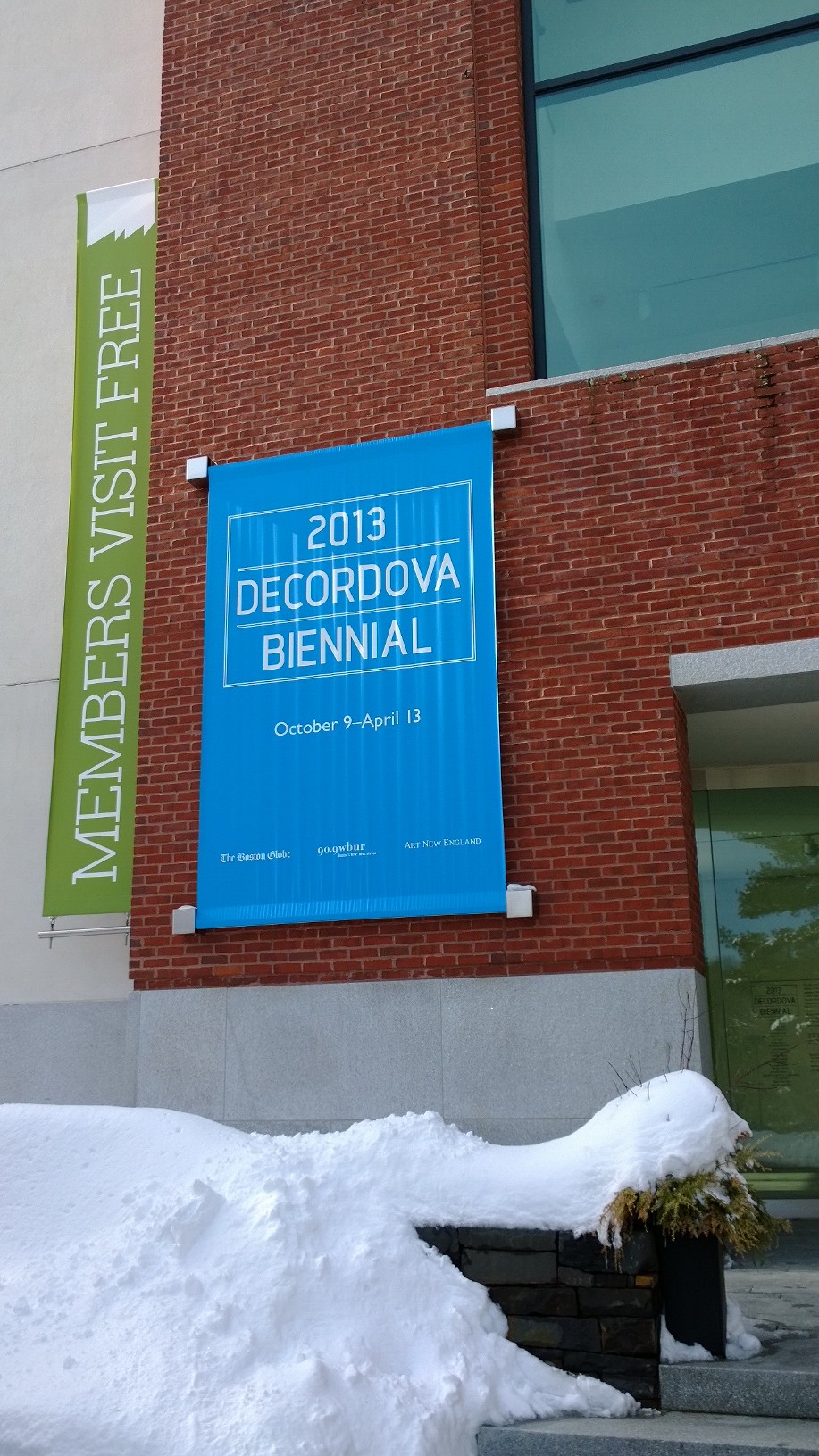
On Sunday, my husband and I decided to see what’s new at the DeCordova Museum in Lincoln.
A favorite in the biennial show of New England artists was Laura Braciale of Manchester, NH. It took me a minute, but when I realized she had displayed everyday objects along with what they looked like once she had turned them into art, I thought, Yes, art really is in everything if you look.
The blurb about her says, “close observation reveals subtle differences between the three-dimensional structures and their two-dimensional renderings. … Her works engage a question concerning representation—which image is more ‘real’? As both her items and her illustrations occupy the same physical reality, however, Braciale’s work suggests that neither is more real than the other.” (Sigh. I’m not really fond of the way museums write.)
In a different DeCordova exhibit we saw three tintype photo portraits by the late David Prifti, Suzanne’s high school photography teacher. (A solo show in Winchester, Mass., goes through March 2, here.)
The biggest surprise was a documentary about Laos, a country we are interested in largely because of the the mystery books of Colin Cotterill. (Read one of my posts about him, here.)
The film, Route 3, shows a small mountain town that, having been leased to China for 75 years, was utterly destroyed to make way for casinos, hotels, entertainments, and jobs for Chinese people alone. Hard to imagine selling a part of your country like that, but Laos is desperately poor.
The documentary was by Patty Chang and David Kelley, who live and work in Boston and Brooklyn.
The DeCordova says on its website, “Blending the genres of documentary and road trip films with surrealist cinematic passages, Patty Chang and David Kelley present a compelling trip through the physical and psychological landscape of a community in transition. … Enlisting the help of tour guides and local entrepreneurs in this tightly controlled area, the artists immersed themselves in this community to create a unique portrait of a changing society.” More information on the artists here and here.










 Suzanne's Mom's Blog