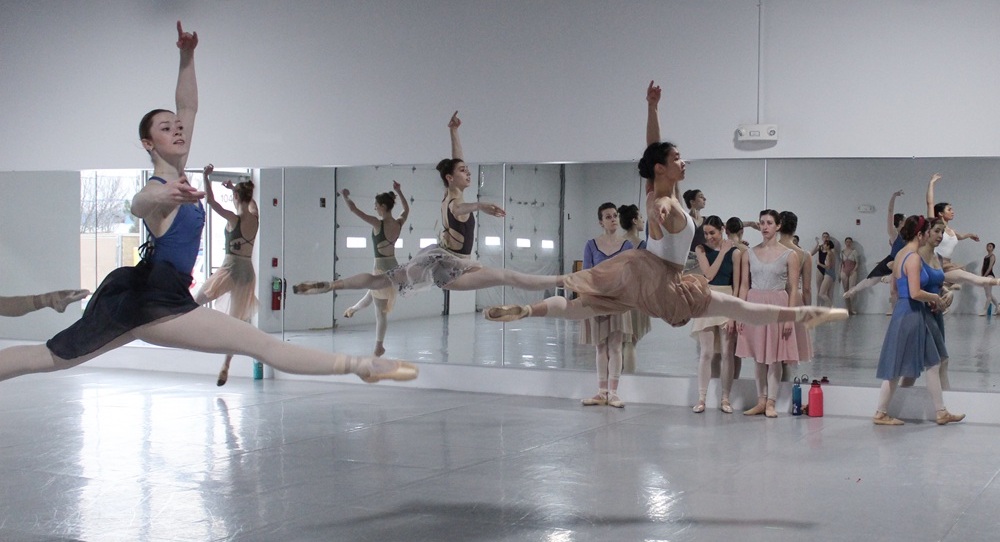
Photo: Julianna Slager/Ballet 5:8.
An ancient Greek philosopher once noted that you can’t step into the same river twice. What he meant, of course, was that the river is constantly changing. The drops of water that touch your foot when you step in are not the same drops you felt a few moments ago when you tested the temperature.
Here’s a story about the changing ballet world and how one company is adapting to the river.
Melody McTier Thomason at Dance Informa writes, “Since our last conversation with Julianna Slager, Artistic Director of Ballet 5:8, the company has experienced tremendous growth with an expanded repertoire, increased guest choreographers, and last year Slager was named a fellow at the School of American Ballet (SAB). Most notably, Ballet 5:8 recently announced a groundbreaking milestone for the 14-year-old company: full-time contracts for its dancers. …
“A dreamer at heart, Slager always had hopes of achieving full-time contracts, but it was in 2019 when vision casting began. ‘We moved into our new building in 2018. 2019 was the first time I was brave enough to share what was in my mind, and the board really took to that. Then COVID arrived. That threw me for a loop a little bit. It was a big test of faith to hang on to unseen things and allow myself to hope.’
“As Slager began to dig further into making her dream a reality, she uncovered a unique model to bring Ballet 5:8 to its next chapter. After reviewing the company’s finances, Slager realized the organization could shift resources from paying part-time contract employees who were doing administrative tasks, to paying dancers to do those same jobs. This shift would allow them to offer the dancers full-time contracts with benefits.
” ‘When we made the discovery that a big structural shift could be the answer to getting us where we wanted to go, we took pen to paper and looked at all the people we have in the organization,’ Slager explains. ‘If dancers are in rehearsal 25 hours a week, and additionally have 10 hours of either teaching or helping with administrative duties, social media, whatever, that still gives them five flexible hours for meetings or time they can spend to cross-train. We sat down and daydreamed a little bit about what it could look like, and then we slowly started talking to the dancers about it. …
” ‘We had a cohort of dancers along with a cohort of board members who created a caucus and talked through how this would work practically,’ Slager says. ‘Then, we rolled it out to the dancers and walked everybody through the process. Now, we are able to do a guaranteed salary increase every year, with a three-year contract which is super exciting so they have better job security. Because we have this stability, the board now can budget further out.’ …
“Combining artistic development alongside administrative tasks, extends beyond full-time company dancers to Ballet 5:8’s Trainee and Second Company dancers. ‘Because we want to make sure our Trainee and Second Company dancers are able to advance into the company and have a skill set, the Trainee directors have done a really good job of giving them a chance to job shadow in areas they’re interested in,’ explains Slager. …
“ ‘I really love working with everybody inside and outside the studio. I think it strengthens our bond as a team because we’re very focused on the goals and the mission. It also helps the dancers. They can see behind the scenes and better understand why organizational decisions are made. On the dancer side, we’re able to have more rehearsal time because everybody is full-time, so the roles they do outside of dance are a little smaller. … The “many hands make the load lighter” frame of mind is how it feels.’ “
More at Dance Informa, here.

 Suzanne's Mom's Blog