Photo: Abby Oulton 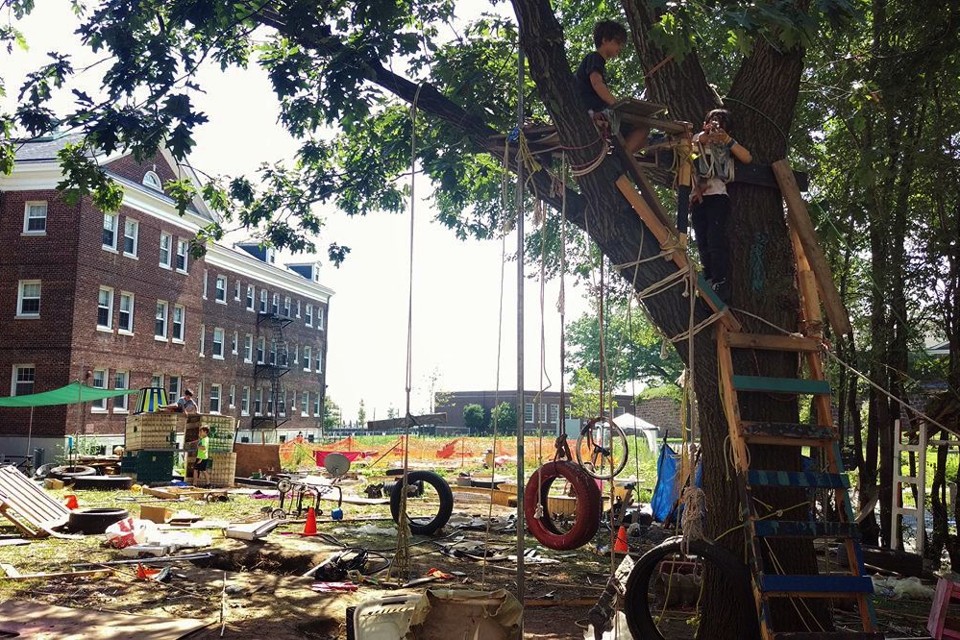
I’ve written before about outdoor nursery schools and child-directed play. Today we carry the concepts a bit further as Timothy D. Walker writes at the Atlantic about the “junk playground of New York City.”
“ ‘It looks like a dumpster playground,’ my wife told me, as we pushed our double stroller down a hill on Governor’s Island in New York City. ‘Like some slum.’
“In front of us was an area that looked like — to my eyes, at least — an Occupy Wall Street campground, with shoddy constructions of plywood, wooden palates, and blue tarp. I counted 10 children, who were roaming a space about half the size of a soccer field littered with car tires, plastic crates, orange cones, and a sea of unidentifiable debris. …
“In 1943, the first adventure playground (‘junk playground’) was piloted in the city of Copenhagen, Denmark, which was under Nazi occupation. From then on, the concept was embraced around the world, especially in Europe. A professional methodology called ‘playwork’ was established in the United Kingdom, in which trained adults (‘playworkers’) would run these environments. …
“Despite their global popularity, adventure playgrounds have struggled to gain traction in the U.S. … Peter Gray, a psychology research professor at Boston College, wrote in the American Journal of Play that free play — ‘activity that is freely chosen and directed by the participants and undertaken for its own sake’ — has declined over the past half century in America, and he inferred that a high level of parental fear about the safety of children and the rise of ‘adult-directed, school-like activities’ are two of the major causes. …
“On the ferry ride back to Manhattan, I reflected on how four simple ingredients — junk, tools, physical space, and playworkers — could create such a powerful learning environment, where children appeared to develop their ‘Four Cs’ (communication, collaboration, critical thinking, and creativity) for hours on end. Indeed, these Four Cs were the key ’21st-century skills’ that many American schools strived to sharpen in their students, but at the junk playground, this development seemed to happen rather effortlessly through self-directed play, supported by well-trained playworkers. …
“Not only do I think playworker-run junk playgrounds represent the future of playgrounds, they seem to provide a glimpse into the future of schooling, too. Today, teachers — especially in America — are gravitating toward more active, child-directed pedagogical methods that look similar to what I observed on the junk playground: ‘project-based learning,’ ‘makerspaces,’ and ‘genius hour.’
“Finland, the Nordic nation that’s often praised as a leader in public education, is implementing its newest national core curricula this fall, in which playful learning and developing student agency are emphasized.”
Interesting, no? For me, child-directed play has always been the goal, but at the same time, I’m a safety nut. I suspect that US parents’ focus on increasing the safety of playgrounds may have something to do with the fact that fewer parents are there to watch. Just as monitoring your preschooler on a swimming trip may be something you don’t want to delegate, you may prefer to be nearby when you let your kids experiment with a junk playground.
There is more at the Atlantic, here. Hat tip: Taught by Finland, on Facebook.


 Suzanne's Mom's Blog