Feeds:
Posts
Comments

Posts Tagged ‘adventure’

Photo: UK Army/Wikimedia.
Captain Preet Chandi in 2021. Nicknamed Polar Preet, Chandi has made three solo expeditions to Antarctica.

Today’s story is about a woman who loves to push her boundaries, test how much more she can do. What she especially loves is solo travel to the antipodes.

Hannah Al-Othman writes at the Guardian, “The record-breaking British explorer Preet Chandi, who made history trekking solo to the south pole, is now turning her ambitions north.

“Nicknamed Polar Preet, the 36-year-old from Derby has made three solo expeditions to Antarctica, earning herself four Guinness world records. …

“Chandi reached the south pole for the first time in January 2022, traveling 702 miles in 40 days, and becoming the first woman of color to complete a solo expedition to Antarctica.

“A year later, she broke the record for the longest solo unsupported one-way polar ski journey, skiing for up to 15 hours a day on as little as five hours’ sleep, while pulling her kit and supplies … “through winds of up to 60mph and in temperatures as low as -30C [-20F].

“She covered 922 miles over 70 days, beating the previous world record of 907 miles (1,459km) set in 2015 by the retired lieutenant colonel Henry Worsley.

“Now, Chandi is in training to try to become the first woman to travel solo and unsupported to the north pole. She will set off from Canada and the journey will involve traveling across sea ice, crossing sections of open water, climbing over rough ice. …

“The physiotherapist, who served as a medical officer in the British army for 16 years, reaching the rank of captain, joked that when she first told her ‘proud and supportive’ Indian family of her plans, ‘some of them thought I was talking about Southall rather than the south pole.’

“After she collected her MBE in 2023, Chandi said: ‘Wherever we start from, we can go and achieve anything.’ …

“On a visit to Landau Forte college in Derby, the [Catherine, Princess of Wales] said: ‘I just think it’s incredible, what you’ve been able to achieve. … As humans we are meant to connect and be with each other, and being on your own all that time is really challenging.’

“Chandi is now training, and fundraising, for her latest record attempt. … ‘When I reached the south pole the first time [January 2022], I said on my blogpost: “I don’t want to just break the glass ceiling, I want to smash it into a million pieces,” ‘ she wrote on her GoFundMe page.

“ ‘I was told no on so many occasions, called stubborn or rebellious because I wanted to do things that were out of the norm and push my boundaries.

“I want to encourage others to push their boundaries, it is amazing how much your world opens up when you start to do so.’ …

“Chandi took unpaid leave from the army to complete her Antarctica expeditions, and is now on a career break. During her service she was deployed in Nepal, Kenya and a six-month UN peacekeeping tour to South Sudan, where she organized a 30-hour endurance event to raise money for charity. She completed the full 30 hours while other soldiers would join her for anything between one and 12 hours.

“Her taste for endurance challenges came after she undertook an ultra-marathon much closer to home. After completing the Dusk till Dawn 50 mile challenge in the Peak District, she caught the bug for adventure, and began seeking out bigger and bigger challenges.

“ ‘Anything ambitious can feel out of reach at the beginning. I’m often still amazed at how far I made it,’ she said. ‘If a Punjabi girl from Derby can get to Antarctica, you can go and achieve anything.’ “

More at Ziba Adventures, here. See also the Guardian, here.
Read Full Post »

Photo: Abby Oulton 

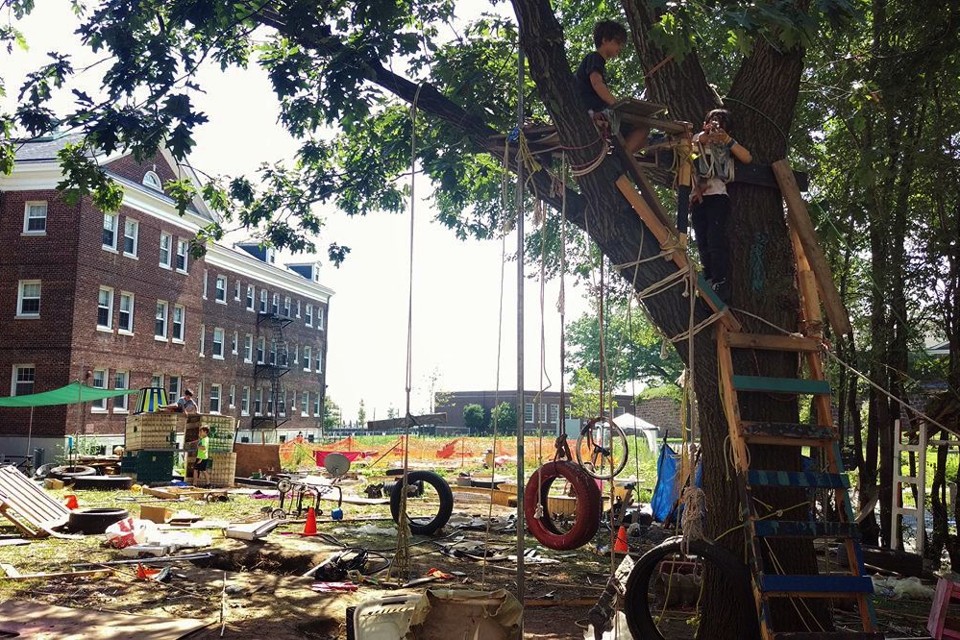
I’ve written before about outdoor nursery schools and child-directed play. Today we carry the concepts a bit further as Timothy D. Walker writes at the Atlantic about the “junk playground of New York City.”

“ ‘It looks like a dumpster playground,’ my wife told me, as we pushed our double stroller down a hill on Governor’s Island in New York City. ‘Like some slum.’

“In front of us was an area that looked like — to my eyes, at least — an Occupy Wall Street campground, with shoddy constructions of plywood, wooden palates, and blue tarp. I counted 10 children, who were roaming a space about half the size of a soccer field littered with car tires, plastic crates, orange cones, and a sea of unidentifiable debris. …

“In 1943, the first adventure playground (‘junk playground’) was piloted in the city of Copenhagen, Denmark, which was under Nazi occupation. From then on, the concept was embraced around the world, especially in Europe. A professional methodology called ‘playwork’ was established in the United Kingdom, in which trained adults (‘playworkers’) would run these environments. …

“Despite their global popularity, adventure playgrounds have struggled to gain traction in the U.S. … Peter Gray, a psychology research professor at Boston College, wrote in the American Journal of Play that free play — ‘activity that is freely chosen and directed by the participants and undertaken for its own sake’ — has declined over the past half century in America, and he inferred that a high level of parental fear about the safety of children and the rise of ‘adult-directed, school-like activities’ are two of the major causes. …

“On the ferry ride back to Manhattan, I reflected on how four  simple ingredients — junk, tools, physical space, and playworkers — could create such a powerful learning environment, where children appeared to develop their ‘Four Cs’ (communication, collaboration, critical thinking, and creativity) for hours on end. Indeed, these Four Cs were the key ’21st-century skills’ that many American schools strived to sharpen in their students, but at the junk playground, this development seemed to happen rather effortlessly through self-directed play, supported by well-trained playworkers. …

“Not only do I think playworker-run junk playgrounds represent the future of playgrounds, they seem to provide a glimpse into the future of schooling, too. Today, teachers — especially in America — are gravitating toward more active, child-directed pedagogical methods that look similar to what I observed on the junk playground: ‘project-based learning,’ ‘makerspaces,’ and ‘genius hour.’

“Finland, the Nordic nation that’s often praised as a leader in public education, is implementing its newest national core curricula this fall, in which playful learning and developing student agency are emphasized.”

Interesting, no? For me, child-directed play has always been the goal, but at the same time, I’m a safety nut. I suspect that US parents’ focus on increasing the safety of playgrounds may have something to do with the fact that fewer parents are there to watch. Just as monitoring your preschooler on a swimming trip may be something you don’t want to delegate, you may prefer to be nearby when you let your kids experiment with a junk playground.

There is more at the Atlantichere. Hat tip: Taught by Finland, on Facebook.

Read Full Post »

Erik’s sister and family are off on their five-month European sailing trip. The three children have homework to do during the first part of the trip, when they would ordinarily be in school. All five family members are contributing to a WordPress blog they call Burning Cloud. Four write their posts in English; the youngest sometimes writes in Danish. The entries are a lot of fun to read.

Here is the oldest child’s May 11 post:

this is a word for word conversation.

Klara : the first qustion is, why are we not moving

Klaus: because we are waiting for our gear to come back from the repair shop

Klara : the second question is: when are  we going to move?

Klaus: on Friday

Klara: the third question is: what is wrong with the motor?

Klaus: the gear is leaking a bit of oil.

Karl-Oscar: how will they fix the gear?

Klaus : it will be repaired in Køge  with some spare parts that are cominng form Gottenburg.

written by Axel.

Join the fun at Burning Cloud Blog. You can follow the route on maps the family posts periodically along with other entertaining pictures. (Don’t miss the photo of everyone making sushi on shipboard.)

Photo: School at sea.

Read Full Post »

In the current heat wave, I want to blog about something cool. I thought about using today’s Globe story on the Boston bar that will be made entirely of ice, but I am not into bars and the entry fee is $19.

So here is one about a tiny kingdom in the Himalayas that is cut off from the world until the river freezes. The only problem is — the river isn’t freezing as much as it used to.

“About 1,000 years ago, the Buddhists there broke away from the Tibetan Empire [and founded a kingdom] in the very north of India, in the state of Jammu and Kashmir.

“The Kingdom is isolated other than two months a year when the river freezes over and people can cross over to India.” It’s called Zanskar.

Hear more at the Public Radio International show “The World,” where guest Daniel Grushkin describes a lucky escape he had near Zanskar when a piece of ice he was stepping on broke off.

And be sure to check out the adventurer’s other excursions at his blog “Roads and Kingdoms, here.


Photo: Sumit Dayal
Trekking over the frozen Zanskar River.

Read Full Post »