Feeds:
Posts
Comments

Posts Tagged ‘affordable’

Photo: Alyssa Schukar/for NPR.
Chelsea Andrews (white hat), president and executive director of Montgomery County’s Housing Opportunities Commission (HOC), at groundbreaking for the Hillandale Gateway housing development in Maryland. The HOC owns 9,400+ home rental properties and provides subsidized housing for 9,300+ households.

Here’s how communities can build enough housing for residents: Don’t wait for the the feds.

Jennifer Ludden writes at National Public Radio, “A few miles outside Washington, D.C., a large dirt and gravel lot dotted with construction equipment was the site of a recent celebration. … It marked the kickoff for construction of Hillandale Gateway: 463 new mixed-income apartments that will be majority owned by Maryland’s Montgomery County.

“It’s public housing. Although this is a far different model than traditional, federally funded housing for only the very poor. …

“Montgomery County is a wealthy community, and it’s long focused on housing for lower-earning families. Still, it hasn’t built nearly enough to keep up with demand, and the gap is growing. So a few years ago, it took an unusual step: It created a $100 million revolving fund to dramatically ramp up construction.

“That means it can develop and finance its own projects ‘instead of waiting for Congress to give us a whole bunch more money,’ says Zachary Marks, the senior vice president for real estate with the county’s Housing Opportunities Commission. The public agency owns the controlling stake in these apartments.

“Congress has moved away from funding public housing for decades. And while there are federal incentives to help the private market build lower-cost apartments, ‘we’re using them all up every year and it’s not enough,’ Marks says.

“Now, by financing its own construction, the county doesn’t have to rely on private investors, either. Marks and others say that’s a major advantage in a boom-and-bust industry where volatility can stall financing for new projects. With the new housing production fund, he says, the amount of local money needed for a project is pretty small. And the county offers cheaper financing with a lower rate of return than private investors would demand.

“But the mixed-income model is what makes this all work in the long run. The market rate rents ‘come to us instead of flowing out to the private sector,’ says Marks, allowing other tenants to pay less. …

” ‘The people who will be living here are my seniors, my kids, my middle-aged adults, the workforce,’ says Chelsea Andrews, HOC’s president and executive director. ‘This is a community that will be inclusive on all economic levels but also in terms of our diverse communities.’ …

“Hillandale is the second project financed by the county’s fund. The first apartments, The Laureate, opened last year about a half hour’s drive away. …

“The building looks nothing like the image of U.S. public housing, most of which is generations old and severely underfunded. Among other amenities, there’s a full gym with yoga studio, a pet washing room and a courtyard pool.

“[Christina] Cooley says she immediately noticed the pool has a lift at one corner, to lower people with a disability safely into the water. … She says she has a traumatic brain injury and one side of her body is partially paralyzed.

” ‘Living here has changed my life,’ she says.

“Cooley is 43 and works part time as a teacher’s aide, but her main income is from disability. …

“Rents at The Laureate range from about $1,335 for a smaller one-bedroom — far below the county median — to $3,885 for a larger two-bedroom.

“A quarter of the units are for people making up to 50% of the area median income. In Montgomery County, that’s $77,350 for a family of four. An additional 5% of the units are called ‘workforce’ housing, for those who make up to 120% of area median income.

Importantly, says Marks at the housing commission, these apartments will be affordable permanently.

“By contrast, federal tax credits expire and lower-rent housing built with them can revert to market rate after 15 or 30 years.

” ‘There’s been a lot of uptake and interest for this model from jurisdictions of all shapes and sizes around the country,’ says Paul Williams, who heads the Center for Public Enterprise. He founded the group to push for more public development generally, including mixed-income housing financed at the local level. These projects are profitable, he says, and don’t use up other, scarce federal funding. …

“Other places that have considered or taken up the idea — sometimes called social housing, as it’s referred to in Europe — include New York and Massachusetts, as well as Chicago and Chattanooga, Tenn.”

More at NPR, here.

Read Full Post »

Photo: Melanie Stetson Freeman/CSM Staff.
Kyle Johnson (left) and Jonathan Hua-Phan create beats in a studio Aug. 24, 2023. Musicians can rent studio space for as little as $10 an hour – as opposed to the $100 an hour average rate in Boston.

Music belongs to everyone, but sometimes making music is expensive, especially if you need a soundproof studio with electronic bells and whistles. Fortunately, there are options.

Alessandro Clemente writes at the Christian Science Monitor, “Sanyé Mylo’s eyes twinkle with excitement. He is standing in the sound booth of The Record Co. in Boston, eager to bring his creation to life.

“ ‘This place is a musical creative sandbox,’ he says. With the press of a button, his latest rap track fills the room. As the speakers blast Mr. Mylo’s beat-pulsing rhythms, it’s hard to resist the urge to dance. ‘I didn’t know spaces like this existed,’ says Mr. Mylo, who grew up in the low-income neighborhood of Dorchester. ‘It’s the community. It’s the mission. It’s the energy. It’s more than just the environment.’

“Mr. Mylo is one of the young musicians in Boston who, thanks to The Record Co., has turned his music into a full-time occupation. The sound studio, located amid a graying backdrop of warehouses on Massachusetts Avenue, is an unexpected island of creativity and hope.

“Founded in 2010 by Matt McArthur, The Record Co. aims to give musicians more affordable access to creative workspaces and introduce the world of music to those who may have never considered their place in it.

“Mr. McArthur understands this challenge firsthand. As a music technology student at Berklee College of Music, he was frustrated by the high costs of renting time in production studios. …

“On average, a recording studio in Boston costs more than $100 per hour to rent. Mr. McArthur’s vision flipped that model on its head. He saw a recording studio not as a sanctuary for wealthy people but as a community hub available to all.

“He took out loans, collected donations, and opened a studio in a tiny basement in Cambridge, Massachusetts. Slowly but steadily, Mr. McArthur expanded it and eventually rented a new property to include rehearsal spaces and production suites.

“Today, The Record Co., with a full-time staff of more than 20 people, is a state-of-the-art, 12,000-foot facility that can be rented for as little as $10 per hour. Each month, it receives about 1,000 reservations, and around 3,500 musicians pass through its doors.

‘We don’t care if you’re good or trying to do it for a living,’ says Mr. McArthur. ‘Our philosophy is that every single person deserves to express their musical creativity.’

“At The Record Co., the ethos is clear: Music belongs to everyone, and so does the space to create it. The building has been shaped not only with an ear to acoustics but also with an eye to inclusivity, ensuring it is as welcoming to a musician in a wheelchair as to one who walks in with a guitar slung over their shoulder. …

“Beat the Odds serves low-income communities to help young people channel their energies into creative pursuits, and confront and discuss their mental health challenges. Thanks in part to the music production facility available at The Record Co., the group continues to expand its reach. It recently received a $600,000 grant from Boston Mayor Michelle Wu to finance its after-school programs. …

“Since rental fees don’t fully cover the operational costs, The Record Co. relies on donations. As a graduate of Berklee with her own memories of scraping by as a poor music student in Boston, Rachel Jordan says her investment feels personal. Now head of marketing for a tech startup in California, she says she welcomes the opportunity to help eliminate barriers to producing music, and she is committed to attracting investors to believe in the value of The Record Co.’s mission.

“ ‘There are so many quantitative ways to measure impact,’ says Ms. Jordan, ‘but sometimes the most meaningful way is through one human story at a time. We can talk about the economic impact of a thriving arts community, and that matters. But the artists themselves also tell the story of impact so well.’ …

“The Record Co.’s purpose becomes more meaningful in the context of the neighborhood surrounding it, which struggles with addiction and homelessness.

“In Boston, the stretch where Massachusetts Avenue intersects with Melnea Cass Boulevard is known as Methadone Mile, a reference to the addiction treatment centers that share the same block as the studio. Mr. McArthur, who lives in the neighborhood, acknowledges the challenges facing those with addictions, noting, ‘I’m not delusional to think that somebody is going to kick a chemical habit just because they got in the studio one day.’ Yet he holds that music offers a positive alternative to counter the pull toward destructive behaviors.

“Mr. Mylo can attest to the transformative power of music. He felt the one-size-fits-all educational system stymied his creativity. College seemed more like an insurmountable debt rather than an opportunity to learn and grow.

“A friend introduced him to Beat the Odds and The Record Co. Here he felt that his talent was not only recognized, but also nurtured.. .. Walls, built from years of distrust and self-preservation, began to crumble, recalls Mr. Mylo.  

“Now he works not only as a musician but also as a producer and mentor for new musicians who join Beat the Odds.”

More at the Monitor, here. No paywall.

Read Full Post »

Photo: José Hevia.
The Guardian reports on “affordable housing near Palma, Mallorca, built by Balearic social housing institute Ibavi, constructed from load‑bearing stone quarried locally.” 

The materials we use these days for constructing new buildings are generally harmful to the environment, at least in their creation. Now some architects are advocating for the old ways, the more sustainable and beautiful old ways.

Rowan Moore writes at the the Guardian, “Imagine a building material that is beautiful, strong, plentiful, durable and fireproof, whose use requires low levels of energy and low emissions of greenhouse gases. It is one of the most ancient known to humanity, the stuff of dolmens and temples and cathedrals and Cotswolds cottages, but also one whose sustainability makes it well-suited to the future. Such a material, according to a growing body of opinion in the world of construction, is among us. It’s called stone.

“Last week I sat in the roof garden of a hefty pile of masonry in central London, talking to three advocates of this magnificent substance: engineer Steve Webb, Pierre Bidaud of the Rutland-based Stonemasonry Company and architect Amin Taha. … The building on top of which we met is their joint creation: the six-storey, five-year-old Clerkenwell block where Taha has his office and his home.

“Their point is that stone has been supplanted in the industrial era by steel, concrete and mass-produced bricks, and is used (if at all) mostly as a thin cosmetic facing, while the hard work of holding up a building is done by the upstart alternatives. They argue that solid stone can once again form the walls and structure of building, with benefits for the environment and for the beauty of architecture. Any form of the material – limestone, sandstone, basalt, granite – can, depending on its properties, be used.

“Webb explains how the strength of stone compares well with steel and concrete, yet its environmental impact is far lower. The latter require several different energy-consuming activities, including extraction, smelting, transport, processing and installation. Stone only needs to be cut out from a quarry, taken to a site and put in place. Where the many ingredients of steel and concrete require multiple holes to be dug in the ground, not to mention such things as blast furnaces and rolling mills, the stonework for a given project only needs one.

“The planet, as Taha points out, is made mostly of stone. … We are in no danger of running out. For the same reason, stone should almost always be locally available, which keeps the environmental costs of transport down. The material is long-lasting and recyclable. ‘Any stone building is a quarry,’ says Bidaud. ‘It can be dismantled.’

“At the same time, 21st-century engineering allows stone to be used more effectively than ever before. The material is naturally strong in compression – that is, when loads are pushed down on it – which means it is good for walls, columns and arches, but less so if it is stretched or bent, as in beams or floor slabs.

It is now possible to combine stone with a (sparing) use of steel such that it can perform like reinforced concrete. …

“Next year, a 10-storey residential tower is due for completion on Finchley Road in north London (by Taha’s practice Groupwork and Webb’s firm Webb Yates Engineers), whose load-bearing stone structure will make it one of the most remarkable buildings in modern Britain. The three are collaborating on a grand new private house whose masonry vaults look almost medieval in their craftsmanship.

“They also cite works by others, such as an eight-storey, all-stone social housing building in Geneva by local architects Atelier Archiplein, and the Salvador Espriu project on the edge of Palma, Mallorca, whose graceful stone ceilings belie the fact that these are affordable homes built by a government housing institute called Ibavi. …

“Webb, Bidaud and Taha argue that stone doesn’t have to be costly. Taha, for example, has demonstrated that you can cut stone into bricks at the same cost or cheaper than the more usual fired-clay kind, with less than one fortieth of the carbon emissions, which has led to 10 quarries offering them as a commercial product. The problem is rather ‘forces of habit in the building industry.’ …

“Meanwhile, [2 billion] bricks of the traditional, energy-hungry, carbon-intensive kind are bought in this country every year. Steel and concrete remain the standard options for a wide range of building tasks. Webb is scathing about professional inertia on the subject, about architects ‘who protest about climate emergency, cycle to work and eat locally grown tomatoes’ but don’t examine their own decisions about construction techniques.

“You can get a glimpse of the highly appealing alternatives in a display at the Design Museum in London, How to Build a Low-Carbon Home, where the work of Taha, Webb and Bidaud is on show (until March 2024) alongside structures in wood and straw. …

“Who could look at the solid stone structure of, for example, the Mallorcan social housing, where the forces of nature and the work of humans is evident in the fabric, and prefer the processed surfaces and plasticized finishes of their British equivalents? And the great thing about stone is that, having been used for millennia, it’s well tested.” More at the Guardian, here.

Construction in the UK is often shoddy. Consider the tragic Grenfell Tower fire, here, and the completely avoidable death toll. “The fire was started by an electrical fault in a refrigerator on the fourth floor. This spread rapidly up the building’s exterior, bringing flames and smoke to all residential floors, accelerated by dangerously combustible aluminum composite cladding and external insulation, with an air gap between them enabling the stack effect.”

My husband has been following that story and says more has been spent on lawyers than on fixing the materials in buildings or adding sprinklers.

Read Full Post »

Photo: 2Life Communities.

Back in June, I was listening to the radio in the car and heard a local interview with poet Billy Collins. Collins was in the area for a 2Life Communities fundraiser. In searching for more information on 2Life Communities, I found this 2021 story from GBH radio. Turns out, there actually exists, through a lottery system, an affordable and very diverse option for retirement in Greater Boston.

Marilyn Schairer reported, “Some senior adults living in and around Boston face a major life dilemma nowadays, especially when they retire and are on a fixed income: they have to choose between paying for heat, for food or for rent.

“That’s what 2Life Communities is working to change. The nonprofit is on a mission to help senior adults live in affordable housing in the Greater Boston area, with over 1,300 units and hundreds more in planning and construction stages, as demographic shifts leave more older Americans burdened by housing costs.

“Amy Schectman, president and CEO of 2Life Communities, said 2Life does more than just provide housing for middle- and low-income senior adults.

“ ‘We’re dedicated to the proposition that every older adult should have the opportunity to live a full life of connection and purpose in a dynamic, supportive environment,’ she said.

The organization’s mission brings together a community of people from all backgrounds and cultures. …

“A major demographic shift is underway in the United States as the baby-boomer generation ages. By 2030, one in five Americans will be 65 years old or over, according to the U.S. Census Bureau.

“But Schectman said only a third of older adults who qualify for subsidized housing actually receive it nationwide. The remainder, as found by Harvard Joint Center for Housing Studies, are ‘housing cost burdened,’ Schectman said, ‘meaning they’re spending an inadequate [amount on] money on food and medicine.’

“Currently, 2Life Communities has 1,340 affordable apartments on six different campuses in the Greater Boston area, including Newton and Framingham, and they’re looking to build another campus in Lynn. … Tenants at 2Life are selected through a lottery system, and the waitlist is long. …

“Tenant Darryl Smith won an apartment in the lottery three years ago, and he is thrilled.

“ ‘Oh man, I’m jumping for joy,’ he said. Smith, who is in his 70s. …

“2Life was formed in 1965, and back then it was called Jewish Community Housing for the Elderly. Schectman said the new name is meant to convey a sense of joyous aging, and it comes from a traditional Jewish or Hebrew toast: ‘L’Chaim,’ which means ‘to life.’

“One of the things tenants said they like about the living situation is the diversity. Resident speak a plethora of languages, and there are lots of people from the Boston area, of course, but many are immigrants, representing countries such as China, Ukraine and Belarus. …

“ ‘The end of the year is a big time of giving,’ she said. ‘And let me be clear, we can’t do what we do without philanthropy. We are 100% dependent because we believe you can’t chintz out on services and programs.’

“The median annual household income among residents is $12,078, according to Schectman. But even with federal subsidies and tax credits, she said partnerships with businesses like Dellbrook Construction are needed. Dellbrook’s CEO Michael Fish said he understands the need for organizations like 2Life Communities.

“ ‘The fact that they’re expanding and growing tremendously is not surprising whatsoever, and it’s incredibly necessary given the state we are in and the need for affordable housing for seniors,’ Fish said.

“And tenants like Darryl Smith feel a lot of gratitude for having a newfound home.

“ ‘I’ve got friends now that you can go right to,’ he said, noting the sense of community. ‘If you have any kind of problem, they’ll walk with you, and everybody’s smiling.’ ” More at GBH, here.

As my husband and I scout retirement communities, we realize that although we are fortunate enough to be able to pay the costs, we are going to lose out on contact with people of diverse backgrounds. Diversity of nationality, religion, and language is often tied these days to economic diversity. I will just have to keep volunteering with English as a Second Language classes. For me, making friends in those classes is truly enriching.

Read Full Post »

Photo: Nadia Abdullah via Sentinel Source.
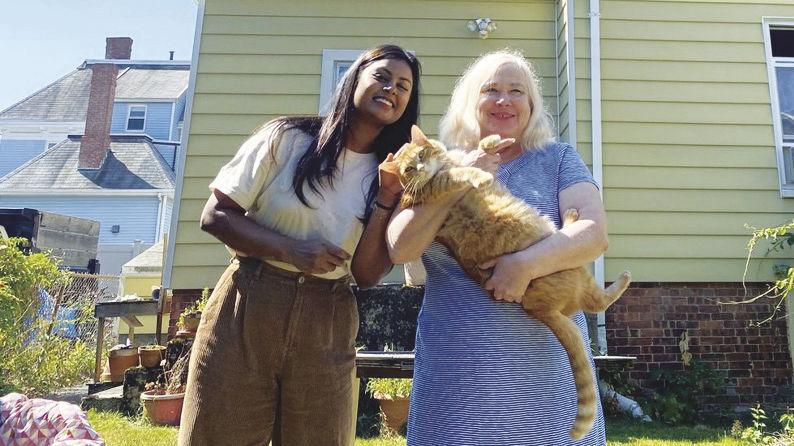
Nadia Abdullah, 25, with Judith Allonby, 64, holding Mango the cat, have been roommates in Malden, Mass., since 2019.

Pretty much all my friends are investigating what Roz Chast calls Places or else at-home services — especially if they expect to need assisted living or memory care eventually. According to today’s story, there’s an interim step, particularly for seniors who live alone, and it’s gaining in popularity.

Cathy Free reports at the Washington Post, “Nadia Abdullah was on the hunt for an affordable apartment in the Boston area a few months before she graduated from college.

“ ‘It was a little frustrating because I couldn’t find anything in my budget,’ said Abdullah, 25, who was sharing on-campus housing with four other students until she graduated from Tufts University.

“At the same time, Judith Allonby, 64, was debating whether to move out of her family’s old home in Malden, Mass., after her parents died. Her two-story house seemed too large for one person and it required a lot of upkeep, but she liked the neighborhood.

“ ‘I rely on public transportation,’ said Allonby, an attorney.

“Then she and Abdullah discovered an alternative: an intergenerational housing arrangement that would benefit them both. While researching their options, they each learned about Nesterly, an online home-sharing agency that matches young renters with not-so-young people looking to supplement their incomes and share their space.

“Abdullah and Allonby each passed the agency’s background check, then they were paired in an arrangement designed to fit their specific needs: Allonby would rent the first floor of her home to Abdullah for $700 a month in exchange for help with the housework and gardening and occasional grocery runs. And Abdullah would get a safe and spacious place to live just six miles from Boston and a 30-minute drive from her robotics engineering job in Beverly, Mass. …

“Allonby said she was surprised at how compatible they turned out to be. ‘It’s really nice to have somebody else around, and Nadia brings a different atmosphere and energy than I had with my 88-year-old mother,’ she said. ‘Nadia is definitely not listening to Frank Sinatra.’

“About 18 percent of Americans live in multigenerational households — meaning two or more adult generations — according to a study from Pew Research Center published this year. Such arrangements have quadrupled in the United States since the 1970s, with about 60 million U.S. residents now living with adults who are of a different generation, according to the study.

“Contributing to that trend is that more young people are priced out of the housing market and more seniors want to age in place, said Donna Butts, executive director of Generations United, a D.C.-based organization that focuses on programs and policies that connect generations. …

“In the United States, several universities foster such arrangements, including Winona State University in Minnesota, Quinnipiac University in Connecticut and the University of California at Berkeley, which has an intergenerational housing program that started in 1986.

“At Drake University in Des Moines, music students are given the opportunity to live rent-free at a local senior living center in exchange for performing several times a month for the residents.

“Molly McDonough, a 22-year-old vocal performance major, recently moved into Wesley Acres, a senior living community that offers everything from independent apartment life to long-term care. …

“She said she was happy to find a pleasant, one-bedroom apartment waiting for her last month on the center’s fourth floor. ‘It came fully furnished, with towels, dishes and anything else I needed,’ McDonough said. ‘They also allowed me to bring my two cats.’ …

“McDonough now often shares meals with senior residents in the communal dining room and she enjoys hearing their life stories. …

“Shortly after she moved in, she found a note on her door from Arlene DeVries, 81, who lives at Wesley Acres with her husband, Fred DeVries, 83.

“ ‘Arlene wanted to give me a tour of Wesley Acres and I found out she’d also been a voice major at Drake,’ McDonough said. ‘Right away, we became good friends.’ …

“In Canada, college students and seniors are moving in together, too.

“Michael Wortis, 85, a retired physics professor from Burnaby, B.C., near Vancouver, said he was intrigued when he received an email last year from Simon Fraser University, where he’d taught for 15 years.

“The university had recently started an intergenerational housing program with Canada HomeShare. Wortis, whose wife died of Alzheimer’s disease in 2015, decided that he could use a little help around the house, in addition to someone to chat with.

“He was matched with Siobhan Ennis, 27, a health sciences graduate student who had been living with three roommates and was looking for some quiet study space.

“In exchange for $400 a month to rent the bottom level of Wortis’s home, Ennis now mows the lawn and helps clean up around the house, and she and Wortis dine together several times a week. They also garden together and have movie nights. …

“As a bonus, Ennis makes terrific stir-fries, he said, and she’s better at figuring out problems with high-tech equipment than he is.

“Ennis said she believes that she actually benefits the most from the arrangement.

“ ‘Michael is such a great person — I love having him as my roommate,’ she said. ‘There is always something to talk about and he’s always direct and thoughtful. We’ll be friends for life.’ ”

More at the Post, here. See my 2019 post on Nesterly here.

Read Full Post »

Photo: Donnel Baird.
Donnel Baird is the founder and owner of BlocPower, a Brooklyn-based energy technology startup that markets, engineers, and finances renewable energy and energy efficiency technologies to buildings in underserved market segments.

This article starts by showing how a professor and a college friend helped motivate a young man depressed about race in America and then describes how he turned himself into a force for change.

Sarah Kaplan writes at the Washington Post, “Donnel Baird kept his coat on while he toured the aging sanctuary. His breath froze on his face mask as he took in the peeling plaster, the dusty basement, the failing boiler that never seemed able to make Bright Light Baptist Church warm.

But when he peered into the kitchen, the shiver he felt was one of recognition. Every burner on the stove was lit. The oven door was open, its temperature set on high. It was exactly how Baird’s family tried to heat his childhood home more than three decades earlier, in another Brooklyn building with a dysfunctional HVAC system.

“The landlord wouldn’t address the problem, and the family couldn’t afford to move. So they stayed, the need to keep their children warm outweighing the danger of toxic fumes and open flames.

“Baird, 40, has made it his life’s work to ensure other people don’t have to make that choice.

“That’s why he launched BlocPower. Since its inception in 2012, his Brooklyn-based start-up has brought clean energy to more than 1,100 low-income buildings across the New York area. Baird’s business plan is simple: the company replaces heating and cooling systems that run on fossil fuels with greener, more efficient alternatives such as electric heat pumps and solar panels. That reduces the pollution driving climate change while also making indoor air healthier. The gains in efficiency generate enough savings to lower costs for property owners and deliver a profit to BlocPower investors. And the renovations create jobs and increase property values, building wealth in neighborhoods that have long been marginalized. …

“The foundations for BlocPower were laid during Baird’s childhood in Bedford-Stuyvesant, a Brooklyn neighborhood just a few miles from Bright Light. It was a community with a spirit of civil rights activism — the center of school integration protests; the home district of Rep. Shirley Chisholm, the first woman and African American to seek a major party’s presidential nomination in 1972. But the area had also been depleted by predatory real estate practices and ravaged by the crack epidemic.

“By the 1980s, when Baird’s parents emigrated from Guyana, the neighborhood was at a nadir. Buildings were in disrepair, jobs were hard to come by, tensions with police were high. As an elementary-schooler, Baird witnessed a fistfight escalate into a deadly shooting. That taught him about desperation, he says; when someone pulls the trigger, it’s because their back is already against the wall.

“Baird’s family eventually moved to Atlanta, where Baird got scholarships to attend a private high school and then Duke University. Surrounded by Whiteness, wealth and privilege, ‘I really started to see the structural elements of racism in America,’ Baird said.

“Then police in the Bronx killed an unarmed Black man named Amadou Diallo, firing 41 shots at him. The immigrant from Guinea was only a few years older than Baird and had been standing in front of his apartment building when he was killed.

“Baird sank into a deep depression. He might have stayed there if he hadn’t wound up in a course at Duke about social movements taught by historian Larry Goodwyn. He became close with the professor, who called the struggling sophomore into his office one day and told him, Baird recalled, to ‘get my s— together.’

“ ‘He said, “You’re so smart, there’s no excuse for you not to figure out how to plug in and get active on the issue of race,’ ” Baird said. …

“After graduation, Baird moved back to New York to work as a community organizer, then got a job partnering with the Department of Energy to retrofit low-income houses so that they used less energy and cost less to heat.

“Roughly a third of U.S. households have trouble paying energy bills, according to the Energy Information Administration. Wealth disparities and decades of racist housing policies mean that Black and Latino Americans are disproportionately likely to live in homes with broken or inefficient HVAC equipment that is more expensive to operate.

“This energy inequality is a public health crisis: aging gas and oil furnaces — as well as the stoves and ovens used to supplement them — can fill homes with dangerous pollutants. A recent MIT study found that ozone and lung-irritating particles from buildings are the nation’s biggest cause of premature death from air pollution. In the neighborhood around Bright Light, where 67 percent of rented homes suffer from maintenance defects, children are hospitalized for severe asthma at twice the citywide rate.

“It’s also an environmental crisis. The energy needed to heat, cool and operate buildings produces almost a third of the United States’ planet-warming emissions.

” Working on buildings ‘brought all the themes of my life together,’ Baird said. ‘The racial justice stuff, the economic justice, the climate stuff.’ …

“Baird began to envision a company that could raise huge amounts of capital and use it to finance green retrofits in low-income buildings. Investors would be paid back out of a portion of the utility bill savings. Baird would make the venture profitable by embracing technology and seeking out partnerships every step of the way.”

Read how he established his company, BlocPower, here, and what it has accomplished so far.

Read Full Post »

Photo: Story Hinckley
By following strict “passive house” standards, a multifamily affordable-housing complex in  Portland, Maine, slashes heating costs.
“Sometimes we turn off the heater because we feel so good,” says one resident.

The modern tendency to look at the old ways of doing things as some sort of backward stage of human development is being proved misguided again and again. In this story, heating and cooling costs are slashed by using an approach that, in part, taps the wisdom of first century BC.

Story Hinckley writes at the Christian Science Monitor, “Cities like Portland, Maine, have realized this energy-efficient design for the affordable housing sector – for residents who can really benefit from lower heating costs.

“Passive house-certified buildings are slightly more expensive to build upfront, but the heat and electricity bills are less than half of what it typically costs to heat a similar building in Portland.

“Passive house design is more than just an architectural novelty, says the team behind Bayside Anchor. It is also a necessary tool for residents or homeowners who care about long-term affordability. As the need for affordable housing grows across the United States, proponents say cities should move beyond building low-income housing as cheaply as possible. …

“Says Greg Payne, director of the Maine Affordable Housing Coalition and development officer at Avesta Housing, the nonprofit affordable housing provider that manages Bayside Anchor, ‘We have to promise that [the building] will be affordable for 45 years.’

“Before moving to Bayside Anchor two years ago, MD Islam, his wife, and their two young children lived in a home without heat.

“ ‘We had to suffer a lot,’ says Mr. Islam, who works at a local recycling plant. ‘Now my family – everybody – is happy. We feel very comfortable.’

“A high-tech ventilation system exchanges indoor air with fresh air from outside, all while retaining the temperature of the indoor air. Thick walls (with 10 inches of insulation, in Bayside Anchor’s case) and triple-pane windows keep the building airtight so very little heat escapes. Instead of a central heating system, each apartment has a small electric baseboard heater. …

“ ‘Sometimes we turn off the heater because we feel so good,’ says Mr. Islam. …

“Property manager Lucy Cayard [says] the passive house design has helped her build a deeper connection with the residents. Since much of the building takes care of itself, the building’s staff can put their time and resources elsewhere.

“ ‘We get to focus more on people’s needs and not the building’s needs,’ says Ms. Cayard. …

“The concept of passively heating and cooling a building is probably as old as architecture itself. Writing in the first century B.C., the Roman architect and military engineer Vitruvius observed that buildings in warmer climates tended to have northern exposures, with windows facing away from the sun, while those in cooler climates had southern exposures. Modern passive house techniques trace some of their history to energy-efficiency efforts in the U.S. during the OPEC oil embargo. The principles underlying Bayside Anchor’s design are further based on techniques honed by scientists in Europe in the 1980s and 1990s. …

“But with a national shortage of 3.7 million affordable rental homes, according to a recent report from the National Low Income Housing Coalition, new building approaches need to be explored. For example, says Mr. Payne, almost 600 households are currently on the waitlist for one of Bayside Anchor’s 36 affordable units.

“ ‘We are watching it happen all across the country,’ says Jesse Thompson, the Portland-based architect behind Bayside Anchor. ‘What’s different about Maine is that it’s the affordable housing folks who are the most progressive, who are moving the most quickly.’ ”

More here.

Read Full Post »

A while back, I showed a photo of a very skinny building near my workplace. Now I have some professional photos from the Providence Revolving Fund, and I think they convey the uniqueness of this building better than my photograph.

I love how Providence works so hard to repurpose old and interesting buildings. This one is only a piece of an old building. Once condemned, it is now lovely and functional.

Here’s what the Providence Revolving Fund had to say before the dedication in May. “The partnership of David Stem, Lori Quinn and the Providence Revolving Fund announce the completion of the formerly-condemned George C. Arnold Building (built 1923).  The Providence Redevelopment Agency (PRA) also played a pivotal role in the revitalization of this unique building.

“The mixed-use building houses two commercial units (Momo and a soon-to-be-opened [Asian] market) and three residential units.  Two of the units are rented at affordable prices.  The historic building rehabilitation was self-financed by the partnership and utilized Federal and State Historic Tax Credits and City of Providence Home Funds.”

I’ve noticed that most Providence buildings have names and people use the names, as if the buildings were pets. When you call something by its name, it strengthens your bond to it.

I’ve had the teriyaki chicken crêpe at Momo a couple times. Messy but delicious. I’m eager for the Asian market to open.

skinniest-building-ever

051216-Arnold-Bldg-Prov-Revolving-Fund


051216-Arnold-Bldg-Prov-Revolving-Fund2

051216-Arnold-Bldg-Prov-Revolving-Fund-Momo


Read Full Post »

In Helsinki, Finland, where young people traditionally leave home at 18 but can no longer afford urban rents, Millennials are applying by the hundreds to live with the elderly.

According to Kae Lani Kennedy at Matador Network, “Retirement homes are serving as more than a community for the elderly. These facilities are providing affordable housing for the city’s growing population of homeless millennials.

“ ‘It’s almost like a dorm, but the people aren’t young. They’re old,’ explains Emil Bostrom, a participant in ‘A Home That Fits,’ a new housing project that allows millennials to move into retirement communities. Bostrom is a 24-year-old kindergarten teacher, and though he has a steady income, it is not enough to compete with 90,000 other renters in a city that has roughly 60,000 affordable rental properties. …

“Bostrom, along with many other young adults, can enjoy discounted rent in exchange for socializing with the seniors in their community. …

“By interacting with a younger generation, the elderly involved with ‘A Home That Fits’ have the opportunity to be engaged in an active and diverse community, instead of being left behind in a forgotten generation.” More here.

And check out a post I wrote about the same phenomenon in Cleveland, here. Both initiatives sound like fun to me.

Video: Seeker Stories

Read Full Post »