Feeds:
Posts
Comments

Posts Tagged ‘africa’

Photo: Filippo Bertozzo​​, Fabio Marco Dalla Vecchia​, Matteo Fabbri via Wikimedia Commons.
Ouranosaurus bones are among the many wonders found in Niger. For scale, the right femur is about a yard long.

Niger turns out to be a treasure trove for paleontology and archaeology, and as Nick Roll reports at the Christian Science Monitor, the country is working to develop enough local experts to deal with the riches. It’s not so farfetched in a place where nomads are already texting researchers about archaeological finds.

“Goats, cows, and pedestrians wander by the two unassuming shipping containers along a street in Niger’s riverside capital without a second thought. But inside lie nearly 50 tons of dinosaur bones wrapped in plaster – potentially some of the most significant paleontological finds this landlocked West African country, and even the continent, has ever known.

“There are fossils from perhaps as many as 100 different species, some of them from ancient animals never seen before. 

“ ‘Small animals, mammals, flying reptiles, turtles’ as well as a 40-foot crocodile and ‘a dozen large dinosaurs that are new, including huge 60-footers, says American paleontologist Paul Sereno.

“Getting them to the capital was years in the making – and their journey isn’t over. The initial discoveries were made in 2018 and 2019, in the vast expanse of the Sahara Desert. It would take time and funding for a proper dig, though, so the paleontologists covered them up and buried them, hoping the winds wouldn’t expose them to curious nomads or dangerous smugglers. 

“Then COVID-19 hit, shutting everything down until finally, last fall, Professor Sereno could return to unearth the fossils again.  

“ ‘Niger is going to tell Africa’s story during the dinosaur era,’ he says. …

“The bones, soon to be shipped to Dr. Sereno’s lab at the University of Chicago for research, represent paleontology’s latest win against the harsh desert environment of Niger, which is home not only to fossils but also to soaring temperatures, shifting dunes, and various armed groups.

“But Chicago won’t be the bones’ final resting place. The fossils are earmarked to be eventually returned to Niger, where the kernels of a formal paleontology sector are being planted in a country that contains some of the richest paleontological finds in Africa but boasts no paleontologists of its own, or even academic programs dedicated to the field. 

“ ‘Each time, we see that we find new dinosaurs, new fossils that permit us to say that the soil is rich – unlike other countries, and other continents,’ says Boubé Adamou, an archaeologist at the Institute for Research in Human Sciences who, as one of Niger’s foremost experts on excavations, helped lead this most recent expedition. …

“In a convoy speeding through the desert last fall, the team of about 20 found themselves massively outnumbered by scores of armed men riding in machine gun-mounted trucks. Those were just their guards, determined to keep this modern-day Saharan caravan safe from smugglers or bandits roving the dunes. …

“The team, composed of researchers and students from the United States, Niger, and Europe, went to three dig sites over three months. By the time they finished in December, they had unearthed everything from an Ouranosaurus with a 25-foot-long, bony ‘sail’ across the length of its back to the 6-foot thigh bone of a long-necked sauropod. …

“The vast expanses of Niger were [once] anything but dry, as rivers, wetlands, and lakes stretched across what researchers called the Green Sahara, home at one point to dinosaurs, and later, ancient human civilizations with embalming techniques that predate the Egyptians – relics of which were also found on the fall expedition. …

“It’s easy to see why Niger remains off the beaten path for paleontologists, despite its riches. As one of the poorest nations on Earth, it combines rough infrastructure with harsh desert conditions.

“But even if the Green Sahara is a thing of the past, the desert today is anything but desolate. Local nomads who’ve long mastered the difficult terrain have become key to conducting paleontology there, spotting bones and leading expeditions through otherwise unnavigable desert expanses. While the pandemic held Dr. Sereno’s team at bay, nomads kept a watchful eye on the carefully buried treasures, texting him updates. …

“Niger Heritage is a project drawn up by Dr. Sereno, Mr. Adamou, and coterie of international and Nigerien researchers and government officials. It envisions two museums [with] the capacity to not just display the fossils but also, for the first time, conduct homegrown research. …

“Niger’s first paleontologists, it is hoped, might be in undergraduate courses right now. With the right guidance and funding – to do Ph.D. programs outside the country – they could start correcting the lopsided nature of paleontology, where resources and opportunities are concentrated in rich countries.”

More at the Monitor, here. No firewall. Subscriptions encouraged.
Read Full Post »

Photo: Disney.
Cape Town residents Nadia Darries and Daniel Clarke co-directed Aau’s Song, the final short film in the second volume of the Star Wars: Visions anthology.

I had just given birth to Suzanne when neighbors offered to help out by taking John to Star Wars. He was five, and that was the moment that Star Wars became a big deal in our family.

It was a big deal around the world, too, and today’s story shows that its lasting popularity in Africa has recently led to Disney and Lucasfilm blessing an African version.

Ryan Lenora Brown reports at the Christian Science Monitor, “When George Lucas first created the Star Wars universe [he] probably didn’t imagine extraterrestrial worlds crawling with fynbos, the brightly colored, prickly shrub land of South Africa’s Western Cape. Nor did he likely envision his Jedi warriors channeling the energy of sangomas, southern African traditional healers. 

“But when South African filmmakers Nadia Darries and Daniel Clarke were asked recently to create their own version of the Star Wars universe for an animated short film, their alien world bore distinct imprints of their Earthly homeland. 

“ ‘We weren’t super intentional about it, but of course we are South Africans, so we are drawing on real experiences from our own world,’ says Ms. Darries, an animator from Cape Town whose work has appeared on the BBC.

“The pair’s 15-minute film, Aau’s Song, is part of a recently released anthology called Star Wars: Visions, in which animation studios from around the world were invited to re-imagine the famous fantasy universe through their own eyes.

The resulting shorts feature Jedi in saris, anime-inspired Sith lords, and lightsaber-wielding teenagers with thick Irish brogues. …

“Since its inception, Star Wars has been the world’s darling. And its films have long had a dedicated following across the African continent. In 2015, for instance, The Force Awakens had the single most profitable opening day in South African cinema history to that point. And the Earthside location of Darth Vader’s twin-mooned home planet, Tatooine, is in Tunisia, where it’s been a popular site of pilgrimage for both local and international fans. 

“But the franchise itself has often been slow to reflect back the diversity of its audience. …

“ ‘As someone growing up in South Africa, my perception of sci-fi and fantasy was that the central character will have pale skin, speak English, and probably be a man,’ says Omar Morto, a South African radio presenter, musician, and lifelong Star Wars fan. 

“In recent years, however, Star Wars has made strides to look more representative of planet Earth, featuring protagonists of color and female characters who actually speak – sometimes even to each other. But its universe is still being imagined, largely, by Westerners. 

“Two years ago, Lucasfilm, the Star Wars production house, released a series of short, Star Wars-inspired films made by Japanese anime studios called Star Wars: Visions. The reaction to that series was so positive, producers said, that they decided to create a second volume, this time featuring animators from around the world. …

“For Ms. Darries and Mr. Clarke, who made Aau’s Song with the South African studio Triggerfish, the project never felt quite so cosmic. They simply wanted to tell a story that meant something to them, Mr. Clarke says. 

Aau’s Song takes place on a planet called Korba. Its inhabitants mine the kyber crystals used in lightsabers, which have been corrupted by the Sith of the Dark Side. Enter Aau, a young girl who has a magical singing voice that can alter the crystals – and a protective father afraid she’ll put herself in danger if she uses it. …

“It [felt natural to Ms. Darries], she says, that the story’s wise woman – a visiting Jedi named Kratu – would resemble a kind of wise woman found in her own family, a sangoma, or diviner. Like Jedi, who often act as peacekeepers and have the power to connect to people’s thoughts, sangomas heal personal and social rifts in part via their connections with the ancestral world. 

“And though the story is about a girl with the power to purify lightsaber crystals, Mr. Clarke says they saw it as fundamentally being ‘about a character healing a poisoned land, which is a very South African story.’ 

“Mr. Morto, the radio presenter, says he can still remember the rainy Cape Town afternoon in the 1990s when his uncle came back from the video rental store with Return of the Jedi. … ‘Since then, it has been my life,’ he says. 

“And so, seeing a Star Wars universe that looked like South Africa in Aau’s Song ‘was special to experience.’ ”

More at the Monitor, here.

Read Full Post »

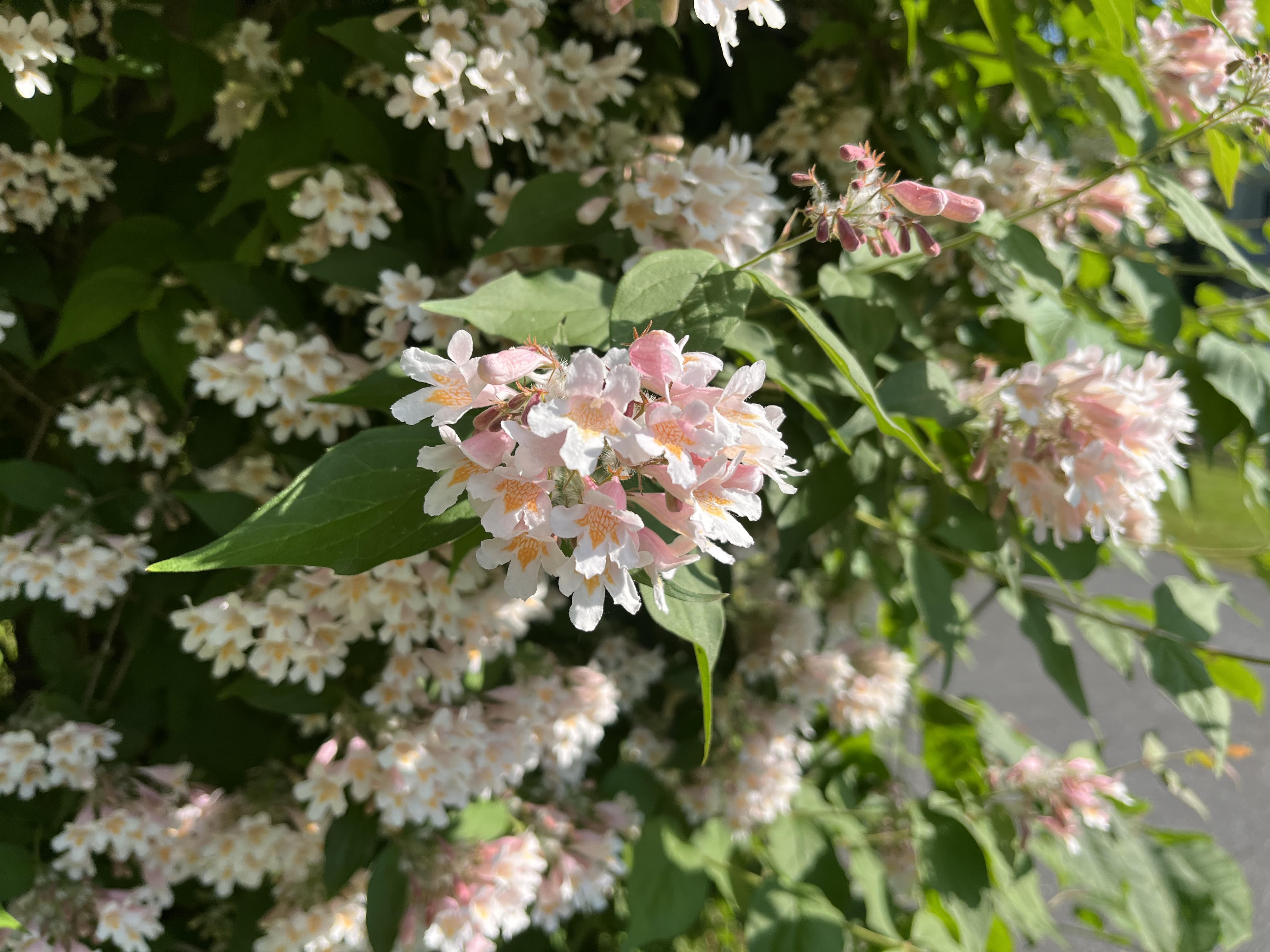
Photo: John and Suzanne’s Mom.
The PictureThis app calls this Beauty Bush. If you want to use the app, note that they try to hide the spot where you click “cancel” to get the free part.

Today’s article, by Michael J. Coren at the Washington Post, will be useful for anyone who walks outside and wonders what kind of flower or tree that is, what bird has that unusual song. It’s a post about apps. I myself use these freebies: Merlin for bird identification and PictureThis for plants (thanking Claudia for that tip).

From Coren: “First I see the wall barley, like tiny fields of wheat on the side of the road. Then a profusion of musk stork’s-bill overflowing with purple flowers. That’s just the crack in the sidewalk. By the time I reach my office, I’ve identified dozens of species, most unknown to me a few hours earlier.

“I’m not a master naturalist, but I have one in my pocket. Thanks to artificial intelligence trained on millions of observations, anyone with a smartphone can snap a picture or record a sound to identify tens of thousands of species. …

“It’s the kind of thing I would normally miss while walking or pedaling to work. Birdsong might be gorgeous but I’d barely hear it. I’d note ‘pine tree’ as a catchall for conifers.

“That has changed. I’m now on a first-name basis with most of my wild neighbors. It has reconnected me to a natural world I love. ….

“For 2.5 million years, humans spent a huge share, if not virtually all, of their time outdoors. Today, many adults are spending more hours on screens than outside.

“Nature is even disappearing from our books, songs and culture, say researchers who looked at nature-related words in popular works during the mid-20th century. Our mental and physical health has declined alongside our estrangement from the outdoors. …

“This new generation of naturalist apps is the Rosetta Stone to the natural world. Reestablishing relationships with your outdoor neighbors might not only transform your commute, it might change your life. There are more than a dozen apps promising to help you identify the natural world, many of them paid. Don’t bother.

Four apps, designed and managed by scientists with world-class data, meet all your ID needs free of charge. And every observation will advance our scientific understanding of the natural world.

“The easiest to use is Seek. The app, an offshoot of iNaturalist, a joint initiative of the California Academy of Sciences and the National Geographic Society, lets you shoot live video. It automatically grabs frames and analyzes them. The augmented reality experience is like downloading a foreign language into your brain. The app identifies the taxonomy of plants and animals instantly as you shoot. If it can’t figure out the species, it will give you its best guess.

“In less than an hour, I had racked up dozens of plants and insects near my house from Bombus vosnesenskii, a native yellow-faced bumblebee, to the purple-flowered bush lupine it was buzzing around. The only drawback? The app doesn’t include deeper context about the species it identifies.

“For that, there’s iNaturalist and Pl@ntNet. Both offer sophisticated, if slightly less user-friendly, apps that upload and analyze photographs of flora. In seconds, they typically return a ranked list of potential candidates with rich descriptions of each. The identification of the most common species is a slam dunk. For rarer ones, it’s easy to compare your observation against those of others in the database.

“The apps’ real superpower is the community around them: Millions of citizen scientists who can vet and confirm your observations. It’s particularly satisfying to watch your skills — and ranking — rise in the apps as you get to know your neighborhood. When you’re ready to up your game, download these apps.

“Finally, there’s Merlin Bird ID, a project of the Cornell Lab of Ornithology. Merlin feels like magic. The app uses a phone’s sensitive microphone to identify bird vocalizations in the sonic landscape around you, painting a visual representation or sonogram analogous to a musical score. …

“Merlin has permanently changed how I hear the world. I can now tune in to birdsong operas that had never entered my consciousness. Within a day, I was able to recognize distinct calls without consulting the app. …

“But the apps are more than tools to get acquainted with nature. They’re pushing AI identification — and conservation — forward. Recognizing natural inhabitants, and our relationship to them, helps us rediscover what remains and protect it.

“ ‘We’re just at the beginning of actual real scientific progress,’ says [Grant Van Horn, a machine learning researcher at the Cornell Lab, who helped build Merlin’s sound ID feature]. ‘And none of this stuff happens without a passionate group of people that helps you curate, train and evaluate the data.’ …

“The first big breakthrough came around 2018 from Snapshot Serengeti, a research project using digital camera traps to photograph thousands of migrating African animals. Organizing this enormous collection featuring a variety of animals, from wildebeests to giraffes, proved overwhelming for the small team of scientists.

“So researchers enlisted thousands of online volunteers to sort and label more than 3 million images. That allowed Jeff Clune, then a computer scientist at the University of Wyoming, and his collaborators to unleash algorithms on what was at the time the world’s largest collection of labeled wildlife images. The new algorithms could identify animals in 99 percent of images with the same accuracy as human volunteers, around 97 percent. …

“Citizen science-powered algorithms are now going beyond individual organisms. They’re mapping their relationships to an entire ecosystem, from the flower a butterfly pollinates to the leaf where the insect lays its eggs.

“ ‘My goal is to turn ecosystems into fire hoses of data,’ says Clune. ‘In the same way a video game company knows everything that happens inside their system, we should know that for the Amazon rainforest. Imagine what that would mean for science.’ …

“Ultimately, the apps’ greatest breakthrough may not be technological at all. It may be raising our awareness. We are nearly blind to entire categories of living creatures. In her book Braiding Sweetgrass, Robin Wall Kimmerer described it as ‘being lost in a foreign city where you can’t read the street signs,’ a form of species loneliness. While these plants and animals are our neighbors, we scarcely acknowledge their existence, let alone their right to exist. …

“This could reverse one of the great losses of the past century: our severed connection to the unique, wild character of where we live.”

More at the Post, here.

And speaking of technology that gets you closer to nature, check this live camera in the early morning East Coast time to watch an osprey feed its baby. Catch it soon, before the baby fledges.
http://198.7.226.69:8023/#view

Read Full Post »

Photo: Guy Peterson/Special to the Christian Science Monitor.
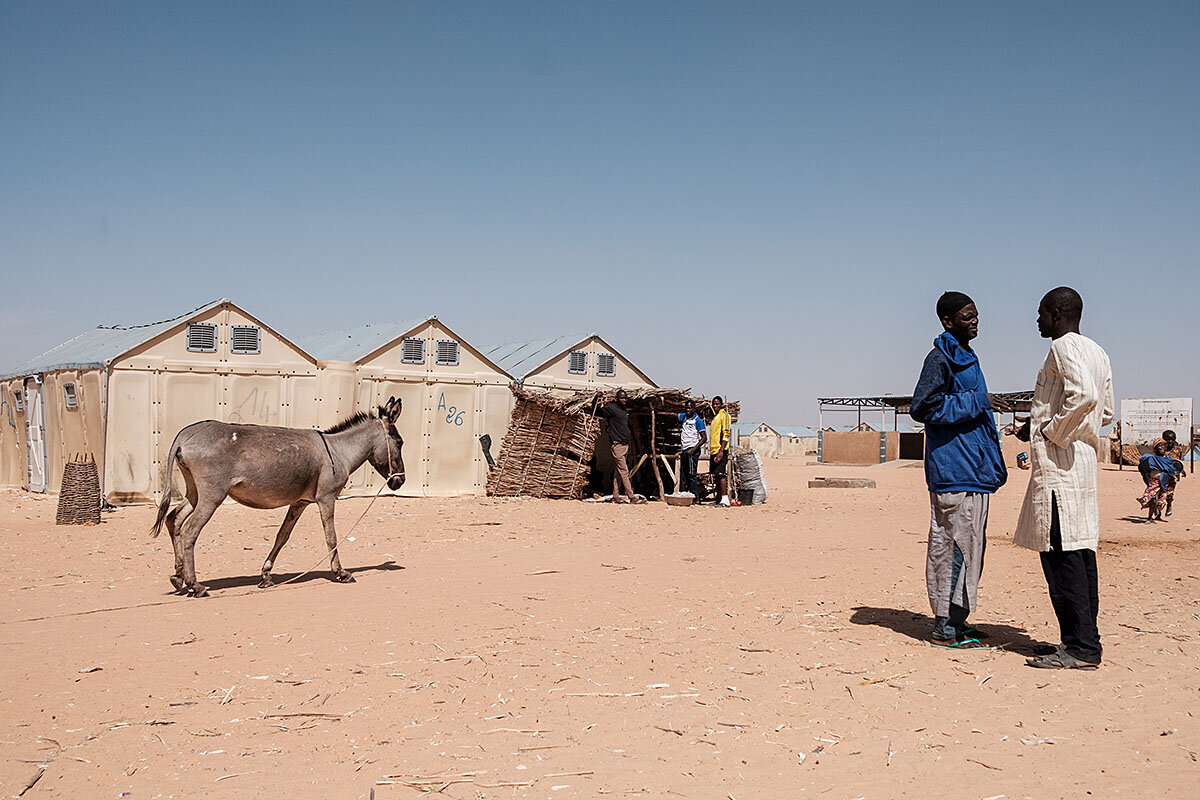
In Niger, the poorest of the poor are protecting refugees on the run.

When I was chatting with blogger Will McMillan after one of his recent concerts, he said he noticed that at my blog, I seemed to seek out stories to cheer people up. I said, “To cheer me up, too.”

A great source for such stories is the internationally focused Christian Science Monitor (CSM). The news site is not unrealistic about the world’s challenges, but it looks for the good people and positive developments it knows are out there.

Here’s a CSM story by Nick Roll set in an impoverished part of Africa.

“Yacouba Aboubacar has an unusual way to measure the welcome he received as a refugee in Niger. 

“His razor blade.

“It takes a certain amount of trust, after all, to let a stranger cut your hair – and a good deal more to allow him to circumcise your baby. But since Mr. Aboubacar fled here from neighboring Nigeria in December, he has found his services as a barber and circumciser constantly in demand.

“Some of that work comes from other refugees, with whom he lives in a sea of white tents huddled on the edge of this small village. But much of it comes from the locals who inhabit the mud-brick houses in town. …

“Mr. Aboubacar is one of some 200,000 Nigerians who have fled rising violence in recent years to seek refuge in neighboring Niger. Chadakori’s population has doubled to 16,000 since 2020 – a refugee intake on a scale almost unimaginable in the West. Yet the response from Chadakori and other villages like it has largely not been one of resentment or rejection. Instead, in one of the world’s poorest countries – beset by its own problems with violent extremism – locals have made visitors feel welcome, even when there is little to share. 

‘Your guest is your god,’ says Laouan Magagi, Niger’s minister of humanitarian action and catastrophe management, reciting a popular local proverb.

“Mr. Magagi, whose grandfather was an immigrant from Nigeria, responds with a firm ‘non‘ when asked if Niger would ever impose a cap on the number of refugees it receives. Despite conflicts in some areas of neighboring Nigeria and Mali stretching back more than a decade, ‘Niger is an open country,’ he says. ‘Niger stands for humanity.’

“Niger and Nigeria have long been deeply interlinked. They share a 1,000-mile border – much of it porous. Trade, languages, and culture straddle this colonial-era divide. Still, Niger is not an obvious place to host refugees, no matter how much they share in common with locals. 

“At $590, Niger’s GDP per capita ranks the 10th lowest in the world. On the United Nations Human Development Index, Niger has long jostled for last place, and now it sits only above Chad and South Sudan. Meanwhile, climate change has made farming in the semiarid country even more unpredictable, and some 3 million people are expected to face hunger in the next six months, according to the nonprofit Save the Children.

“But in welcoming refugees, Niger is not an outlier. About 86% of the world’s refugees live in low- and middle-income countries, and nearly 70% are in a country that neighbors the one they fled from.

“ ‘A lot of people disagreed’ at first, saying ‘we should not accept them,’ says Achirour Arzika, Chadakori’s traditional chief, recalling the day three years ago when a government delegation came to ask the residents if refugees could be resettled here. But he held firm, and others soon warmed to the idea. ‘It could happen to us also,’ he says. ‘So we agreed, and we gave a place where we could host them.’ 

“Besides, he adds matter-of-factly, ‘this is … international law,’ referencing Niger’s adherence to the 1951 United Nations Refugee Convention.

“Conflict between armed groups and the military have also displaced more than 350,000 Nigerians. … In northwest Nigeria, where Mr. Aboubacar is from, criminal groups stage regular armed robberies and kidnappings. It’s a campaign of terror born of poverty, joblessness, poor governance, and fights over the region’s dwindling land. 

“One evening last December, he was sitting outside with friends drinking tea in his village in Sokoto state, near Nigeria’s northern border. … After the attack, Mr. Aboubacar and the rest of his village fled north, over the border. He soon found himself in Chadakori, where ‘we were really received well,’ he says. 

“Integration isn’t always so smooth. Different official languages – French in Niger, English in Nigeria – are used in government as well as education. Refugee students must now make the switch to French, and government forms need translation.

“ ‘It’s a very welcoming country. … It’s just that the resources are very limited,’ says Ilaria Manunza, Niger country director for Save the Children, which runs child protection and other youth services in the country’s refugee camps. And the population of refugees, she notes, is constantly in flux. ‘They tend to go back when the situation is a little bit calmer, and they flee [again] when attacks increase.’ …

“Four years ago, Anas Habibou led a group of about 350 Nigerian refugees trekking through Niger, seeking somewhere to settle. Some villages offered help, but ‘many villages refused,’ says Mr. Habibou. Today, he is the traditional chief for 5,500 Nigerian refugees who have settled next to the town of Dan Daji Makaou, 22 miles away from Chadakori, where they outnumber the local population by a factor of four or five. ‘We are safe here,’ he says. ‘Even before NGOs brought anything, the head of the village and his people contributed personally.’

“Yacouba Saidou, a prominent Dan Dadji Makaou elder, says that other village leaders in the region warned him that trouble stalked refugees. They told him that the violence that caused Nigerians to flee could strike next on their doorstep. But his town’s experience, he says, has been the opposite. Refugees have been a boon to the local economy, working as farm laborers and brick makers, and spending their earnings in local markets. ‘It has turned into something beneficial to us,’ he says.”

More at the Monitor, here. No firewall.

Read Full Post »

Photo: Corinne Staley, Flickr, CC BY-NC 2.0.
The Congo basin is home to numerous endemic plant and tree species, but today there are serious threats to the health of the ecosystem.

Peat bogs are the last thing I picture when thinking about the Congo. Shows how ignorant I am. Apparently, I am not alone. As the radio show Living on Earth reports, “Western scientists only learned about the Congo Basin peatlands in 2017. But indigenous communities have avoided disturbing the peatland while sustainably hunting and fishing in the area for generations. Raoul Monsembula grew up in the area and now works with Greenpeace Africa. He spoke with host Bobby Bascomb for a local perspective on the region.

BOBBY BASCOMB: “This area is new to the western world but, of course, local people have known about it for generations. Can you tell me a bit about your relationship with the peatlands and how the communities surrounding it used the area?

“RAOUL MONSEMBULA: The elders said to us it was a productive area for the fish and animals, and we could only do seasonal fishing and hunting, and collect some firewood because it’s a fragile area, where the fish and animals reproduce. We only use it during the dry season. We don’t go there during the wet season when the animals are reproducing.

We were advised by our elders to never start a fire in these areas, because these areas were essential for food. It’s also an area where we practiced traditional ceremonies.

“And you don’t see a lot of hospitals here but you don’t see people dying a lot because they’re using medicinal trees from the peatland and eating forest fruit.

“BASCOMB: So as a scientist from the DRC who grew up there, you spent your life in this region, how surprised were you to learn about the enormous amount of carbon locked up in the soil there?

“MONSEMBULA: When the scientists came here and we learned about the peatland, that night it was one of the biggest celebrations I’ve ever had in my life, we danced and we drank with the villagers because even if we didn’t know about the peatlands for a long time we knew that they were special. Even as we now begin to scientifically understand what this area means, the elders knew for a long time that this area would benefit humanity. This discovery made us very happy even if we were unsure if carbon would have any financial significance or not! It’s as though we are helping the world fight against climate change. …

“The problem is in Indonesia they are growing a lot of rice and palm oil crops in the peatlands, so the youth think why not grow them here too because it’s easy money. Most of the young people, the ones who are less than 25 years old, some of whom are unemployed or not well educated, want to do things like that.

“BASCOMB: Well you know the Congo Basin, the rain forest there, is second only to the Amazon of course in terms of being the largest rainforest in the world but unlike Brazil the Congo basin hasn’t really seen a whole lot of development but what are you seeing on the horizon in terms of possible development and threats to the integrity of the peatlands?

“MONSEMBULA: Logging is nearing the peatlands and agribusiness is growing. And the growing population can be problematic because it will encourage the development of more rice crops or palm oil crops in the peatland.

“That can be a problem because with a larger population if people can’t make a living, send their kids to school or go to the hospital they will damage the peatland by logging ecologically valuable trees to sell the wood and once they do that the peatland can dry. …

“BASCOMB: How can the Western world, do you think, support people living in the Congo Basin to preserve this thing that’s so important for all of us but at the same time support the people that need development?

“MONSEMBULA: The problem is that we need donors. We need western countries who are creating a lot of pollution to give some money for peatland protection. But another thing is corruption. You know how bad governance is in Central Africa. Like right now in the DRC we are hearing about millions of dollars going to the Central Africa Forest Initiative, they are giving a lot of money but when you’re in the field you don’t see anything. There is now a very big forest community project which is funded by international NGOs like Greenpeace, not the DRC government. We don’t want people to donate through the government ministry. With the corruption and bad governance that money will not go to the field.”

Reading this story on the day after the US elections, I am struck but something. I may be overgeneralizing, but it seems to me that the elders in the Congo have the wisdom, but in the US, it’s the youth. Whoever shows wisdom, I hope we can give them all the support they need.

More at Living on Earth, here.

Read Full Post »

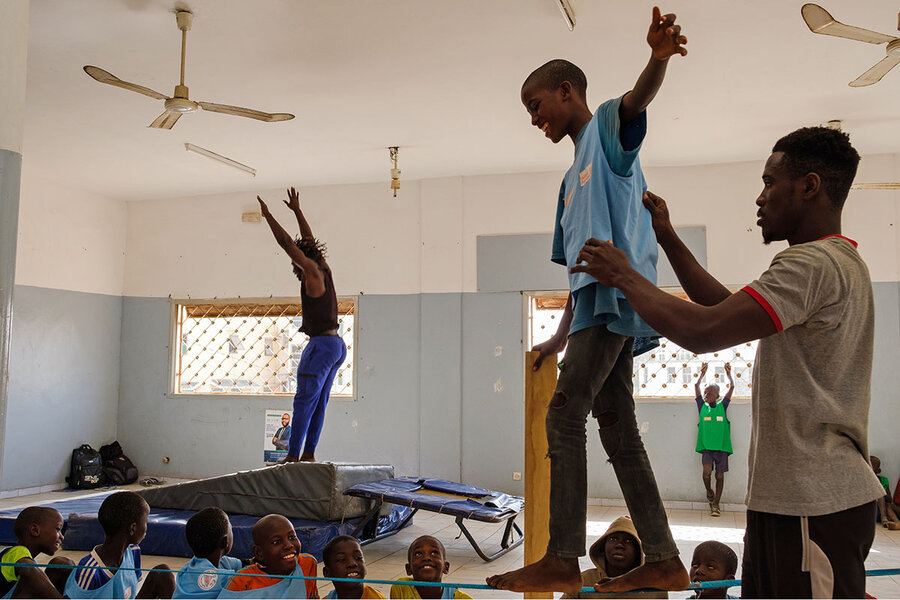
Photo: Guy Peterson.
A circus troupe offers hope to Senegal’s street children.

Poor children in Senegal often have a heartbreaking life, but one who rose above years of deprivation figured out a way to help others by sharing something that helped him. Today I’m drawing from three sources about what that was.

The BBC writes, “Every year, thousands of young Senegalese children are sent to the cities to study the Quran, only to find themselves forced into begging for money and food on the streets.”

DW.com reports about help coming from a man who was once one of their number. “In Senegal, circus skills were not really seen as a ‘proper’ or ‘respectable’ job. But that didn’t stop a former street beggar from founding Senegal’s first circus company in 2010. Today, Sencirk teaches circus acts to underprivileged kids. [The kids have even] represented Senegal with their juggling and acrobatic skills on the acclaimed TV show Africa’s Got Talent.”

Guy Peterson expands on the initiative at the Christian Science Monitor. “Under the shade of a dusty canvas tent in the sweltering heat, five men rehearse for a circus tour of France the following week.

“They make up Senegal’s only circus troupe, and each of them took long roads to get here, overcoming difficult childhoods, facing rejection by their families after they escaped abusive religious schools, and living on the street. …

“According to human rights groups, the talibés, as the boys are known, are vulnerable to exploitation and abuse from teachers. Talibés are forced to beg for money each day, and if their quota is not filled, they can be beaten and starved.

“Senegal has seen increasing youth unemployment, which leads many young adults to consider emigration if they can’t find opportunities at home. Sencirk helps them see those opportunities. 

“Modou Touré escaped [and] after taking up circus training in Europe, he returned to Dakar and founded Sencirk in 2006, providing free training to teens who escaped from their schools. The program allows them to work through traumatic experiences and to see paths toward a better future, whether that means working in the circus or reintegrating into society.

“An older performer and teacher at Sencirk, Sammi, explains, ‘We can teach them how to work together, how to grow, to believe in themselves.’ ”

According to the BBC, Sencirk’s founder “trained in Sweden for three months and toured with professional circus troupes around the world, before setting up the Sencirk tent in Dakar.

” ‘Circus is my therapy,’ says Mr Touré, now 31.

“The practice also assists him control his emotions and has the capacity to help others like him, he says.

” ‘It gives them confidence and helps them battle their demons.’ “

One 14-year-old trainee told the BBC, that “he loves everything about the circus: ‘It helps me learn and it makes me aware.’ …

“He hopes to join Sencirk as a full-time performer one day.

“Mr Touré’s troupe conducts regular free workshops at rescue homes for street children and women’s shelters to provide entertainment and identify talent.

” ‘It shows them they can go from the streets to making a living in the circus,’ Mr Touré says.

“Out of both necessity and the desire to preserve what they call the ‘Africanness’ of their shows, Sencirk uses locally found materials to make its equipment, such as trapezes, safety mats and juggling balls.

“Sencirk’s unique approach to circus is to share personal stories that other West Africans can relate to.

“One performance portrays the draws and dangers of clandestine migration to Europe. Another shares the experience of living as a talibé runaway.

“It’s a community built on resilience – a group of people working through shared trauma who are strengthened by their ability to overcome it together.”

More at the Monitor, here.

Read Full Post »

Photo: Dean Paton.
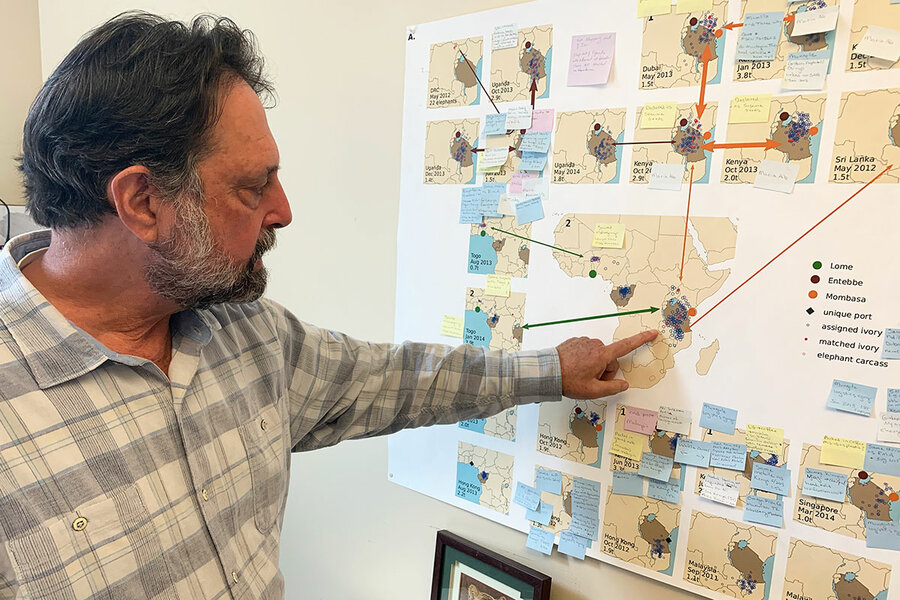
At Sam Wasser’s University of Washington office, maps show where ivory poaching occurs and where the contraband is exported. Dr. Wasser’s DNA work revealed that most ivory comes from east and west-central Africa.

It’s sad to read that gangs with powerful tentacles in every country are deeply embedded in the trafficking of endangered species. But on the other side, you know, environmental warriors have superpowers of their own, powers that go beyond righteous indignation.

Dean Paton writes at the Christian Science Monitor, “When Sam Wasser was a young biologist studying baboons in Tanzania, he never imagined he would one day lead an international force cracking down on the smuggling of illegal goods, from elephant ivory to pangolins and timber.

“Yet fighting transnational criminal organizations, or TCOs in law enforcement parlance, is exactly what he’s doing today, all because of his passion for animals.

“And because he discovered how to extract DNA from elephant poop.

“Today, Dr. Wasser is a professor at the University of Washington in Seattle. But in 1989 he was observing environmental stresses on baboons when Tanzania launched … a ‘brutal crackdown’ on elephant poaching rings. Tanzania battles a reputation for being among a handful of worst offenders in Asia and Africa that fuel the illegal ivory trade.   

“[The crackdown] had unexpected consequences. ‘All of a sudden our baboons started to be killed by leopards at an incredibly high rate,’ Dr. Wasser says. … The team realized the leopards had mostly ignored the local baboon fare while feasting on the remains of elephants left by poachers, who took only the tusks.  

“The decline in elephant carrion and subsequent decimation of the baboon troops ‘made me realize how significant poaching really was on all levels,’ he says, ‘and on all the other species that were similarly affected by the ecological cascade of events.’

“A self-described ‘animal nerd,’ Dr. Wasser points out that elephants are ‘some of the smartest animals around,’ he says. ‘They can recognize themselves in a mirror. You can put a spot on their forehead, and they’ll look in a mirror and they’ll wipe it off. That’s a high cognitive ability.’ But ‘we lost over 100,000 elephants from 2007 to 2015. There are currently an estimated 415,000 elephants remaining in Africa.’

“Dr. Wasser explains that poachers often go back and kill members of the same elephant families – so frequently that he believes it creates a form of elephant PTSD.

“Elephants also exhibit a strong interest in their dead. ‘They’ll go and they’ll just explore the carcasses of elephants. … It’s just too hard to watch, and the fact that we’re developing ways to potentially stop it – it keeps me going.’

“For the baboon studies, Dr. Wasser used hormones from animal dung to help understand their reproductive successes or failures. That work led Dr. Wasser to think, ‘You know, I could apply these tools to elephants. … You could then go and collect dung samples from elephants across the continent, genotype all the samples, and essentially create a DNA map,’ he explains. ‘And we could then get the DNA from the ivory to match to the map.’ …

“By 1997 Dr. Wasser had cracked the code and published one of the first papers on extracting DNA from elephant feces, and ‘right around the same time we were moving forward to see if we could develop methods to get DNA out of ivory.’

“Dr. Wasser’s team got its first break in 2005: Bill Clark, chair of Interpol’s Wildlife Crime Working Group, asked for help analyzing a shipment of ivory intercepted three years earlier in Singapore. It had been the largest seizure of ivory to date, about 6 tons, which included 40,000 carved hankos – also called chops – small pieces of ivory used throughout Asia to ink one’s name or seal on correspondence. Each would fetch about $200 retail, making the hankos alone worth $8 million.

“Until Dr. Wasser and his colleagues employed their emerging science to analyze that seizure, the biologist says ‘everyone’ believed these tusks were coming from all across Africa. But, using their dung-to-DNA analyses, ‘that’s not what we found.’

“Dr. Wasser’s game-changing work helped law enforcement realize the ivory was coming from a small number of specific areas in east and west-central Africa – yet was being shipped out of ports on either side of the continent. …

” ‘People don’t understand the intricate structure in wildlife crime,’ explains Rod Khattabi, a former homeland security agent who now runs the Justice Initiative for the Grace Farms Foundation, which partners with Dr. Wasser to train law enforcement agencies in Africa. … Wildlife criminals operate like independent cells, which makes arresting disparate elements of the syndicate tougher.

“ ‘That’s why Sam is so critical – because he can connect the dots,’ Mr. Khattabi says. ‘He’ll tell me, “Rod, this stuff is coming from Rwanda” even if it shipped out of Togo. He can almost pinpoint where the elephant got killed.’ …

“Dr. Wasser’s sleuthing has expanded beyond elephants. ‘The work that we were doing with the illegal ivory trade – we realized it was relevant to all of these other species that are all coming out of Africa,’ he says. ‘Same problem: transnational criminals shipping it on containers – and us needing to really get the transnational criminals.’

“In 2021, with funding from the Washington State Legislature, Dr. Wasser and his colleagues formed the Center for Environmental Forensic Science. ‘There were also other tools that other scientists were using that could complement what we’re doing,’ he says. ‘Now we’ve got over 40 scientists from the University of Washington alone that are part of our center’ using an array of synergistic methods including isotopes, chemistry, and handheld DNA detectors to fight a spectrum of crimes.”

More at the Monitor, here. No firewall.

Read Full Post »

Photo: Annabel Lankai.
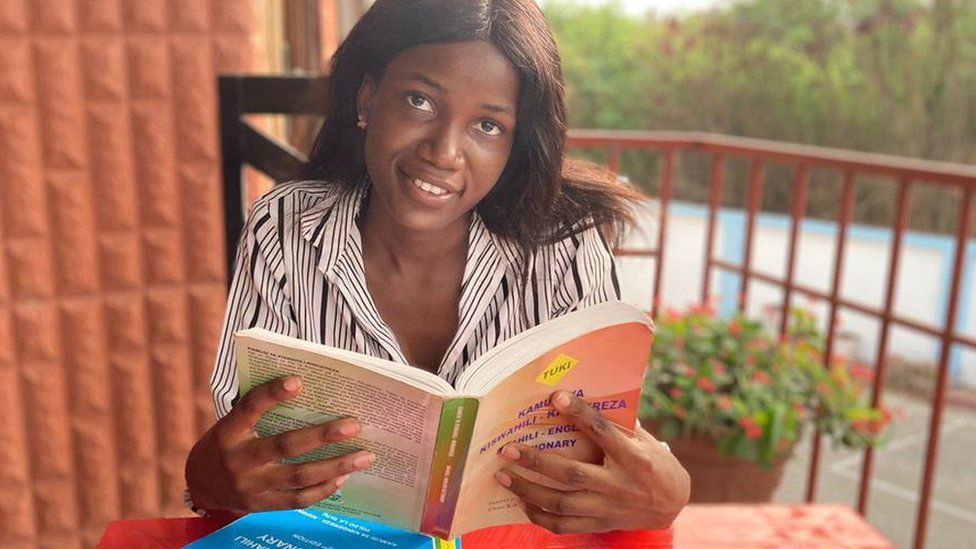
Ghanaian Swahili student Annabel Naa Odarley Lankai is advocating to make Swahili the lingua franca of Africa.

The BBC reports on renewed efforts to make Swahili the Esperanto of Africa, the universal language on the continent.

“With more than 200 million speakers, Swahili, which originated in East Africa, is one of the world’s 10 most widely spoken languages and, as Priya Sippy writes, there is a renewed push for it to become the continent’s lingua franca.

” ‘It’s high time we move from the colonizer’s language.’

“This is not part of a rousing speech by a pan-African idealist but rather the sentence is uttered quietly and calmly by Ghanaian Swahili student Annabel Naa Odarley Lankai. … Africa should ‘have something that is of us and for us,’ the 23-year-old adds.

“In its heartland, Swahili and its dialects stretch from parts of Somalia down to Mozambique and across to the western parts of the Democratic Republic of Congo. But Ms Lankai’s classroom at the University of Ghana in the capital, Accra, is some 4,500km (2,800 miles) west of Swahili’s birthplace – coastal Kenya and Tanzania. The distance could be seen as a measure of the spread of the language and its growing appeal. …

“Swahili, which takes around 40% of its vocabulary directly from Arabic, was initially spread by Arab traders along East Africa’s coast. It was then formalized under the German and British colonial regimes in the region in the late 19th and early 20th Centuries, as a language of administration and education. …

“At its recent heads of state meeting, the African Union (AU) adopted Swahili as an official working language. It is also the official language of the East African Community (EAC), which DR Congo is poised to join.

“In 2019, Swahili became the only African language to be recognized by the Southern African Development Community (SADC). Shortly after, it was introduced in classrooms across South Africa and Botswana. Most recently, Ethiopia’s Addis Ababa University announced it would start teaching Swahili. …

“Tom Jelpke, a researcher of Swahili at London’s School of Oriental and African Studies, argues that as connections grow across the continent, people will want a common way to communicate. He believes that its closeness to other languages in east and central Africa will cement its position there. But beyond those regions there may also be an ideological element. …

“Says Ally Khalfan, a lecturer at the State University of Zanzibar … ‘It is about our property and our identity as Africans.’ …

“Currently, English is the official or second language in 27 out of the 54 countries in Africa, and French is the official language in 21 of them.

” ‘English is still the language of power,’ says Chege Githiora, a linguistics professor in Kenya, in recognition of the political and economic reality. He advocates what he calls ‘fluent multilingualism,’ where people are comfortable speaking more than one trans-national language. …

“But whereas Swahili has an appeal in east, central and southern Africa, it has more competition in the west and the north. Arabic is dominant in the north, but in the west there are African languages – such as Hausa, Igbo and Yoruba – which could vie for the status of lingua franca.

“If Swahili is to become truly pan-African it will take political will, an economic imperative and financial investment to reach all regions.”

More at the BBC, here. No firewall.

Read Full Post »

Photo: David Levene/The Guardian.
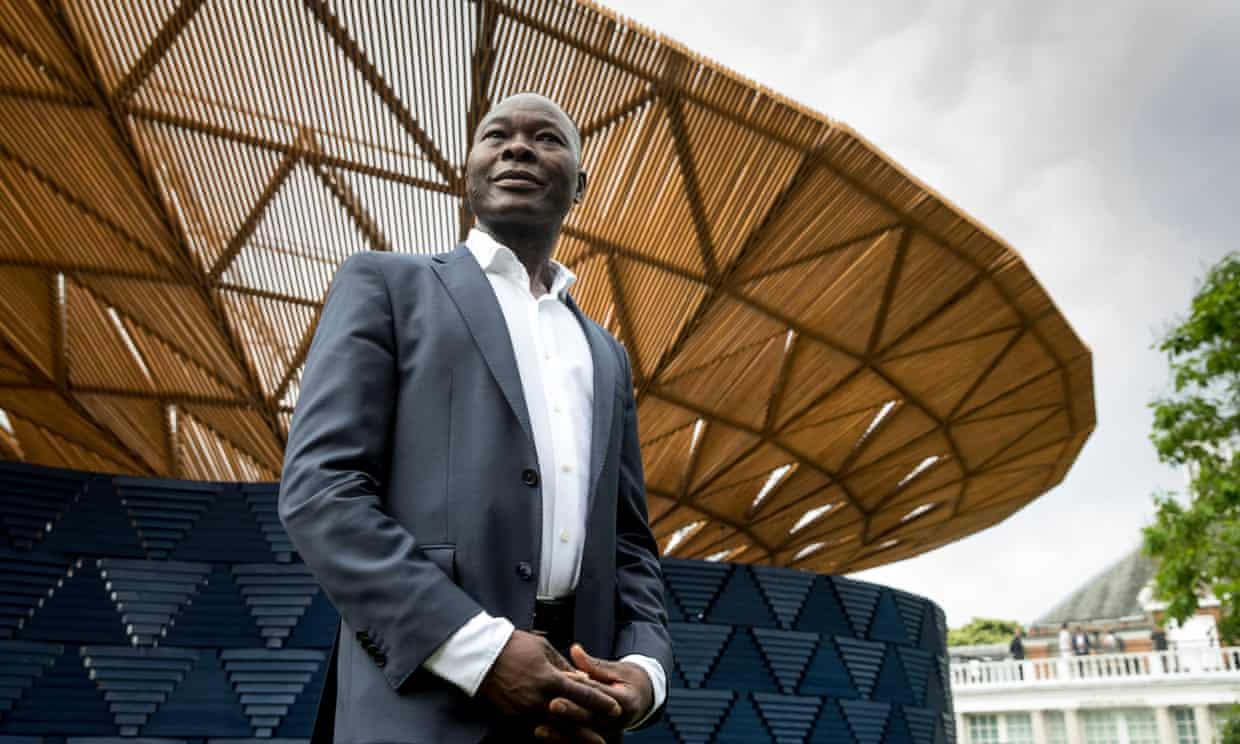
Francis Kéré, outside his Serpentine pavilion in London, is the most recent recipient of the prestigious Pritzker Prize for architecture.

There’s a 7-year-old girl in my family who has been designing buildings this week, complete with elevators, staircases, rooftop playgrounds, and two kinds of dining rooms. With flowers. I can’t help wondering if this is the kind of childhood interest that leads to a career like the one in today’s story.

Oliver Wainwright reports at the Guardian, “Few architects have experienced such a meteoric rise, against such odds, as Francis Kéré. Born in a remote village in Burkina Faso without running water or electricity, he began his career by building a mud-brick school for his community, before being selected to design the country’s national parliament less than 15 years later. Now he continues his unparalleled trajectory, named as the winner of the 2022 Pritzker prize, architecture’s highest international accolade.

“ ‘It is unbelievable,” said Kéré, speaking from his office in Berlin. “I don’t know how this all happened. First of all I am happy and overwhelmed, but the prize also brings a great sense of responsibility. My life is not going to be easier.’

“He is the first black architect to be recognized in the [award’s] 43-year history, reflecting the profession’s overwhelmingly white, male, middle-class bias. …

“ ‘I don’t want to talk about racism directly,’ he said, ‘but this is a field where you need a lot of resources. You really need to be strong and be lucky, as competitions are not always so open. I hope that young people in Africa will see me and know that this is a possible path for them too.’

“Kéré has made a name for himself with a series of schools and medical facilities in Africa that appear grown out of their context, built by local communities with the bare minimum of resources. Often featuring walls of clay-earth bricks, shaded by large, overhanging corrugated metal roofs, his buildings are elegantly tuned to their arid climate – whether in Mali, Togo, Kenya, Mozambique or Sudan – using natural cooling to avoid the need for air conditioning.

” ‘Francis Kéré’s entire body of work shows us the power of materiality rooted in place,’ said the Pritzker jury, chaired this year by Chilean activist-architect Alejandro Aravena. ‘His buildings, for and with communities, are directly of those communities – in their making, their materials, their programmes and their unique characters. They have presence without pretence and an impact shaped by grace.’

“Born in Gando in 1965, Kéré was … the first in his community to attend school, sent away at the age of seven, after which he won a scholarship to study woodwork in Germany. He saw slim prospects for a career in carpentry in a country that had little wood, so he switched to study architecture at the Technical University of Berlin. For his final project he designed a primary school for his home village – and set about fundraising and mobilising friends and family to see it built. It was realized in 2001, for about [$26,000]. …

“Kéré’s Gando primary school set out the basic principles that would go on to define his work, using earth bricks made on site, topped with a perforated ceiling crowned by a thin ‘flying roof.’ …

“Kéré suspended his metal canopy above the classrooms to encourage stack ventilation, drawing cool air in through the building’s side windows and releasing hot air through the holes in the ceiling. The whole village was involved in construction: children gathered stones for the foundations while women brought water for the brick production, beginning a collaborative model of practice that he has continued ever since. The school won an Aga Khan award in 2004, catapulting Kéré to international fame and prompting him to found his practice in Berlin the following year. …

“International commissions including the Serpentine pavilion in 2017, and an installation for the Coachella music festival in 2019, have continued to help him raise funds and awareness of his work in Africa. …

“His biggest project so far, for the national assembly of Benin, is currently under construction, rising out of the ground in the capital, Porto-Novo, in the form of a majestic palaver tree. ‘The site is next to a botanic garden,’ he said, ‘so we proposed to extend the garden and place the biggest tree in the centre, with a debate hall beneath the figurative tree canopy – reflecting how democracy has always been conducted in west Africa.’

“His equivalent project back home, for the national assembly of Burkina Faso in Ouagadougou, is now hanging in the balance, after the president was removed by a military coup in January. Kéré was commissioned in 2015, following a national uprising when the parliament was torched and the then-president hounded out of the country. …

“ ‘I want the people to take ownership over the parliament building,’ he said, ‘so that, one day, when the next revolution comes, they will protect it as their own.’ ”

More at the Guardian, here.

Read Full Post »

Photo: Obinna Obioma via BBC.
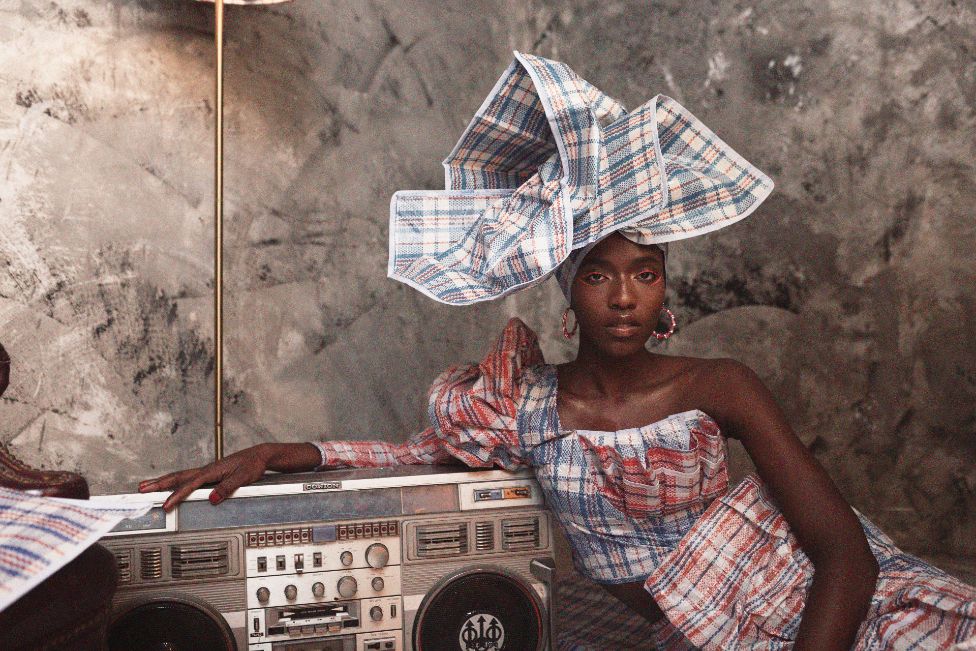
Nigerian photographer Obinna Obioma using creative ways to display an iconic West African plastic bag.

Suzanne liked a recent plastic-recycling article in the New York Times, and we thought you would like it, too. (The Times blocks people from sharing photos, so the one above is from the BBC. You can also check out fashions made of plastic at the Guardian, here.)

Times reporter Ruth Maclean writes from Senegal, “A crowd of people holding curved metal spikes jumped on trash spilling out of a dump truck in Senegal’s biggest landfill, hacking at the garbage to find valuable plastic.

“Nearby, sleeves rolled up, suds up to their elbows, women washed plastic jerrycans in rainbow colors, cut into pieces. Around them, piles of broken toys, plastic mayonnaise jars and hundreds of discarded synthetic wigs stretched as far as the eye could see, all ready to be sold and recycled.

“Plastic waste is exploding in Senegal, as in many countries, as populations and incomes grow and with them, demand for packaged, mass-produced products.

“This has given rise to a growing industry built around recycling plastic waste, by businesses and citizens alike.

From Chinese traders to furniture makers and avant-garde fashion designers, many in Senegal make use of the constant stream of plastic waste.

“Mbeubeuss — the dump site serving Senegal’s seaside capital of Dakar — is where it all begins. More than 2,000 trash pickers, as well as scrubbers, choppers, haulers on horse-drawn carts, middlemen and wholesalers make a living by finding, preparing and transporting the waste for recycling. It adds up to a huge informal economy that supports thousands of families.

“Over more than 50 years at the dump, Pape Ndiaye, the doyen of waste pickers, has watched the community that lives off the dump grow, and seen them turn to plastic — a material that 20 years ago the pickers considered worthless.

“ ‘We’re the people protecting the environment,’ said Mr. Ndiaye, 76, looking out at the plastic scattered over Gouye Gui, his corner of the dump. ‘Everything that pollutes it, we take to industries, and they transform it.’

“Despite all of the efforts to recycle, much of Senegal’s waste never makes it to landfills, instead littering the landscape. Knockoff Adidas sandals and containers that once held a local version of Nutella block drains. Thin plastic bags that once contained drinking water meander back and forth in the Senegalese surf, like jellyfish. Plastic shopping bags burn in residential neighborhoods, sending clouds of chemical-smelling smoke into the hazy air.

“Senegal is just one of many countries trying to clean up, formalize the waste disposal system and embrace recycling on a bigger scale. By 2023, the African Union says, the goal is that 50 percent of the waste used in African cities should be recycled. …

“The recycled plastic makes it to enterprises of all stripes across Senegal, which has one of the most robust economies in West Africa.

“At a factory in Thies, an inland city known for its tapestry industry to the east of Dakar, recycled plastic pellets are spun out into long skeins, which are then woven into the colorful plastic mats used in almost every Senegalese household.

“Custom-made mats from this factory lined the catwalk at Dakar Fashion Week in December, focused this time on sustainability and held in a baobab forest. Signs were constructed out of old water bottles. Tables and chairs were made of melted down plastic.

“The trend has changed the focus of the waste pickers who have worked the dump for decades, gleaning anything of value. …

“The government says that in a few years, the giant landfill will close, replaced by much smaller sorting and composting centers as part of a joint project with the World Bank.

“Then, most of the money made from plastic waste will go into government coffers. The waste pickers worry about their livelihoods.” More at the Times, here.

As great as it is to keep reusing plastic, it would be best not to make it at all for most purposes. It eventually breaks down and ends up in the ocean and our bodies. When I read “plastic mayonnaise jars” in the article, I wanted to remind you that, at least in the US, there are lots of things you can buy in glass if you look: glass mayonnaise jars, glass olive oil jars, glass mustard jars, glass pasta sauce jars, glass lemon juice bottles, and more. I even get milk in glass bottles. Glass is better than plastic. And you can get both laundry and dishwasher detergent in cardboard.

Check out my 2019 post on Cambodian fashion made from recyclables, here.

Read Full Post »

Photo: Vanessa Nakate.
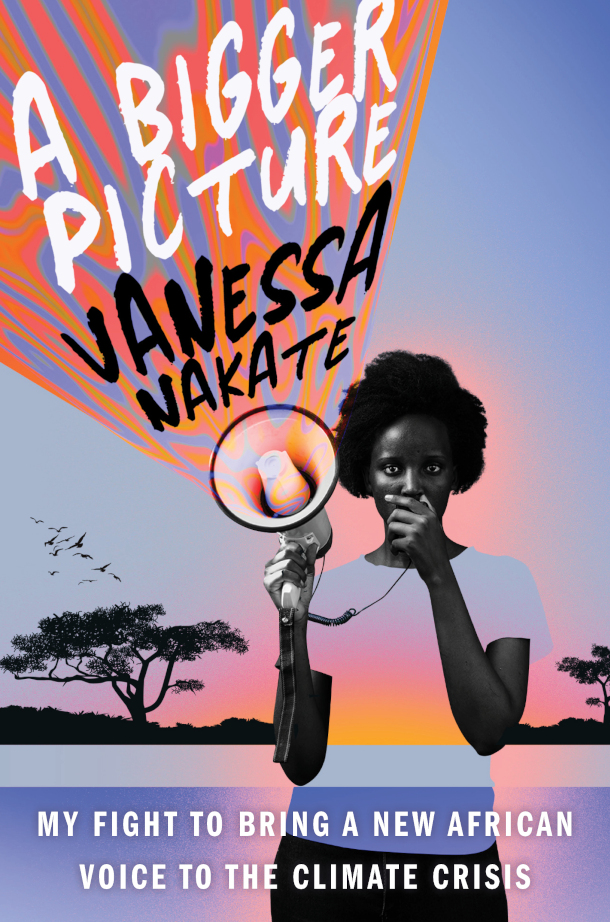
Vanessa Nakate’s book A Bigger Picture: My Fight to Bring a New African Voice to the Climate Crisis recounts her journey as an environmental justice activist.

I continue to be impressed that people college age and younger are taking the lead on the critical issues of our time — gun control, climate change, inequality, everything. It is probably wrong to put pressure on them, but I do think they’re more likely to have answers — often because they don’t know what’s “impossible.” Older folks tend to believe things that have never been done are impossible. Young ones don’t.

At Living on Earth, Steve Curwood talks to a young Ugandan activist who has become a leader in fighting climate change.

“STEVE CURWOOD: Greta Thunberg started the Fridays For the Future climate strikes by sitting in front of the Swedish Parliament, and millions of people around the world ultimately joined her cause. One of them was Vanessa Nakate of Kampala, Uganda, who was just getting out of college at the time.

“Teenaged girls in Uganda don’t typically have the same social freedoms as many in the Global North have to be out on their own picketing and demonstrating. But at age 22 Vanessa Nakate could, as college age women have a lot more freedoms in her culture. And in the face of climate change, intensified floods and droughts that ravaged Uganda at the time, Vanessa was inspired by Greta to organize and start holding climate strike signs herself in front of the Ugandan Parliament.

“Greta Thunberg soon heard of Vanessa through social media and in January of 2020 Vanessa was invited to join Greta for a press conference at the World Economic Forum in Davos, Switzerland. But the Associated Press cropped Vanessa, the only black woman, out of a widely circulated photo that included Greta Thunberg and three other white European activists. Comments citing that editorial decision as racist soon went viral. And since that incident Vanessa has used her visibility to bring light to climate struggles in the Global South. In her book, A Bigger Picture: My Fight to Bring a New African Voice to the Climate Crisis, Vanessa points to how climate change is impacting Africa and the short shrift that she and other people and nations of color receive at the UN climate talks. … [Vanessa] what kind of climate change effects are going on in Uganda? …

“VANESSA NAKATE: Uganda as a country heavily depends on agriculture for survival for many communities, especially those in the rural areas. But with the rising global temperatures, many people are threatened with floods, droughts and landslides, causing massive destruction, massive loss of lives, loss of homes, farms and businesses. … In the western part of the country in areas of Kasese, because of the rising global temperatures, many people have been displaced and still are living in camps because of extreme flooding.

“CURWOOD: Please tell me a story of a particular recent climate related incident. …

“NAKATE: I can talk about one that happened last year. During the pandemic in 2020. The water levels of Lake Victoria rose as a result of extreme rainfall. And many people were displaced from their homes at a time when they had to stay at home to keep themselves safe. And with the rise in the water levels. Not only were farms destroyed, but even toilets were submerged, causing contamination of water sources and threatening the livelihoods of very many people.

“CURWOOD: Now, you join Friday’s for the Future in your 20s Vanessa. And that movement was made up of well, mostly teenagers and younger folks, why did you choose to join? …

“NAKATE: This is a challenge for some of my friends, because most of them were just finished in college and in their 20s. So, we all had this feeling that this movement was a movement for teenagers. But to me, that wasn’t the issue. … I just wanted to demand for climate justice and to talk about the challenges that the people in my country were facing because of the climate crisis.

“CURWOOD: Vanessa, tell me about some of the projects that you’re working on now.

“NAKATE: In 2019, I started school project Vash Green Schools Project. [It] involves the installation of solar panels and ecofriendly cookstoves in schools. I started this project to help drive a transition to renewable energy in schools in Uganda, and also for the clean cooking stoves to reduce the firewood that schools were using for preparation of foods. Almost all the schools in my country use firewood for food preparation. But with these ecofriendly stoves, the number that is used is greatly cut. … So far we’ve done installations in 13 schools.

“CURWOOD: You write in your book that when you came actually to the UN, a couple of [bad] things happened. …

“NAKATE: One of the people was a part of the Ugandan delegation [who] asked if I can meet him and talk about my activism. [I met] members of parliament, and I remember one of them actually recognizing me and saying that I’ve seen you on TV, you’re the girl who strikes every Friday. And at that moment, I’m like, wait, you’ve seen me. And you haven’t even said anything about the activism that I’m doing. …

“For the UN Youth Climate Summit … I was told that I would have a speaking role. I worked on my speech. And I was just really happy to talk about the experiences of the people in my country. [Then] I’m told that, well, you’re actually not going to speak but you will just be able to, you know, be like in discussions with other young activists. And at that point, it was really a disappointment before I left and I couldn’t tell my family or my friends because they were very excited.

“[And after the Davos incident] I felt like everything that I said at the press conference … didn’t matter, like it just went into the air and immediately disappeared, and no one was really paying attention. …

“It’s important for people to know that, historically, Africa is responsible for only 3% of global emissions. And yet Africans are already suffering some of the most brutal impacts of the climate crisis. It’s also important to know that while Africa, while the global south, is on the frontlines of the climate crisis, it is not on the front pages of the world’s newspapers. And it’s also important to know that there are a number of activists in the African continent in the global south who are speaking up, who are demanding for justice from leaders, from governments, from corporations. … We want climate action from the leaders and our voices will not be silenced.”

More at Living on Earth, here.

Read Full Post »

Photo: Aloha Feels Chocolate.
Many boutique candy companies are determined to do more than the giants about child labor. “There are over 27 million slaves in the world today. Of them, over 9 million are children,” says slavefreechocolate.org.

I’m sure you know I’m not going to focus on the dark side of anything, so as we dig out from Halloween chocolate created by name brands that have failed to end child labor, let’s start by mentioning companies that are more careful about sourcing.

I, too, buy the mini Trick-or-Treat bars available in the supermarket. But I also have a friend who loves getting chocolate on her birthday, and that is when I really focus on ethical brands. There’s a long list here. Taza is one I know. It’s headquartered in Somerville, Massachusetts.

The problem with chocolate seems to be that even companies seeking Fair Trade labels are often bamboozled by chocolate growers or aggregators on the ground. No doubt, it’s hard to get to the bottom of things unless you work directly with a grower.

In a February article from the Guardian, we learn that several young men who were once child slaves in Africa were hoping for a hearing in US courts. After all, big companies like Cargill, Mars, and Hershey are based here.

Oliver Balch writes, “Eight children who claim they were used as slave labour on cocoa plantations in Ivory Coast have launched legal action against the world’s biggest chocolate companies. They accuse the corporations of aiding and abetting the illegal enslavement of ‘thousands’ of children on cocoa farms in their supply chains.

“Nestlé, Cargill, Barry Callebaut, Mars, Olam, Hershey and Mondelēz have been named as defendants in a lawsuit filed in Washington DC by the human rights firm International Rights Advocates (IRA), on behalf of eight former child slaves who say they were forced to work without pay on cocoa plantations in the west African country.

“The plaintiffs, all of whom are originally from Mali and are now young adults, are seeking damages for forced labour and further compensation for unjust enrichment, negligent supervision and intentional infliction of emotional distress.

“It is the first time that a class action of this kind has been filed against the cocoa industry in a US court. Citing research by the US state department, the International Labour Organization and Unicef, among others, the court documents allege that the plaintiffs’ experience of child slavery is mirrored by that of thousands of other minors.

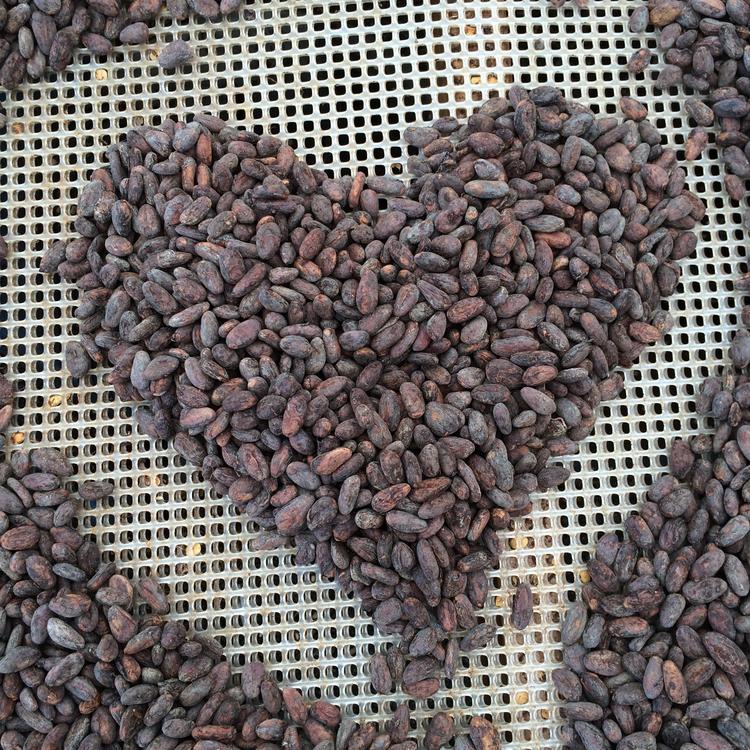
“Ivory Coast produces about 45% of the global supply of cocoa, a core ingredient in chocolate. The production of cocoa in west Africa has long been linked to human rights abuses, structural poverty, low pay and child labour.

“A central allegation of the lawsuit is that the defendants, despite not owning the cocoa farms in question, ‘knowingly profited’ from the illegal work of children. According to the submissions, the defendants’ contracted suppliers were able to provide lower prices than if they had employed adult workers with proper protective equipment.

“The lawsuit also accuses the companies – whose industry body is the World Cocoa Foundation – of actively misleading the public in the voluntary 2001 Harkin-Engel Protocol, characterized by the complainants as promising to phase out some child labour (‘the worst forms,’ in the protocol’s words). …

“In the legal claim, all eight plaintiffs describe being recruited in Mali through trickery and deception, before being trafficked across the border to cocoa farms in Ivory Coast. There, they were forced to work – often for several years or more – with no pay, no travel documents and no clear idea of where they were or how to get back to their families.” More at the Guardian, here.

Alas, at the Washington Post, here, you can read that the former child slaves were not granted standing by the courts, although the plaintiffs sued confidently “under the Alien Tort Statute, a 1789 law that allows federal district courts to hear ‘any civil action by an alien for a tort only, committed in violation of the law of nations or a treaty of the United States.’ ”

Robert Barnes and Peter Whoriskey reported in June, “The Supreme Court on Thursday said U.S. chocolate companies cannot be sued for child slavery on the African farms from which they buy most of their cocoa. But the court stopped short of saying such a lawsuit could never go forward.

“The court’s splintered decision was written by Justice Clarence Thomas. Justice Samuel A. Alito Jr. dissented from the decision, saying it was premature to dismiss the suit.”

Alito, for goodness sake! This is why I don’t like blanket assumptions about what Supreme Court justices are thinking. You can say what position they are likely to take, but you can’t really know. And besides, it’s too depressing to assume you know.

Anyway, we’re back to Square One with chocolate and child labor.

Except that informed consumers can do their part: start asking themselves the right questions and paying a few more cents to be sure no children are harmed. After all, more chocolate-buying holidays are fast approaching.

Photo: jbdodane/Alamy
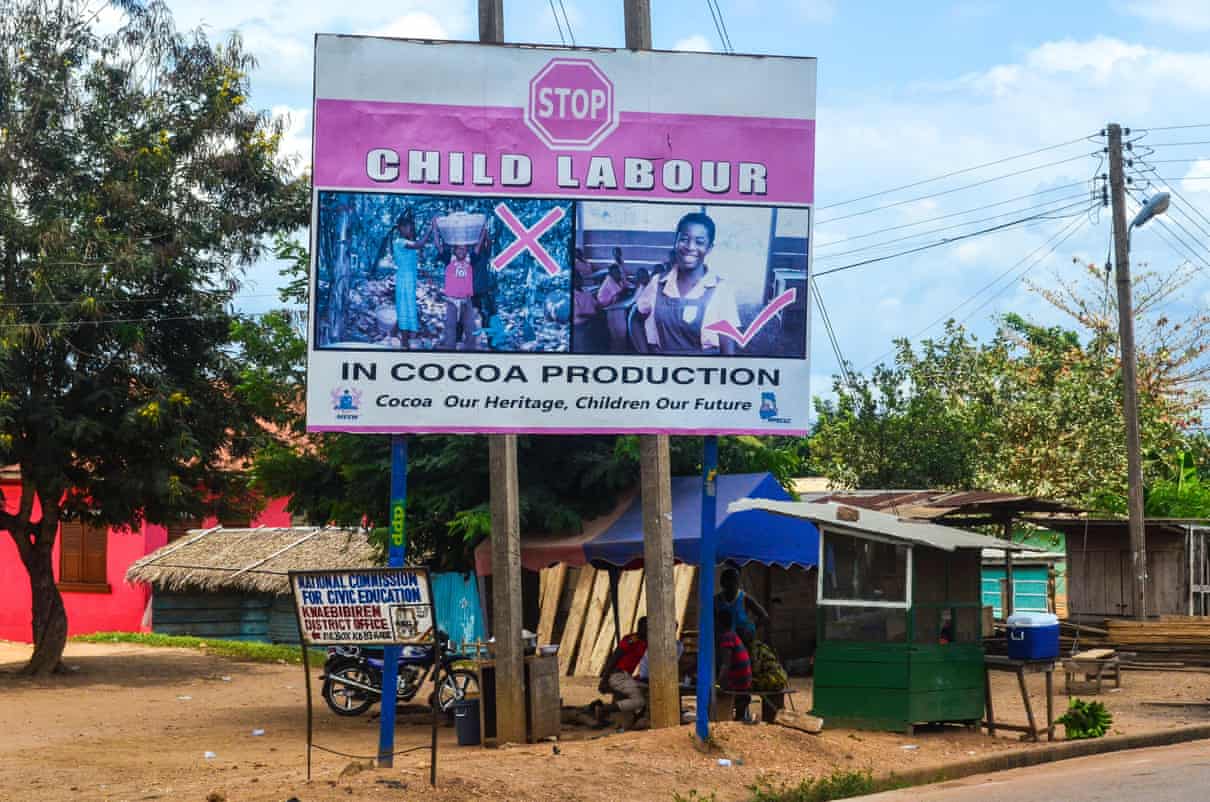
A sign warns against child labor in cocoa production in Ghana.

Read Full Post »

Photo: Ars Technica.
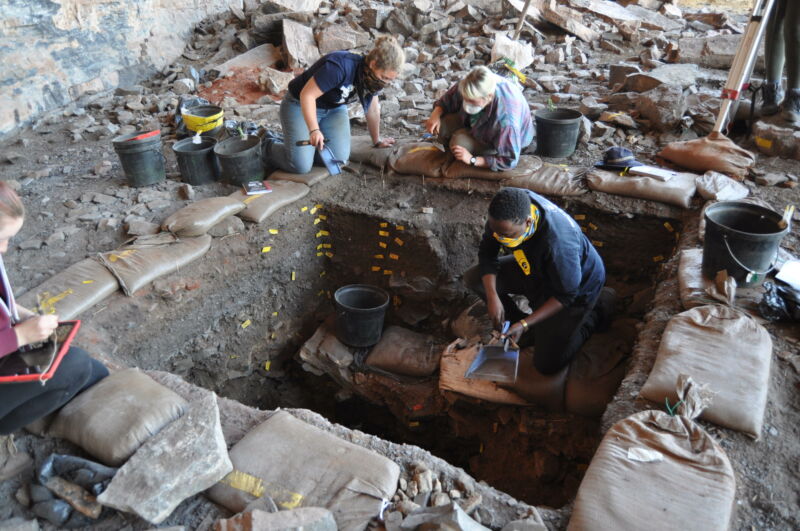
A recently published study suggests coastal Africa didn’t have a monopoly on innovation.

More Americans are starting to recognize the pernicious effects of coastal attitudes about the majority of US states. Sarah Smarsh’s wonderful memoir of growing up in Kansas, Heartland, was one thing that helped me understand that a derisive phrase some people use — “flyover country” — is both ignorant and dangerous.

Today’s story shows that there has been a similar attitude in African archaeology, where the only civilizations thought to be creative and innovative were on the coasts. The latest discoveries in the southern Kalahari reveal a different story.

Kiona N. Smith writes at Ars Techninca, “Between 125,000 and 70,000 years ago, people began to do some very modern things: collecting small objects for no practical reason, decorating things with pigments, and storing water and possibly even food in containers. The oldest known sites with evidence of those behaviors are along the coastline of southern Africa. …

“And according to one idea in paleoanthropology, something about that way of life enabled those early people — or maybe pushed them — to innovate. Their distant neighbors who lived far from the sea supposedly lagged behind the cultural times.

But Griffith University archaeologist Jayne Wilkins and her colleagues recently unearthed evidence that landlocked people were just as hip and modern as their counterparts on the coast.

“At Ga-Mohana Hill North Rockshelter, there’s a layer of sediment dating back to 105,000 years ago and scattered with stone tools. In it, Wilkins and her colleagues found a large chunk of red ocher, worn flat and striated on two sides, as if it had been used as pigment. The rock shelter also held a cache of translucent white calcite crystals, which hadn’t been worked or used as tools; it looked as if someone had gathered up the crystals simply for the sake of having them, or maybe as a ritual offering. Several broken, burned pieces of ostrich eggshell, buried in the same layer, may once have held stores of water.

“The Ga-Mohana Hill artifacts are roughly the same age as the oldest similar finds on the coast, according to optically stimulated luminescence dating, which measures when quartz grains in the sediment were last exposed to light — in this case, about 105,000 years ago. That’s around the same time that people along the coast of southern Africa started collecting seashells for no apparent practical purpose, while people at Diepkloof Rockshelter in South Africa stored their water in the oldest known ostrich eggshell containers.

“It sounds like an almost laughably simple idea to a 21st century human: if you put some stuff inside a larger thing, you can carry it more easily and store it for later. But we’ve had the benefit of at least 200,000 years of figuring out how to do things. At one point in our distant prehistory, containers were an amazing new idea. It would have been, as Wilkins and her colleagues put it, ‘a crucial innovation for early humans.’

“The conclusion from these finds is that people in the African interior weren’t lagging behind coastal cultures at all. Some of the most important innovations in human prehistory happened in multiple areas of the continent at around the same time.

“If you’re not an archaeologist, it may seem obvious that people living inland could be just as innovative as people living on the coast, but all the evidence archaeologists had until now told a different story. The oldest traces of a whole suite of new (at the time) human behaviors have all been found at sites relatively close to the coastline. …

“That has more to do with geology than with what people were actually doing in the distant past. ‘Stratified Late Pleistocene sites with good preservation and robust chronologies are rare in the interior of southern Africa,’ [the research team] wrote in their recent paper. The result is what they describe as a ‘strong bias towards coastal sites that marginalizes the role of inland populations.’ …

“Ga-Mohana Hill North Rockshelter [tells] us something important about our past: lots of people, in lots of different environments, found similar solutions to problems.”

More here.

Read Full Post »

On my first day at the Boston Fed in 2005, I attended orientation with two other new hires, one an immigrant from Mali. In the years since, especially after Mamoudou returned to Africa, I’ve read with alarm about the many tragedies his country has suffered. How do people live through great upheaval and keep their sense of self and their spirits intact?

Anastasia Tsioulcas has some thoughts at National Public Radio.

“The northwestern African country of Mali is one of the world’s musical cradles. Its rich traditions helped give birth to American blues and jazz, traditions brought by enslaved Africans to these shores. But today, Mali is in turmoil. The country has suffered a long civil war spurred by Islamist insurgents (whose attacks are still ongoing), and the government fell to a coup in August. The country is also trying, like the rest of the world, to cope with the coronavirus.

“Despite all of those challenges, however, Malian musicians are still creating amid the chaos — and have some important lessons to share about how to get through tough times.

“The band Songhoy Blues plays rollicking music of resistance against the political and social threats its country is facing.

“These Malian musicians came together in 2012 after attacks by local and foreign jihadists forced people to flee the country’s northern cities and towns as well as its vast Saharan desert. …

” ‘When the civil war start in Mali, when they banned music, all the people from the north of Mali has to move to the south just to be safe at that moment,’ explains Aliou Touré. He’s the lead singer of Songhoy Blues. …

” ‘When you come far away from your hometown and you meet each other,’ Touré explains. ‘you speak the same language. It’s kind of like a satisfaction of nostalgia when you meet someone who speak your language, who do what you do, who love something that you love.’ …

“The Malian musicians are a thoroughly modern band, but they’re also walking in the footsteps of some of their country’s most revered musicians, like Ali Farka Toure and Salif Keita.

“And like those other artists, the music of Songhoy Blues is born of struggle — and not just political. When I spoke to Aliou Touré (no relation to Ali Farka) by phone in Bamako, he had just recovered from a bout of malaria. And, like so many other places in the world, the coronavirus pandemic has shut down his country. He says enduring each hurdle is like surfing.

‘As every single band in the world during now,’ [Aliou Touré] says, ‘we just keep surfing on the waves — see what’s gonna happen next day, what’s gonna happen next day, next month.’

“The pandemic shutdown, though, has created some interesting creative opportunities for artists. … The pandemic has also provided a respite for one of the country’s most beloved singers, Oumou Sangare.

“Sangare spent much of the coronavirus shutdown in the U.S. — first in New York, and then in Baltimore. She’s since returned to her home in Bamako. She says the isolation was actually nourishing.

” ‘I rejoiced in my confinement,’ she says in French. ‘I’ve never had the chance to rest like that in the 30 years of my career.’ …

“That period of reflection gave Sangare the creative energy to start work on a new album herself. Sangare also acknowledges that Mali’s ongoing civil strife has taken a severe toll across the nation — across ethnic and geographic boundaries. …

” ‘The whole country is suffering. I think that the Malians must unite. That’s my point of view: It is unity that makes strength.’

“For years, musicians have been at the forefront of urging the country to stay united and to stand for peace. Their voices are now again in the lead — trying to bolster the country’s courage.

“Songhoy Blues decided to name its latest album Optimisme — ‘optimism.’

“Lead singer Aliou Touré says that he’s learned that it’s the only way forward. ‘That’s the only thing keeping us, keeping people smiling, and that’s the only, only way to give ourselves a hope,’ he says. ‘It’s the best way to keep yourself alive. To be optimist, I think, is the biggest message ever that the whole world need to hear right now.’ “

As Bonnie Johnson at WICN jazz radio says, “Stay Positive. Test negative.”

More at NPR, here.

Read Full Post »

When pandemic restrictions caused the cancellation of African musicians’ concerts, many took the coronavirus battle into their own hands, without having to be asked by any government to create a public service announcement.

Public Radio International’s The World reports on the wave of Covid-19 songs giving Africans reliable information and warning against fake health news on social media.

“When graduate student Dipo Oyeleye heard the song ‘We Go Win (Corona)‘ by Cobhams Asuquo, a Nigerian singer-songwriter,” the radio show reported in September, “he knew what his next research project would be: a study of the myriad coronavirus songs that flourished in Africa at the pandemic’s onset on the continent. …

” ‘I love artists using the moment to create music that actually helps to disseminate the right information to the general public,’ Oyeleye told The World.

“Originally from Nigeria himself, Oyeleye studies at the University of Wisconsin, Madison, where he is now researching COVID-19 songs from Nigeria to Uganda, Democratic Republic of Congo to Ghana, among many other places across the continent. Oyelele has been able to compile and track the impact of at least 50 songs from various African artists.

“Unlike the US, where very few artists have taken on COVID-19 as a subject in songs, African musicians quickly turned to their songwriting as a form of communication and to disseminate crucial public health information: social distancing, washing hands and staying home during lockdowns. 

” ‘This is a major [pandemic that] directly affects everybody, including the musicians. Some of them had to cancel their shows. I think the personal became political,’ Oyeleye explained. 

“Having battled epidemics such as the Ebola virus, most Africans are used to governments that call on musicians to produce ‘edutainment,’ or songs with a message to sensitize the public. 

“But Oleyele says that what makes the coronavirus songs different is that it was not ‘necessarily initiated by the governments. It’s just, you know, individuals lending their voices to help prevent the spread of the virus.’ 

“Some artists took a direct public health approach, while others used humor or religion to ease fears and connect with various communities. And some songs were specifically meant for people who could only communicate in local languages. There’s really something for everyone. …  

” ‘Wash your hands / love each other / we go win o,’ [Asuquo] croons at the piano.

“In [a] reggae-inspired song, Bobi Wine opens with the bad news that ‘everyone is a potential victim’ of the virus, but also a potential solution … and calls it ‘patriotic’ to social distance and isolate if sick with possible virus symptoms.” More at PRI’s The World, here. Extra details at the Washington Post, here.

I’m impressed with these musicians. Will we get songs to slow the spread here, too?

Read Full Post »

« Newer Posts - Older Posts »